Imagine What We Can Build Together
One complete story. Start to finish.
From the water to the people to the conservation, science, innovation, education and your role in the vision — walked through in a deliberate start-to-finish order. Scroll down to begin.
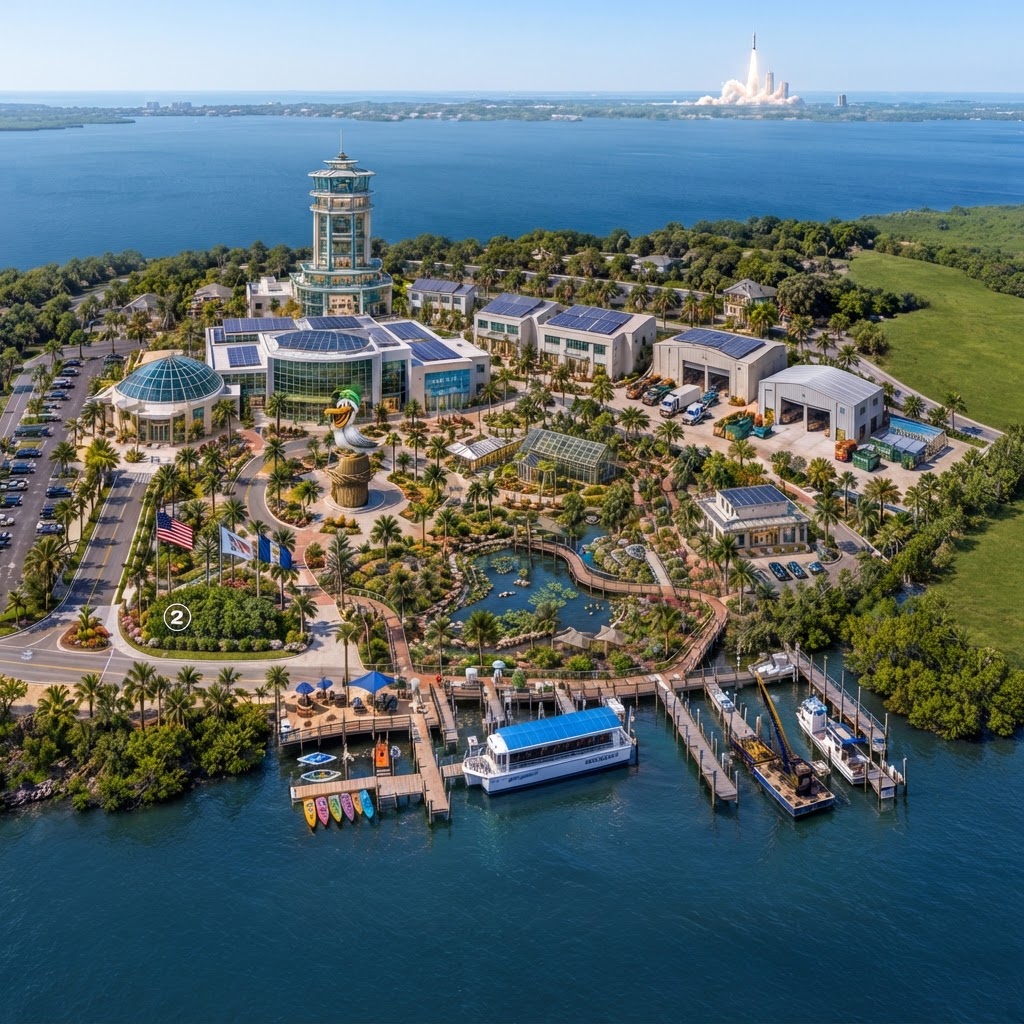
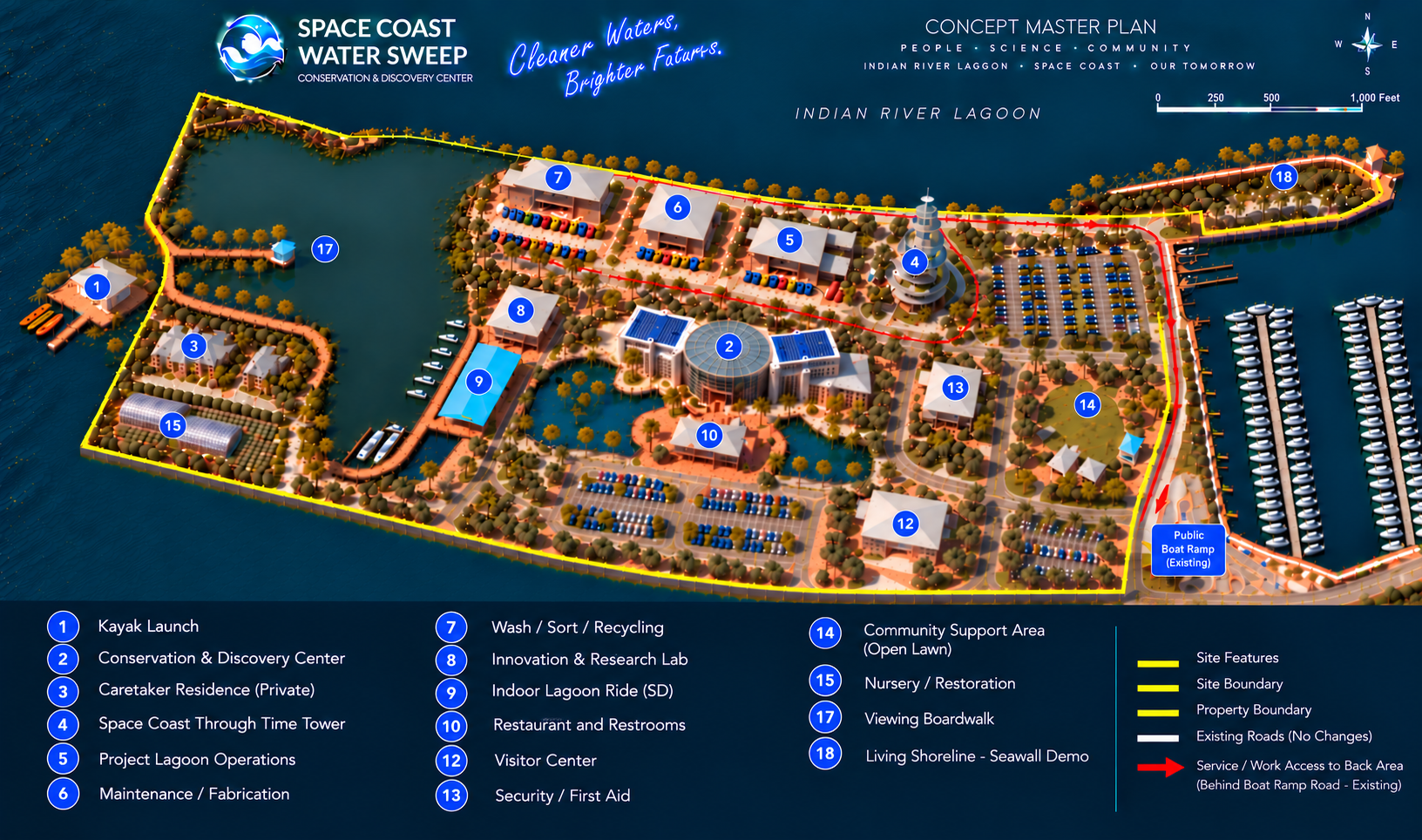
EARLIER VISION CONCEPT — The current Concept Master Plan is shown below.
From Project Lagoon to Something Much Bigger
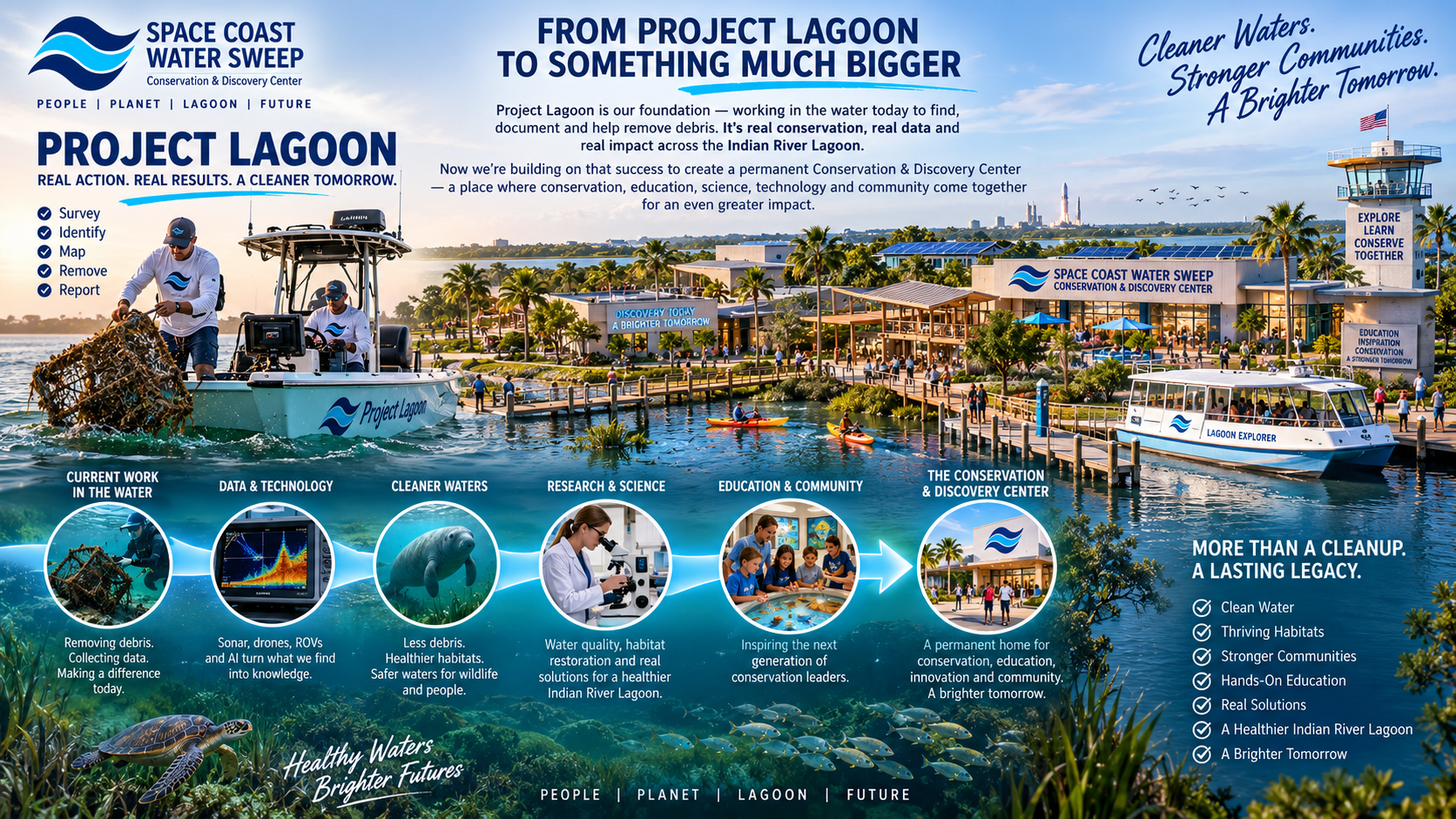
Project Lagoon is being built to find what the water hides — using technology, data and targeted field operations to identify submerged debris, understand where problems exist, remove what can be responsibly recovered and verify the results.
The Conservation & Discovery Center takes that mission further. It brings conservation operations, research, innovation, education and public discovery together in one working campus — creating a place where people can see the lagoon, study it, experience it, help protect it and participate in building its future.
Signature experiences envisioned for the campus include the Space Coast Through Time Observation & Launch Tower, Our Space Coast gallery, the Currents Through Time Living Lagoon Monitor, and the Lagoon Water Treatment & Environmental Engineering Testbed.
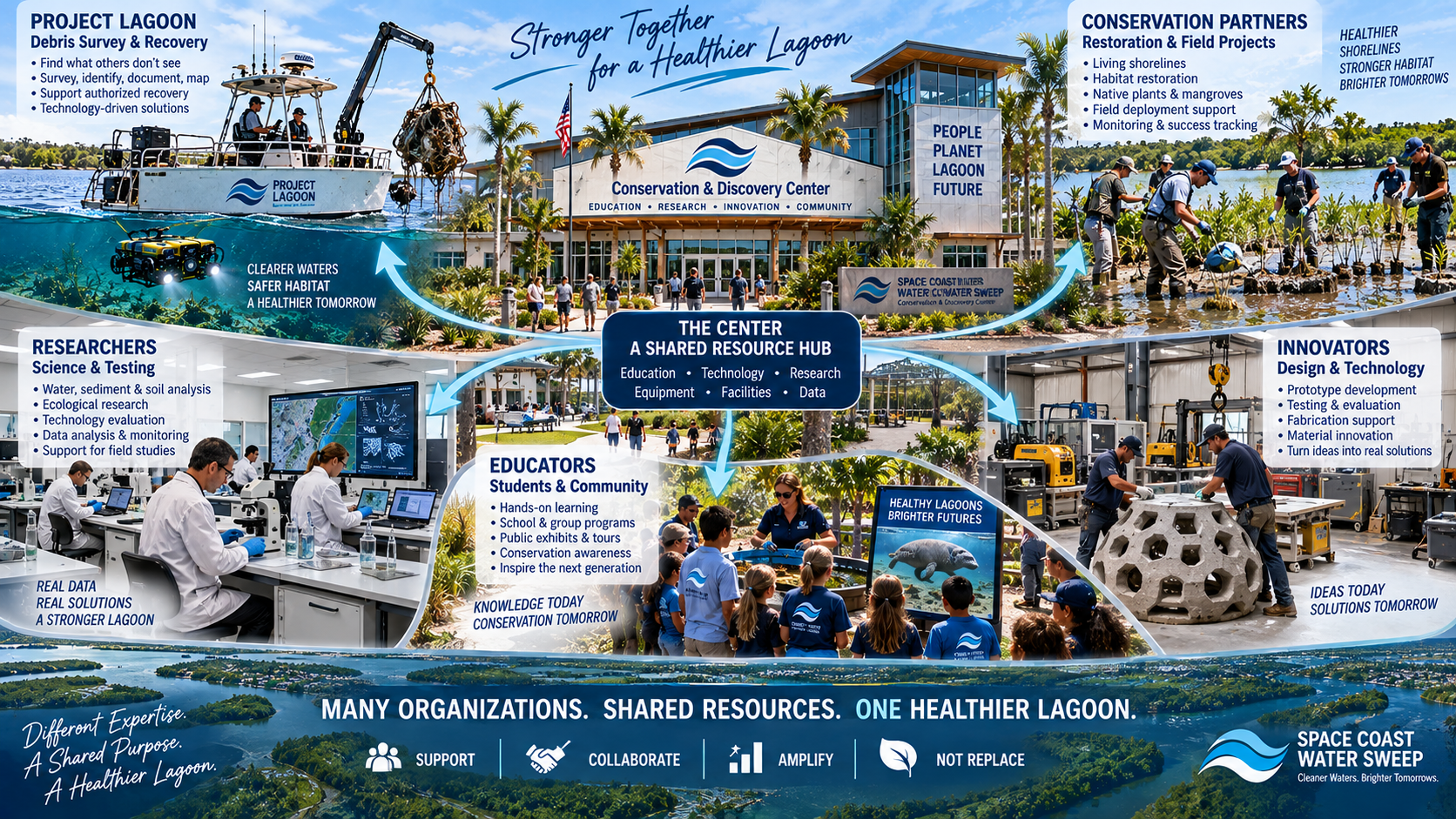
Built to Support — Not Replace
A Center designed to strengthen the conservation work already happening around the Lagoon.
The Conservation & Discovery Center is not being created to replace the organizations, researchers, businesses, agencies, universities and conservation professionals already doing important work for the Indian River Lagoon.
Our primary public mission at the Center is EDUCATION AND AWARENESS — helping people understand the Lagoon, the challenges it faces, the work already underway and how they can become part of its future.
Project Lagoon adds a focused field mission: using technology to survey, identify, document and map submerged debris and support the authorized recovery of debris and other materials that may otherwise remain unseen.
Beyond our own work, the Center is envisioned as a SHARED CONSERVATION RESOURCE. Its laboratories, research and testing areas, technology, fabrication capabilities, equipment, data systems and resource-recovery facilities could help qualified nonprofit organizations and conservation partners accomplish more without requiring every organization to duplicate expensive infrastructure.
Where appropriate, qualifying nonprofit organizations could potentially access certain Center resources at little or no cost. Availability, responsibilities, project requirements, scheduling and terms would be considered individually for each collaboration.
What the Images in This Vision Mean
Throughout this walkthrough you will see conceptual images of living shorelines, habitat structures, wave-reduction systems, monitoring equipment, restoration technologies, research equipment, fabrication capabilities and people working in the field.
These images illustrate the types of work and capabilities the Center could support.
They do not mean Space Coast Water Sweep intends to manufacture, install, operate or take ownership of every solution shown. In many cases, the Center's role may instead be to provide laboratory space, equipment, research, fabrication and prototyping capability, field support, vessels, technology, data analysis, AI, monitoring, testing, educational resources or other infrastructure that helps an existing organization advance its own work.
For example, showing a wave-reduction device does not mean SCWS intends to reproduce a company's proprietary product or enter that company's business. The Center could instead help a partner research an idea, evaluate materials, develop or test an authorized prototype, monitor an existing installation, collect field data, analyze performance or provide other mutually agreed support.
Existing proprietary designs, patents, technologies and intellectual property remain the property of their respective owners and would be respected through appropriate agreements and protections.
Three Connected Roles
The Center's work spans education, focused field operations, and support for partners — each connected, each distinct.
EDUCATION & AWARENESS
Help visitors, students and the community understand the Lagoon, its history, its challenges, the work underway and opportunities to participate in its future.
PROJECT LAGOON
Survey • Identify • Document • Map • Recover
Use technology and field operations to find and support the authorized recovery of submerged debris and materials that can otherwise remain unseen.
PARTNER SUPPORT
Research • Test • Prototype • Measure • Analyze • Share Resources
Use Center capabilities to help qualified organizations, researchers and conservation partners extend the impact of their own work.
PROJECT LAGOON
Debris Survey & Recovery
CONSERVATION PARTNERS
Restoration & Field Projects
RESEARCHERS
Science & Testing
EDUCATORS
Students & Community
INNOVATORS
Design & Technology
WE DON'T NEED TO DUPLICATE GREAT CONSERVATION WORK.
WE WANT TO GIVE GREAT CONSERVATION WORK MORE RESOURCES TO SUCCEED.
SUPPORT • COLLABORATE • AMPLIFY — NOT REPLACE
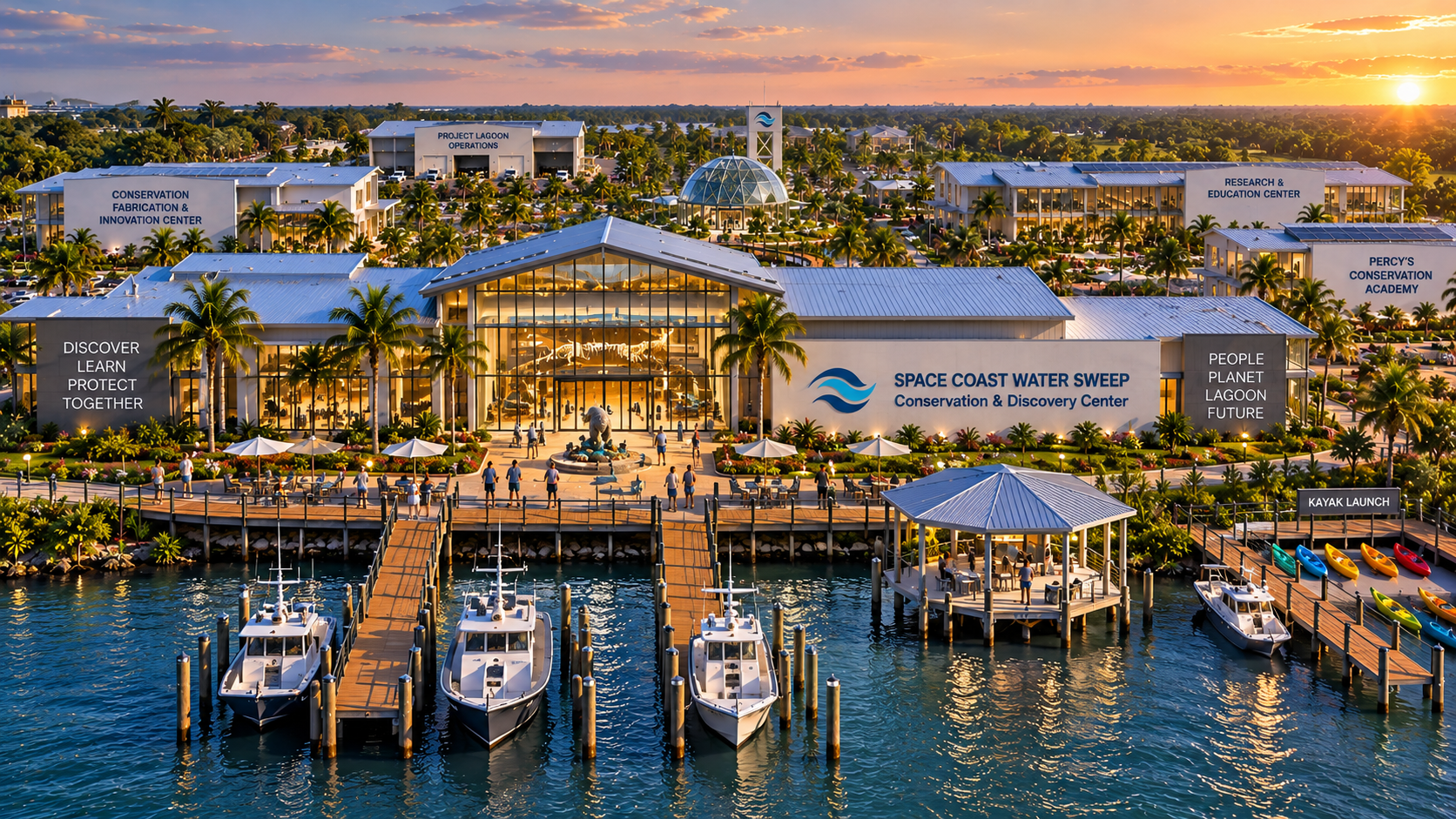
A Big Vision — With a Smarter Waterfront Footprint
The vision concentrates the facilities that truly require water access — boats, docks, research operations, kayaking and on-water experiences — into a focused waterfront zone.
From there, the Conservation & Discovery Center expands inland into a larger campus for discovery, research, education, innovation, conservation operations and future growth. This approach preserves flexibility while allowing the Center to grow around its mission.
More Than a Place to Visit
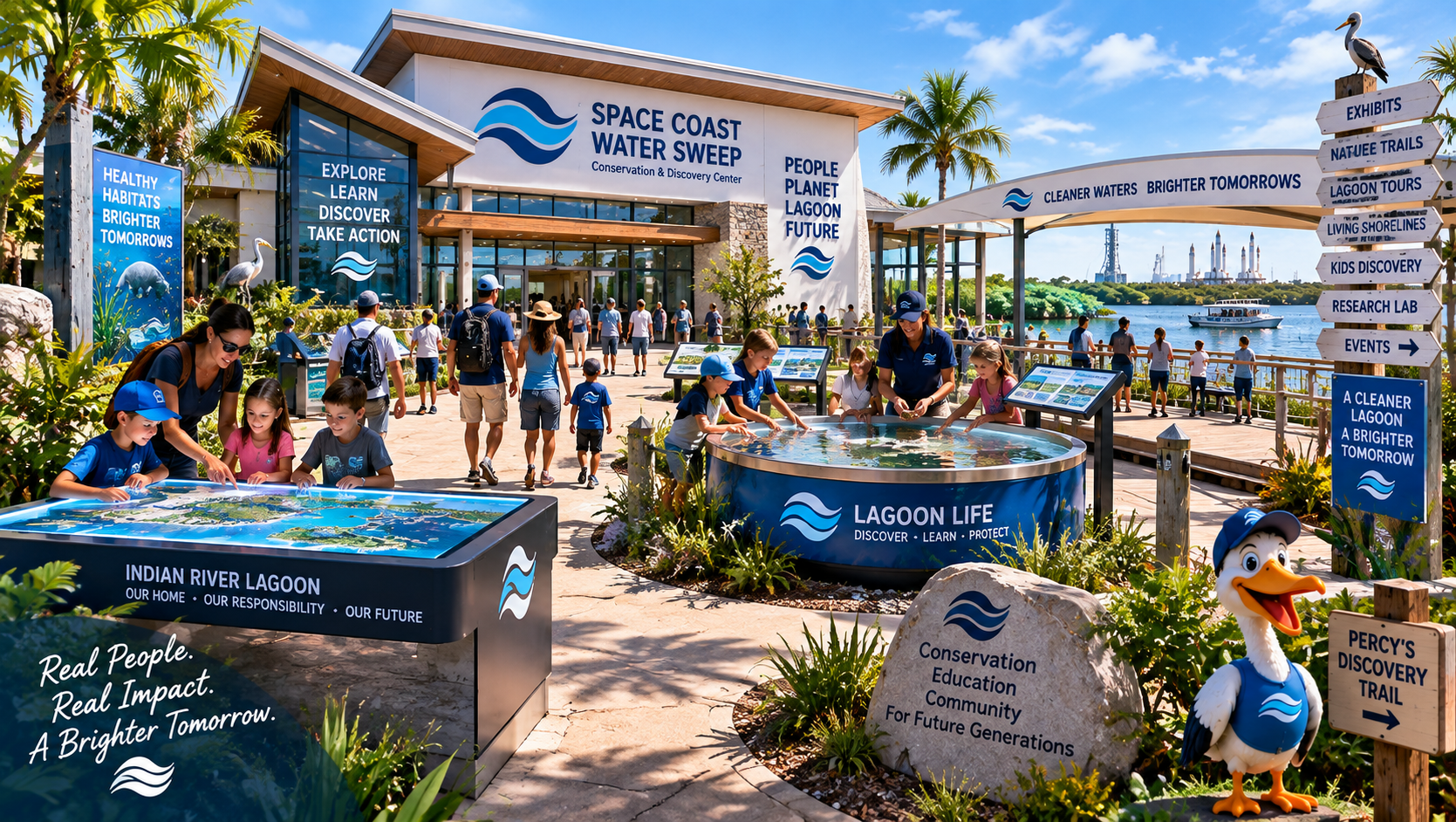
The Conservation & Discovery Center is envisioned as both a destination and a working conservation campus.
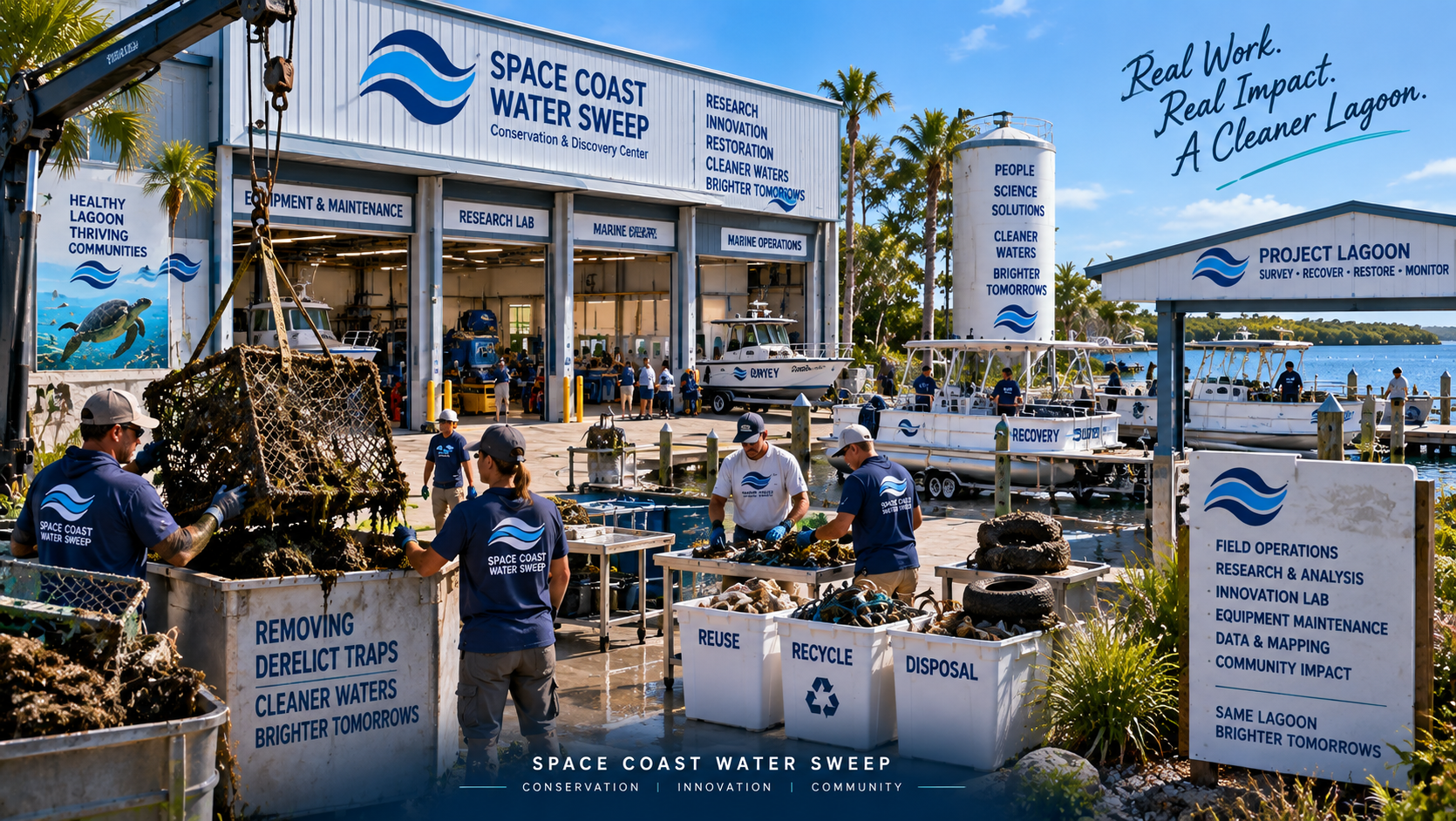
Visitors may be discovering the lagoon through exhibits, trails, research demonstrations and on-water experiences while, behind the scenes, Project Lagoon teams are preparing survey boats, researchers are studying environmental conditions, students are participating in field science, and new conservation solutions are being designed and tested.
The work and the experience are connected by one purpose: A healthier future for the Indian River Lagoon.
Built With Room to Grow
FUTURE CONSERVATION & CAMPUS EXPANSIONThe campus vision intentionally preserves undeveloped land for future conservation, research, education, technology and mission opportunities.
Not every idea for the future has been invented yet. The goal is to create a campus capable of evolving as new challenges, discoveries, partnerships and solutions emerge.
What Exists Today vs. What We're Building Toward
Throughout this walkthrough, the vision uses clear status language so visitors can tell what is already happening and what is planned for the future.
IN USE TODAY
Space Coast Water Sweep is already doing real conservation work on the Indian River Lagoon.
IN DEVELOPMENT / TESTING
Technology and capabilities being actively developed, tested or piloted.
PLANNED CENTER CAPABILITY
Facilities, programs and experiences envisioned for the future Conservation & Discovery Center.
FUTURE RESEARCH / EXPANSION
Longer-range research questions and opportunities that may emerge as the Center grows.
WATER CONNECTS EVERYTHING.
CONSERVATION BEGINS WITH THE DESIGN.
THE CENTER IS BUILT TO LEARN AND IMPROVE.
Water Connects Everything
Why water matters. What healthy water means. How water connects people, communities and the Lagoon.
Every Living Thing Needs Water.
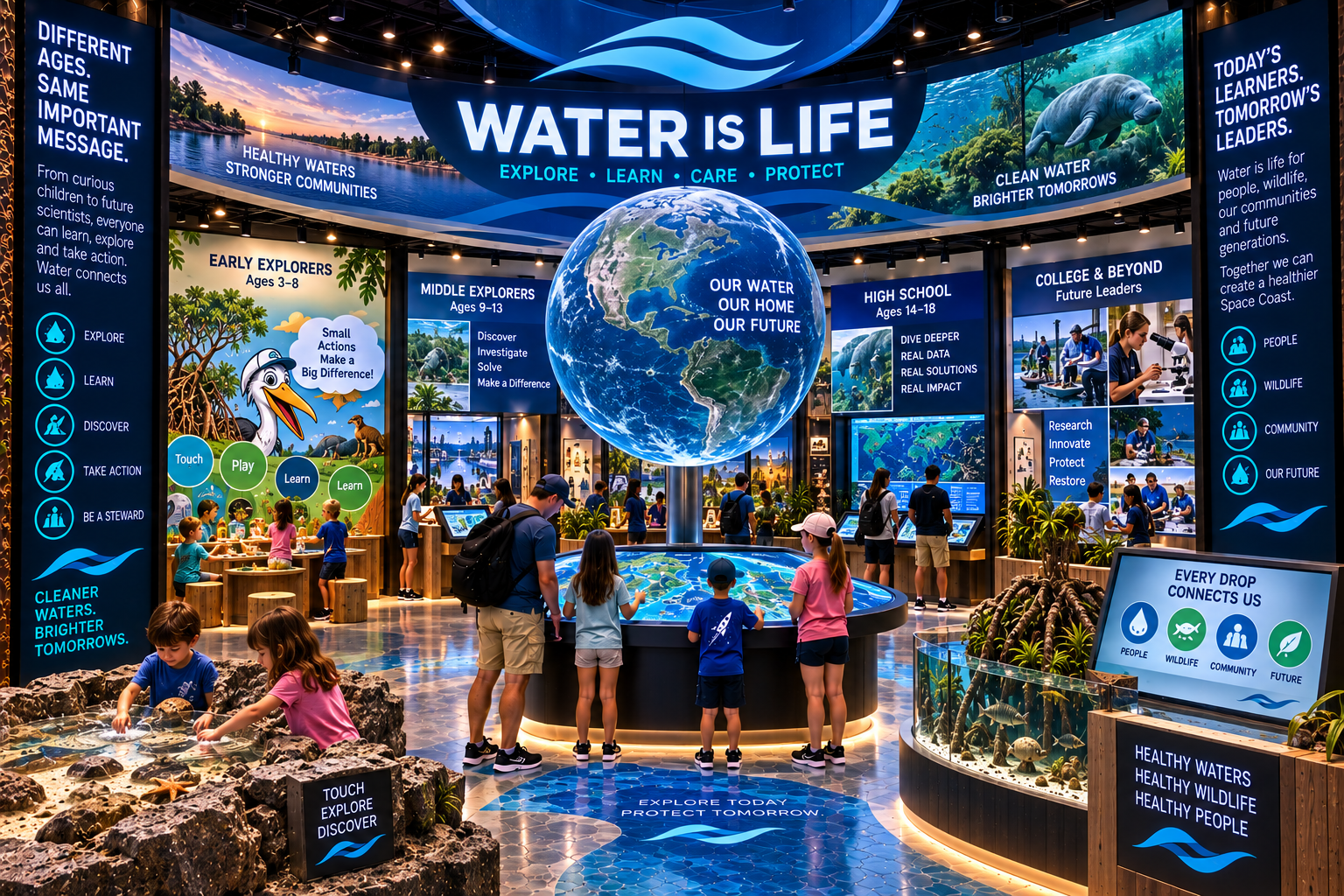
Water is not important only to fish and wildlife. Water supports people, communities, recreation, food, economies, habitats and life itself. We swim in it, boat on it, fish in it and enjoy being near it. Properly treated safe water is essential for drinking and everyday life.
When water becomes polluted or environmentally degraded, recreation, wildlife, habitat, community use and human health considerations can all be affected.
A Scientific Guardrail
Visually clear water does not automatically mean healthy or safe water. Water can look clean while containing things we cannot see. This exhibit teaches visitors to look beyond what's visible — to water chemistry, dissolved oxygen, salinity, temperature, nutrients, turbidity, microorganisms, microplastics and more.
CHILDREN CAN
- Make it rain
- Move water
- Build a shoreline
- Experiment with runoff
- Explore filtration
- Discover what may be hidden in water
DEEPER SCIENCE
- Water chemistry
- Dissolved oxygen
- Salinity and temperature
- Nutrients and turbidity
- Microorganisms and microplastics
- Watershed movement and human water use
Protecting water isn't only conservation. It is protecting a system that makes life possible.
How Did Water Touch Your Life Today?
Water connects everything — the rain that falls on your roof, the stormwater that flows through your neighborhood, the wetlands that filter it, the Lagoon that receives it, and the ocean beyond. Understanding the Lagoon means understanding where water comes from and where it goes.
Freshwater enters the Lagoon through rainfall, stormwater runoff, drainage canals, creeks and managed discharges. Salinity shifts with rainfall, tides and ocean connections. Dissolved oxygen, nutrients, turbidity and water chemistry all shape what can live there.
The Conservation & Discovery Center is designed to help visitors understand the complete water cycle — from the drop of rain that falls on the parking lot to the Lagoon it eventually reaches.
SALINITY
Salt and freshwater balance
DISSOLVED OXYGEN
What fish and wildlife breathe
NUTRIENTS
Nitrogen, phosphorus and growth
TURBIDITY
Clarity, light and suspended material
EVERY LIVING THING NEEDS WATER.
Visually clear water does not automatically mean healthy or safe water. Water can look clean while containing things we cannot see.
The Campus Behind the Experience
The working campus: operations, receiving, maintenance, fleet support, food-service back of house, staff areas, residence and behind-the-scenes infrastructure.
A Place Built Around the Lagoon — Without Having to Build Everything on the Water.
The Conservation & Discovery Center is envisioned as a working conservation campus where public discovery, science, education, technology and real-world lagoon restoration come together.
By concentrating water-dependent activities near the Indian River Lagoon and allowing the larger campus to extend inland, the vision can create a major destination while using waterfront property strategically.
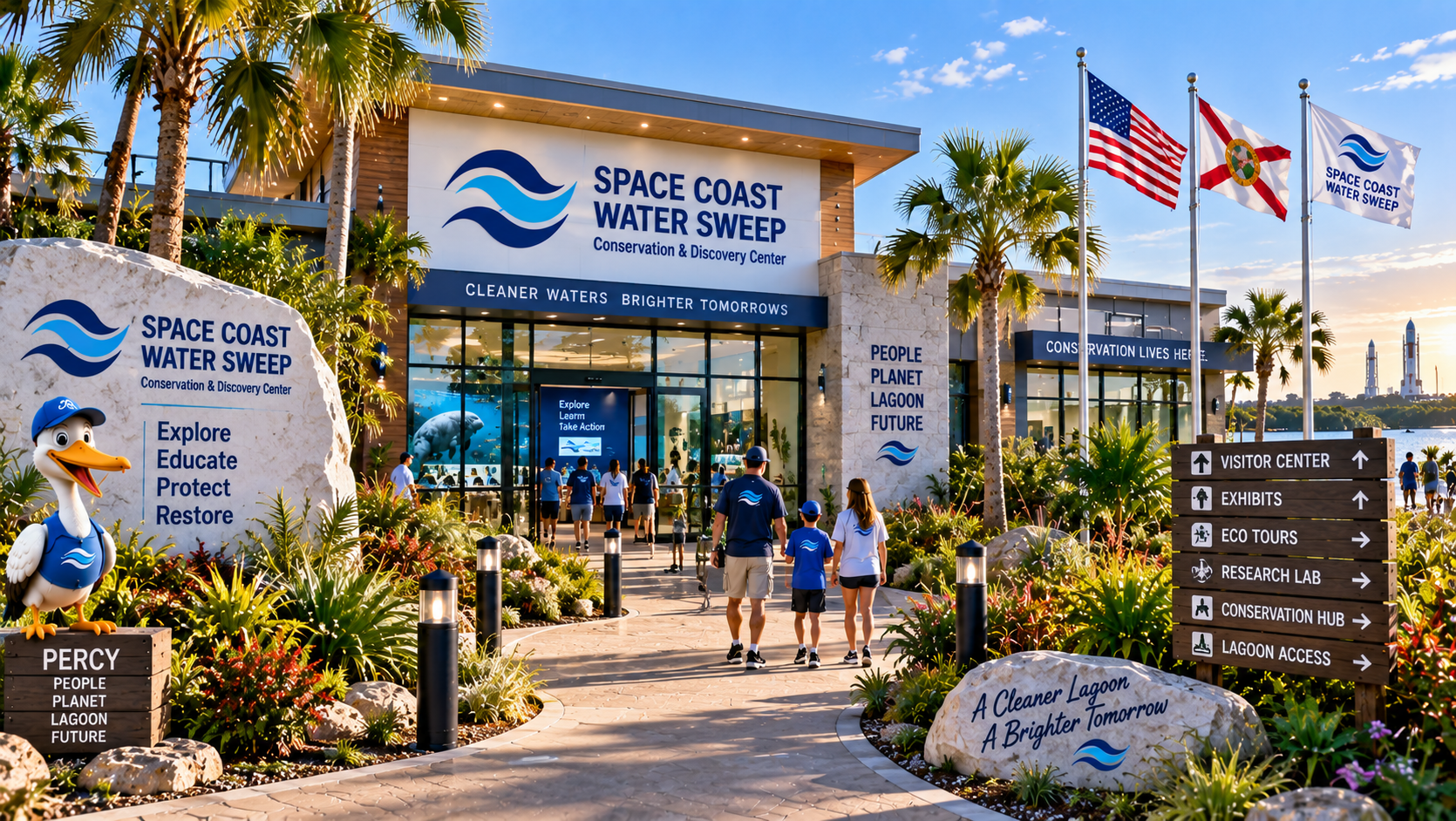
Your Visit Starts Before You Ever Reach the Water.
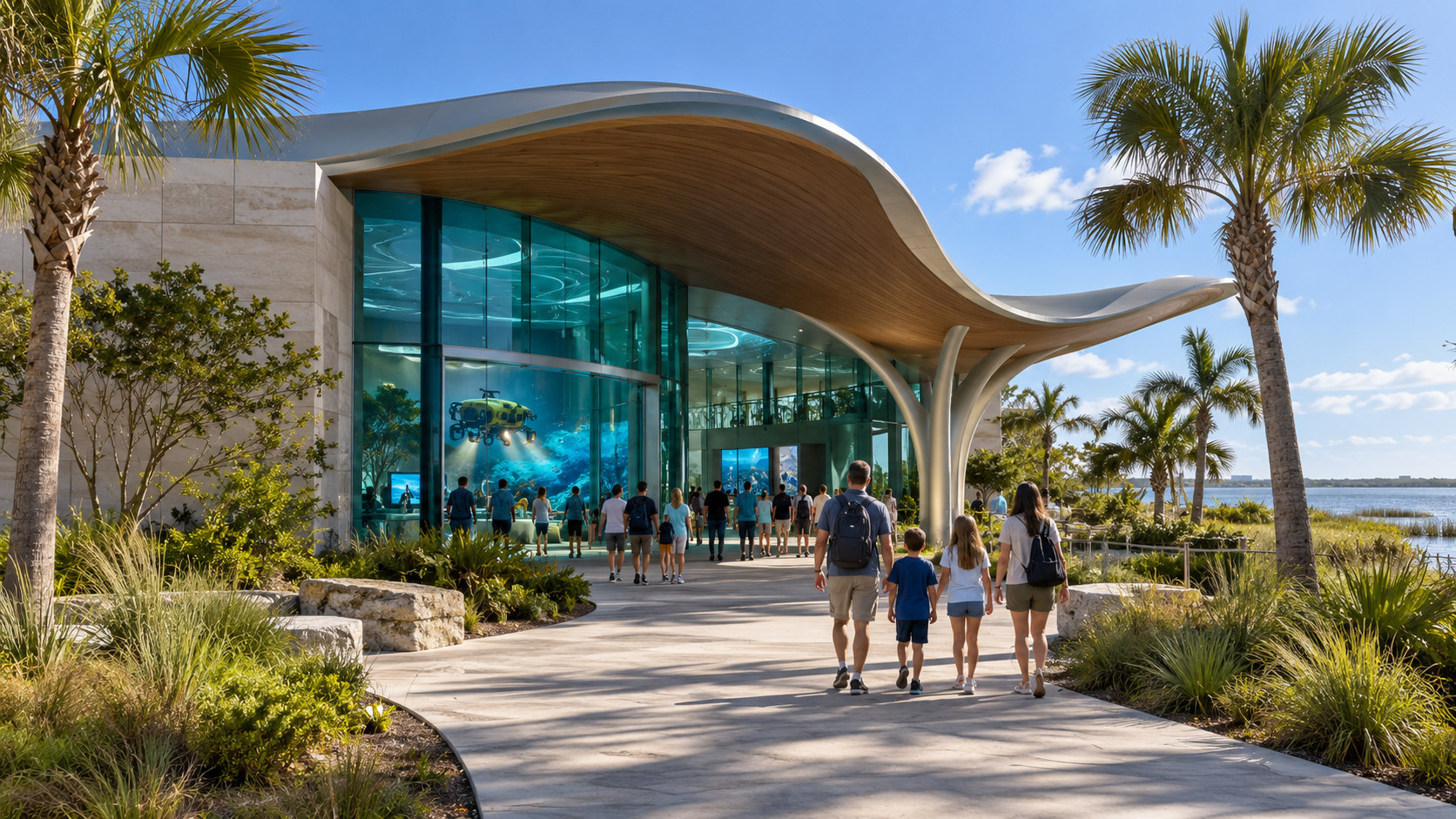
The public side of the campus is designed as a welcoming Space Coast destination rather than an industrial operations facility. Visitors arrive through a landscaped public entrance that begins introducing the Indian River Lagoon mission immediately.
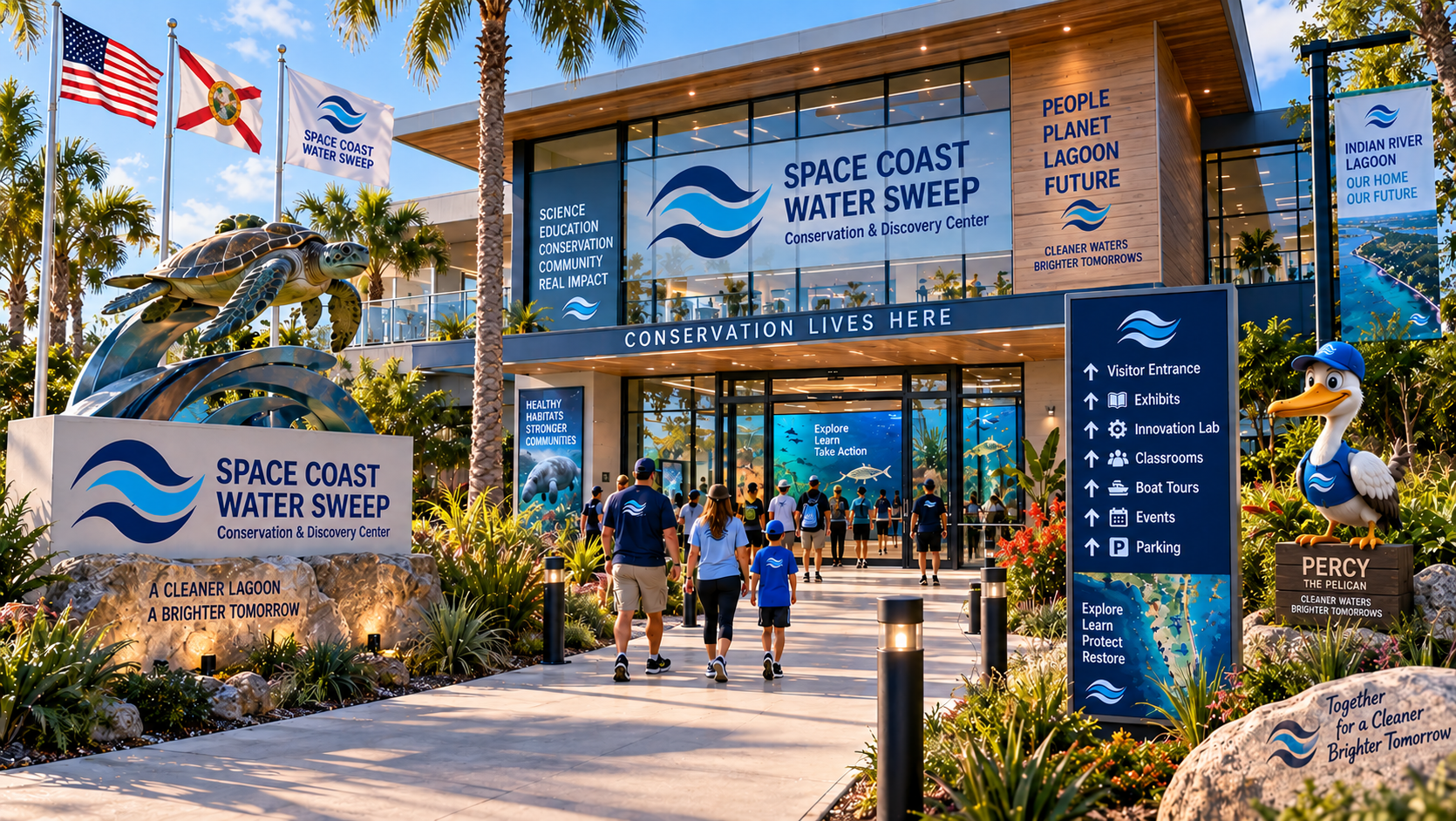
The Conservation & Discovery Center
This is the primary public gateway into the mission — connecting visitors to the full story of the Indian River Lagoon and the work being done to protect it.
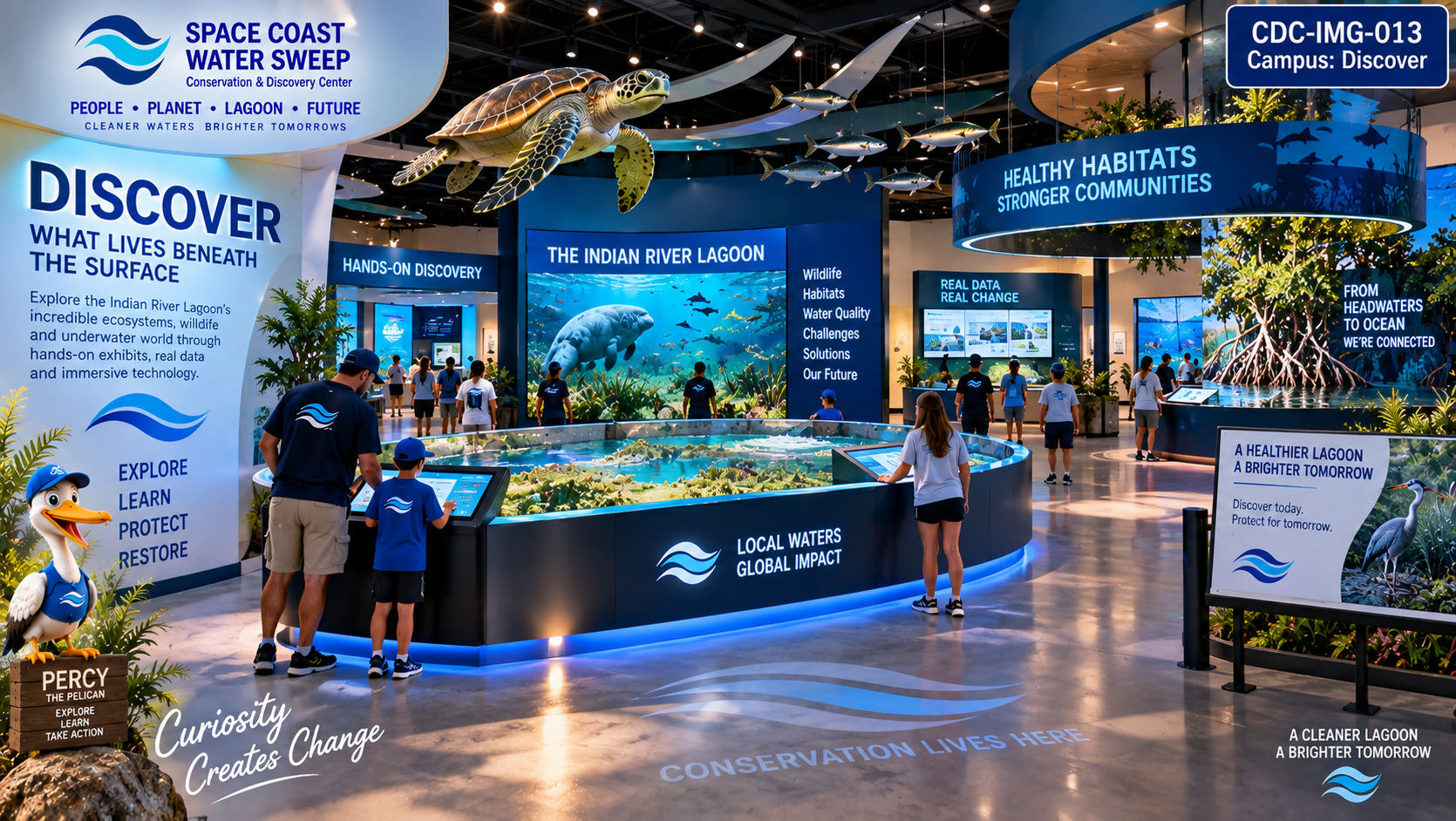
The Experience Doesn't Stop at the Building.
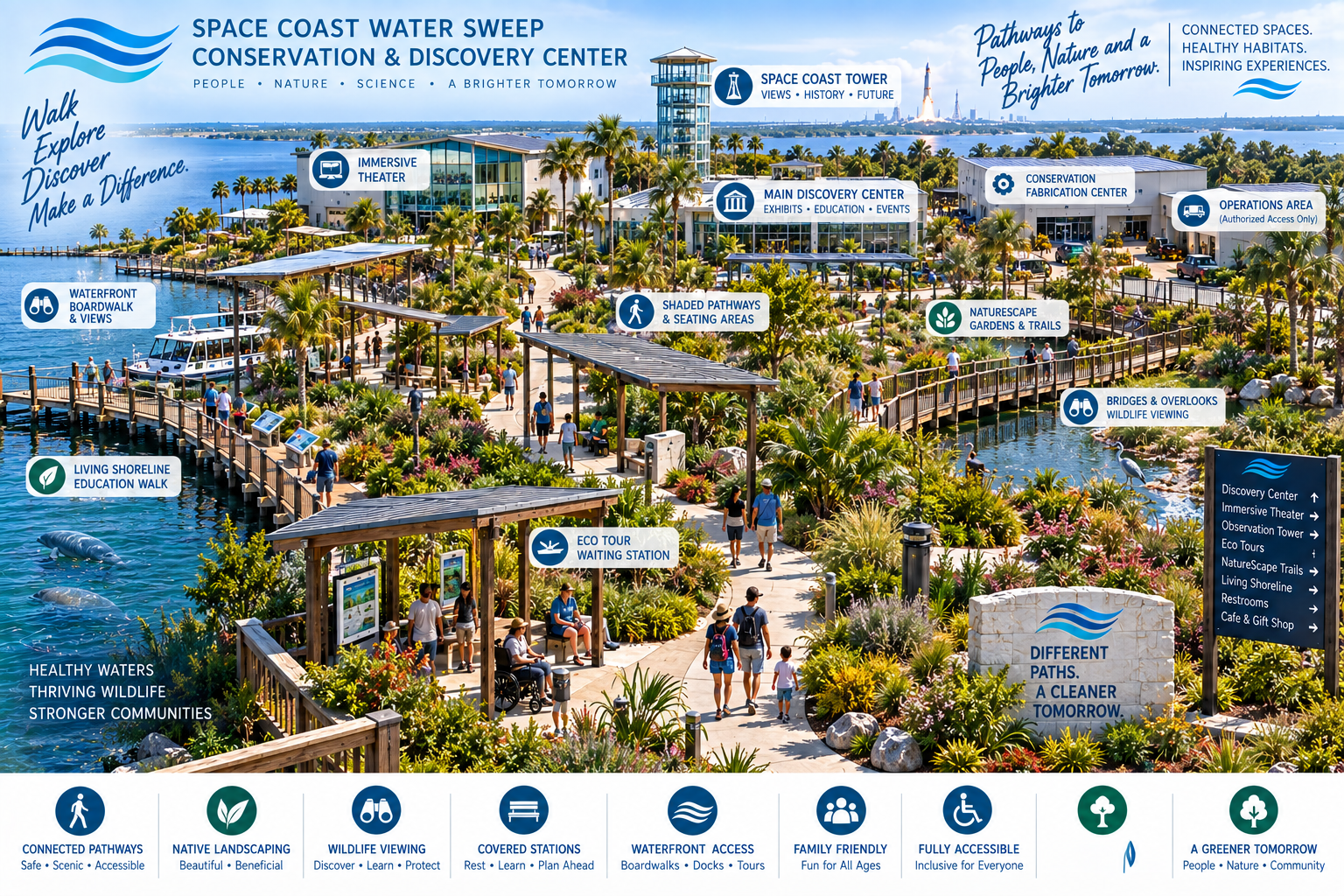
The campus itself becomes part of the educational and conservation experience. Visitors should be able to learn simply by walking across the property.
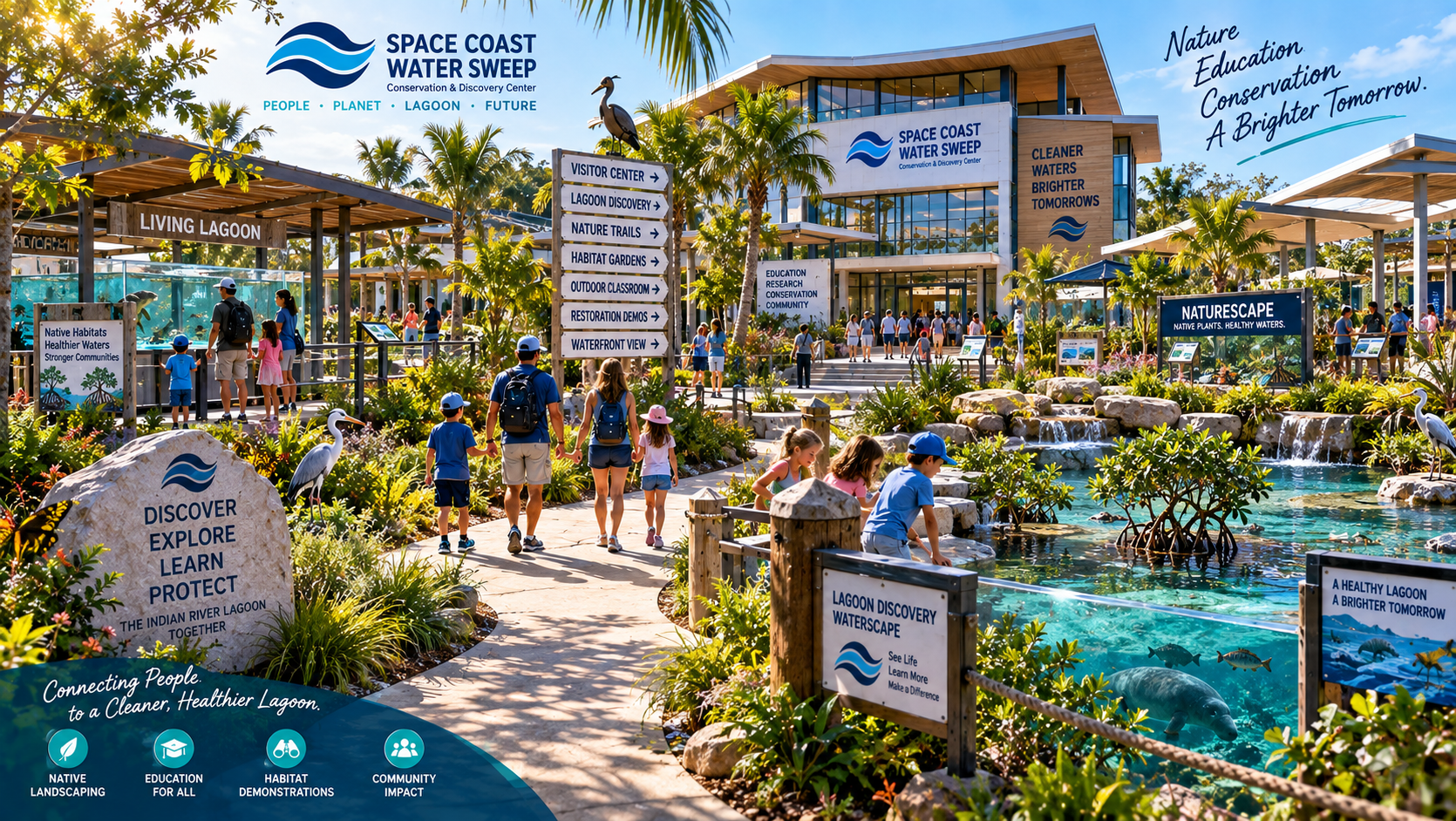
Behind the Experience Is Real Science.
The campus is not simply an attraction. Research, education and technology can happen alongside the public experience. Visitors may be able to observe portions of this work through safe demonstrations, viewing areas and interpreted experiences without entering controlled working spaces.
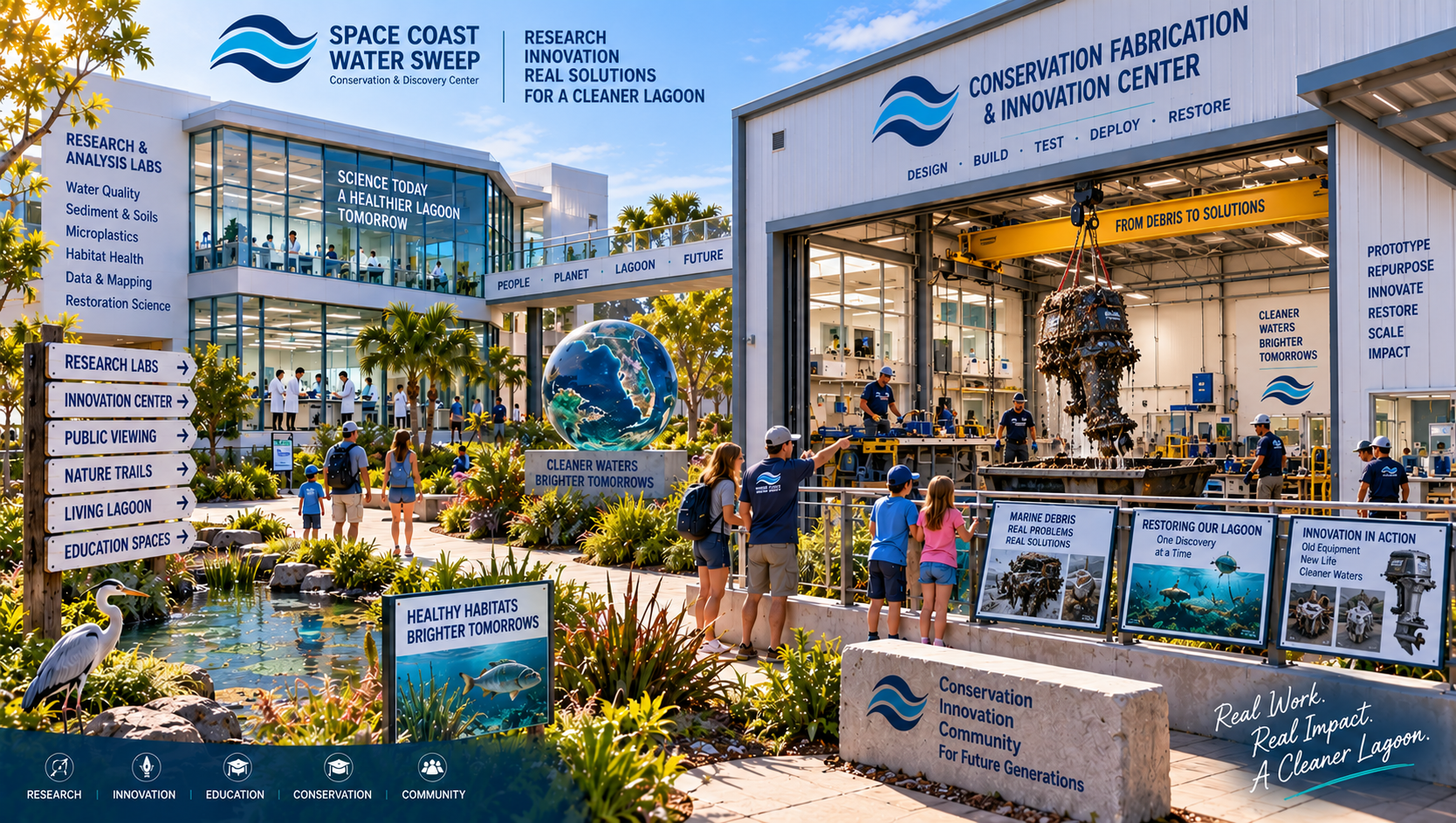
This Isn't a Conservation Theme Park. The Work Happens Here.
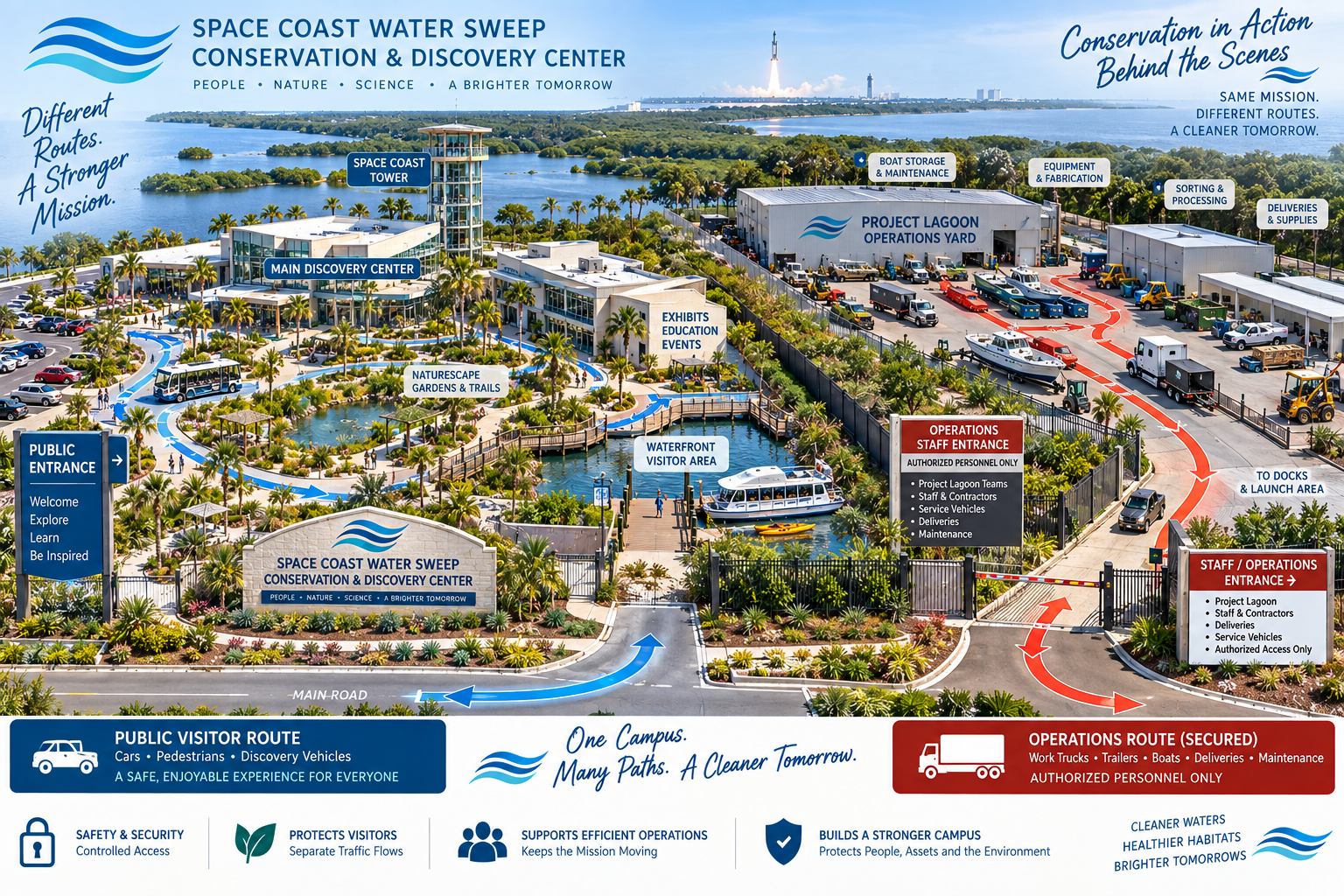
Project Lagoon field operations can operate from the same overall campus while remaining appropriately separated from public visitor circulation.
Public visitors should not normally travel through this service entrance or active work yard.
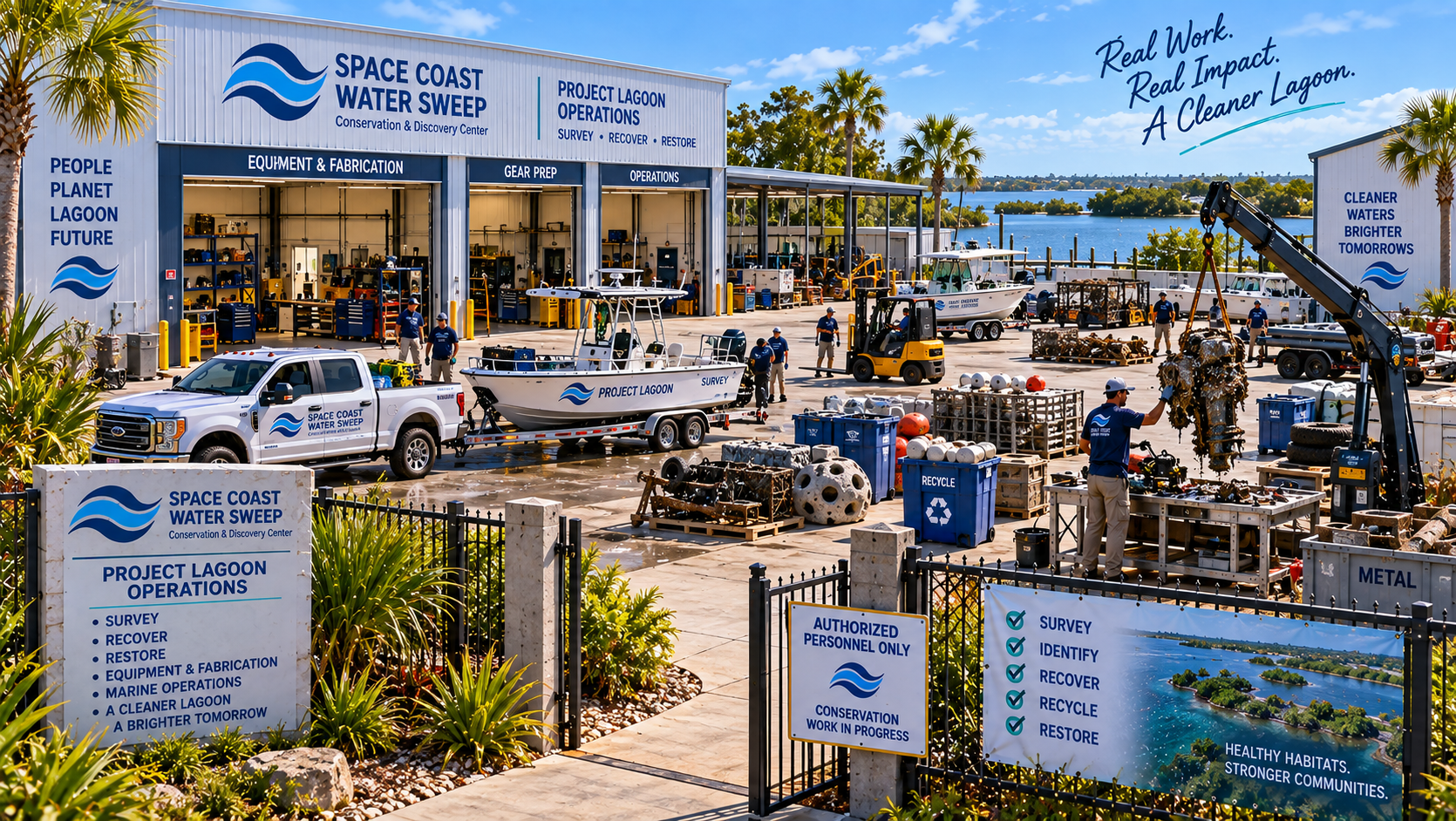
Visitors and Field Crews Shouldn't Have to Use the Same Front Door.
PUBLIC CAMPUS ROUTE
OPERATIONS ROUTE
Separating these circulation systems can improve visitor experience, safety, security, operational efficiency, truck and trailer movement, and emergency access.
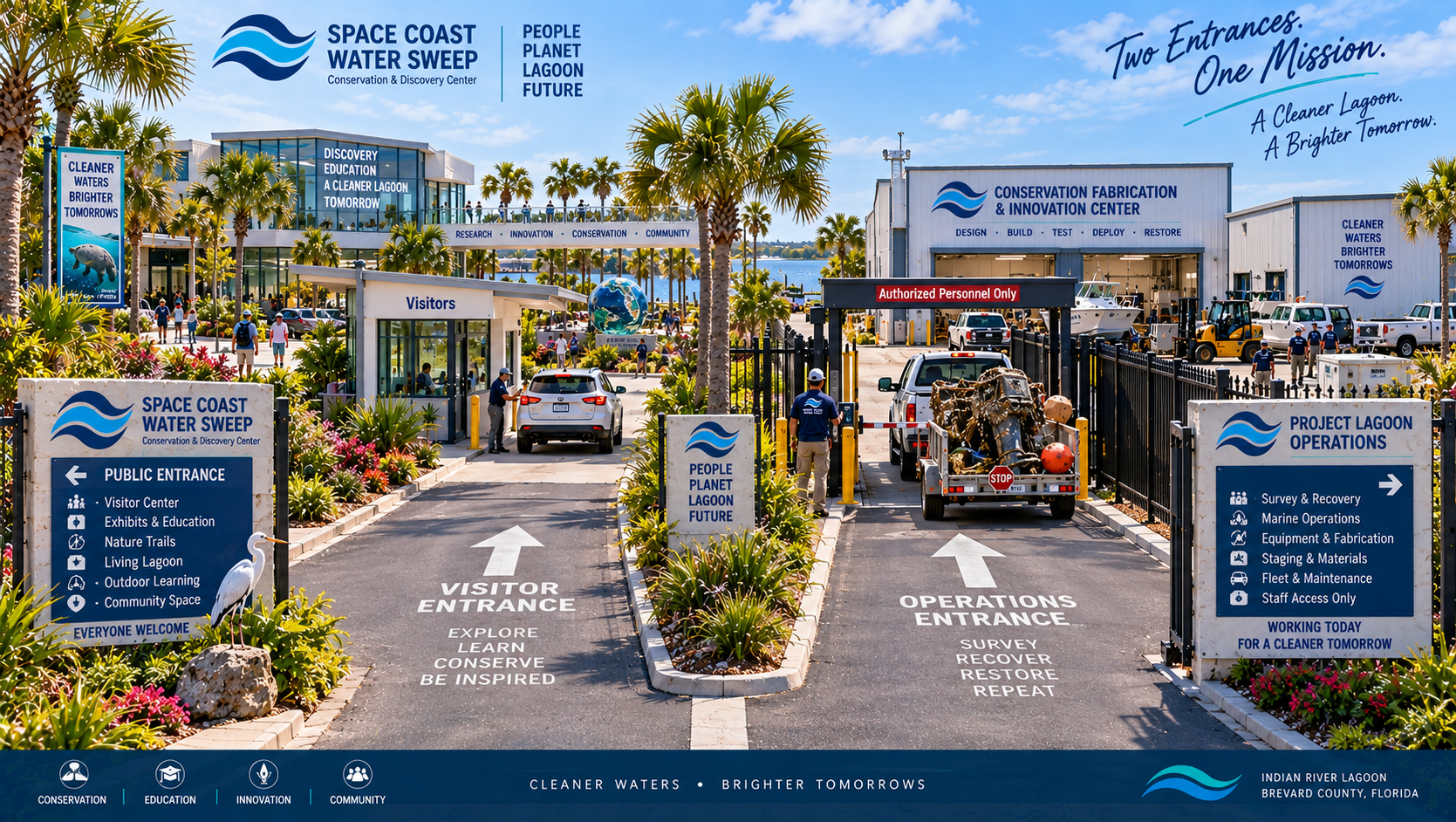
The Waterfront Is Where the Campus Meets the Mission.
Only functions that truly benefit from or require water access need to occupy the waterfront edge. Industrial and public dock activity are kept appropriately separated.
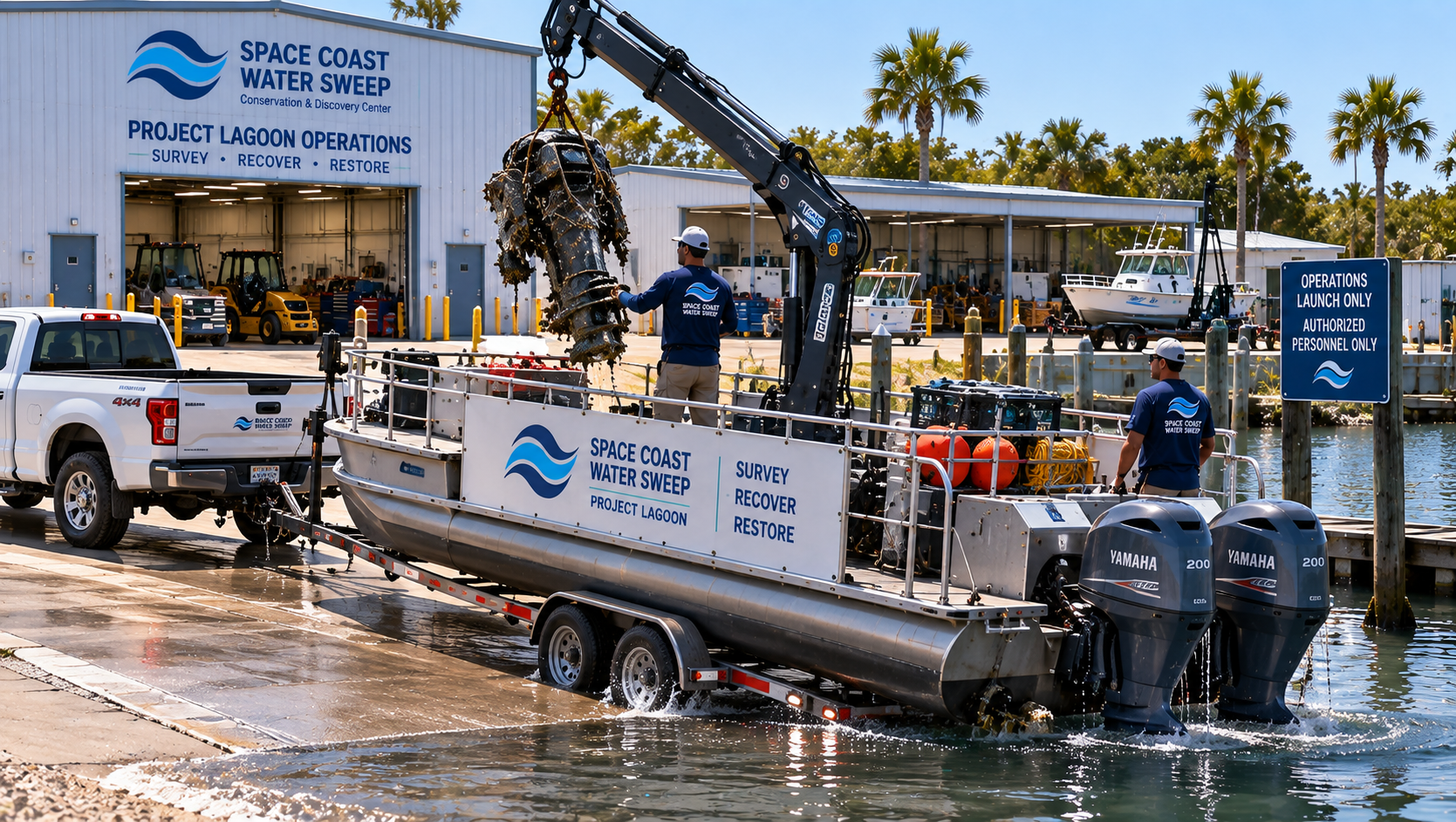
Some Parts of the Campus Are Designed to Stay Behind the Scenes.
The far/private portion of the operational campus may include support functions that allow the property and conservation operations to respond quickly when needed.
The Campus Operations & On-Site Facility Residence is a mission-related facility concept associated with on-site operational oversight and rapid response — not a visitor attraction. It is positioned as far as public visitor areas as practical, with privacy, landscaping buffers, and separate secured vehicle access. The Visiting Researcher/VIP Guest Suite is intended for mission-related short stays.
The operational campus may also include behind-the-scenes food-service support infrastructure — receiving, dry storage, refrigerated/frozen storage where needed, centralized food preparation where appropriate, sanitation/washing, concession storage, and waste/recycling.
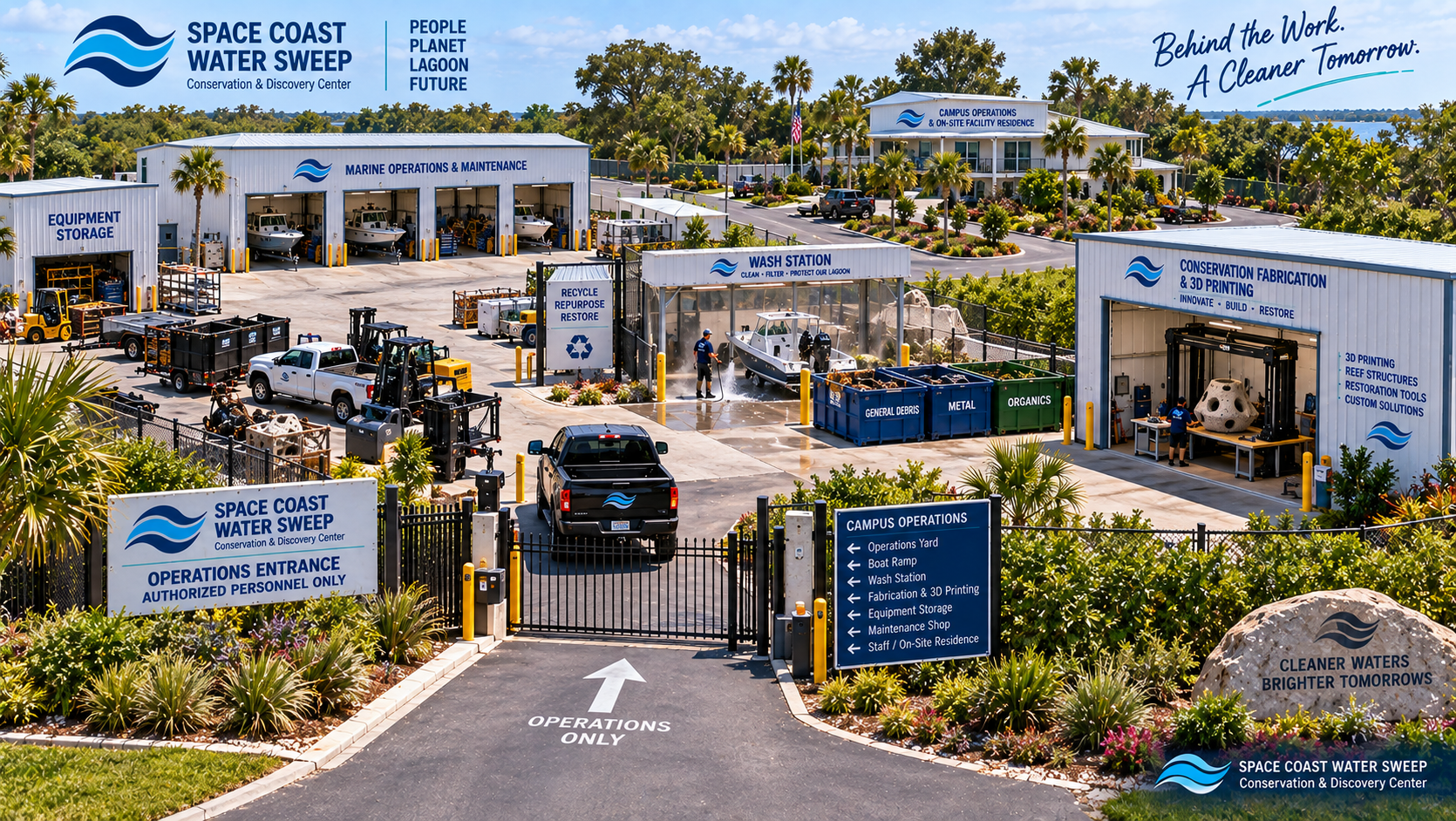
Don't Build Out Every Acre Just Because You Can.
Part of the long-term campus strategy is intentionally preserving undeveloped land. Some of the most important opportunities this campus could support may not exist yet.
One Campus. Many Missions.
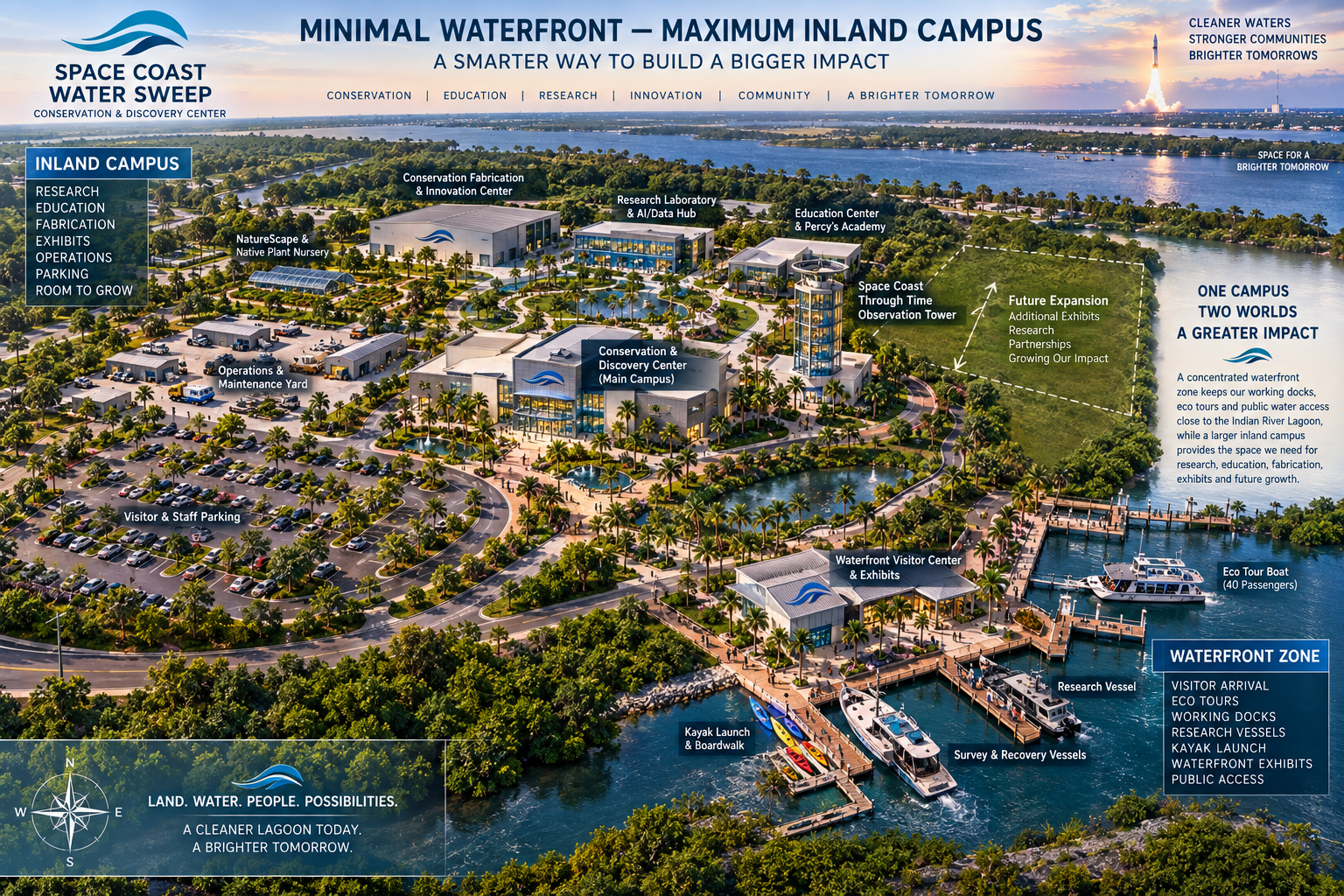
Walk. Explore. Discover. Make a Difference.
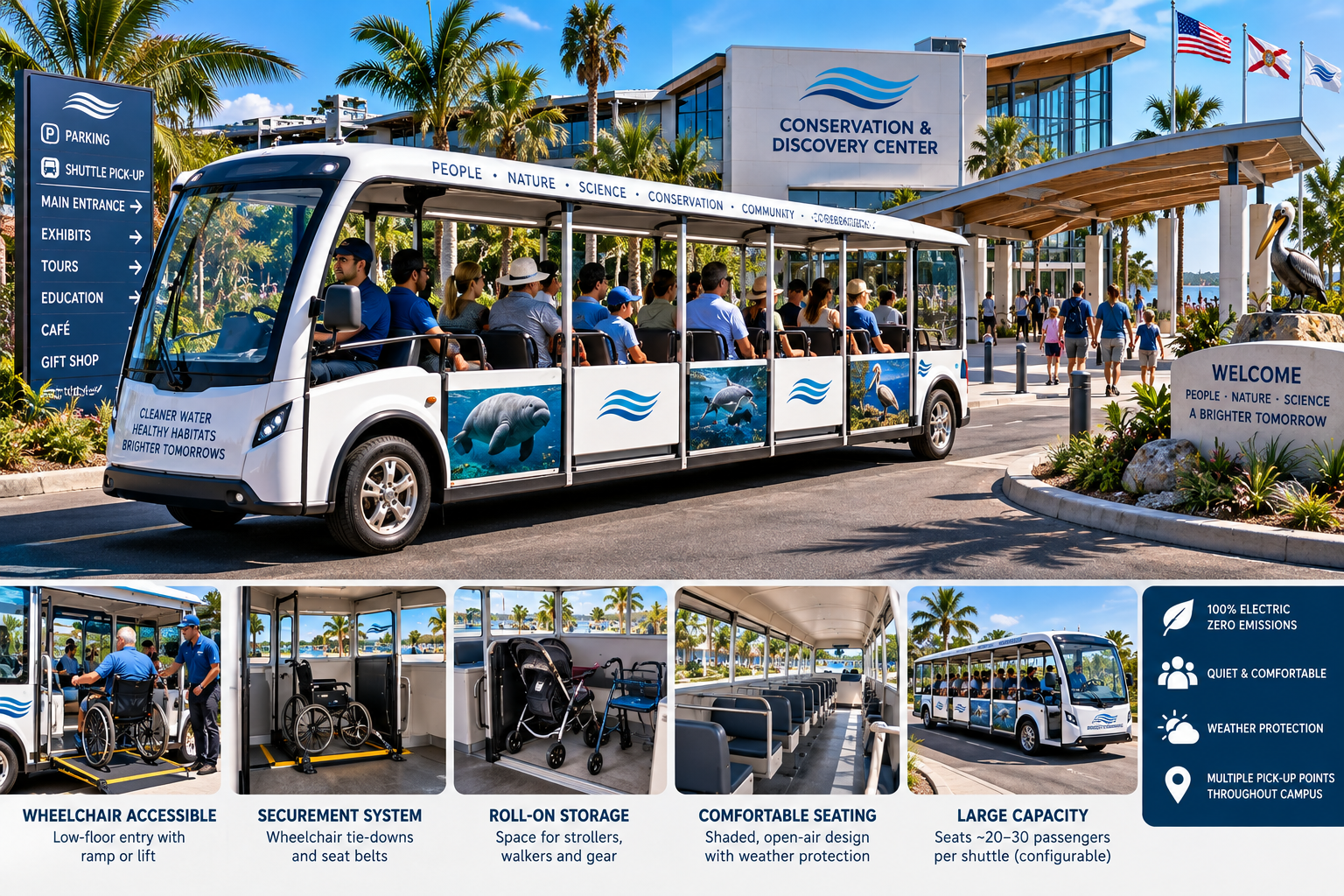
The Center Comes to You.
Explore at your own pace. Walk when you want to walk. Ride when you want to ride. Accessibility is a design requirement from the beginning — not a separate lesser experience. The same Center. The same destinations. The same experience.
Parking & Arrival Shuttles
Larger-capacity electric vehicles move visitors between parking areas and the main arrival area. Open-sided or partially open, weather-protected electric shuttles support families, older visitors, visitors with disabilities, strollers, walkers, wheelchairs and mobility equipment. Strollers and walkers should have roll-on storage where feasible. Wheelchair users remain in their wheelchair with accessible boarding and engineered securement systems. Companion seating is provided next to wheelchair securement positions so families and companions ride together.
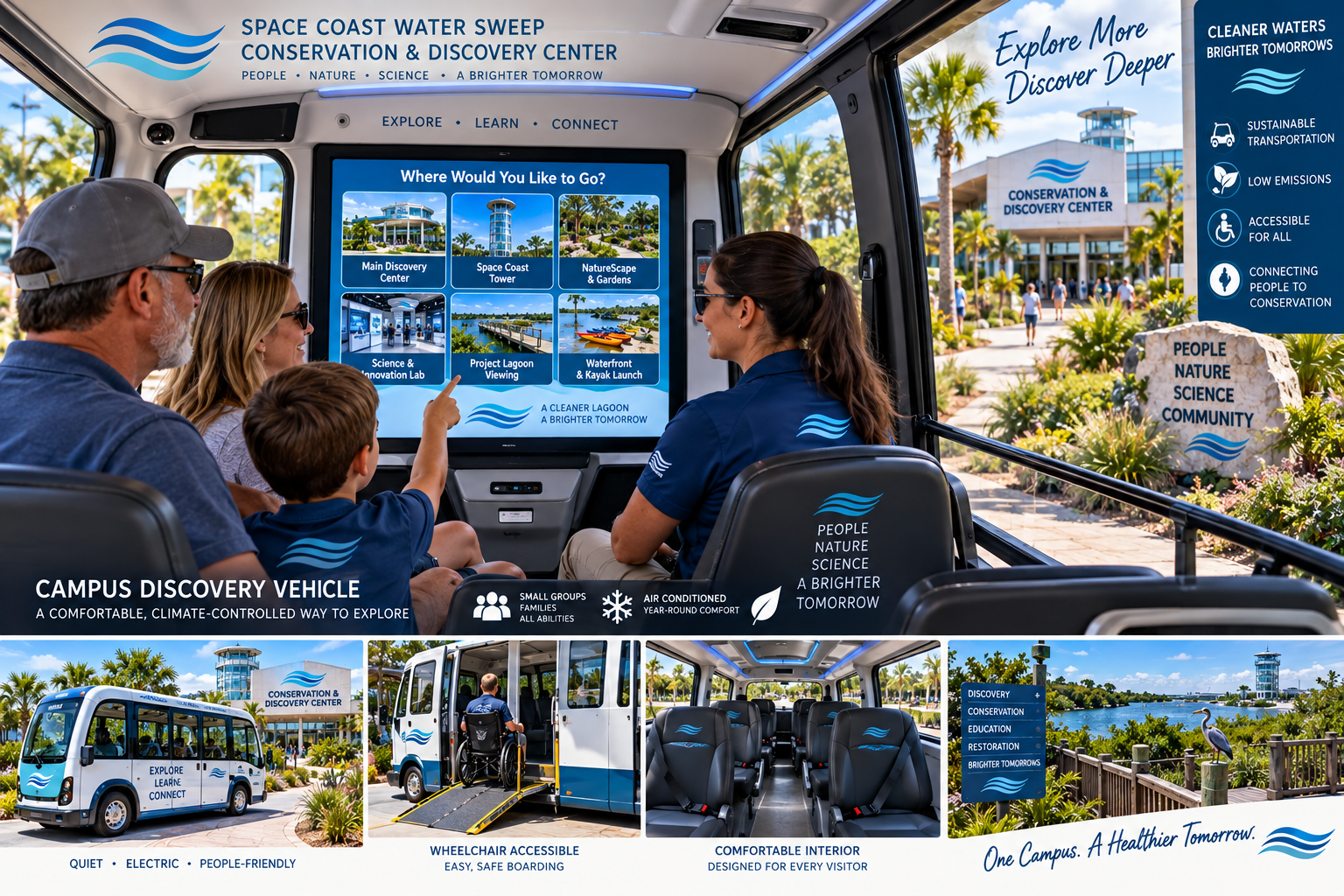
On-Demand Campus Discovery Vehicles
A larger fleet of smaller, enclosed, climate-controlled, electric and accessible vehicles operating inside the public campus. A visitor or group enters and selects a destination — Main Discovery Center, Space Coast Tower, NatureScape, Science & Innovation, Project Lagoon Public Viewing, Waterfront or Parking Shuttle Connection — and the vehicle transports them. Long-term autonomous or highly automated operation may be envisioned where technology, regulation, insurance and safety requirements permit. The infrastructure also supports manually driven operation.
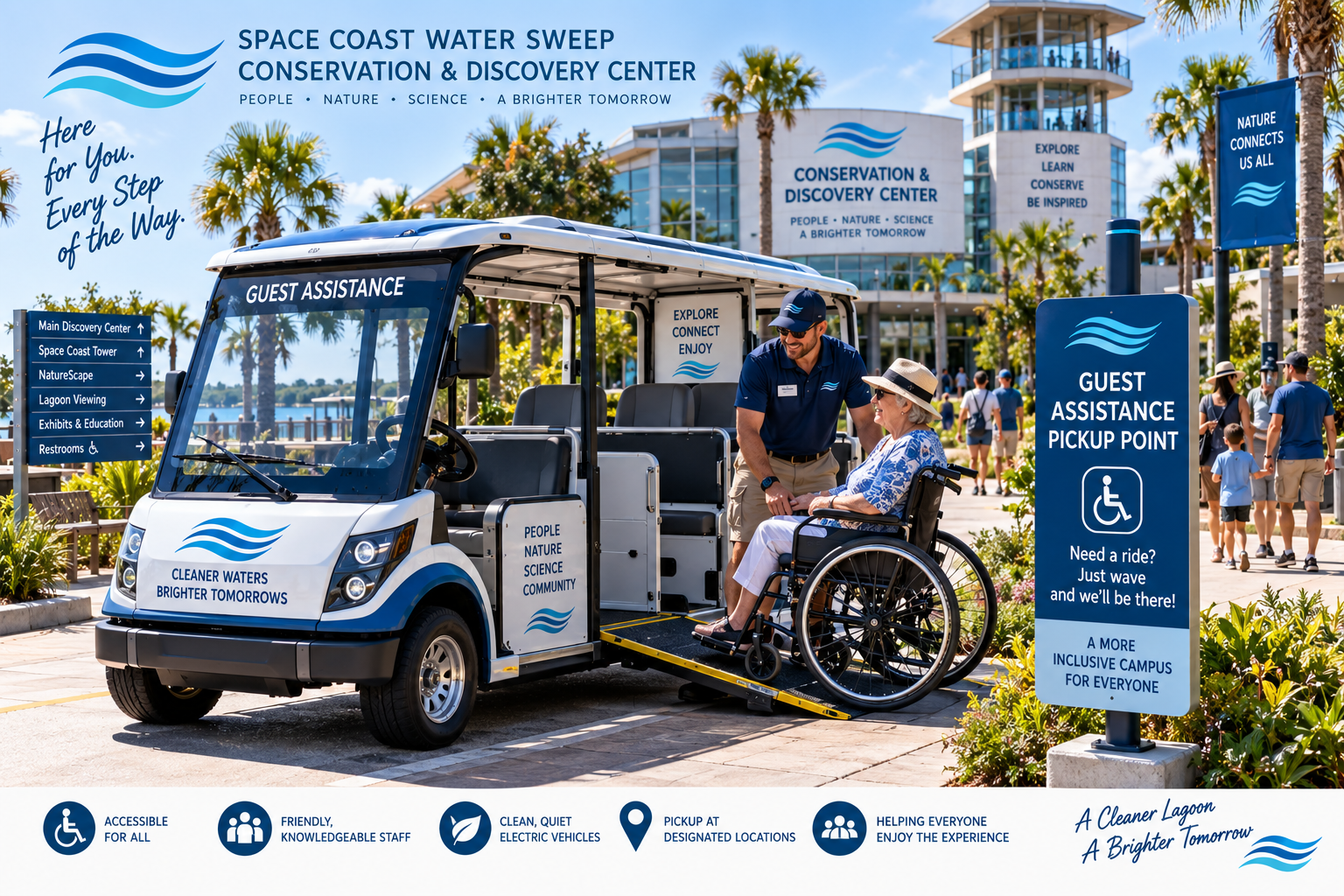
Guest Assistance Vehicles
Several matching small electric vehicles remain human-operated, circulating through approved public mobility areas to assist visitors who become tired, overheated or need transportation without first reaching a regular mobility station. Useful for older visitors, mobility-limited visitors, families with young children and anyone who reasonably needs assistance. Designated safe pickup points and a future app-based request-a-ride capability are envisioned. A non-phone method is also provided at appropriate locations.
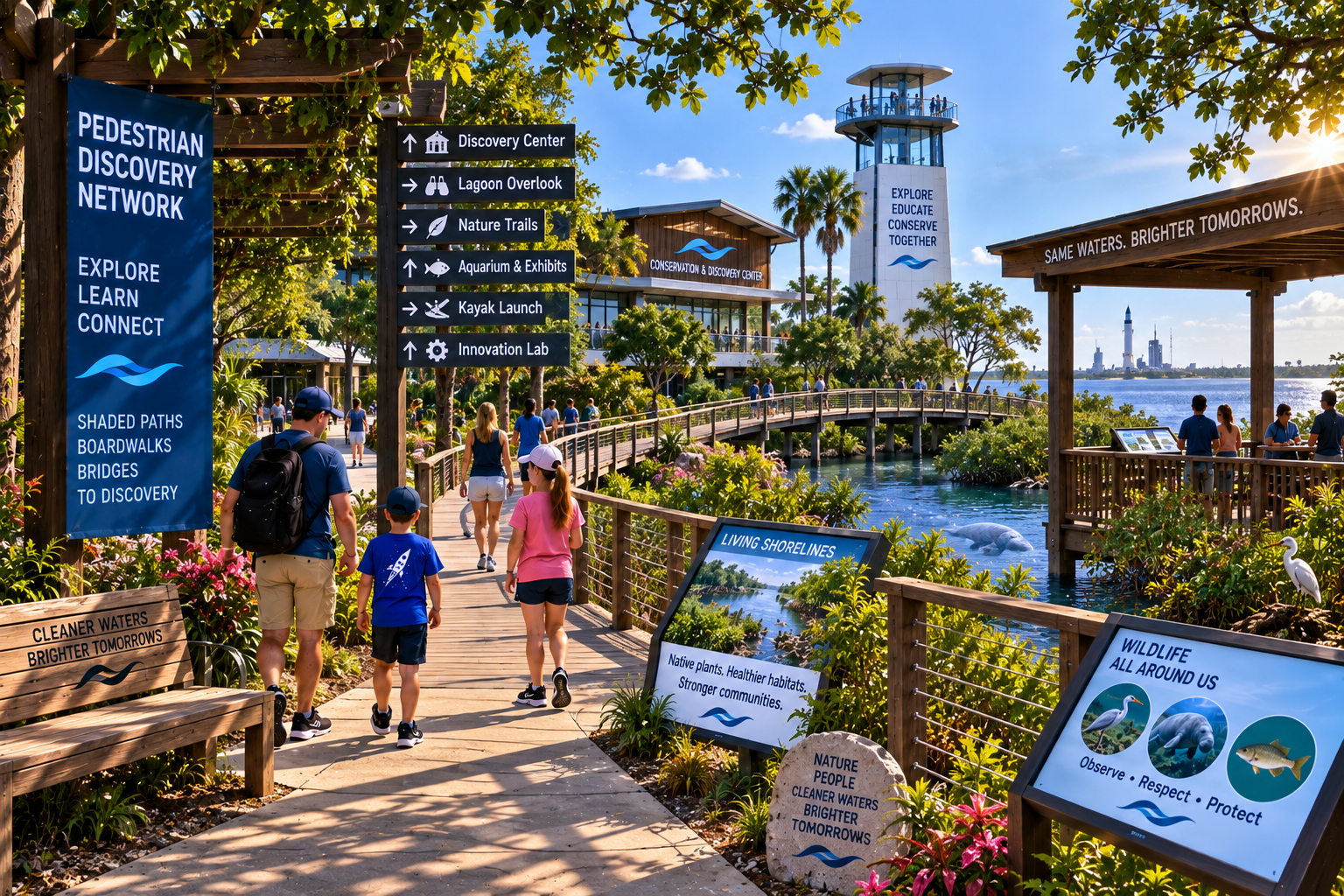
Pedestrian Discovery Network
Walking paths, shaded trails, NatureScape paths, boardwalks, bridges and waterfront walks remain the primary pedestrian experience. The mobility system does not replace walking — it makes long-distance walking optional. Covered and shaded stations with seating are provided at appropriate intervals along pedestrian routes.
Secured Operations Network
Project Lagoon, staff, service and operations circulation remain separate where practical. This serves staff, work trucks, trailers, boats, deliveries, contractors, operations, debris handling and maintenance. Public autonomous and discovery vehicles do not casually travel through restricted industrial or operations areas.
Mobility Operations & Charging Center
A conceptual restricted support area for charging, staging, maintenance, fleet monitoring, dispatch, cleaning and vehicle readiness. Campus renewable energy may contribute to charging where feasible. The fleet is not claimed to be powered entirely by on-site solar.
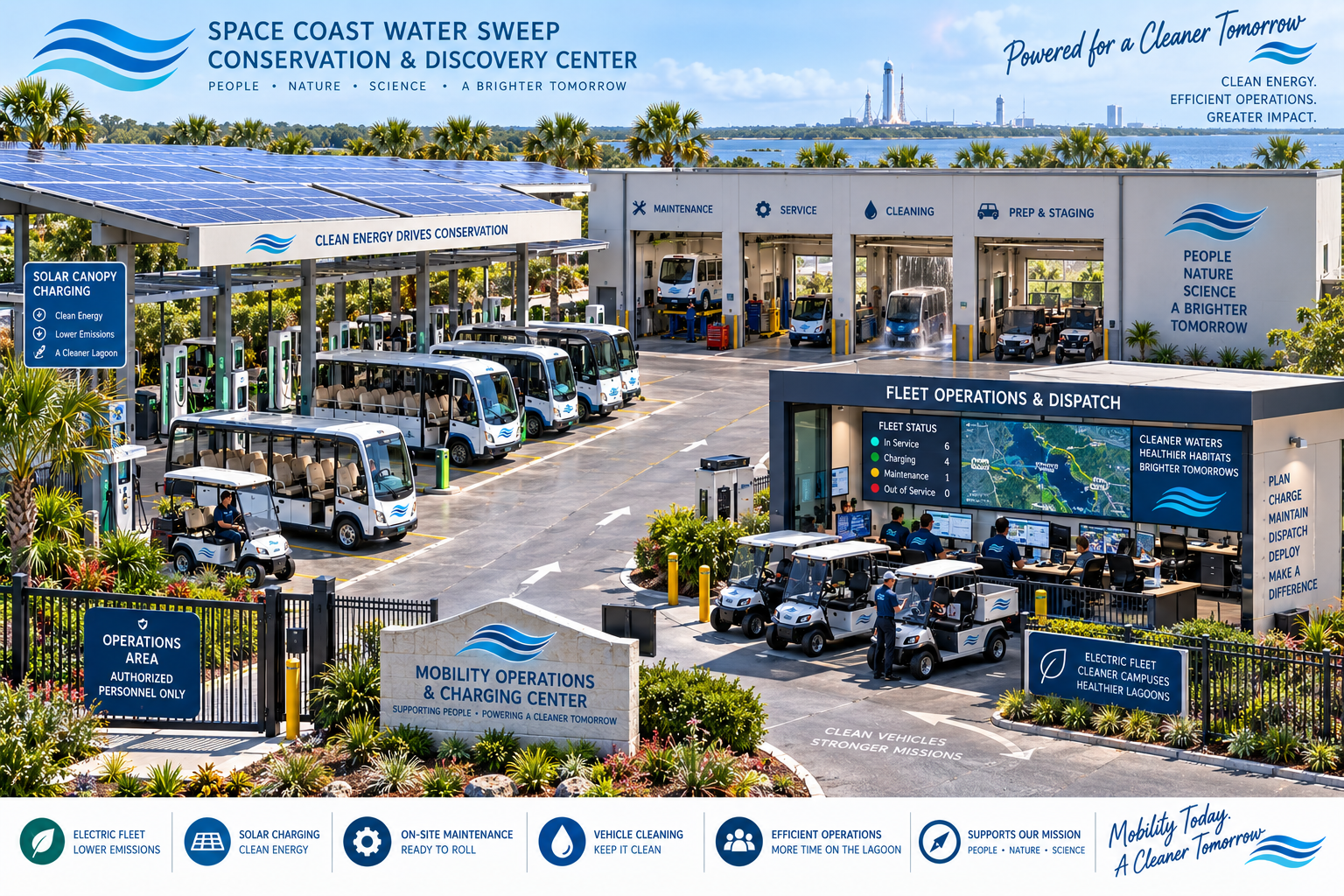
VEHICLE STAGING & DISPATCH
Educational Narration
"To your right is NatureScape, where the Center demonstrates Florida-native landscaping, rain gardens, living shoreline techniques and approaches designed to reduce runoff while creating habitat."
As vehicles pass Center features, short location-aware narration explains what visitors are seeing. Narration remains short and optional. Future technology may support different narration modes — normal visitor, school/STEM, conservation, special event or approved sponsor/private tour.
The same Center. The same destinations. The same experience.
Strollers, walkers and wheelchairs are supported throughout the fleet — not limited to one special vehicle. Companion seating, covered/shaded stations and accessible boarding are standard across the entire system.
The Campus Behind the Experience
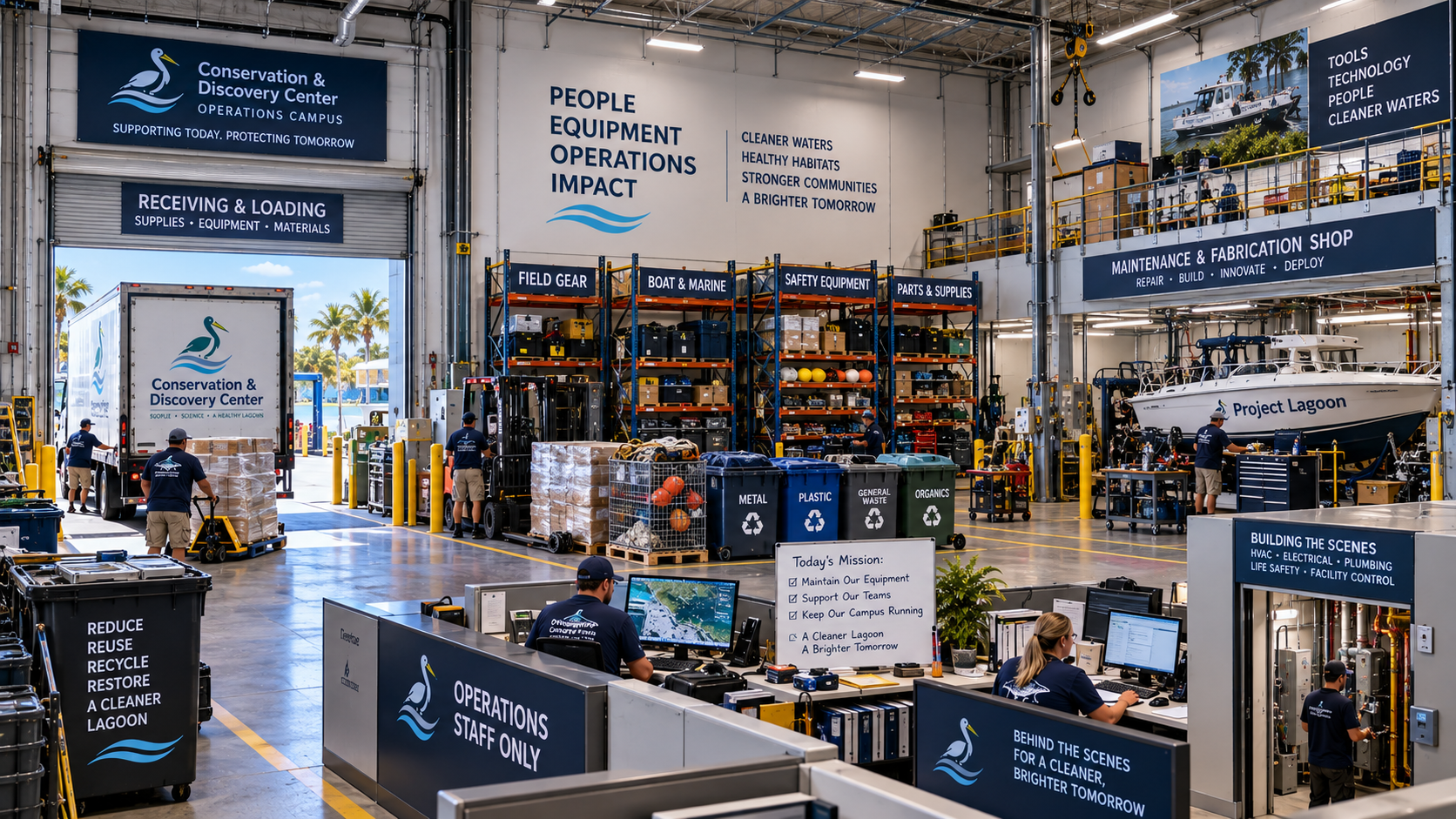
The attraction closes. The working campus continues. Behind the public experience is a professional working campus with the infrastructure needed to keep the mission running every day.
RECEIVING & WAREHOUSING
- Central receiving / loading
- General storage
- Retail inventory
- Fulfillment
PROJECT LAGOON SUPPORT
- Equipment storage
- Charging
- Inspection
- Deployment preparation
- Fleet maintenance
- Rigging
FACILITY MAINTENANCE
- Maintenance shop
- Custodial operations
- Janitorial supplies/support
FOOD-SERVICE BOH
- Dry storage
- Cold/freezer storage
- Preparation/support
- Sanitation
- Dishwashing
- Internal distribution
BUILDING SYSTEMS
- Mechanical systems
- Electrical systems
- HVAC
- Plumbing
- Building controls
- Pumps/water systems
TECHNOLOGY
- Conventional IT/networking
- Secure AI/computing infrastructure
STAFF AREAS
- Staff offices
- Shared workspace
- Meeting rooms
- Conference/briefing space
- Staff break/welfare areas
- Lockers/changing/showers
SUPPORT SPACES
- Volunteer staging
- Research support/storage
- Sample storage
- Fabrication material storage
- Attraction technical/backstage
- Event support/storage
EMERGENCY
- Emergency responder access
- ICS-compatible flexible space
Direct SCWS Oversight with Qualified Outside Support
SCWS expects to maintain direct oversight of core campus operations while also using qualified outside companies where appropriate. The model below reflects current planning assumptions — not final staffing decisions.
Potential SCWS In-House Roles
Welcome Center Staff
Ticket sales and merchandise staff for the public-facing visitor experience.
Daily Roving Cleaning
Staff providing day-to-day guest-area attention and cleaning support.
Head of Security
SCWS employee responsible for on-site security oversight and coordination with a qualified outside security provider.
Security Assistants
At least two SCWS personnel supporting daily campus security operations.
Grounds Lead + Assistant
SCWS employees responsible for inspections, small tasks and day-to-day property attention. An outside landscaping company may provide scheduled landscaping work using its own equipment.
Property Manager
SCWS employee responsible for coordinating the building/property maintenance program, identifying work needed, coordinating contractors, supporting competitive bids/procurement under SCWS procedures, and checking completed work.
Potential Outside Service Opportunities
Project Lagoon remains an SCWS program under SCWS operational and mission control. Specialized outside technical support for Project Lagoon equipment does not mean Project Lagoon is outsourced.
Exact staffing levels, contractor packages, frequencies and responsibilities remain planning assumptions until facility design, operating hours, workload, security requirements and budgets are established.
ON-SITE FACILITY / OPERATIONAL RESIDENCE
Conceptual 3-Bedroom Residence
- • As far from public areas as practical
- • Near secure operations entrance
- • Private entrance/access
- • Purpose: knowledgeable after-hours operational continuity
- • Hurricanes, security, boats, facilities, exhibits awareness
- • Not luxury housing
- • Not a substitute for professional emergency responders
Conceptual 2-Bedroom Visiting Researcher Suite
- • Associated with secure operations/residential zone
- • For scientists, university partners, speakers, collaborators
- • Mission-related short stays
- • Not public lodging
THE ATTRACTION CLOSES. THE WORKING CAMPUS CONTINUES.
Project Lagoon — From Survey to Recovery
The complete survey-to-recovery workflow. Professional field operations. Normal operations and storm response.
We Don't Just Clean the Water.
We Find What the Water Hides.
Project Lagoon is envisioned as a technology-assisted conservation system that combines underwater survey, field observations, data, targeted recovery and verification to better understand and remove submerged debris from the Indian River Lagoon.
Instead of sending crews out to search blindly, the goal is to identify where problems are, document what is found, prioritize recovery and return afterward to verify the results.
Project Lagoon capabilities shown here represent the long-term operational vision and may include equipment, systems and facilities that are proposed, planned or dependent on future funding and partnerships.
SEE HOW IT WORKS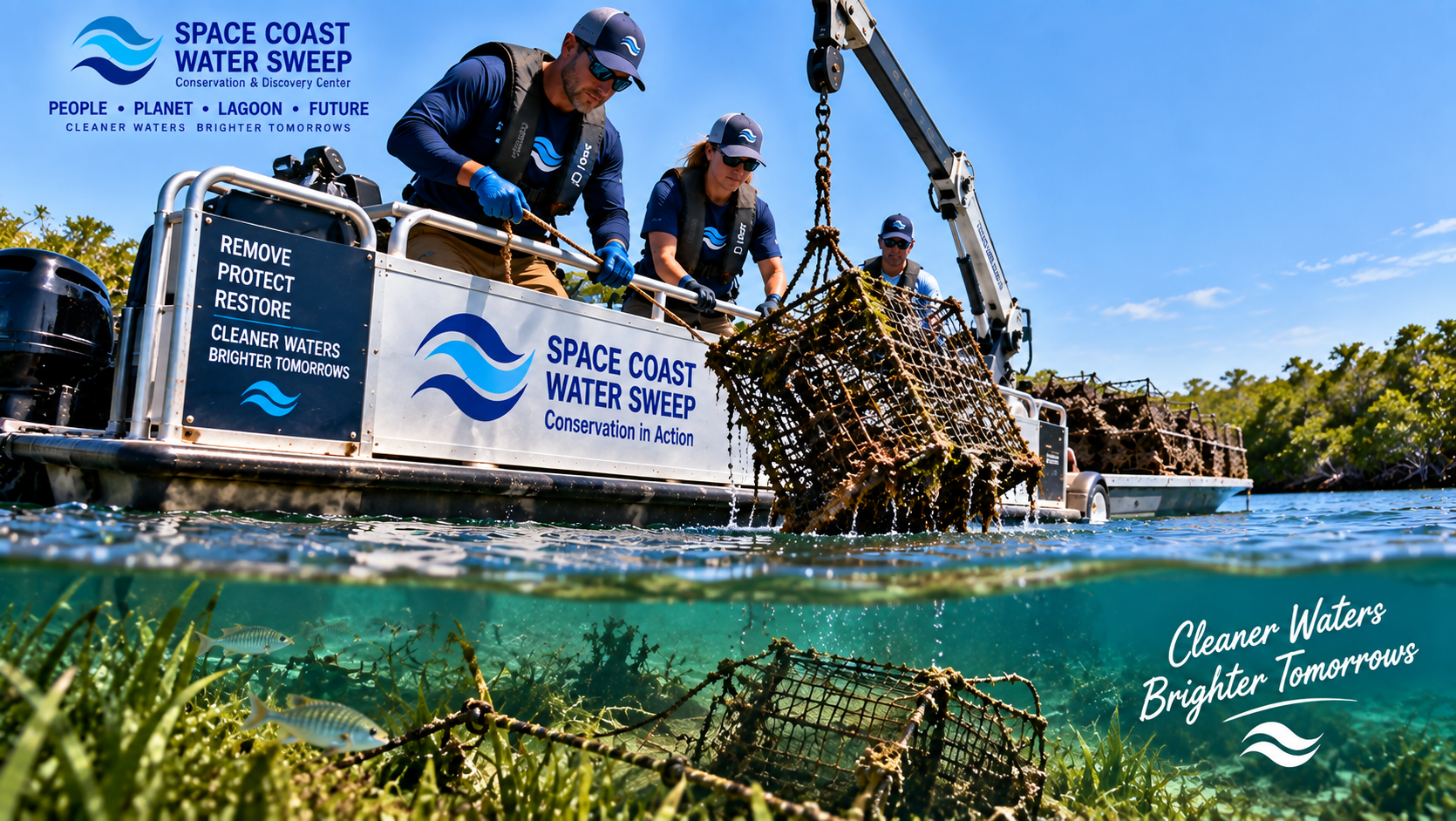
VOLUNTEER CONSERVATION vs. PROFESSIONAL PROJECT LAGOON OPERATIONS
There is an important distinction between community volunteer conservation and the professional, technology-driven Project Lagoon field program. Both matter. They are different.
SCWS volunteer activities include recurring land cleanups, water cleanups, boating and kayak volunteer activities, and community conservation events. Project Lagoon is a professional field program using sonar, ROVs, GPS and trained crews to survey, document, prioritize and recover submerged debris. Volunteers are trained to recognize and respect active legal fishing and crabbing gear — that message is part of the culture.
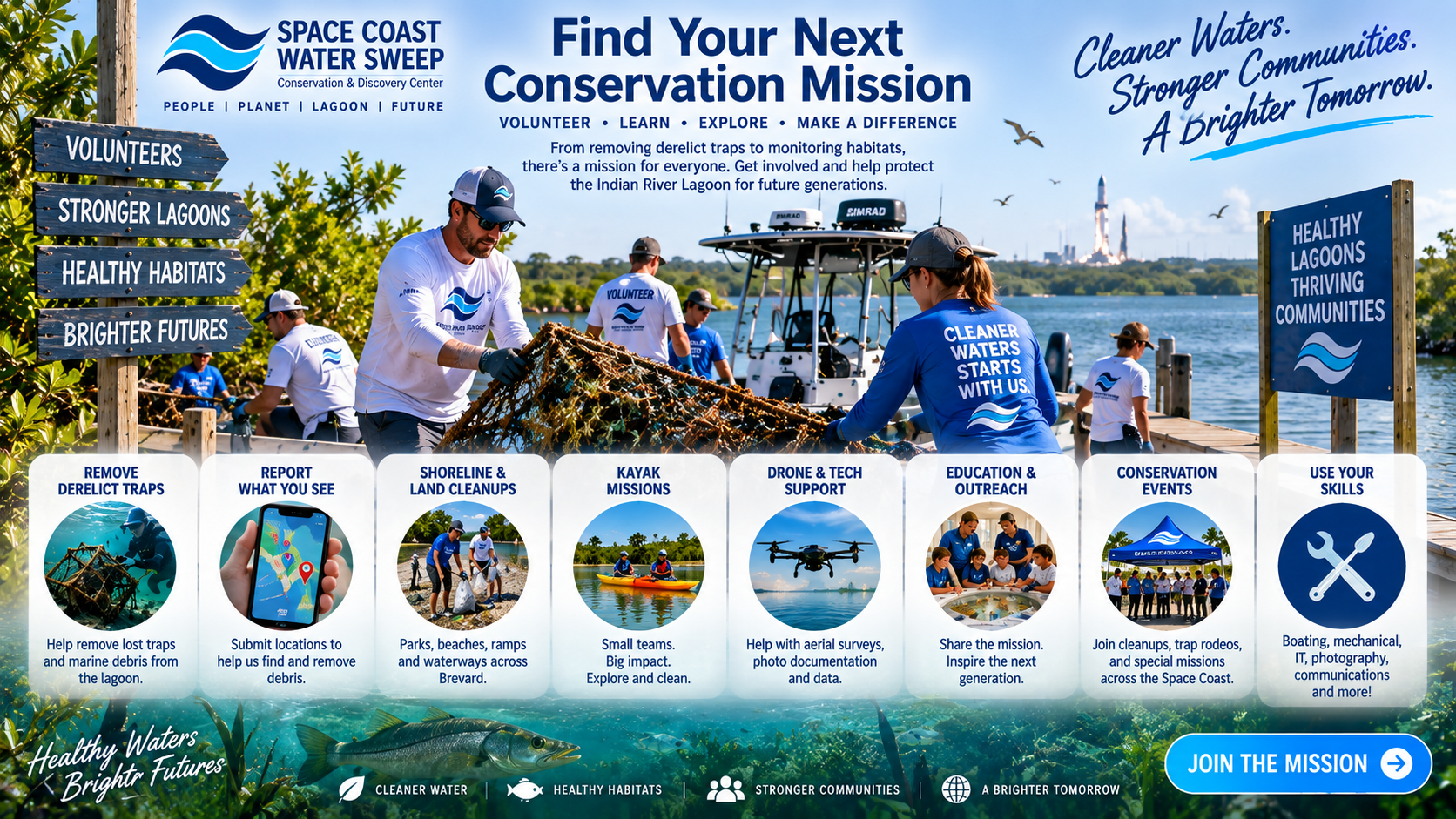
Find Your Next Conservation Mission.
A prominent large digital screen in an appropriate public or arrival area of the future Center will eventually be powered by the SCWS event and app system. It can show a filtered selection of events SCWS wants to highlight.
Visitors could eventually find their next conservation mission through QR or touchscreen registration and details. For now, the physical exhibit and display concept is established.
Look, don't touch active legal gear.
Legal active fishing and crabbing gear is not debris. Volunteers are trained to recognize and respect active legal gear.
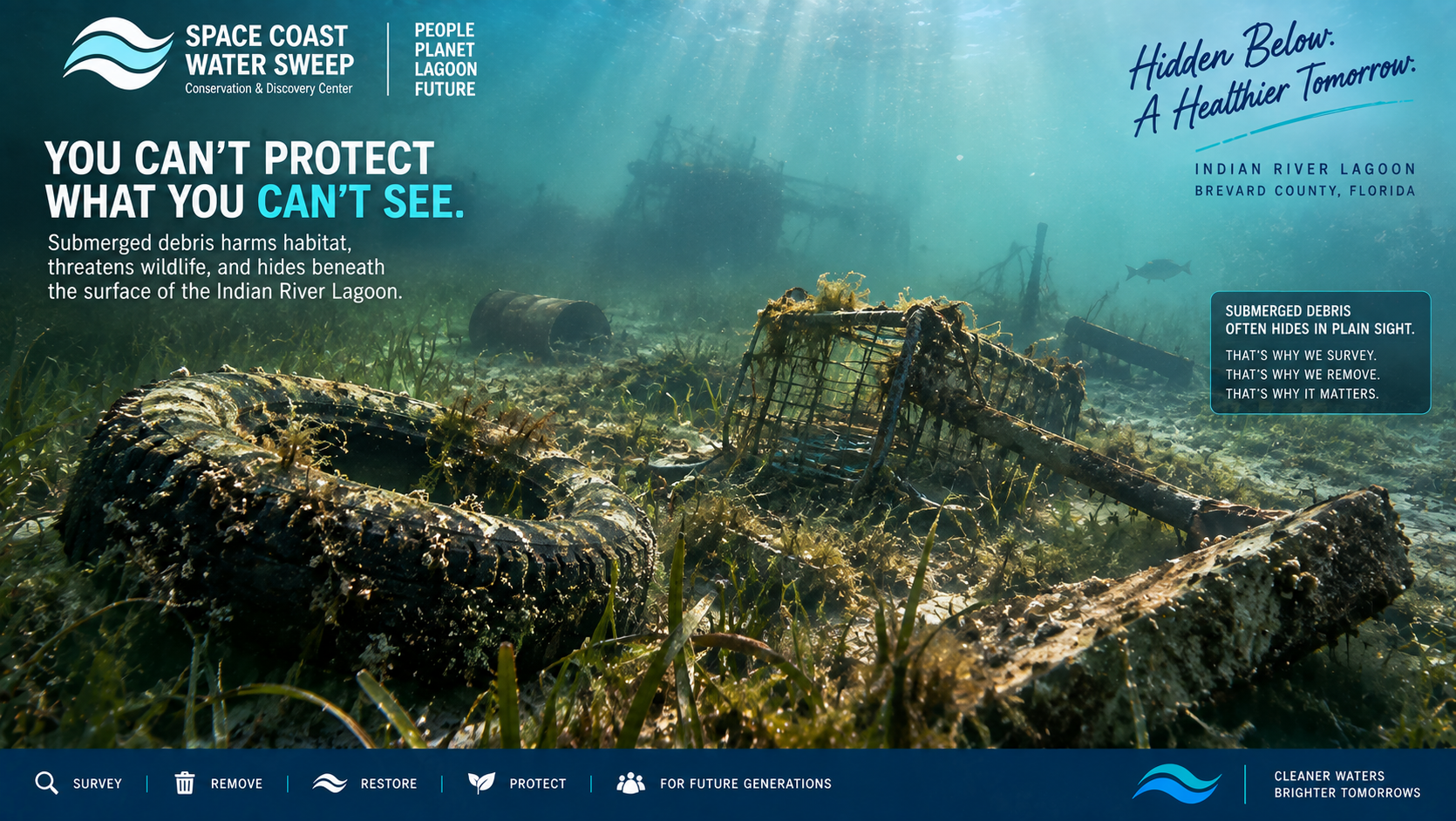
Some of the Biggest Problems Are the Ones You Can't See.
Marine debris can settle below the surface, move with storms and currents, become entangled in habitat, create navigation hazards and remain hidden from normal shoreline cleanups.
Recovery decisions depend on authorization, safety, environmental impact, ownership/legal status, size, condition, access, and permitting or specialty requirements where applicable.
Hidden Waters Helps Turn the Unknown Into a Map.
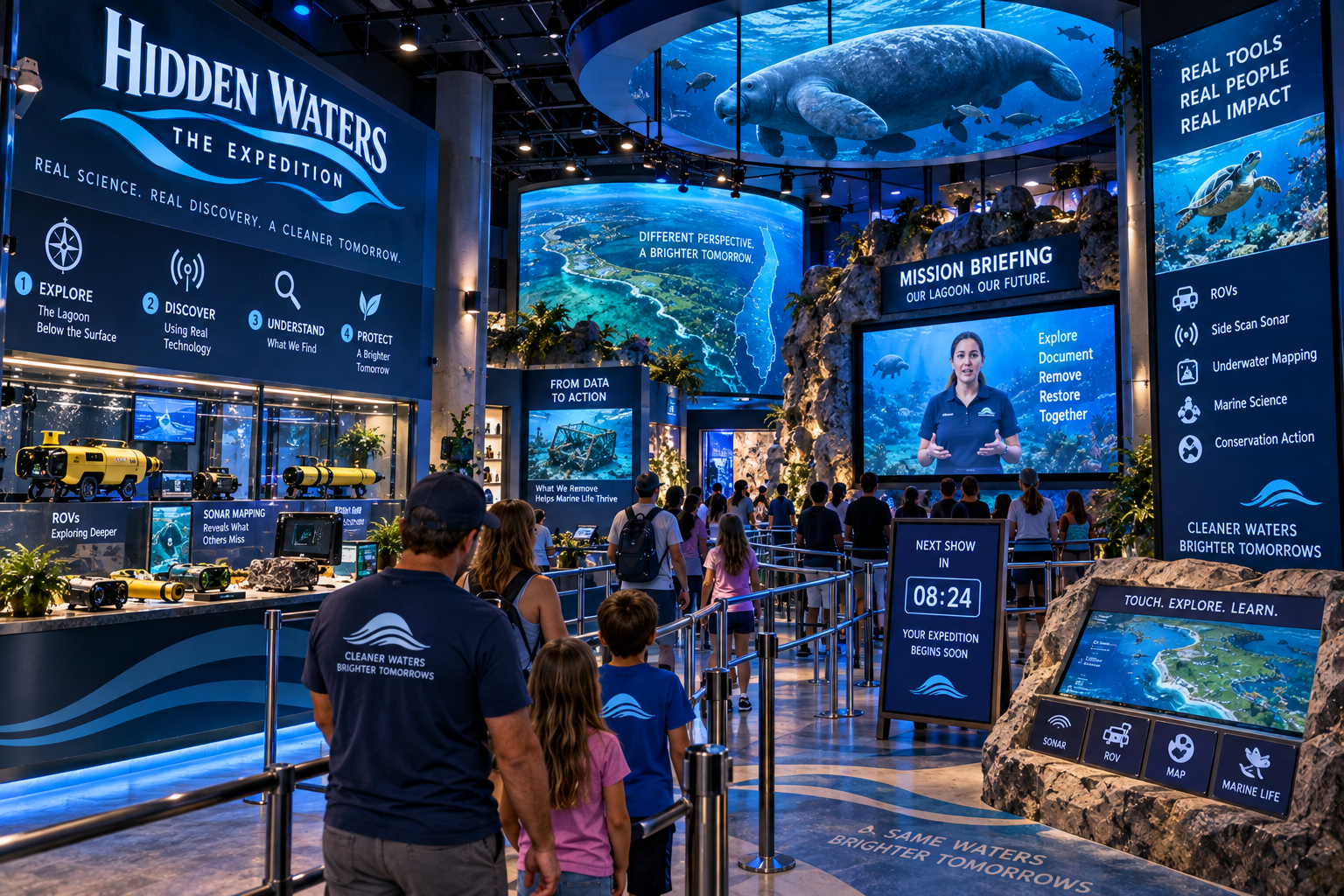
Hidden Waters is the survey and observation layer supporting Project Lagoon. Survey crews document where they travel and where potential targets are observed.
This is a future operating vision. Not every technology is implied to be already deployed at full scale.
Note: 'Hidden Waters' in this field/survey context refers to the survey and observation concept supporting Project Lagoon's operations. It is distinct from 'Hidden Waters: The Expedition,' the future immersive visitor attraction described later in the walkthrough.
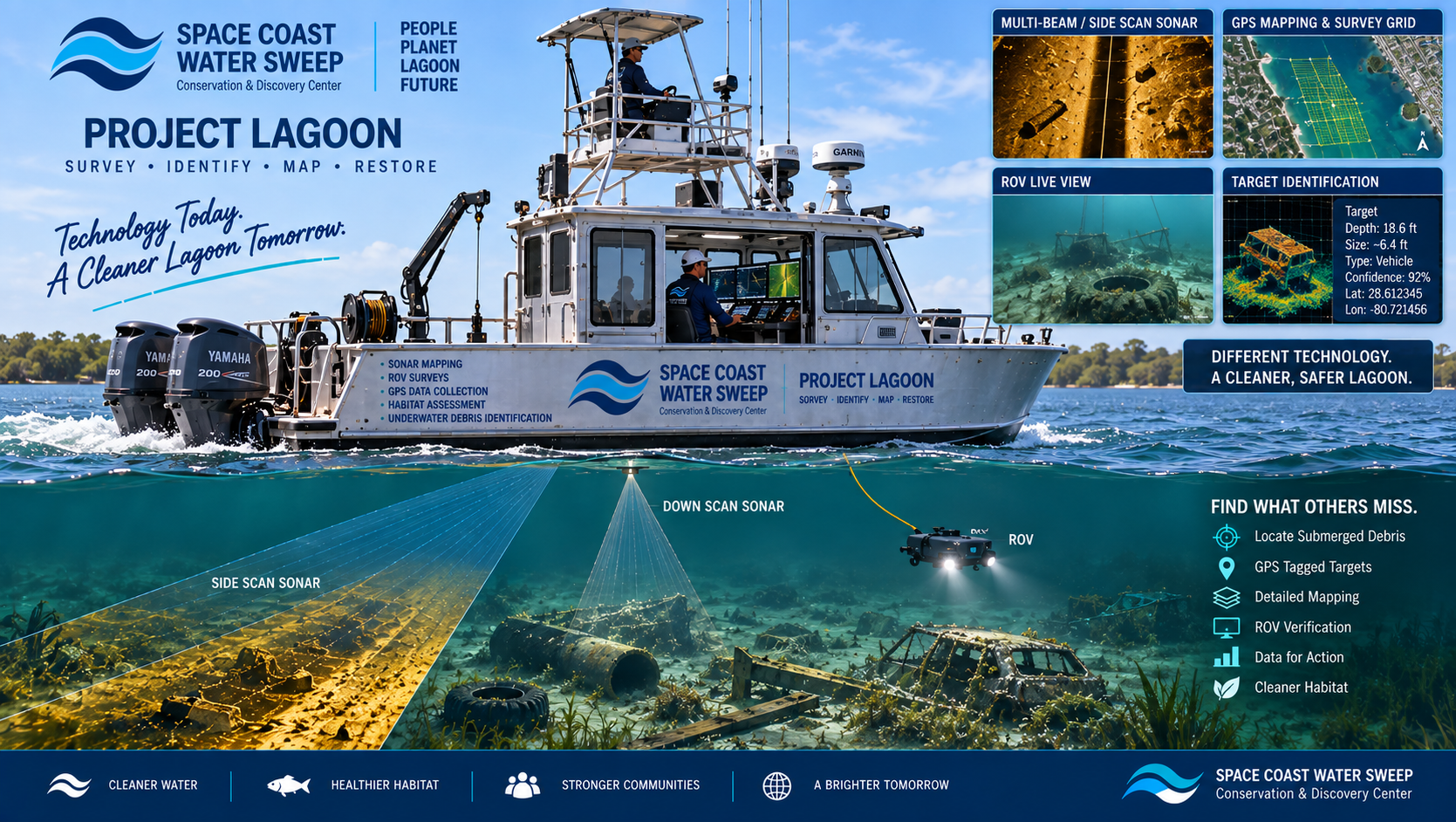
One Tool Doesn't See Everything.
Different tools can complement one another to build a more complete picture of what lies beneath the surface.
SONAR
Maps underwater structure and potential debris.
ROV
Provides close-up underwater visual inspection when conditions allow.
DRONE
Provides aerial context, shoreline observations and surface-area reconnaissance where appropriate.
FIELD OBSERVATION
Trained crews identify, photograph and document targets in real-world conditions.
GPS & MAPPING
Connects observations to exact survey coverage and repeatable locations.
AI & DATA ANALYSIS
Can help organize observations, recognize patterns and identify hotspots as the system grows.
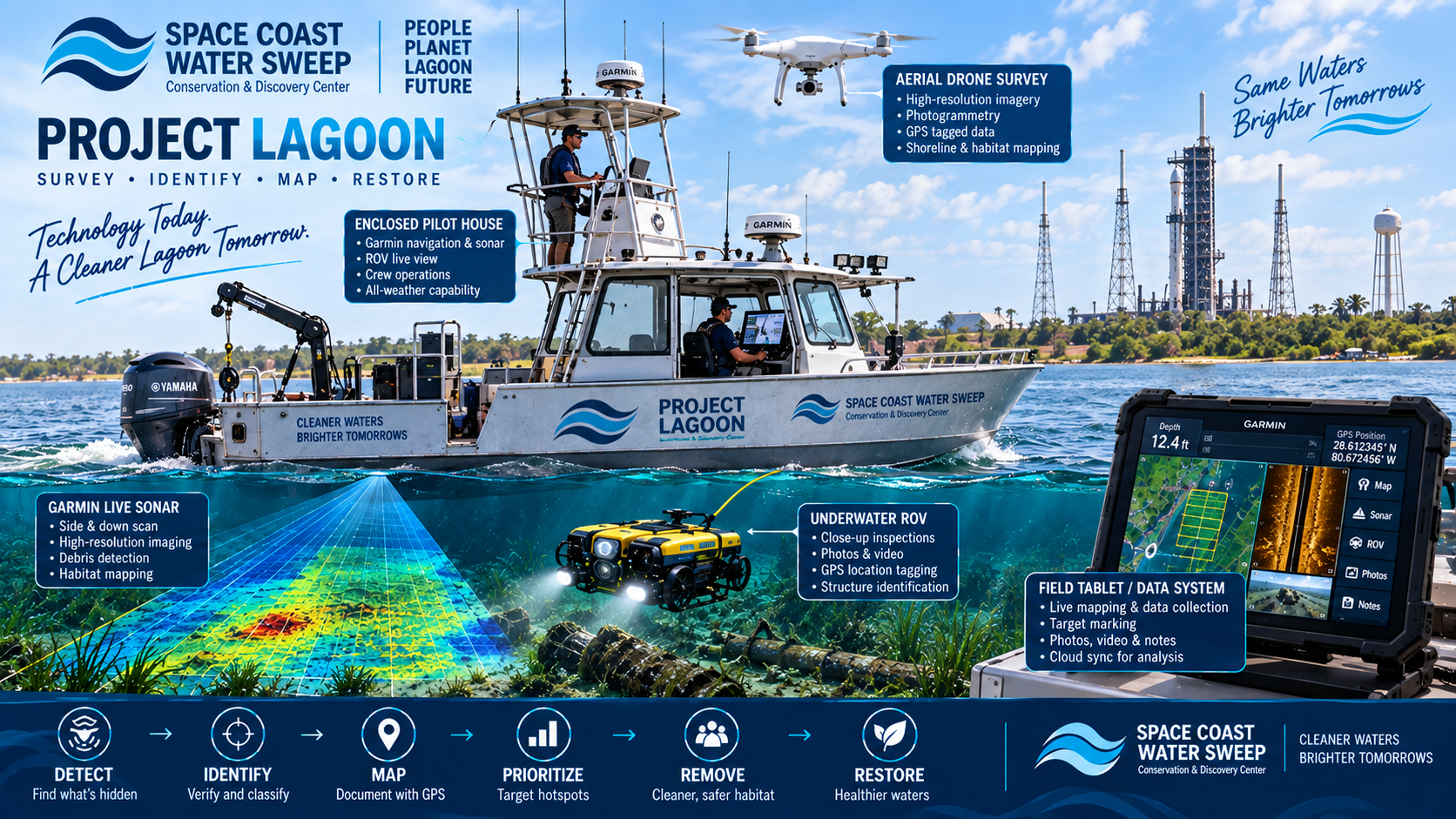
If We Find It, We Want to Know What It Is, Where It Is and When We Saw It.
Potential observations may be documented with GPS coordinates, timestamps, survey tracks, photos or video, debris classification, estimated size, condition, environmental context, recovery priority and follow-up status. This allows the program to move beyond anecdotal cleanup.
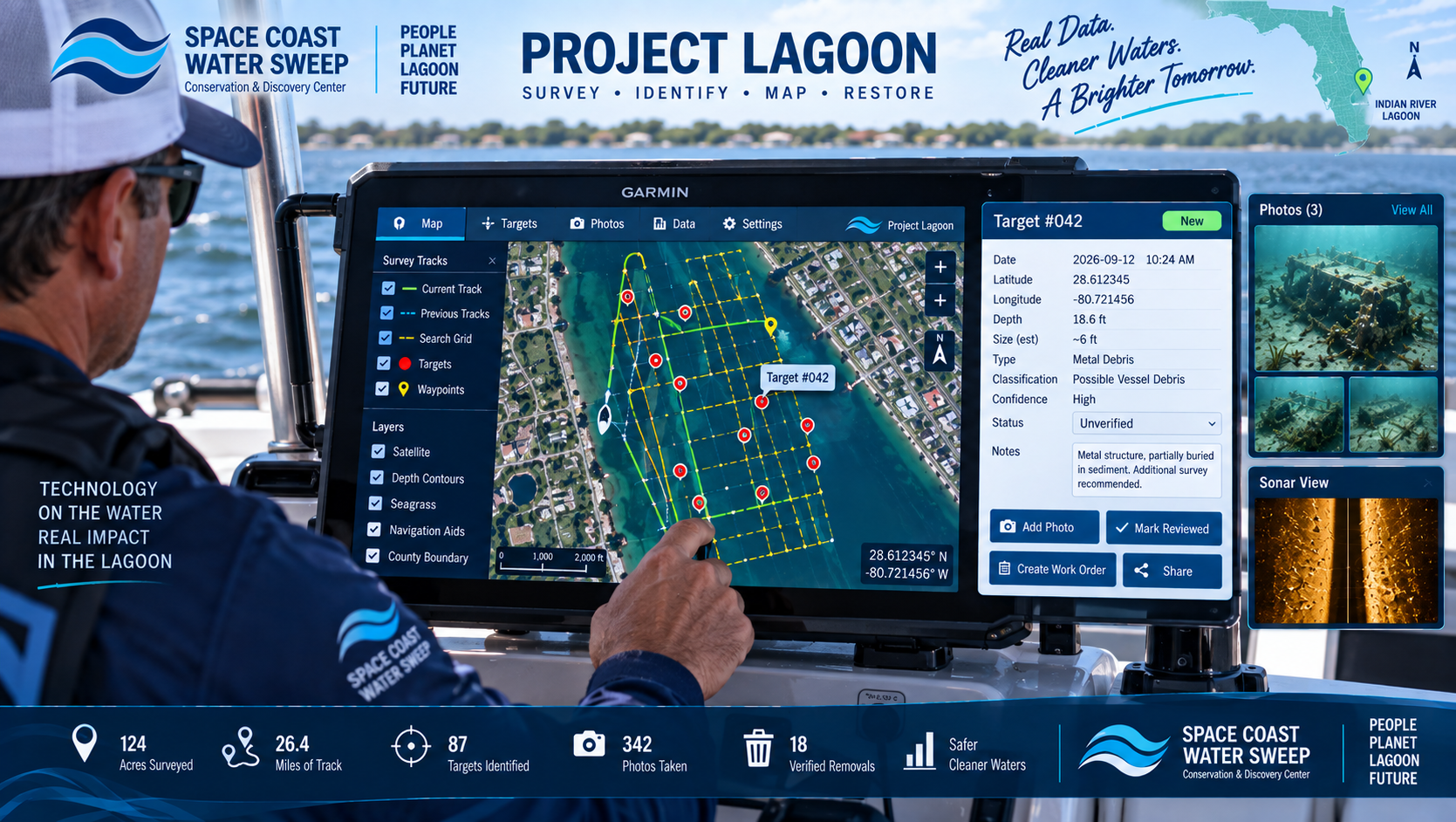
Don't Send a Recovery Crew Every Time Someone Sees One Piece of Debris.
Survey teams can continue documenting an area until enough verified recoverable targets are identified to justify a focused recovery mission. Project Lagoon can then dispatch recovery crews to defined target areas rather than searching blindly.
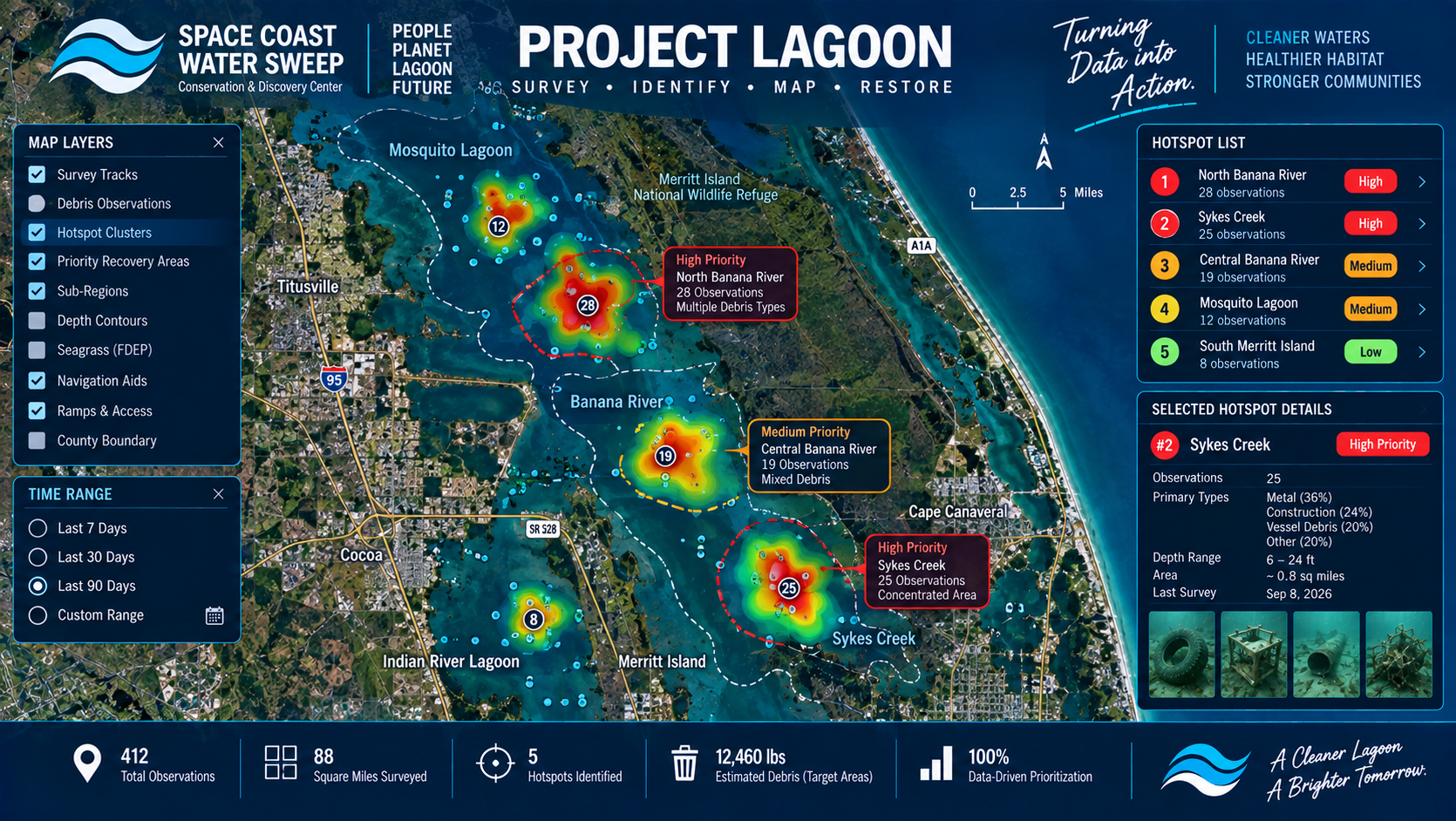
Now the Crew Knows Where to Go.
Recovery teams can receive target locations and supporting information before launching. Different debris requires different recovery methods.
Some items may require law enforcement coordination, specialty contractor support, hazardous-material protocol, agency direction, or leaving the object in place.
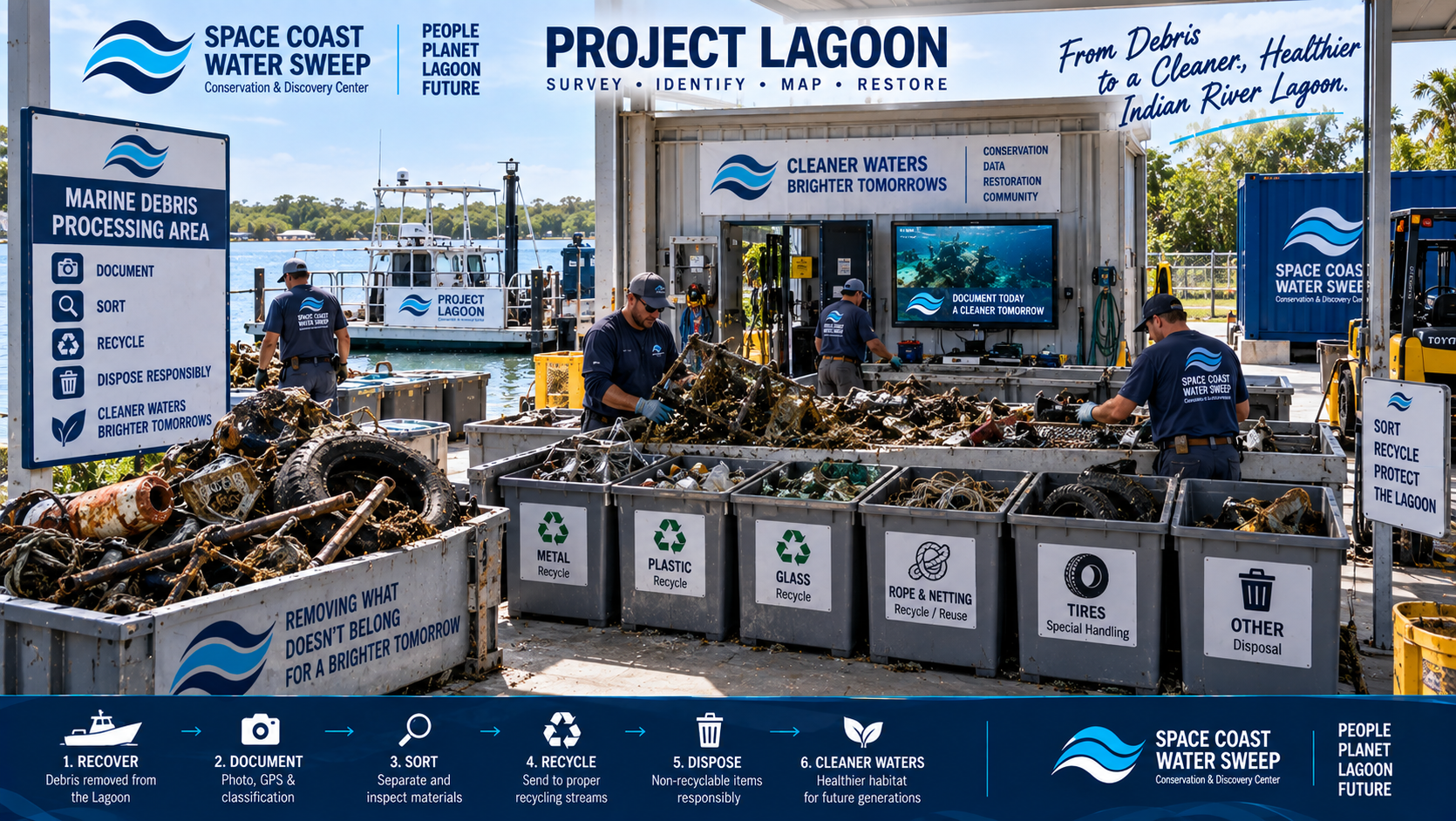
Removing Debris Is Only Half the Job.
Recovered material must be documented, transported, sorted and handled appropriately. The future operations campus may support staging, weighing, photography, sorting, recycling, containerization, trailer loading, and specialty disposal coordination.
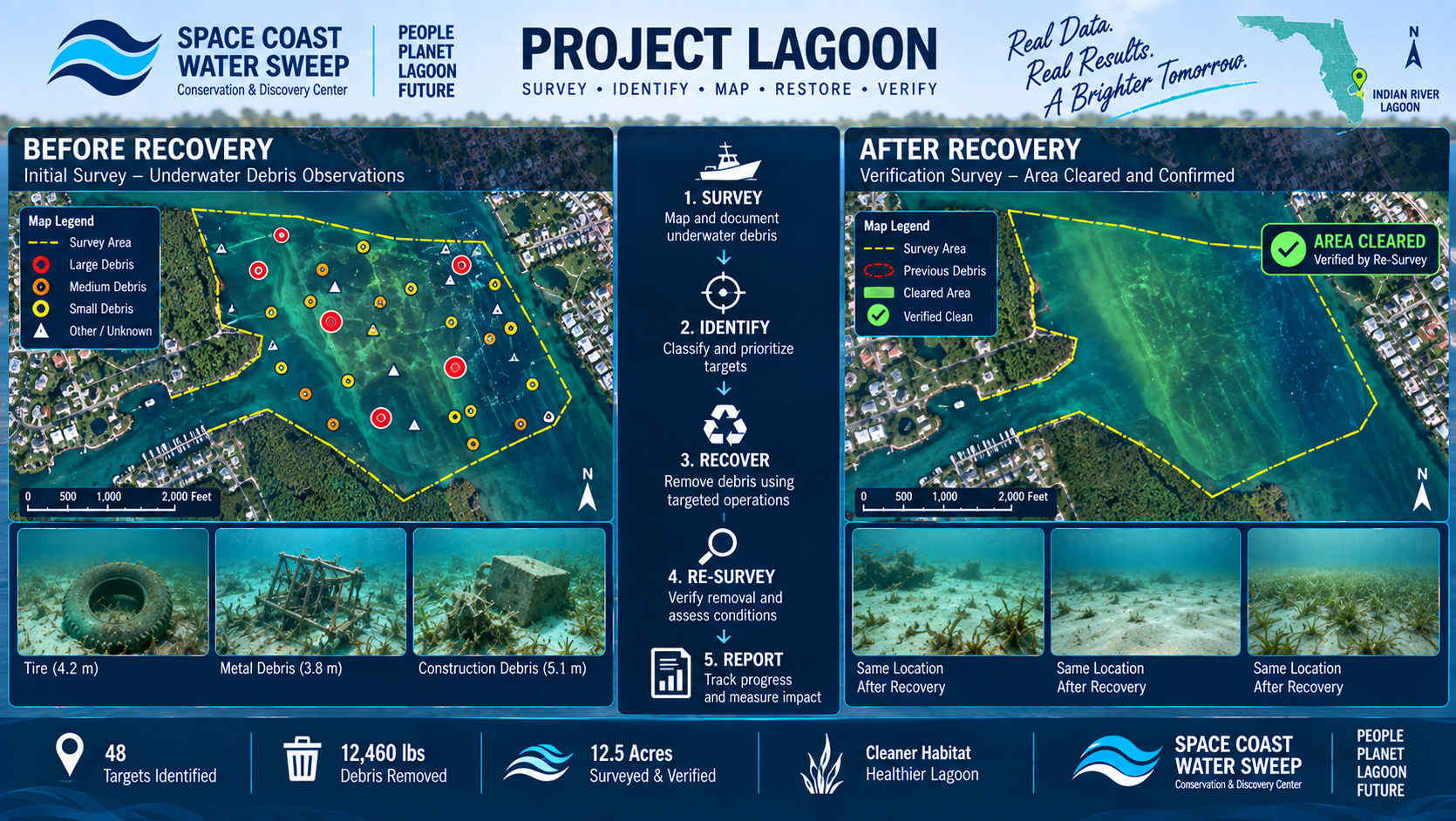
Removal Should Not Be the End of the Story.
After targeted recovery, the area can be surveyed again. Verification can help answer: Was the target removed? Were additional items discovered? Was the area adequately covered? Did debris return later? Is the site changing over time? Does the area need future monitoring?
Every Mission Can Teach Us Something About the Lagoon.
Over time, Project Lagoon data may help identify patterns and trends that improve conservation effectiveness.
As the system grows, data connections to Hidden Waters, Currents Through Time, the AI/Data Hub, research partners, university work and environmental reporting may create new opportunities for understanding the Lagoon.
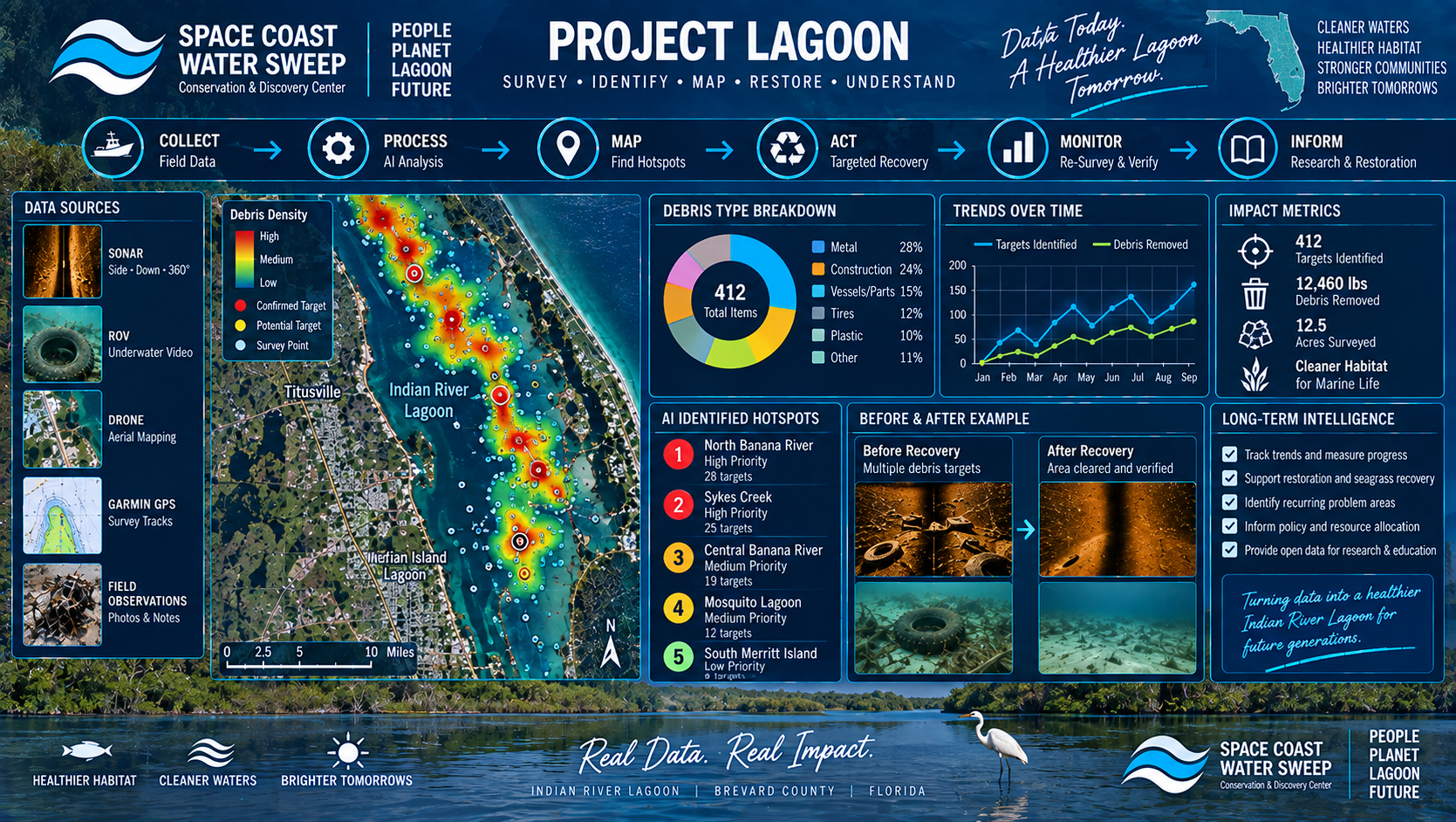
After a Storm, Time Matters.
The system may also support post-storm or hurricane response. Project Lagoon is positioned as a supporting conservation capability — not a replacement for emergency management, law enforcement, FWC, Coast Guard, county government or other agencies.
Normal operations are the core mission. Hurricane and post-storm response is an additional capability — not the sole reason Project Lagoon exists.
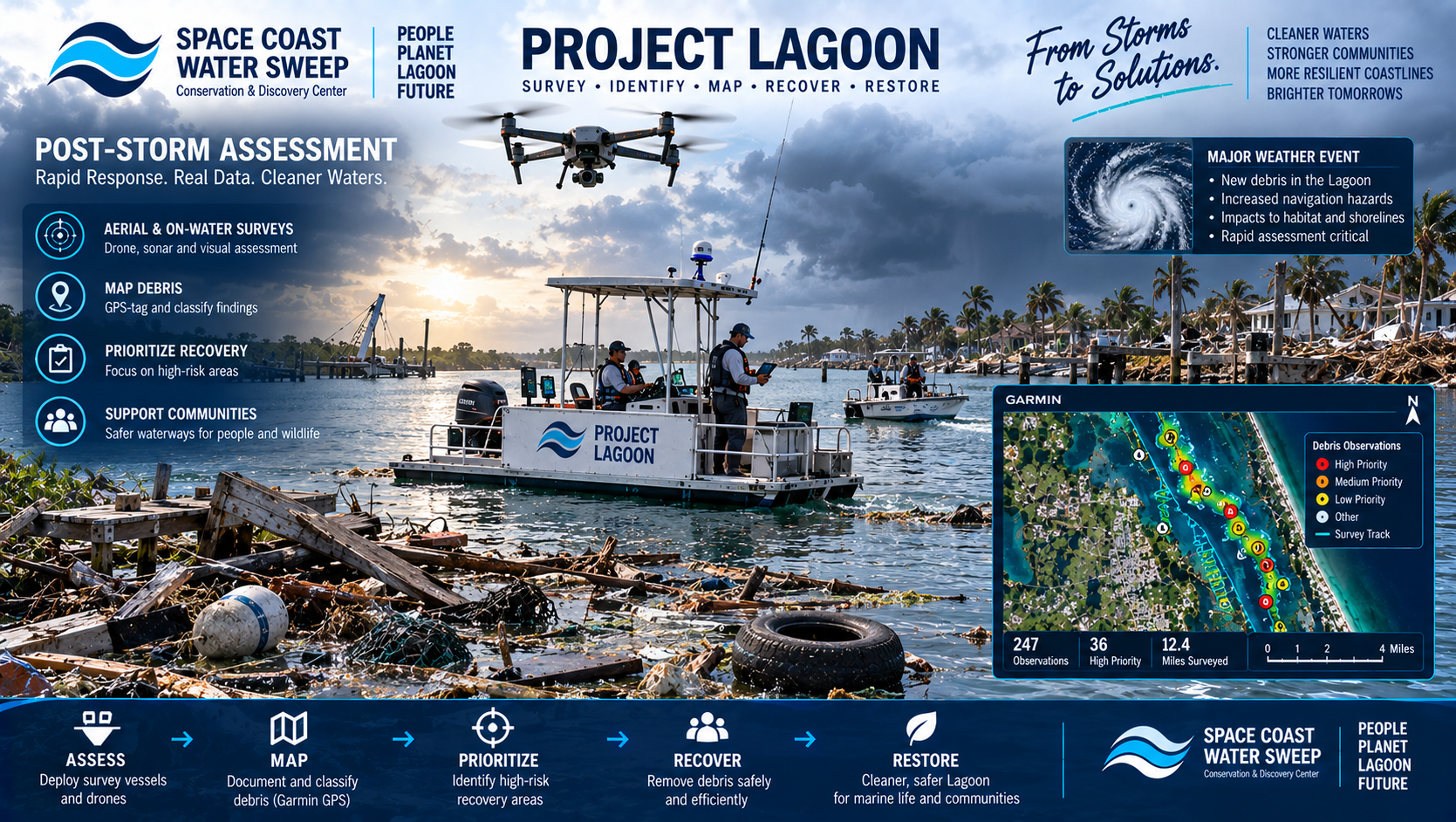
From Finding It to Proving It's Gone.
This creates a repeatable conservation system rather than isolated cleanup events. Detection does NOT automatically mean removal — possible outcomes include recover, leave/monitor, natural feature, or refer to appropriate agency/specialist, subject to safety, authorization, environmental considerations, ownership and applicable law.
THEN WE DO IT AGAIN.
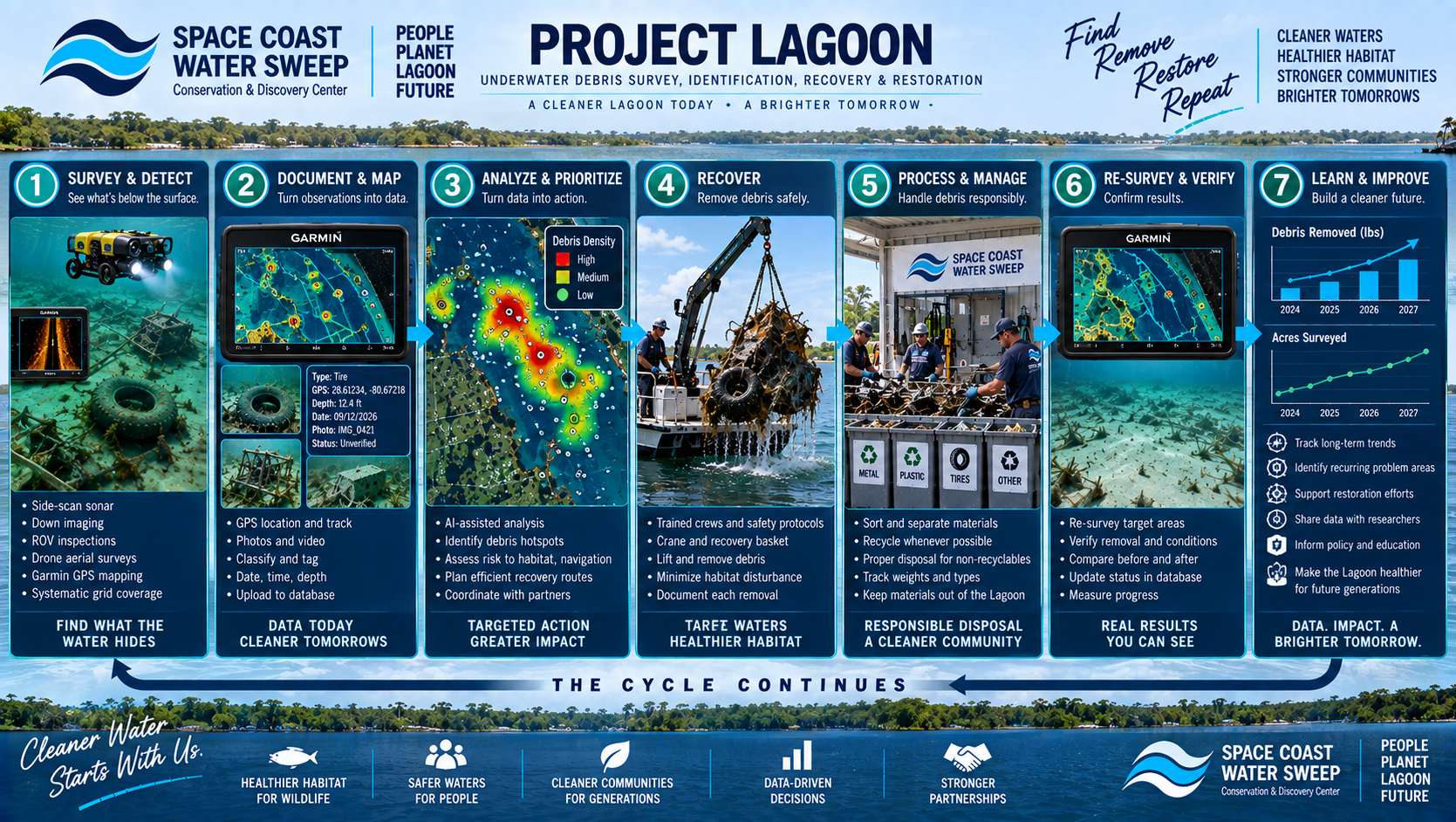
The Technology Helps. People Make the Mission Happen.
Technology does not replace trained crews, volunteers, partners and field judgment. The system depends on people. The future Center can create a place where all these capabilities connect.
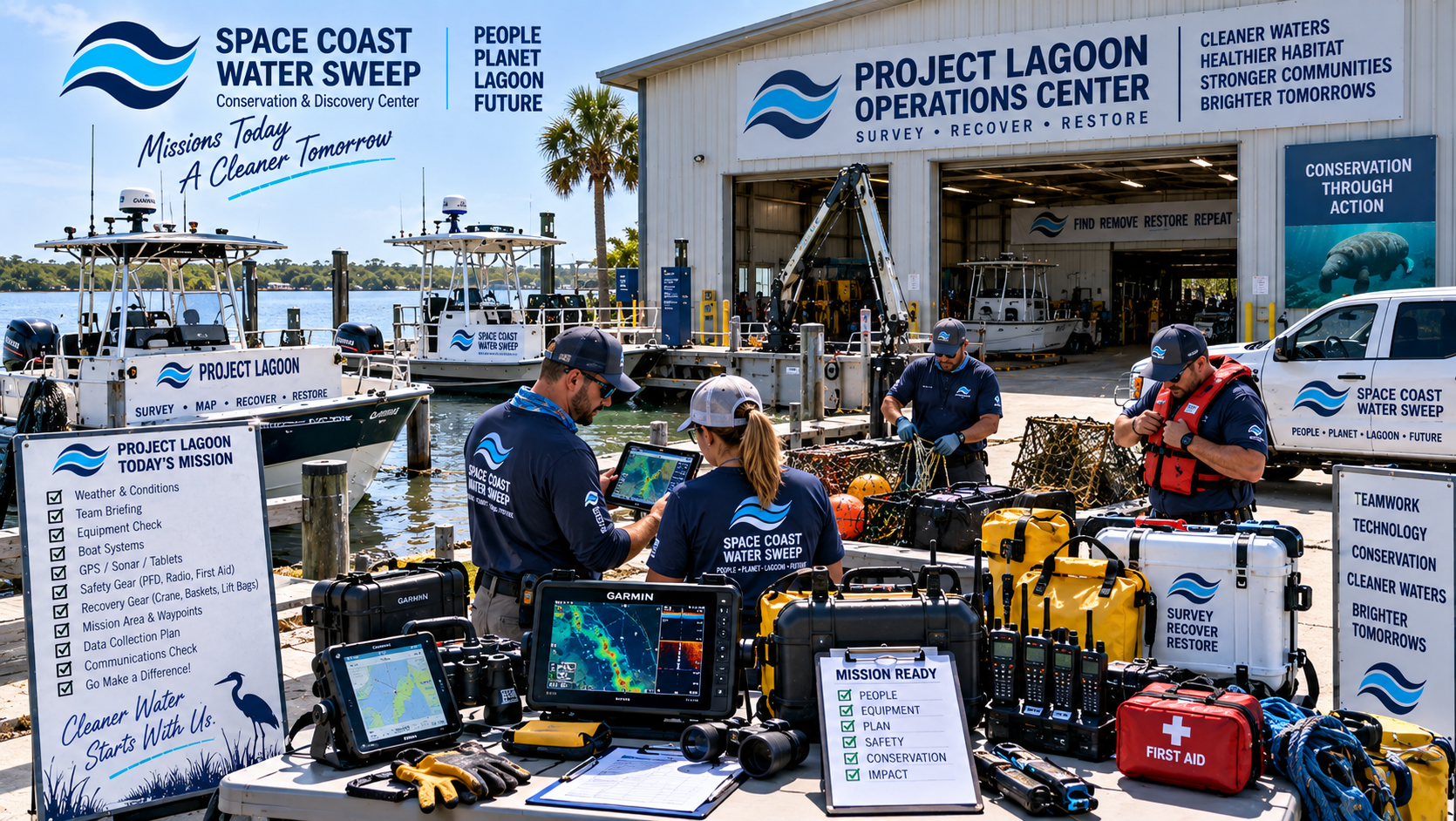
Project Lagoon — Fleet, Technology & Working Waterfront
The boats, equipment, technology and working docks behind the mission.
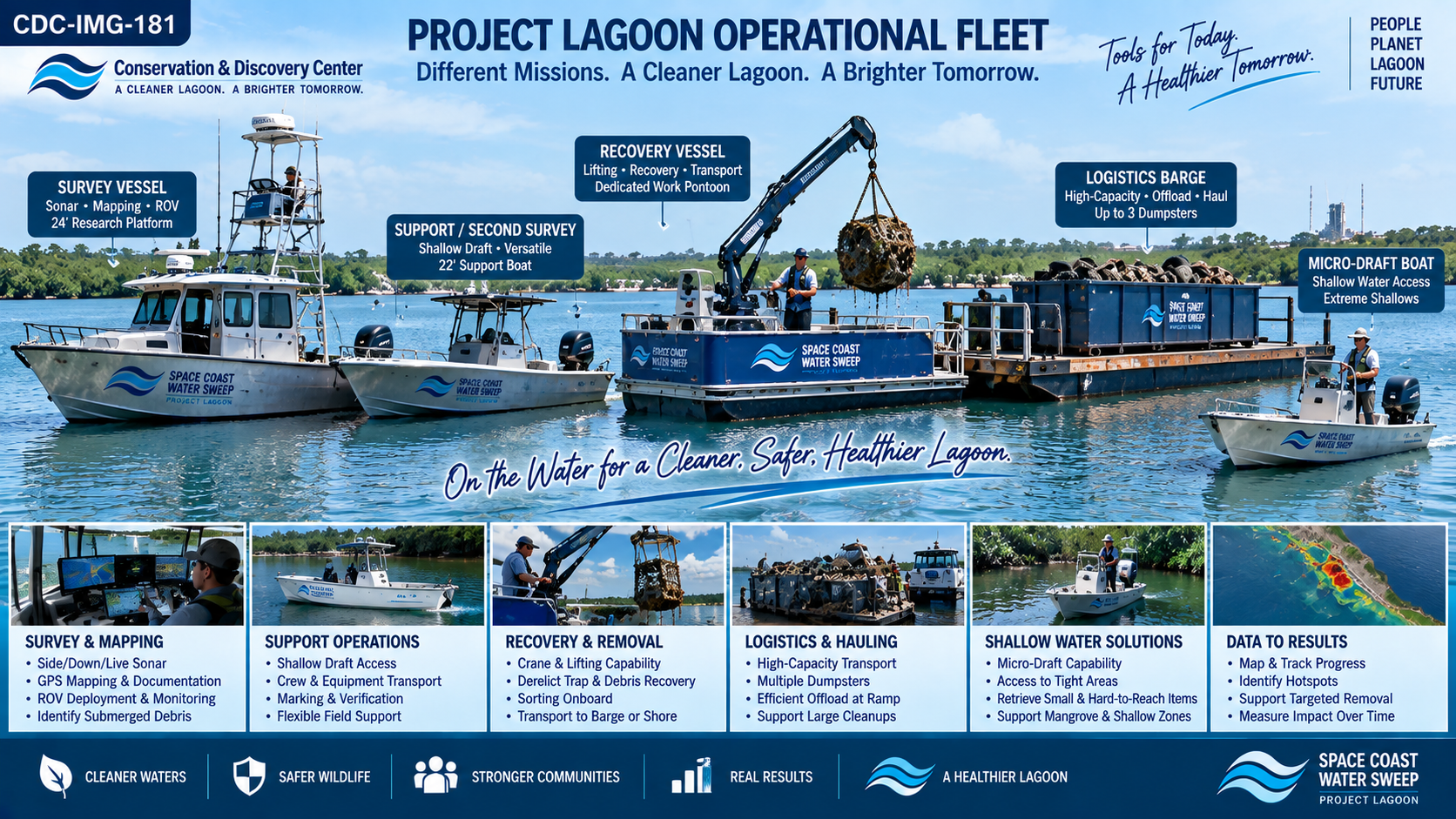
The Boats Behind the Mission
Project Lagoon is not something that operates only after hurricanes. Normal operations are the core. The conceptual fleet brings together survey capability, recovery capability and logistics support.
No manufacturers or final technical specifications are locked. The fleet concept evolves as capability, funding and partnerships grow.
Survey Team A
Survey vessel with sonar, GPS, mapping and field documentation capability. Conceptually an approximately 24-foot commercial metal survey-vessel with enclosed pilothouse concept.
Survey Team B
Second survey vessel providing parallel coverage and redundancy for assigned waterway survey operations.
Recovery Vessel
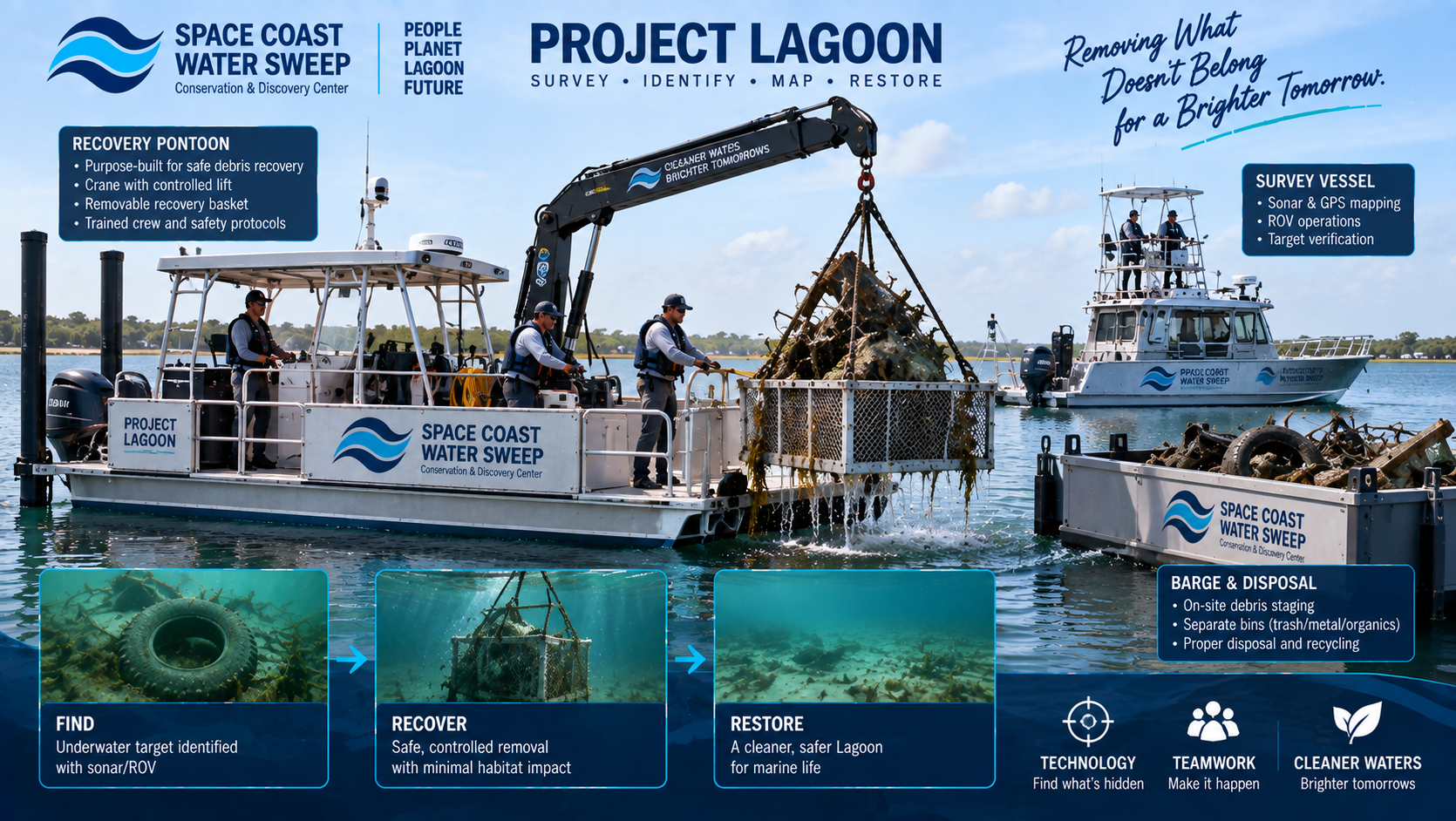
Purpose-built recovery boat responding to documented and prioritized recovery targets with lifting equipment and trained crew.
Recovery Pontoon
Heavy-handling capability with crane or davit systems, removable recovery baskets and specialized rigging for larger submerged debris.
Micro-Draft Support Boat
Shallow-water support capability for areas inaccessible to larger vessels.
Barge / Logistics
Transport and debris-handling support for larger recovery operations and material movement.
One Tool Doesn't See Everything.
Different tools can complement one another to build a more complete picture of what lies beneath the surface.
SONAR
Maps underwater structure and potential debris.
ROV
Provides close-up underwater visual inspection when conditions allow.
DRONE
Provides aerial context, shoreline observations and surface-area reconnaissance where appropriate.
FIELD OBSERVATION
Trained crews identify, photograph and document targets in real-world conditions.
GPS & MAPPING
Connects observations to exact survey coverage and repeatable locations.
AI & DATA ANALYSIS
Can help organize observations, recognize patterns and identify hotspots as the system grows.
The Waterfront Is Where the Campus Meets the Mission.
Only functions that truly benefit from or require water access need to occupy the waterfront edge. Industrial and public dock activity are kept appropriately separated.
PUBLIC WATERFRONT is not the same as WORKING WATERFRONT. The working waterfront is where Project Lagoon boats launch, recover, stage, wash down and prepare for the next mission.
PUBLIC WATERFRONT ≠ WORKING WATERFRONT
Public visitors enjoy the boardwalk, observation areas and water experiences. Project Lagoon crews use a separated working waterfront with direct operational access toward the water.
Resource Recovery — What Happens After Recovery
Where recovered material goes. Sorting, documentation, recycling, research and responsible routing.
RECOVER → DOCUMENT → RECEIVE → INSPECT / TRIAGE → CLASSIFY → SORT → ROUTE → RECORD
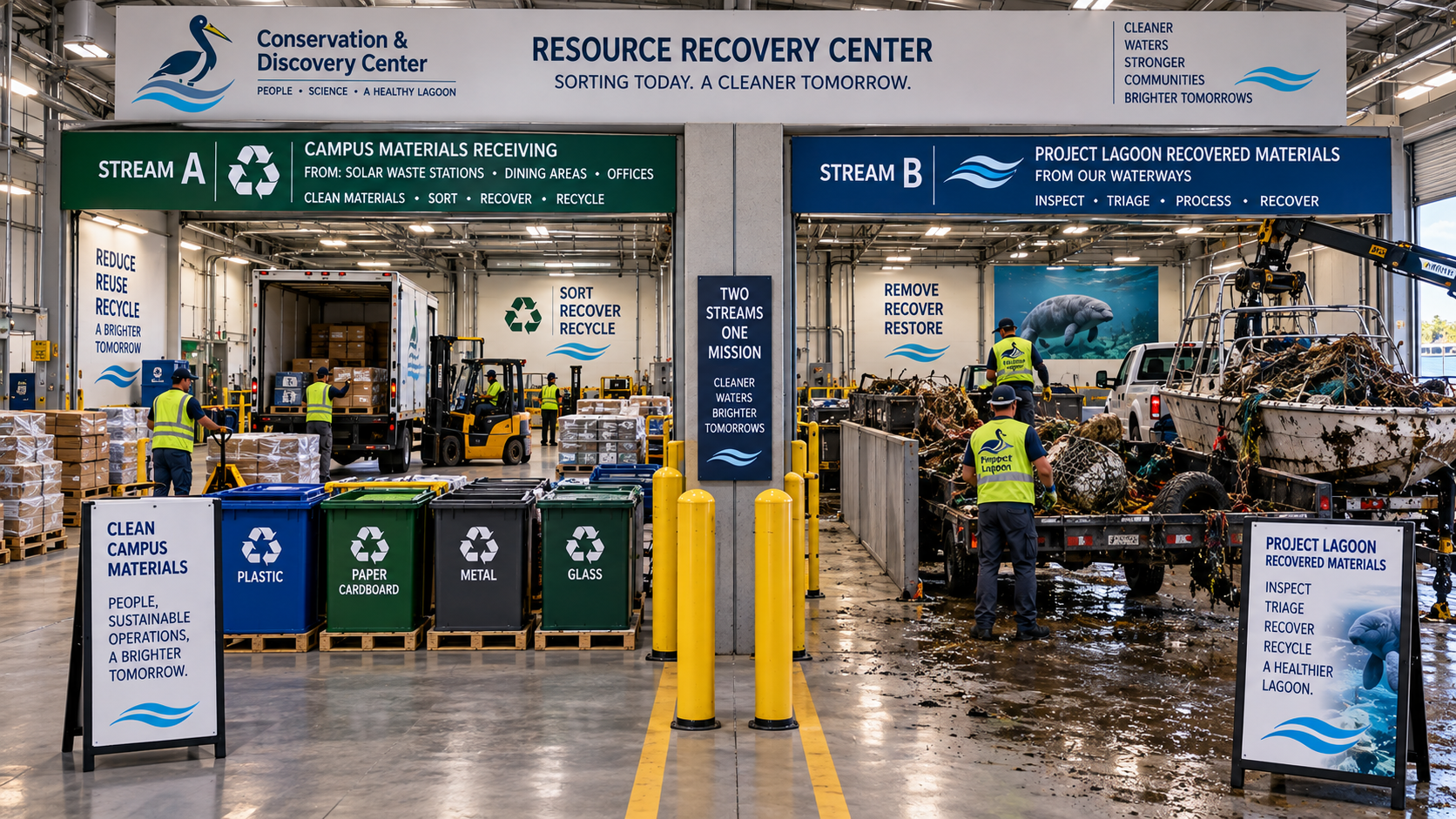
Recovered material from Project Lagoon is not simply discarded. It enters a controlled process of documentation, inspection, sorting and responsible routing — distinct from normal public-campus waste.
RESPONSIBLE HIERARCHY
AVOID → REDUCE → REUSE → REPAIR / REPURPOSE → RECOVER MATERIAL → CONVERT WHERE APPROPRIATE → RECYCLE → RESPONSIBLE DISPOSAL
Resource Recovery & Materials Management Center
From Waste to Information. From Recovery to Responsible Reuse.
The future Center should explore a dedicated behind-the-scenes facility where appropriate campus waste and suitable smaller materials recovered through Project Lagoon can be received, inspected, identified, sorted, separated, recovered, documented and responsibly routed. This is not simply a trash room. It is a conceptual materials-recovery, sorting, documentation and education capability that supports the larger principle: a campus that practices what it teaches.
Two Separate Controlled Receiving Streams
A — Campus Materials
Materials collected from appropriate areas such as smart solar waste & recycling stations, dining areas, the Center Store, offices, public spaces, events, classrooms, staff areas and other appropriate campus operations.
Visitors should still be encouraged to sort materials correctly. However, the Center should recognize that visitors sometimes place materials into the wrong container. Where operationally practical, the Center may use downstream sorting to recover appropriate materials that would otherwise be lost because of incorrect visitor sorting.
The Center does not claim 100% recovery or zero waste.
B — Project Lagoon Recovered Materials
The second receiving stream serves appropriate smaller materials recovered by Project Lagoon field teams — beverage cans, aluminum, appropriate metals, bottles, suitable plastics, smaller pieces of recoverable material, appropriate fishing-related debris and other suitable debris recovered from waterways.
IMPORTANT
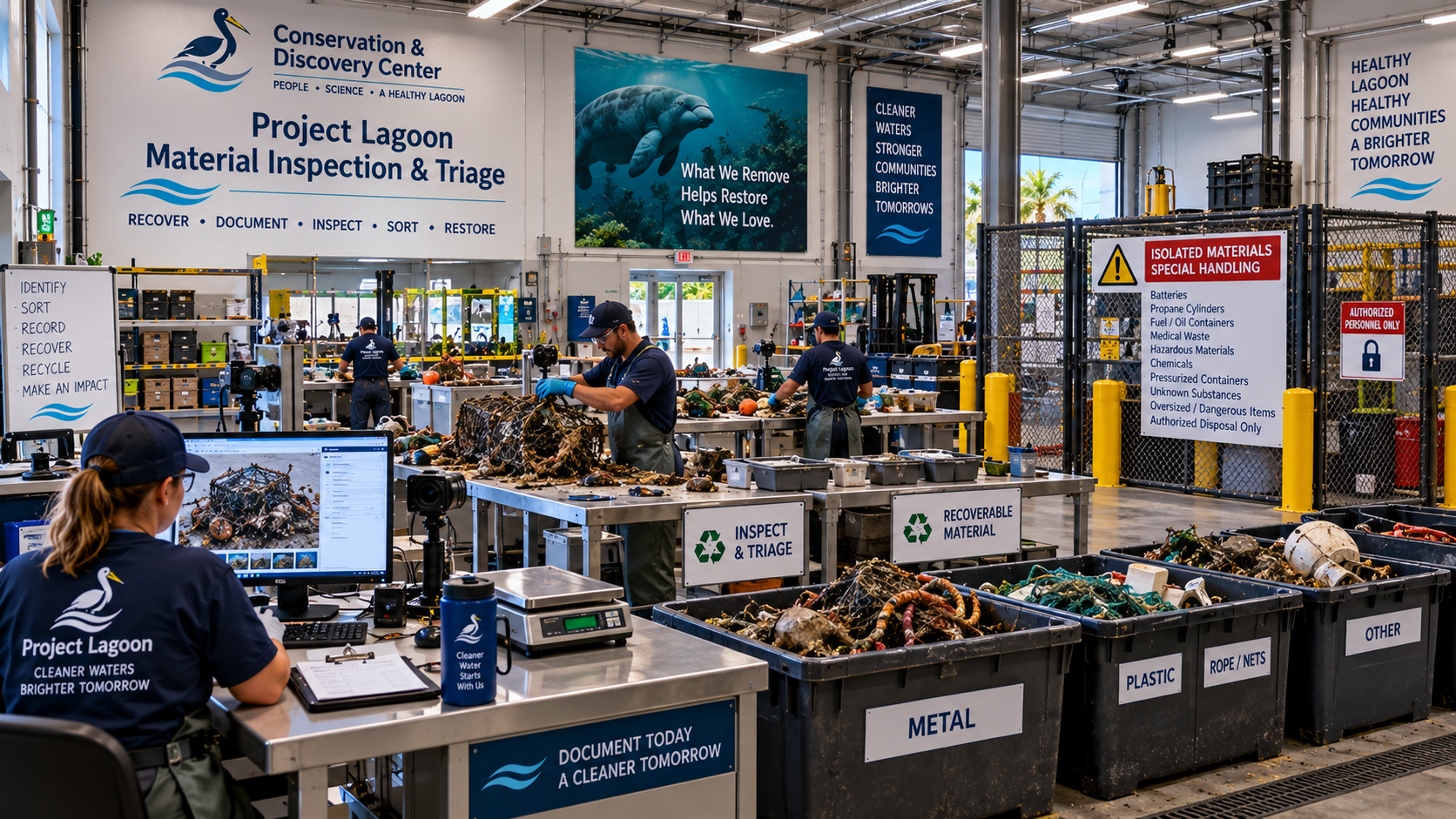
Project Lagoon material must NOT automatically enter the general sorting system. Waterway debris may be wet, muddy, biologically fouled, sharp, contaminated, chemically contaminated, unknown, hazardous, oversized or inappropriate for normal processing. A separate Project Lagoon Material Triage / Inspection Area is required before recovered material reaches the automated/common sorting system.
Project Lagoon Material Triage / Inspection Area
Project Lagoon staff should inspect recovered material before processing. Conceptual workflow:
MATERIALS REQUIRING SPECIAL HANDLING
Materials requiring special handling should remain OUTSIDE the normal sorting stream. Examples may include batteries, propane cylinders, fuel/oil containers, medical waste, hazardous materials, chemicals, pressurized containers, unknown substances, oversized debris, sharp or dangerous objects, materials requiring specialty disposal and other materials determined unsuitable.
These materials would be isolated and handled through appropriate trained personnel, procedures and authorized disposal/recycling pathways. Detailed hazardous-material handling instructions are not provided on the public website.
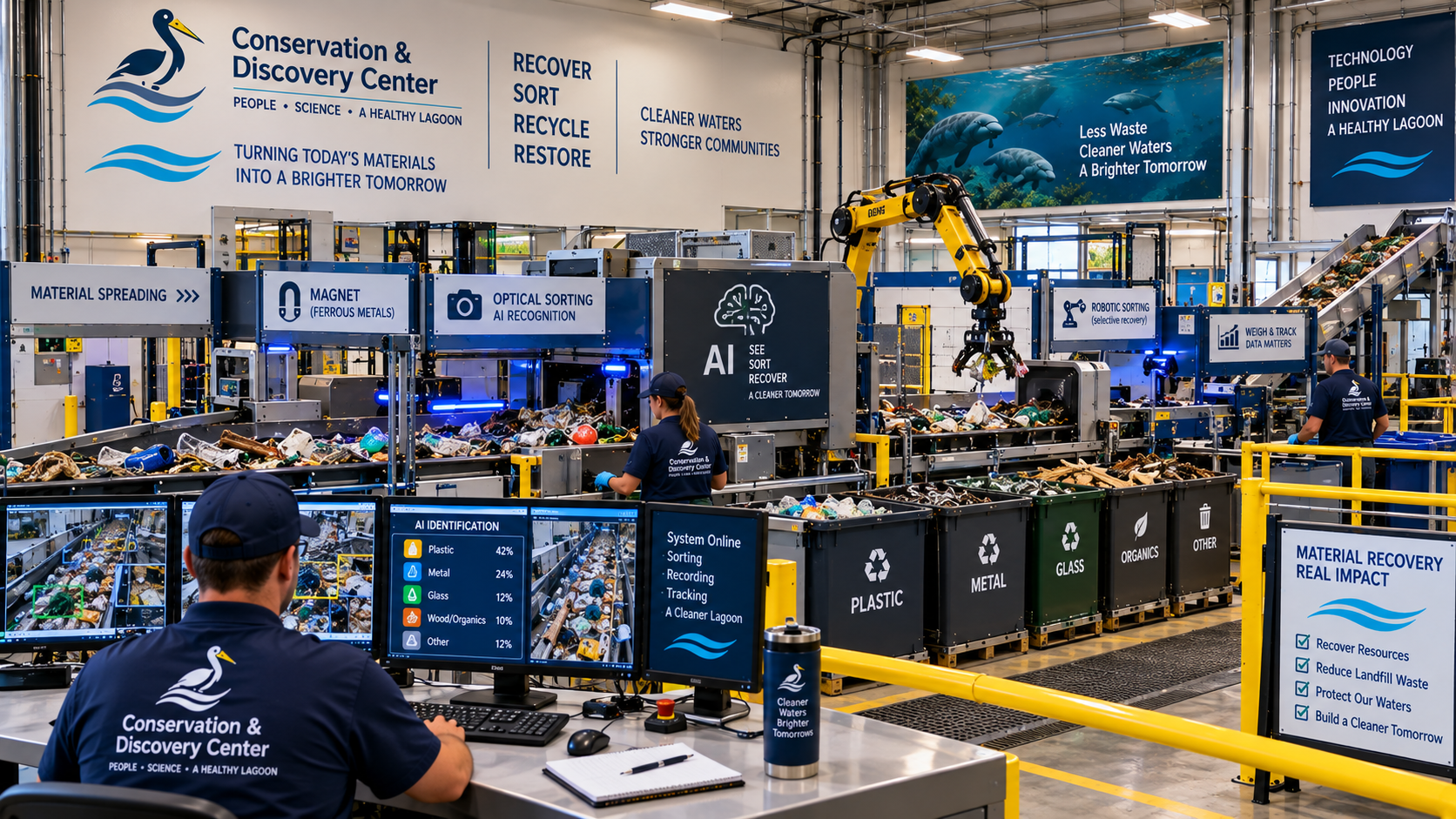
Automated / Technology-Assisted Sorting
The Center should explore an appropriately scaled automated or semi-automated material-recovery line. The final system could combine proven mechanical separation with modern optical, sensor-based and AI-assisted identification technologies where they provide practical value.
Conveyor systems
Material spreading / separation equipment
Screens
Magnets for ferrous metals
Eddy-current or other appropriate non-ferrous separation
Optical sorting
Near-infrared identification where appropriate
Machine vision
AI-assisted material identification
Air separation / air jets where appropriate
Selective robotic sorting where practical
Weighing systems
Material-category tracking
Contamination identification
Other proven or emerging recovery technologies
FINAL SYSTEM DEPENDS ON
The Center does not promise that all technologies will be installed. The system is not designed around robotics alone. No final technology vendor, equipment manufacturer, throughput, recovery percentage, automation level or final system configuration is claimed.
Material Output Streams
The Center does not claim that every category will always be economically or operationally recyclable. The goal is to recover and responsibly route materials where practical.
Project Lagoon Documentation Connection
Where practical, Project Lagoon should be able to maintain the chain of information from where material was found, through what the material was, and ultimately what happened to it.
This could allow Project Lagoon reporting to distinguish between simply “debris removed” and the more useful “debris removed, characterized and responsibly routed.”
The Center does not invent current capabilities or claim this system already exists. This is part of the future Center vision.
Data & AI Connection
The facility could generate actual operational data such as material received, material categories, weights, recovery quantities, contamination, campus waste trends, Project Lagoon recovered-material trends, recycling/recovery pathways, residual waste and equipment performance where appropriate.
THE AI / DATA INFRASTRUCTURE MAY HELP:
The physical Resource Recovery Center performs material handling and sorting. The AI/Data infrastructure may help identify, measure, record, analyze and report. These functions are kept conceptually distinct. The Center does not merge this operational facility with the AI & Environmental Intelligence Core. Any future public dashboard must display actual measured data. The Center does not invent statistics.
Behind-the-Scenes Working Campus Tour
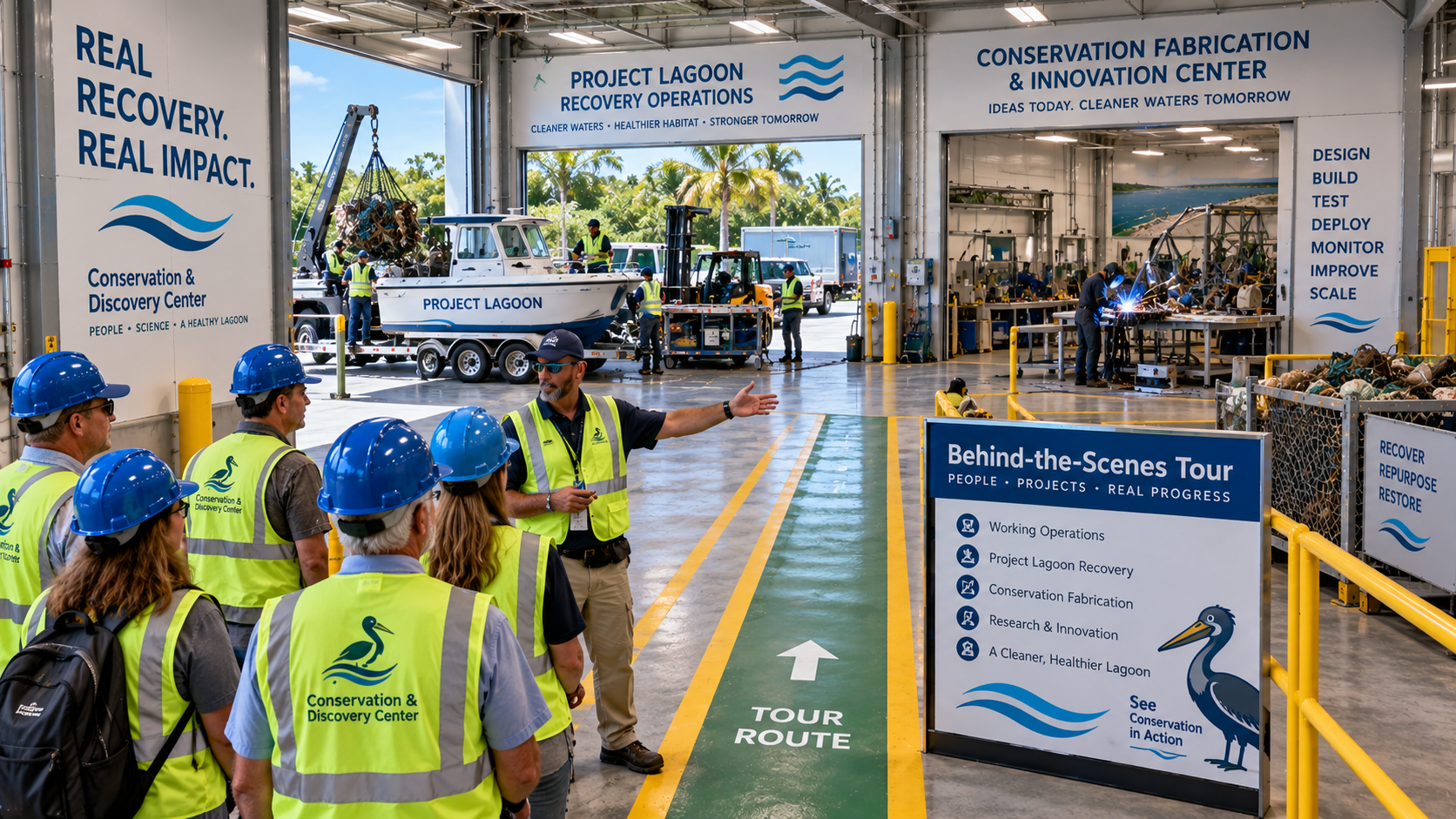
The Resource Recovery & Materials Management Center is primarily a secured working facility and remains outside normal public circulation. There is no permanent public glass observation gallery or general-public viewing window into the facility.
Instead, the future Center may offer scheduled, staff-guided behind-the-scenes tours as an optional premium / add-on visitor experience, providing controlled guided access to selected normally non-public areas of the campus. Potential tour experiences could include selected safe viewing/access areas associated with the Resource Recovery & Materials Management Center, Project Lagoon operations, appropriate vessel/equipment areas, research/innovation functions where appropriate, the Conservation Fabrication & Innovation Center, selected technology demonstrations and other operational areas approved for public tours.
ACCESS MAY VARY DEPENDING ON:
The Center does not promise access to every area on every tour. No final pricing, attendance, tour frequency or tour capacity is established at this time.
RESOURCE RECOVERY TOUR EXPERIENCE
Visitors on an approved guided behind-the-scenes tour could enter a designated safe tour route / observation area within or adjacent to the working facility. They may see, when operationally appropriate:
SAFETY SEPARATION
The tour must maintain controlled separation from active hazards, industrial equipment, secure areas, research restrictions and ongoing operations. Visitors should never enter active processing zones or freely walk around industrial equipment. Sensitive operational/security details are not published.
Tour Finale — Make Something
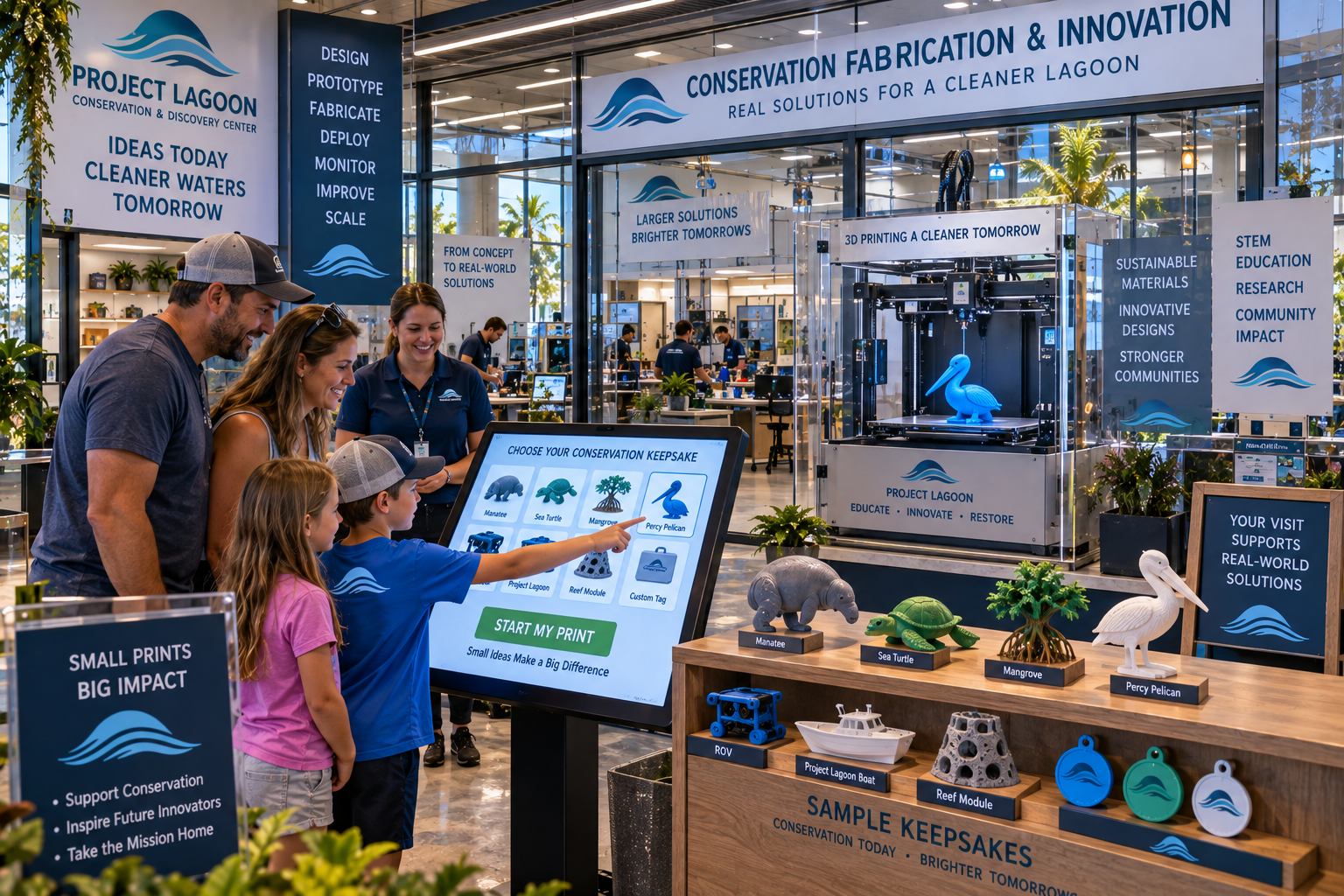
After completing the behind-the-scenes experience, guests could continue to a controlled visitor experience associated with the Conservation Fabrication & Innovation Center. The finale connects resource recovery, materials, fabrication and innovation:
See how materials are recovered. See how ideas become objects. Then make something to remember the experience.
Visitors could choose one small 3D-printable keepsake from a curated library of Center-approved designs. Potential future design themes might include Percy, manatee, sea turtle, mangrove, seagrass, fish, Project Lagoon vessel, ROV, sonar-inspired design, Center logo / future Center symbol, Space Coast / Lagoon themed object and other approved conservation designs. Final souvenir designs are not locked at this time.
START YOUR PRINT
The visitor does NOT manually operate, service or reach into the 3D printer. The printer remains enclosed where appropriate, safety-interlocked, controlled by the Center’s approved system, supervised/managed by staff, and limited to pre-approved printable files and settings. The visitor interaction initiates an approved automated print job.
RECEIVING THE KEEPSAKE
Because some 3D prints may take longer than the remaining tour time, fulfillment remains flexible. Depending on final technology and object size, the visitor’s selected item could potentially finish during the tour, be collected later during the same Center visit, be retrieved from a designated pickup location, or use another practical fulfillment method developed during final operations planning. The Center does not promise instant printing. Final print time depends on design, material, printer technology and production system.
RECOVERED / RECYCLED MATERIAL CONNECTION
Where technically appropriate, the Center should explore using recycled or recovered-content printing materials, creating an educational connection:
The Center does NOT claim that debris recovered from the Indian River Lagoon can simply be placed into a 3D printer. Recovered plastics would require appropriate identification, cleaning, processing, material separation, quality control, formulation, safety evaluation and compatibility testing before they could potentially become usable fabrication material. A specific “made from recovered Lagoon material” claim is made only when the actual material chain can be documented and verified.
The Educational Story
You throw something away. But “away” isn’t a place.
This reinforces the Center’s conservation mission without shaming visitors — demonstrating why correct recycling matters, why contamination matters, why material recovery matters, why litter entering waterways matters, why recovered materials have different destinations, and how better data can improve future operations.
Living Laboratory / Research Connection
The Center itself becomes a living laboratory. The facility could potentially provide an appropriate controlled environment for future evaluation of:
The Center does not promise outside research partners, claim university partnerships unless separately authorized, or claim that experimental technology will control safety-critical processing without appropriate validation.
Facility Planning — Secured Operations Side
The Resource Recovery & Materials Management Center should be placed conceptually on the secured operations / service side of the campus — not in the middle of normal public visitor circulation.
Service vehicle access
Project Lagoon material receiving
Campus waste receiving
Separate controlled receiving areas
Processing / sorting area
Recovered-material storage
Residual-material storage
Specialty-material isolation area
Wash / cleanup support where appropriate
Ventilation
Drainage / environmental controls
Fire / life safety
Pest / odor management
Equipment maintenance access
Loading / pickup access
Designated safe tour route / observation area if feasible
The Center does not invent final building dimensions, final processing capacity or final permits.
Smart Solar Waste Stations Connection
The public-facing smart solar waste & recycling stations are the collection front end. The Resource Recovery & Materials Management Center is the processing / recovery back end. Together they create one coherent campus system.
Relationship to Existing Debris Processing
The Resource Recovery & Materials Management Center becomes the future campus’s more complete small-material recovery/sorting capability. Large or oversized Project Lagoon debris may still require separate staging, dumpsters, roll-offs, trailers, scrap handling, specialty contractors, direct vendor pickup and specialty disposal. The automated sorting line is not intended to process every object Project Lagoon recovers.
This concept consolidates and strengthens — rather than duplicates — the existing Project Lagoon debris-processing, sorting and recycling vision.
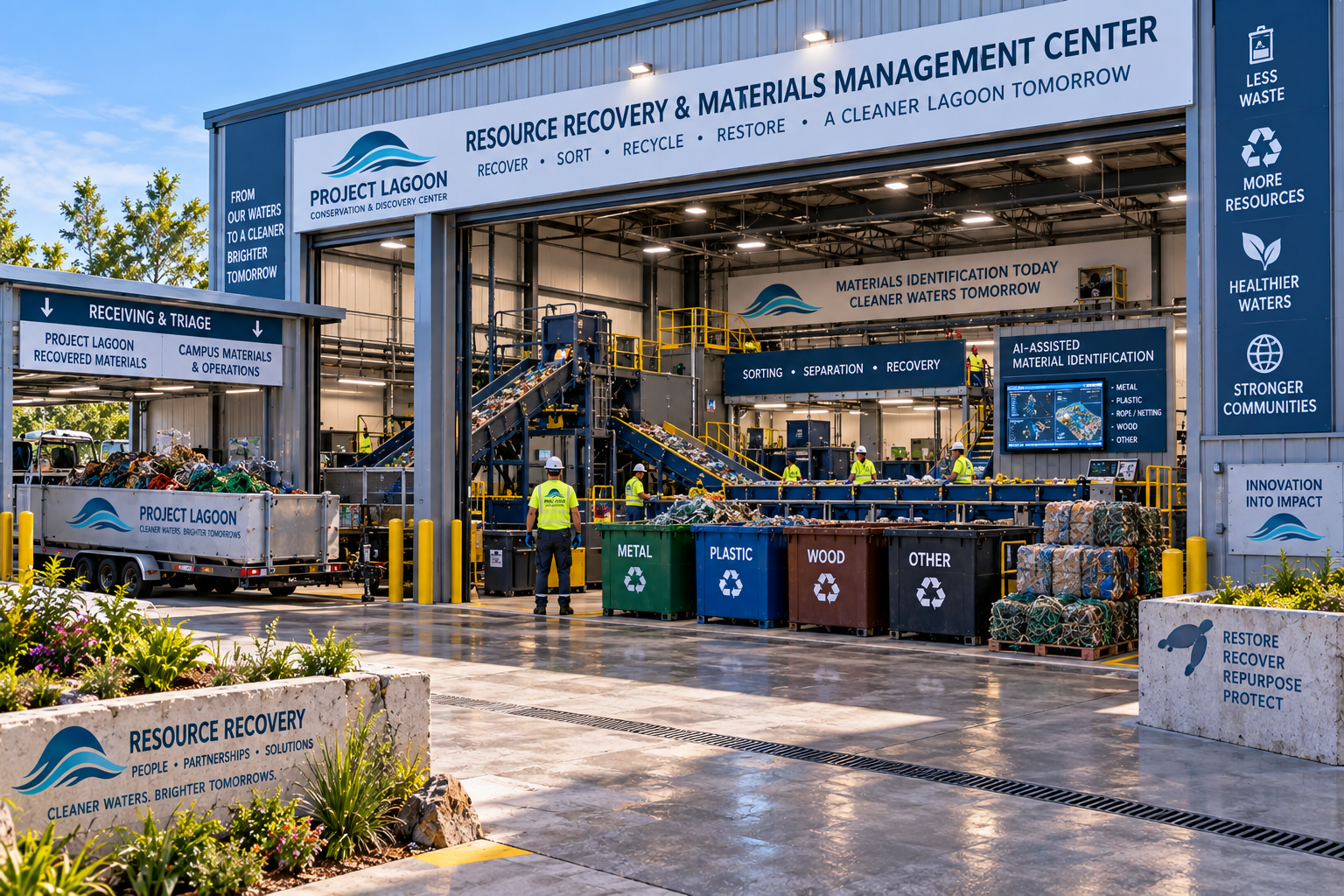
The Center does not claim 100% recycling, zero waste, 100% automation, exact recovery percentage, exact throughput, exact building size, final equipment, final vendor, final AI capabilities, final staffing, final processing cost, final construction cost, final permits, that all Project Lagoon debris can be processed, or that hazardous materials enter the normal sorting line. All language is conceptual.
NatureScape — The Landscape Is the Exhibit
The campus landscape is not decoration. It is a living conservation exhibit.
The Landscape Itself Can Teach Conservation.
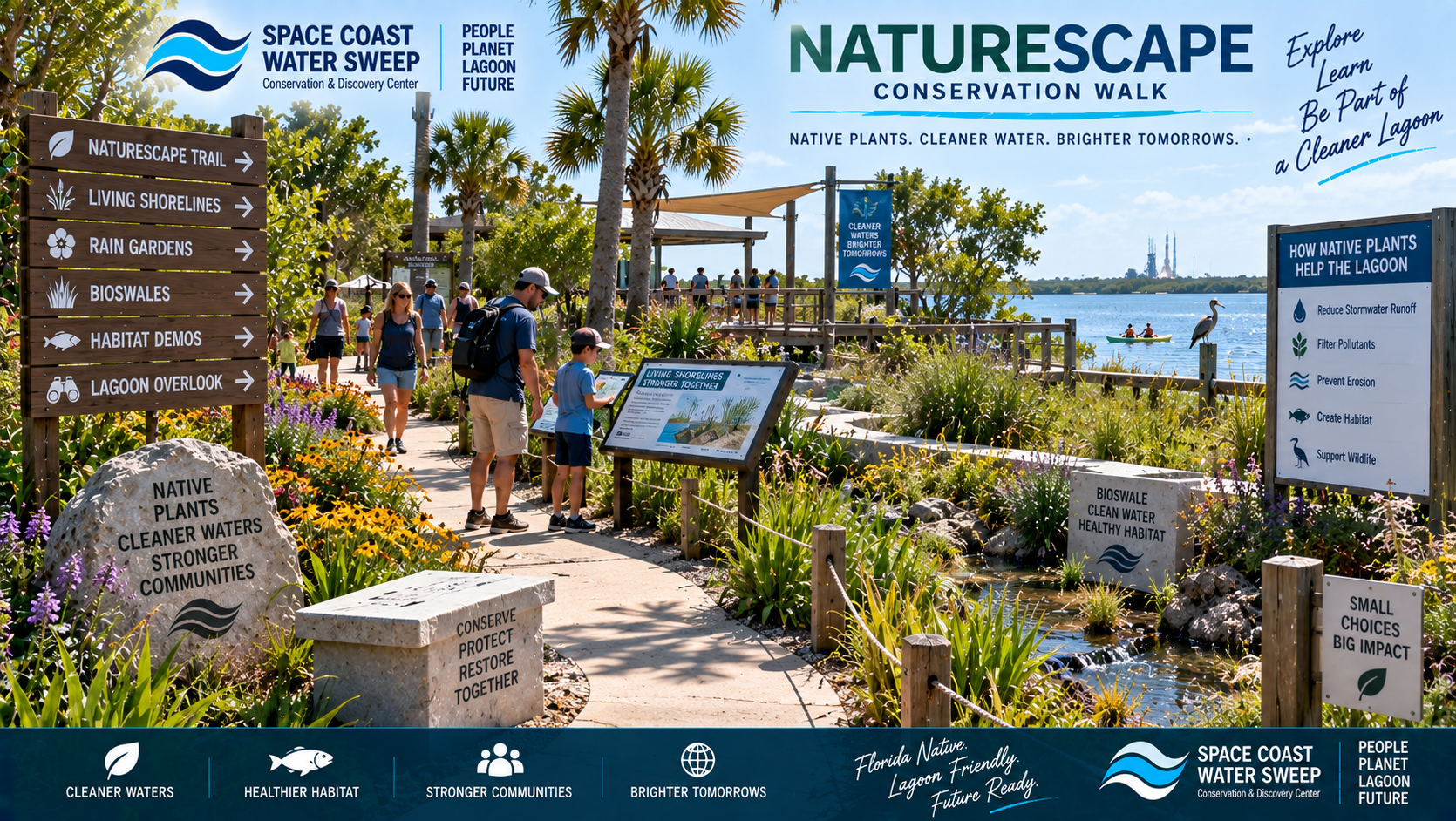
NatureScape and the Conservation Walk invite visitors to learn by moving through the property. The landscape also makes the Center a pleasant place to visit even when someone is not attending a formal program.
Sometimes conservation means building something. Sometimes conservation means deciding not to build there. The campus vision does not imply every acre will be developed.
Where Does the Rain Go?
NatureScape demonstrates how rainwater moves through the landscape — from parking lot to bioswale to wetland to Lagoon. Rain gardens, permeable surfaces and shoreline buffers show visitors how thoughtful landscape design can reduce runoff and protect water quality.
RAIN GARDENS
Shallow depressions that capture and filter stormwater runoff.
BIOSWALES
Landscaped channels that slow, filter and infiltrate water.
PERMEABLE SURFACES
Paving that allows water to pass through rather than run off.
SOMETIMES CONSERVATION MEANS BUILDING SOMETHING.
SOMETIMES CONSERVATION MEANS DECIDING NOT TO BUILD THERE.
Support Native Plants & Restoration Nursery
Support native plant growing, nursery supplies, community education, and plants for approved restoration projects.
Support Native Plants & Restoration NurseryNative Plant & Restoration Nursery
Growing native plants for restoration, research and community conservation. A major program of the future Center.
The Landscape Starts Here
The Native Plant & Restoration Nursery is envisioned as a substantial on-site growing and research facility — not a garden center. It supports the Center's restoration mission, living shoreline projects, NatureScape landscaping, research programs and future community conservation efforts.
The nursery operates on two distinct tracks: restoration production for appropriate permitted and partner restoration projects, and community conservation making suitable Florida-native plants available to Florida residents through future Center programs where appropriate.
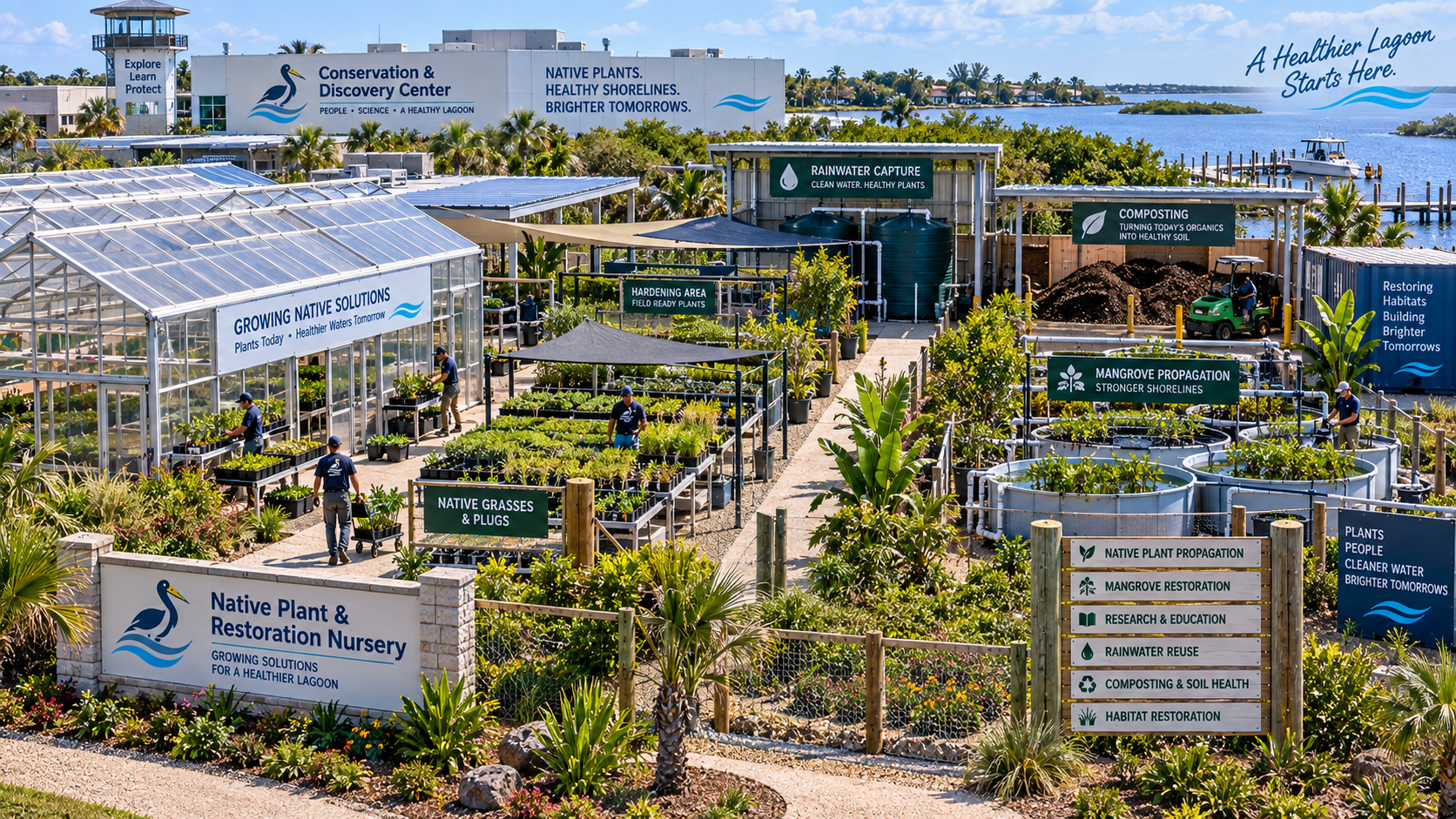
Growing Plants for Restoration Projects
The nursery's primary mission is producing appropriate native species for restoration — grasses, plugs, appropriate mangroves for permitted/partner restoration projects, shoreline vegetation and habitat components.
These plants support living shoreline installations, habitat restoration, NatureScape campus landscaping and research experiments. Mangroves grown here are for appropriate permitted restoration projects — not general visitor giveaways.
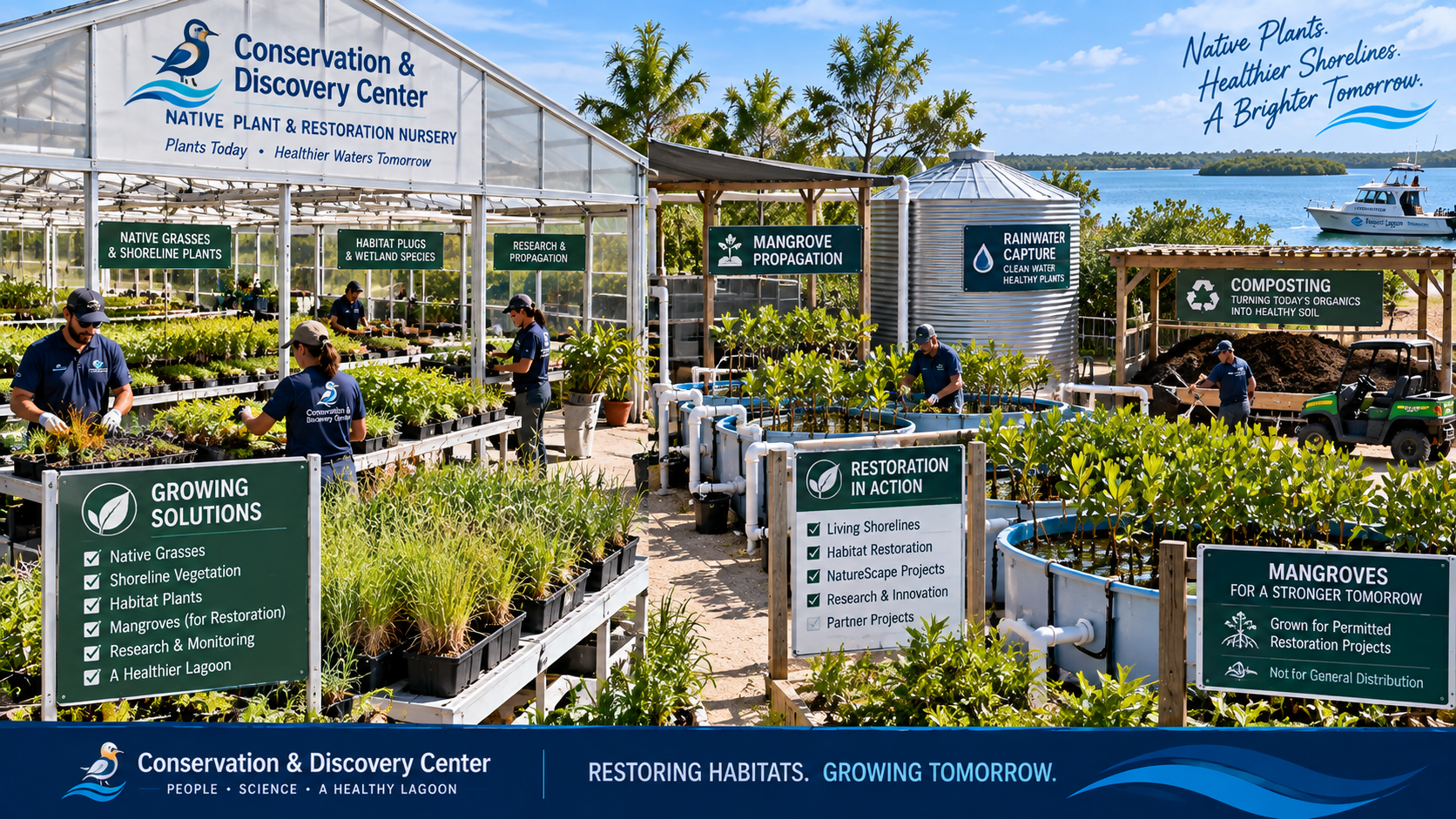
Helping Residents Plant for the Lagoon
A future community conservation program could make suitable Florida-native plants — native grasses, plugs, pods and appropriate species — available to Florida residents through Center programs where appropriate.
This is not a general plant giveaway. It is a conservation give-back concept designed to help residents replace turf, reduce runoff, support pollinators and create lagoon-friendly landscapes at home.
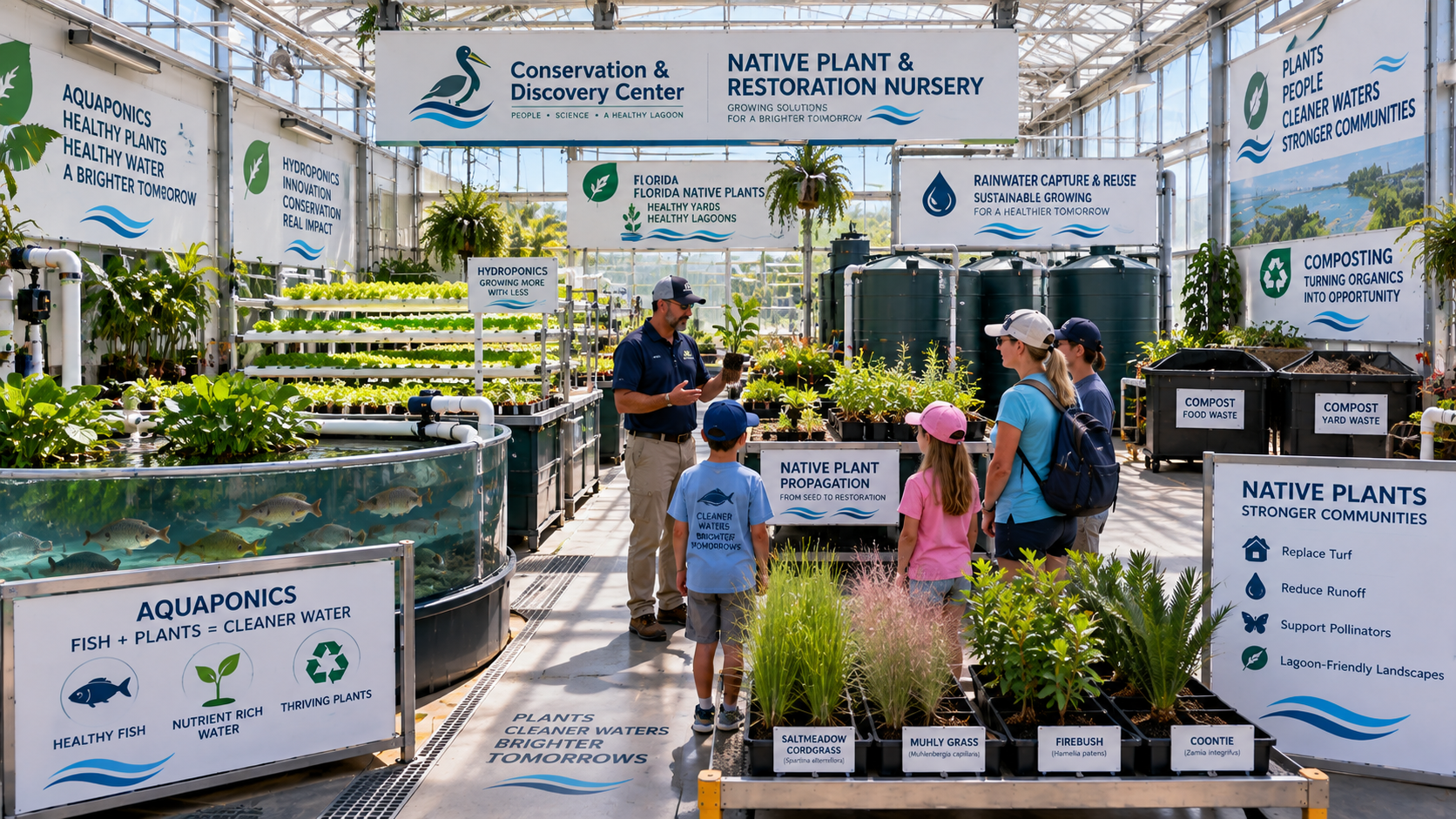
Growing With the Environment in Mind
The nursery is envisioned to demonstrate responsible growing practices — including water conservation, composting, reduced chemical use and educational demonstrations showing visitors how native plant propagation works.
AQUAPONICS
Integrated fish and plant growing demonstrations showing how aquatic systems can support plant production.
HYDROPONICS
Soil-less growing where appropriate for specific species and research applications.
RAINWATER CAPTURE / REUSE
Capturing and reusing rainwater for irrigation to reduce potable water use.
COMPOSTING
Converting organic waste into growing media, closing the materials loop on campus.
EDUCATIONAL DEMONSTRATIONS
Visitors can see how native plants are propagated, grown and prepared for restoration.
NURSERY RESEARCH
Testing propagation methods, growing conditions and species suitability for restoration.
THE NURSERY CONNECTS TO
POTENTIAL SUPPORT FOR THE NURSERY
The nursery program may be supported through admission revenue, donations, sponsorships, grants and plant-program gifts. No specific funding has been secured.
Support Native Plants & Restoration NurseryLiving Shorelines & Habitat Restoration
Using natural systems to protect shorelines, restore habitat and strengthen the Lagoon.
What If the Best Seawall Was Not a Seawall?
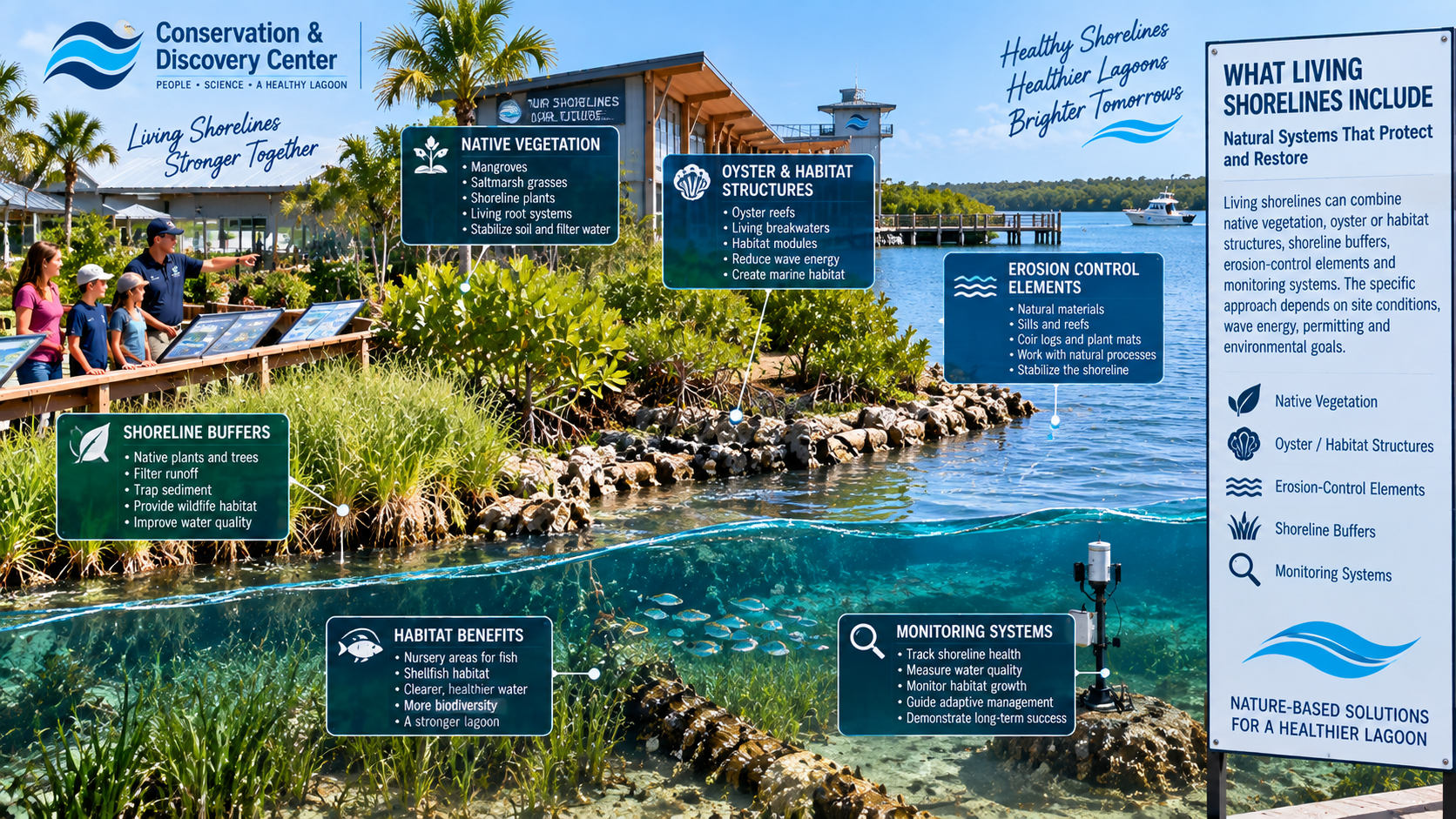
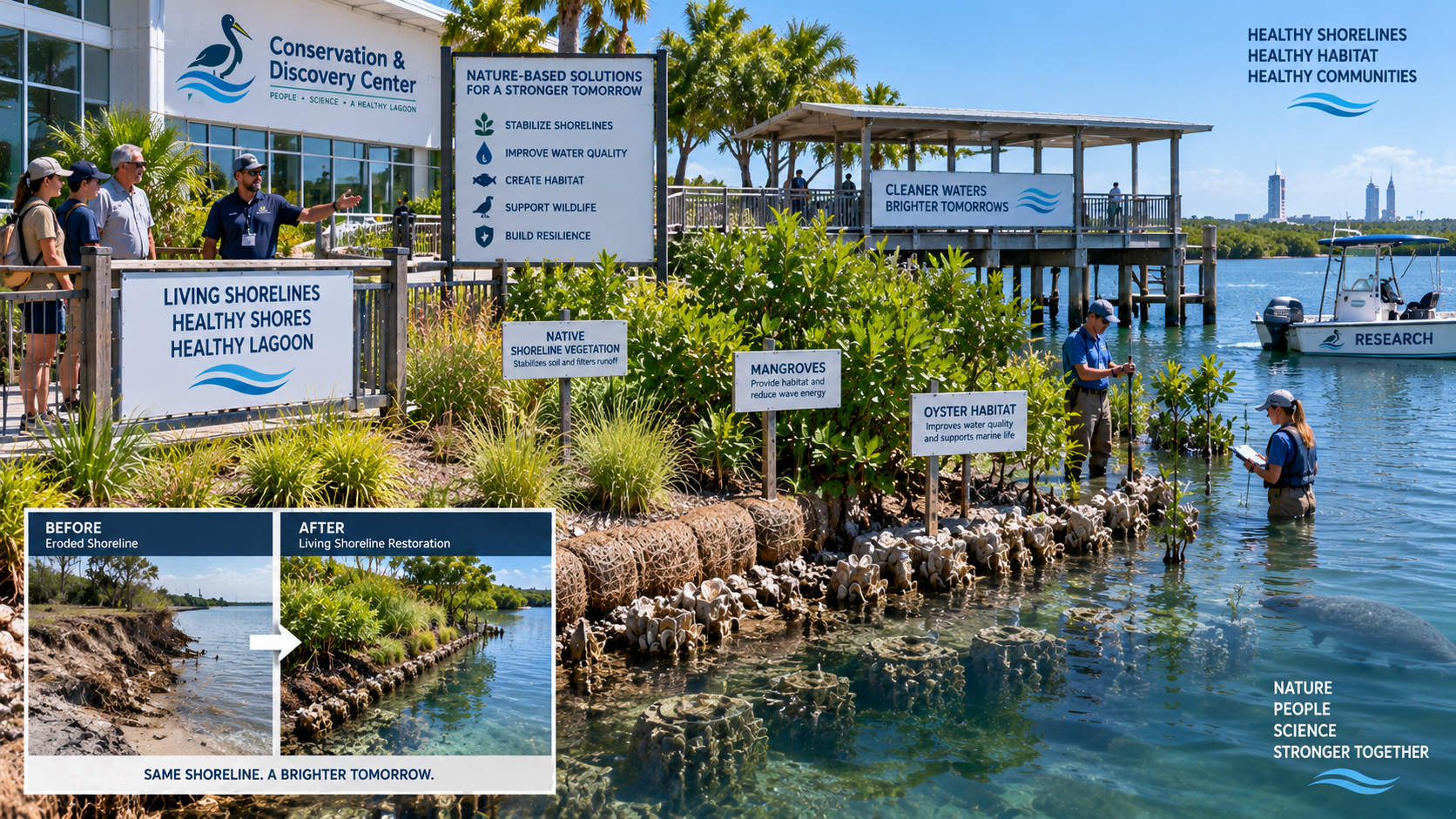
Living shorelines use native vegetation, natural materials and ecological processes to stabilize shorelines, reduce erosion and create habitat — rather than relying solely on hard structures like seawalls or bulkheads.
The Conservation & Discovery Center is envisioned as a place where living shoreline techniques can be researched, designed, fabricated, installed, monitored and improved — connecting the Nursery, Research Lab, Fabrication Center and field operations in a single restoration loop.
Natural Systems That Protect and Restore
Living shorelines can combine native vegetation, oyster or habitat structures, shoreline buffers, erosion-control elements and monitoring systems. The specific approach depends on site conditions, wave energy, permitting and environmental goals.
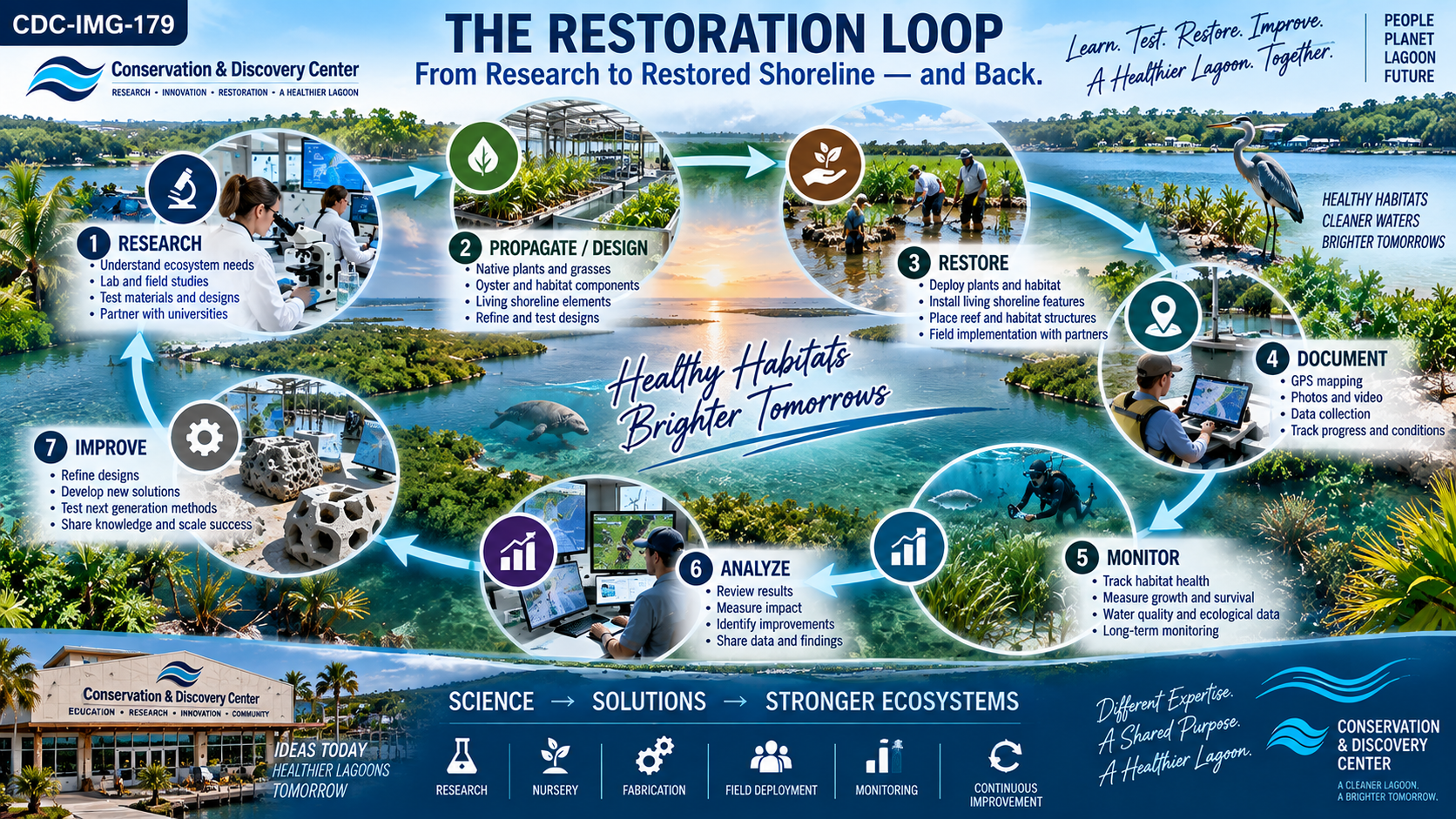
From Research to Restored Shoreline — and Back.
Living shoreline and habitat restoration at the Center is not a one-time installation. It is a continuous loop of research, propagation, installation, documentation, monitoring, analysis and improvement.
THEN USE WHAT WE LEARN TO MAKE THE NEXT RESTORATION BETTER.
Restoration Connects the Whole Campus
Living shoreline and habitat restoration is not a standalone program. It connects multiple Center capabilities into a single mission.
NURSERY
Propagates native plants and mangroves for restoration projects.
RESEARCH LAB
Studies shoreline conditions, materials and ecological response.
FABRICATION
Builds shoreline modules, habitat structures and erosion-control concepts.
FIELD OPERATIONS
Installs, monitors and maintains restoration sites on the water.
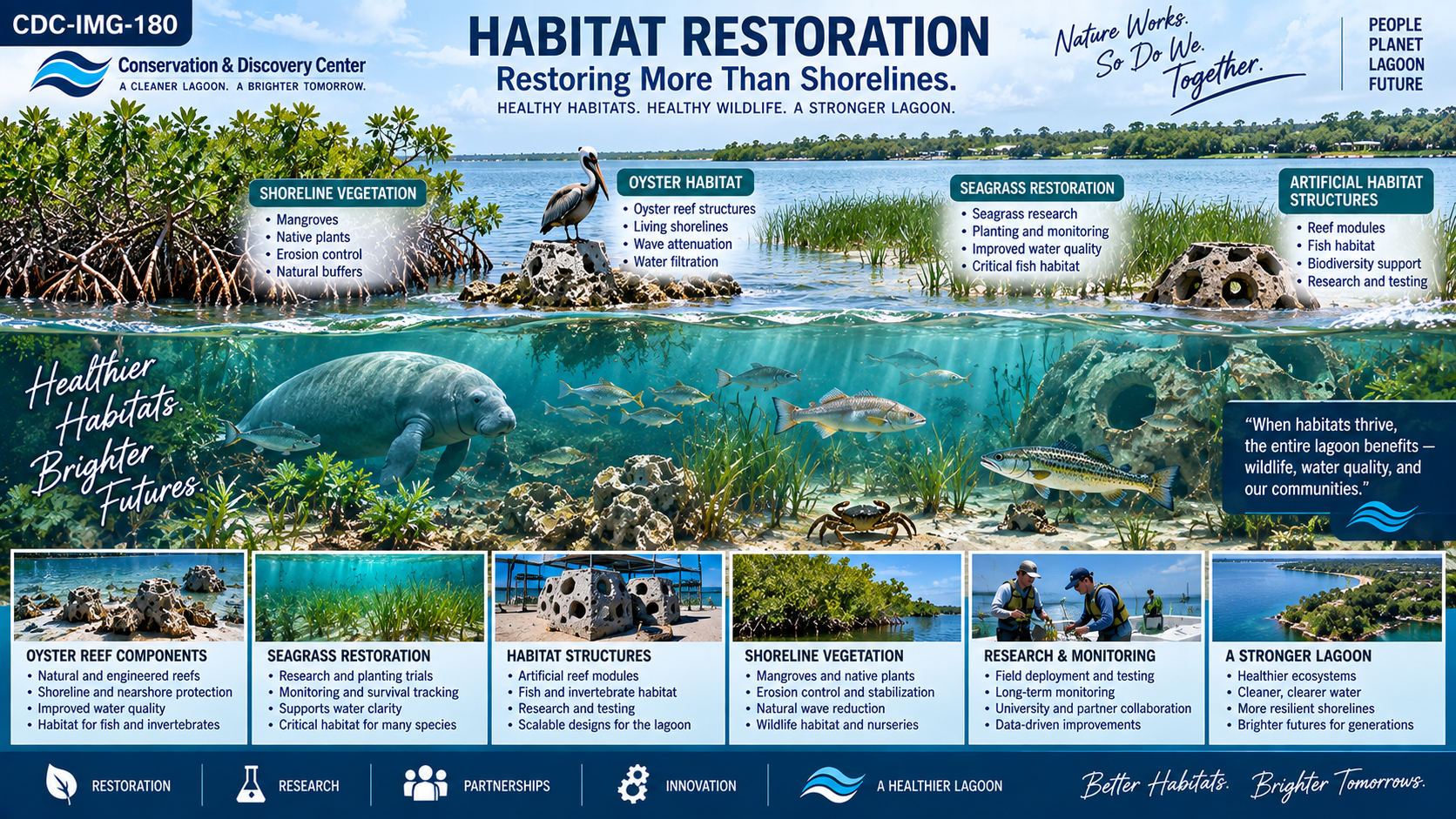
Restoring More Than Shorelines.
Habitat restoration at the Center can include oyster reef components, seagrass restoration research, artificial habitat structures, shoreline vegetation and experimental techniques — all subject to appropriate permits, environmental review and monitoring.
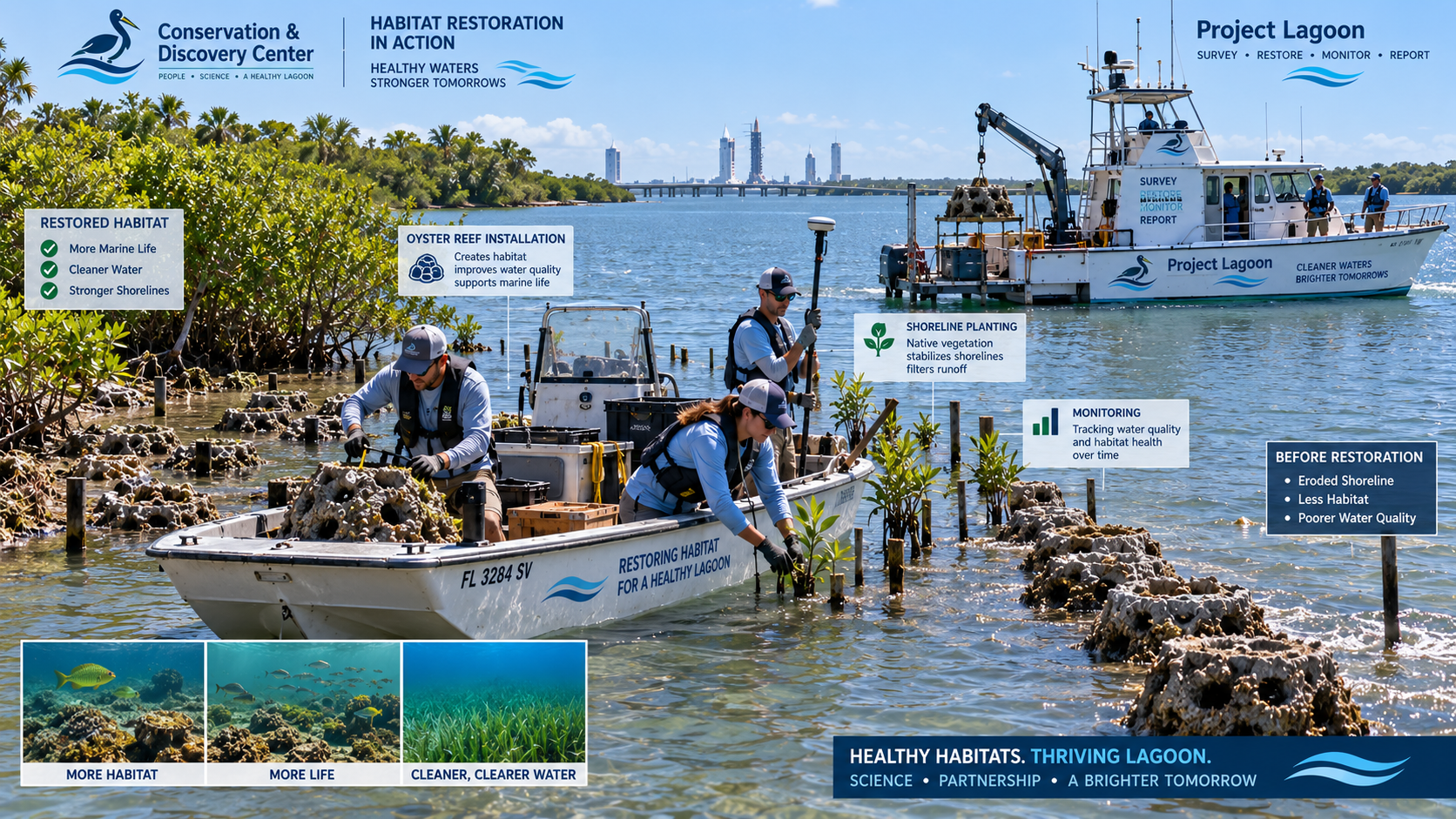
PARTNER CAPABILITY
Concepts shown here may represent technologies or restoration methods developed, owned or implemented by partner organizations or other specialists. The Center is envisioned as a resource for collaboration, research, testing, monitoring, prototyping, education and field support — not as a replacement for existing organizations, businesses or proprietary technologies.
Support This Restoration Work
Help develop native shoreline planting, living shoreline projects, and monitoring for healthier lagoon habitat.
Support Lagoon Habitat RestorationDiscover the Lagoon
Living Lagoon, Lagoon Discovery Waterscape, Interactive Lagoon & Play River, Lagoon After Dark. Distinct experiences that help visitors see, touch and understand the water.
See the Lagoon We're Working to Protect.
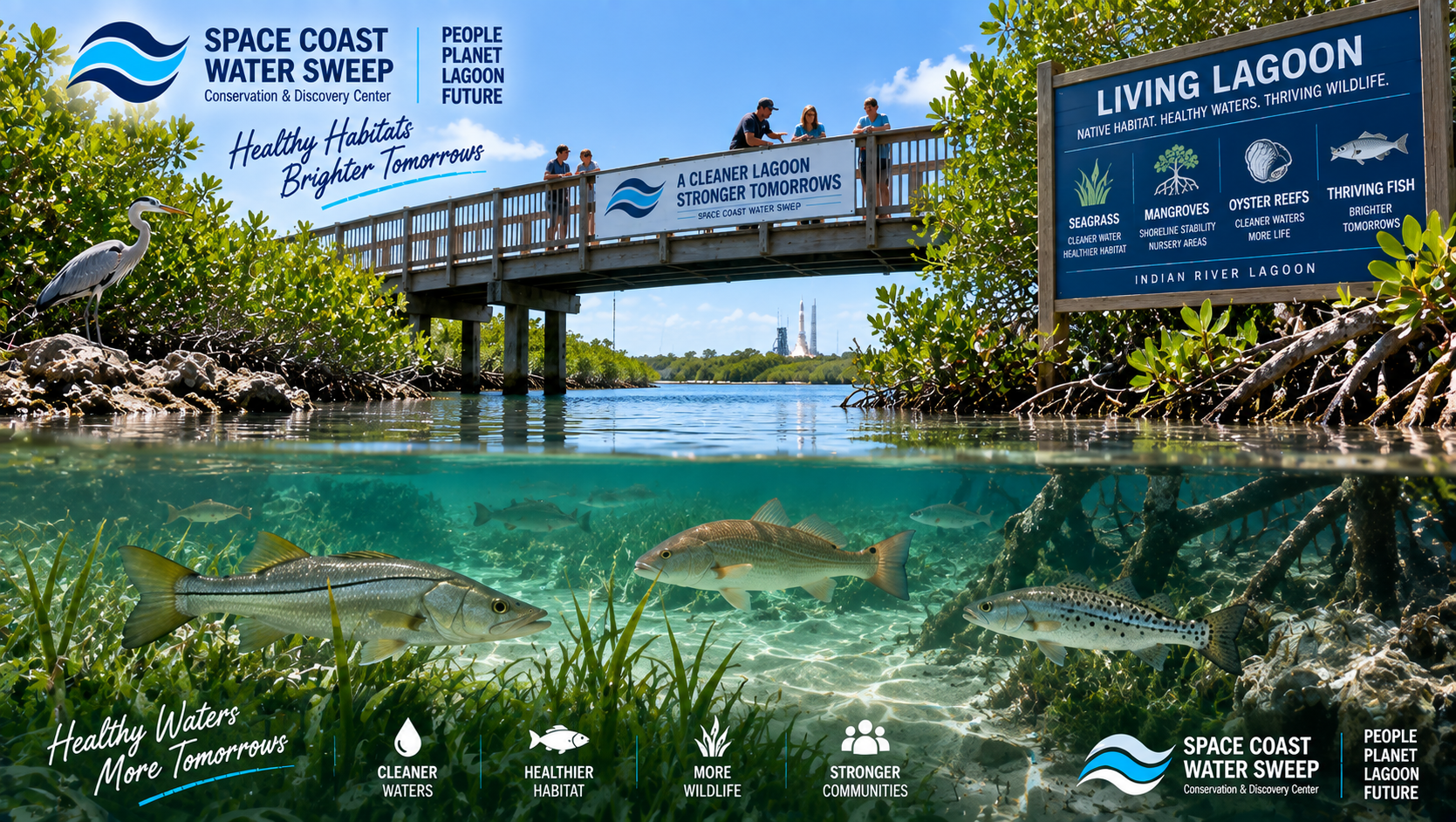
The proposed Living Lagoon is a clear-water, lagoon-inspired outdoor habitat integrated into NatureScape and the Conservation Walk. It connects fish, habitat, water quality and conservation in a single living experience — designed for observation and education, not fishing.
This is a historically and ecologically inspired representation based on the best available scientific and historical information — not an exact reconstruction. No fishing. Observation and education only.
Follow a Drop of Water From Rainfall to the Lagoon.
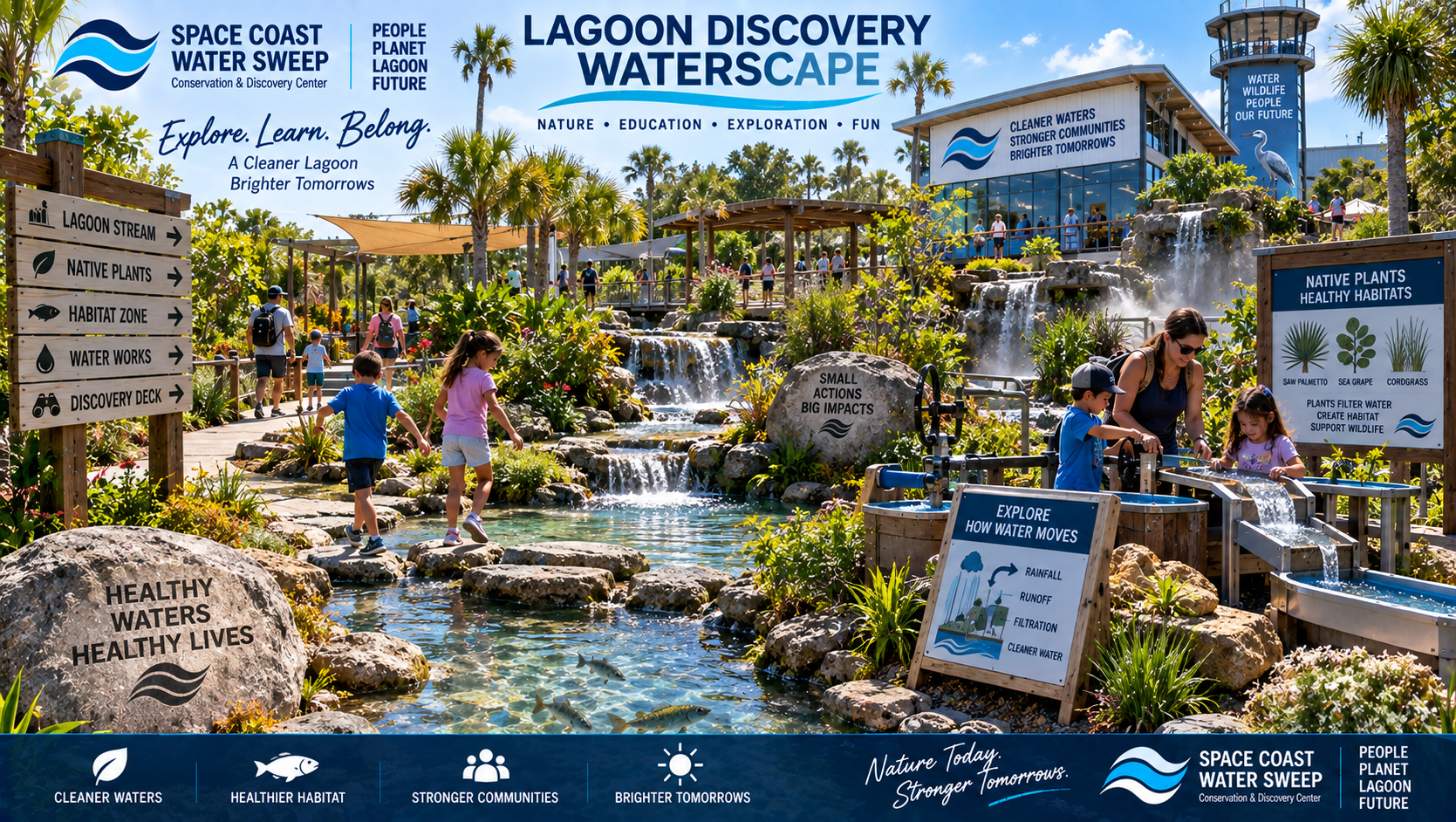
The proposed Lagoon Discovery Waterscape is an environmentally themed outdoor water experience designed to combine cooling, play, exploration and education. It is not a splash pad and not a swimming pool.
All public-contact water features would require appropriate treatment, engineering, health/safety systems and approvals. Visitors do not interact with untreated Lagoon or stormwater.
A Recreational Water Experience for Families.
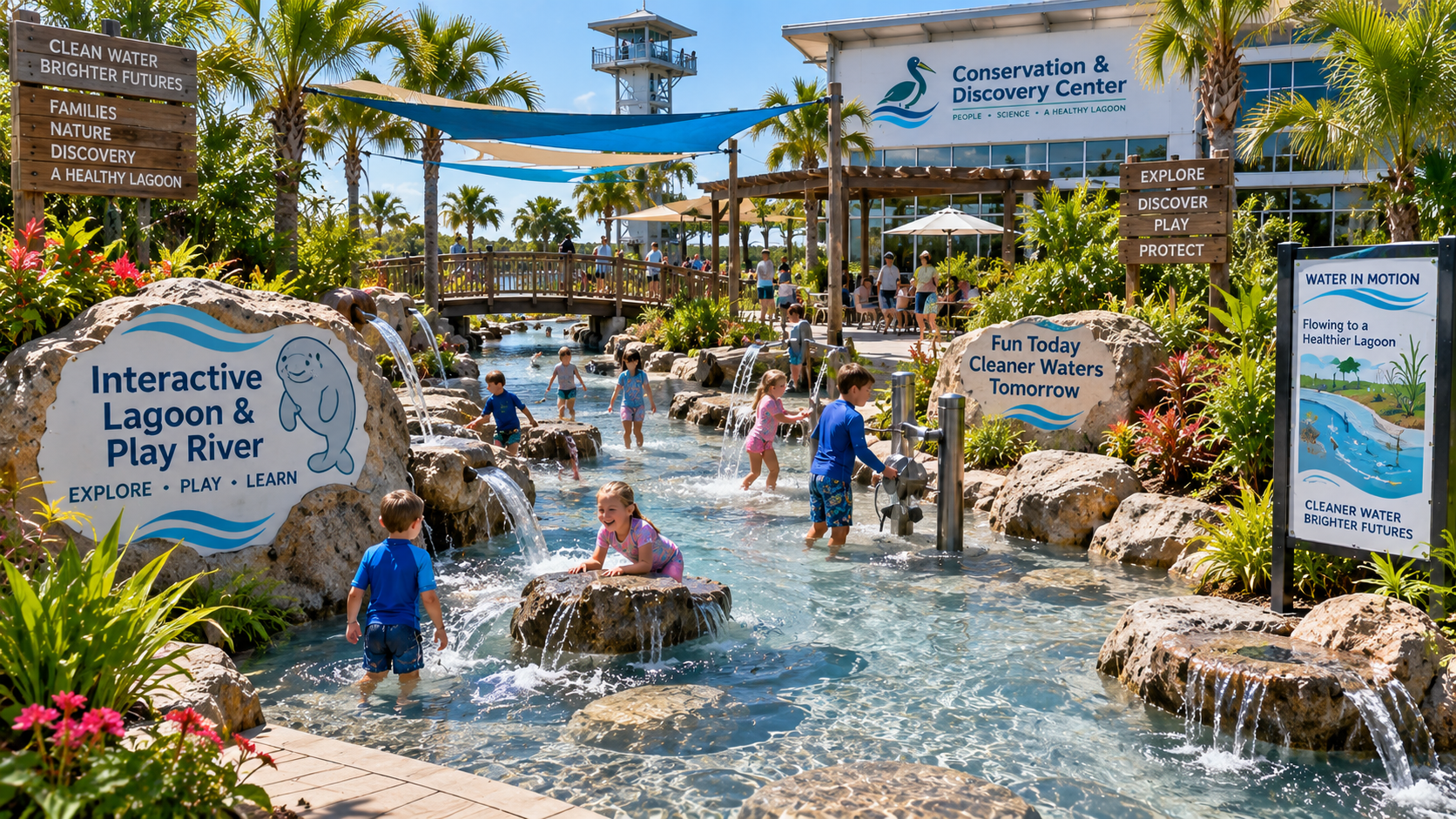
The Interactive Lagoon & Play River is a conceptual recreational and interactive water experience distinct from the educational Waterscape. Where the Waterscape teaches the water cycle, the Interactive Lagoon & Play River is about experiencing water — subject to final engineering, treatment and safety design.
This concept is separate from the Living Lagoon (which is a habitat observation experience, not a contact experience) and from the Waterscape (which is an educational water-flow experience). All public-contact water features require appropriate treatment, engineering, health/safety systems and approvals.
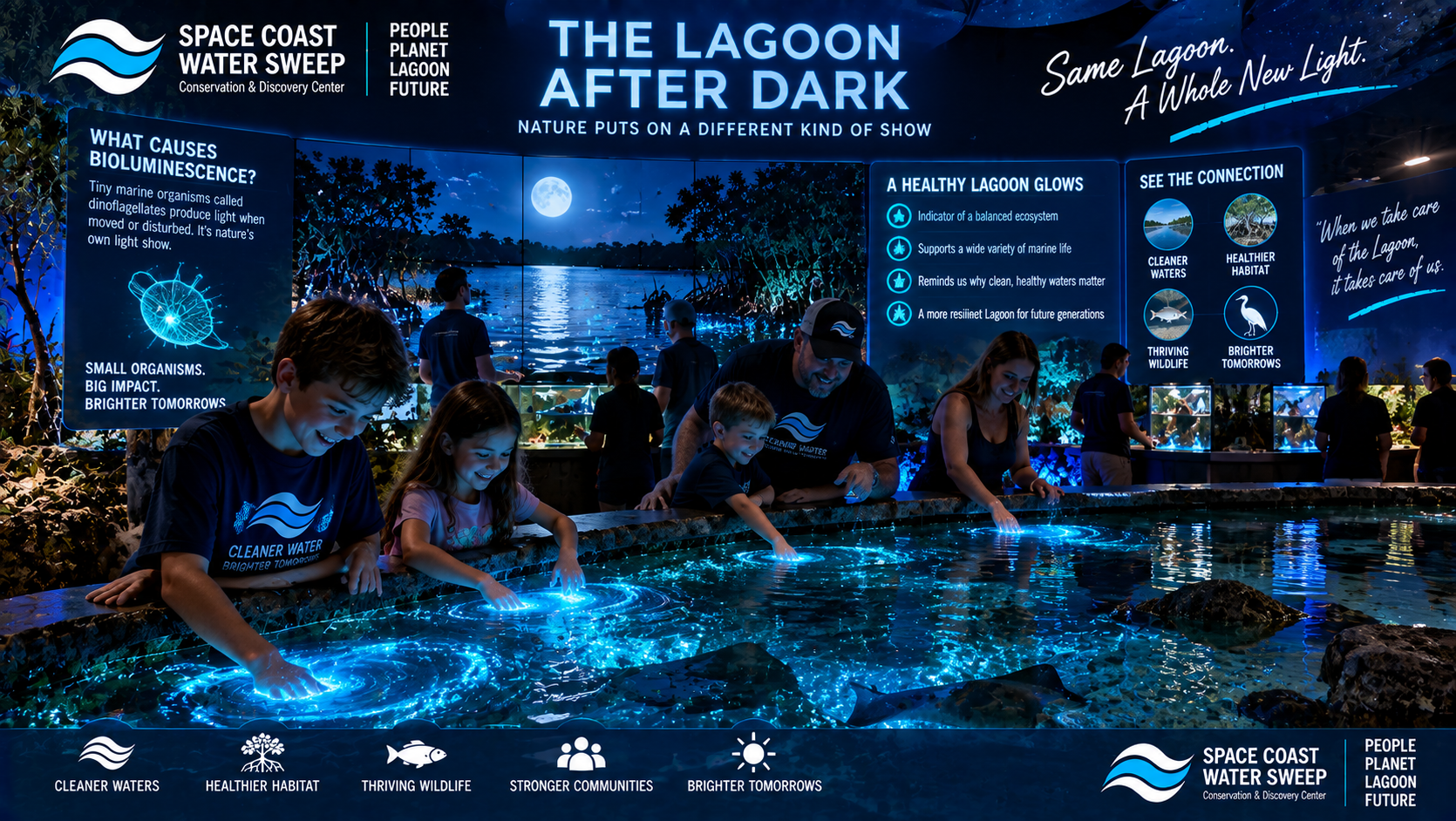
What If You Could Make the Lagoon Glow in the Middle of the Day?
The Lagoon After Dark is a proposed indoor controlled bioluminescence experience inspired by seasonal bioluminescence in the Indian River Lagoon. Visitors may learn about dinoflagellates, comb jellies, seasonality, water conditions and ecology — and interact with a controlled shallow lagoon-style system where movement creates visible glowing trails.
Direct-contact interaction is subject to biological, public-health, engineering, animal-welfare, environmental and operational feasibility. Natural bioluminescence in the Indian River Lagoon is seasonal and conditional — not a year-round guarantee.
The indoor experience is viewable during normal daytime operations and could potentially be enhanced as an evening experience.
KEEP THESE EXPERIENCES DISTINCT
LAGOON DISCOVERY WATERSCAPE: Educational water landscape explaining rainfall, runoff, drainage, stormwater, freshwater and the Lagoon.
INTERACTIVE LAGOON & PLAY RIVER: Recreational/interactive water experience subject to final engineering, treatment and safety design.
LIVING LAGOON: Clear-water Lagoon-inspired native/representative habitat experience. No fishing — observation and education only.
LAGOON AFTER DARK: Controlled indoor bioluminescence experience viewable during normal daytime operations and potentially enhanced as an evening experience.
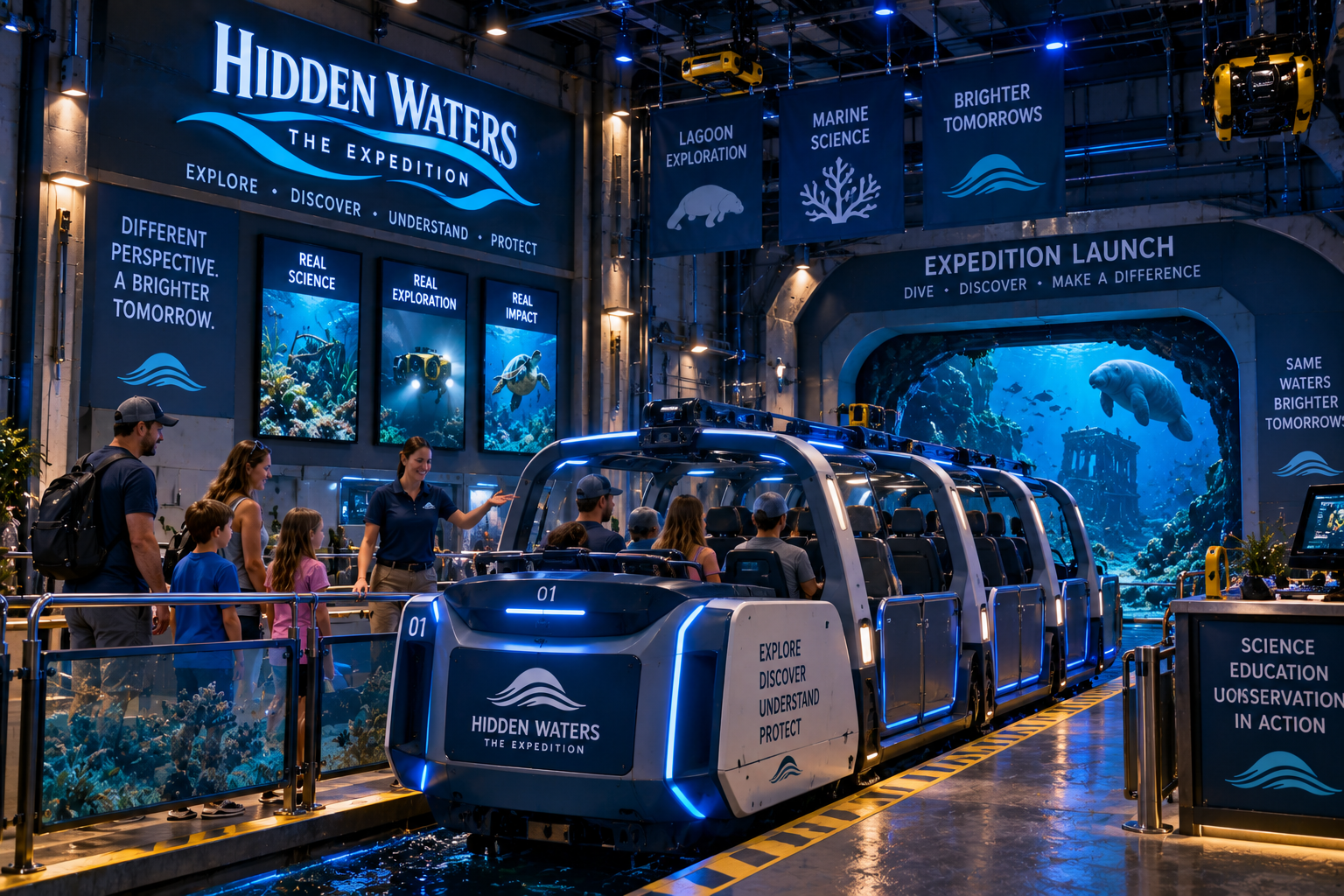
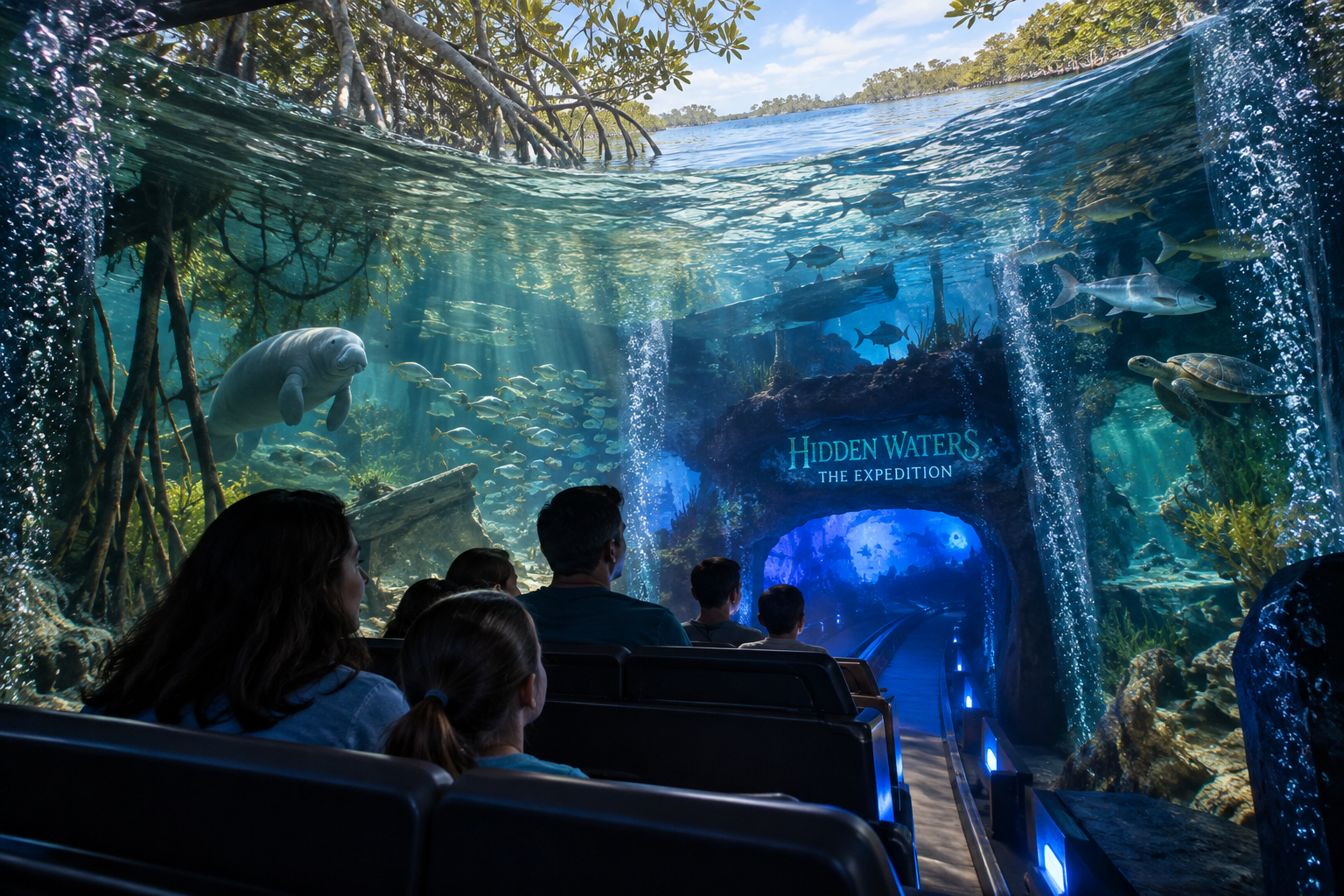
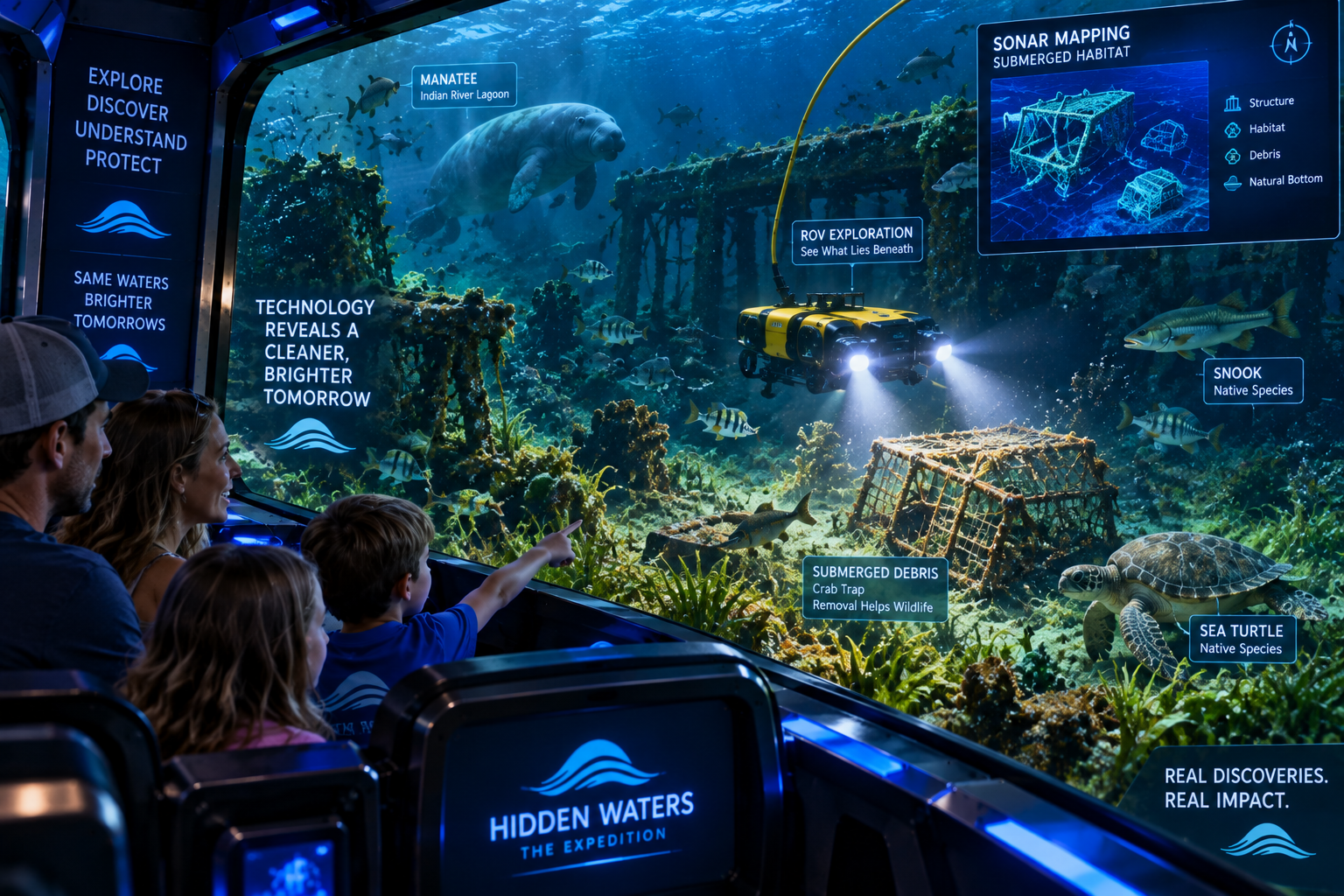
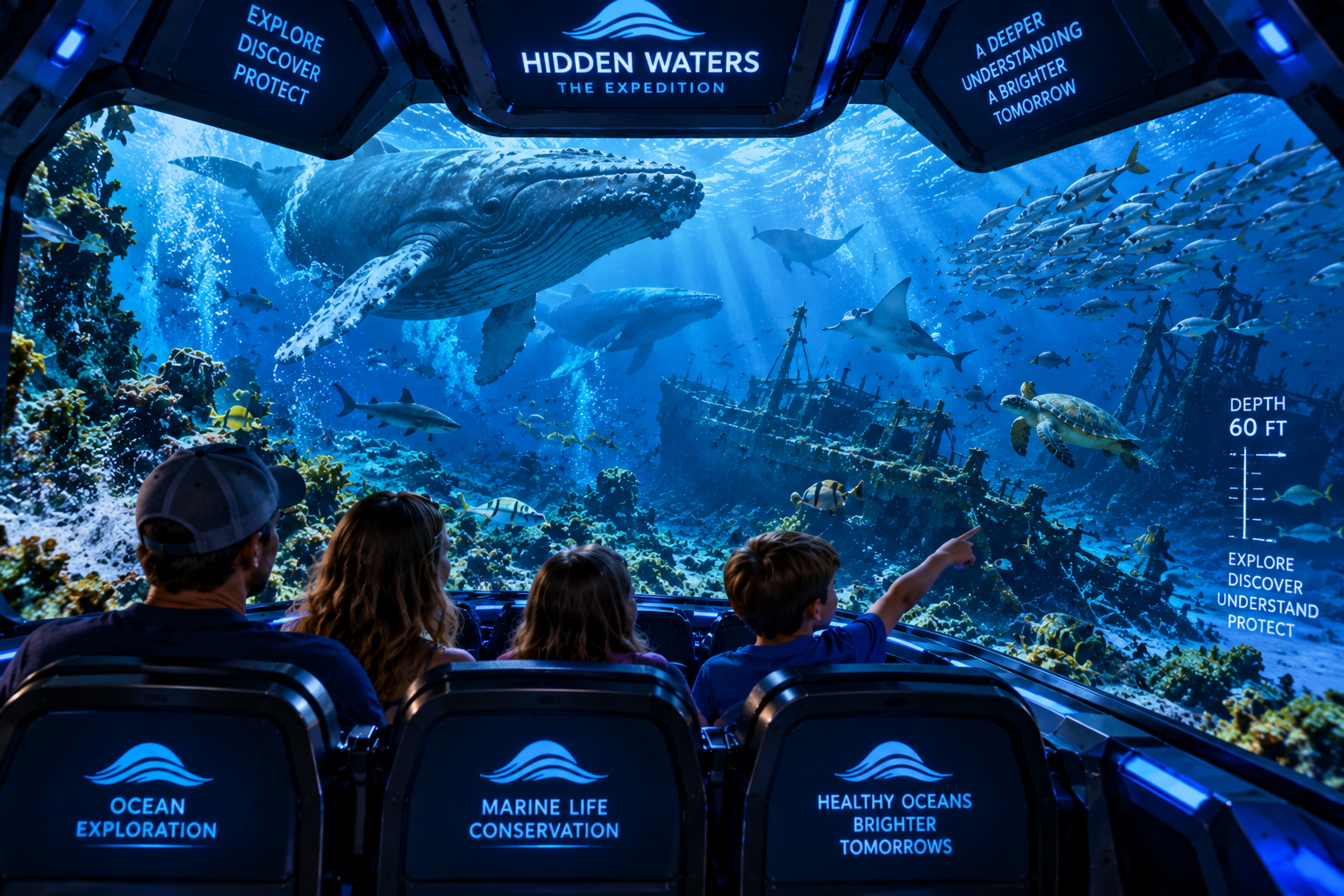
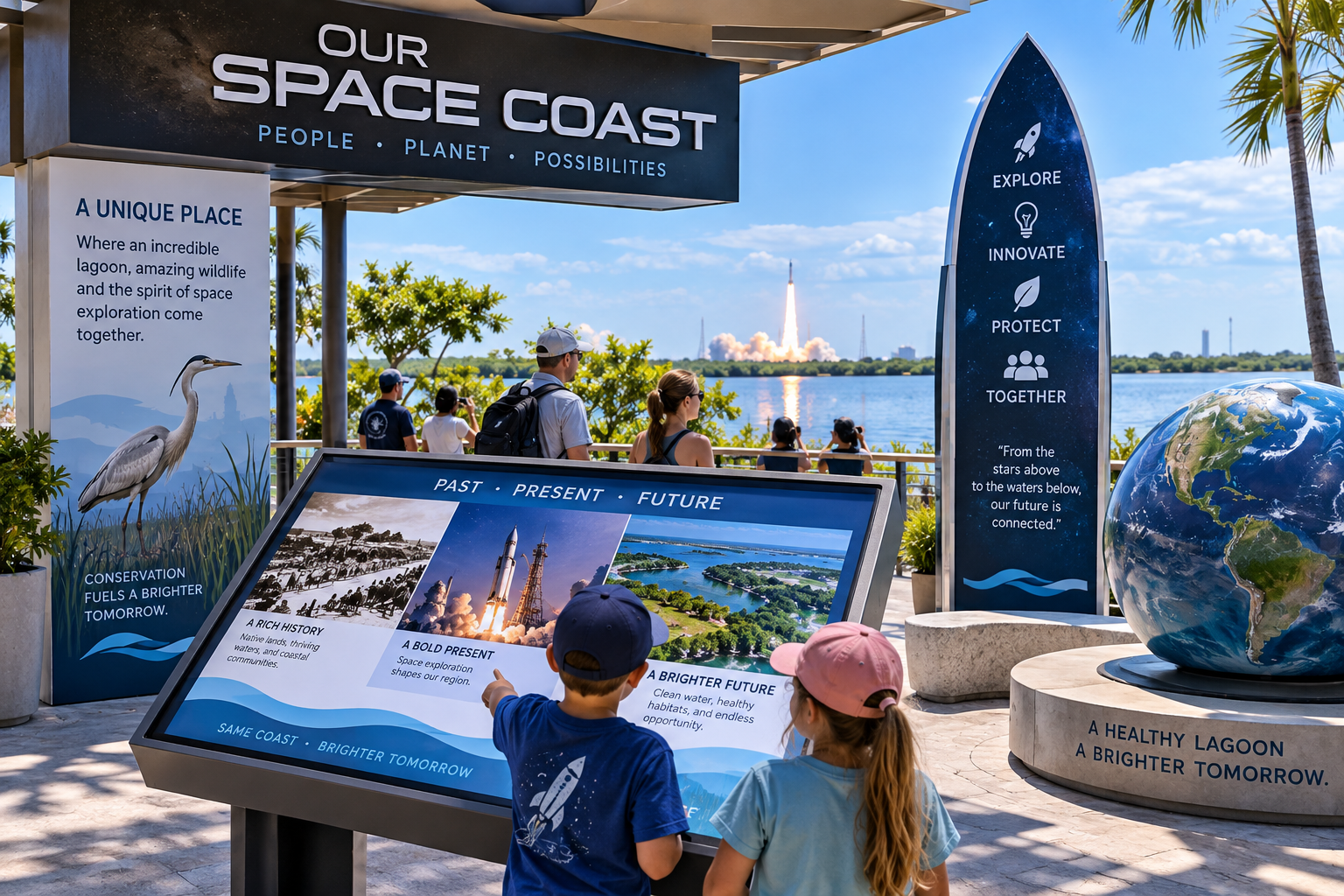
Our Space Coast — Past, Present & Future
The story of people, place and lagoon. A major indoor gallery. A vertical journey through time. The Space Coast as a living, changing region.
Our Space Coast — People • Place • Lagoon
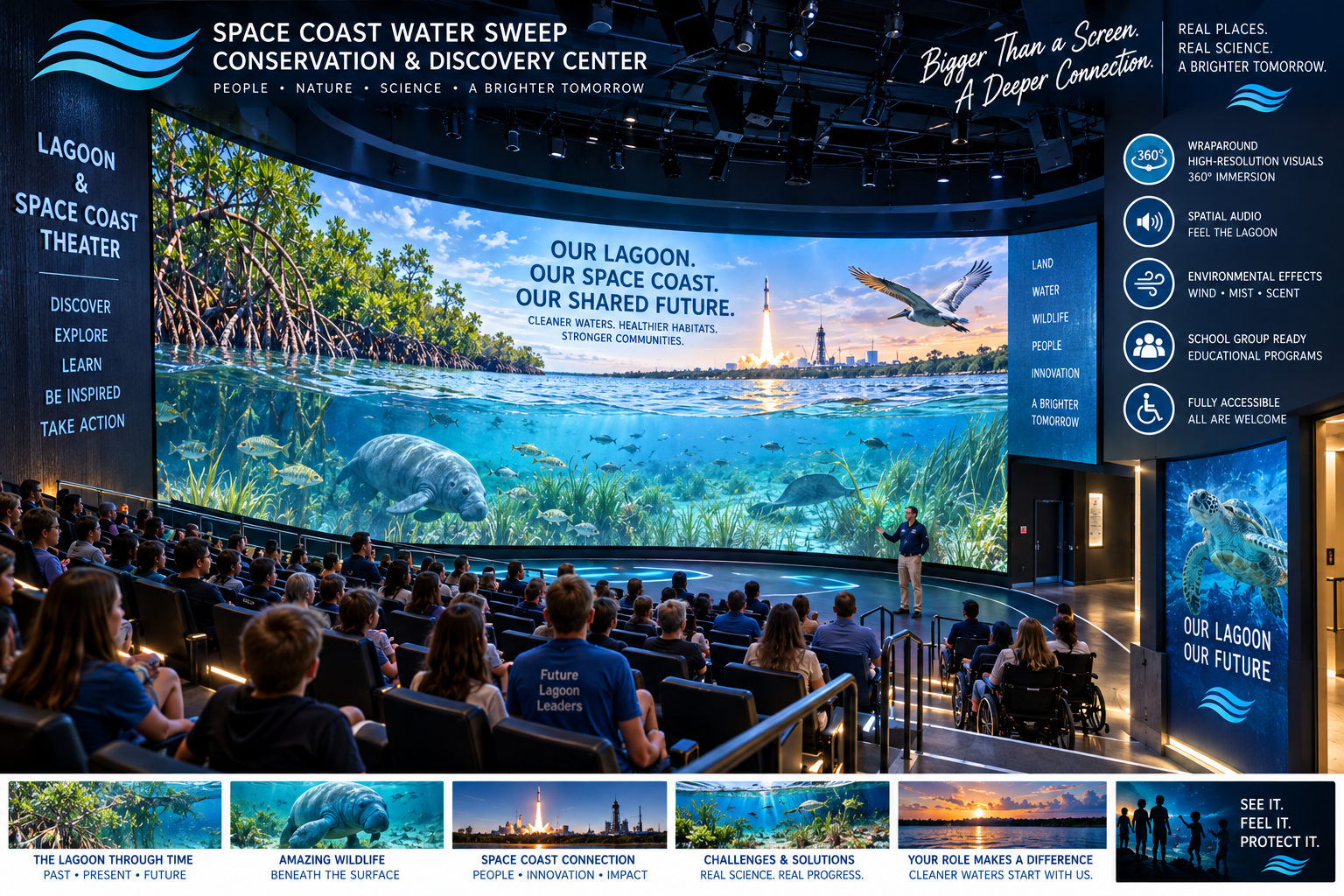
Our Space Coast is envisioned as a major permanent indoor gallery within the main Conservation & Discovery Center. It tells the interconnected natural, human, cultural, maritime and environmental story of Brevard County, the Space Coast and the Indian River Lagoon.
The gallery uses digital-first museum design — large digital walls, interactive maps, touchscreens, digital tables, changing exhibits, appropriate artifacts, photography, oral histories and interactive educational experiences. The existing SCWS educational lesson library and Percy's Conservation Academy serve as a deeper educational content layer.
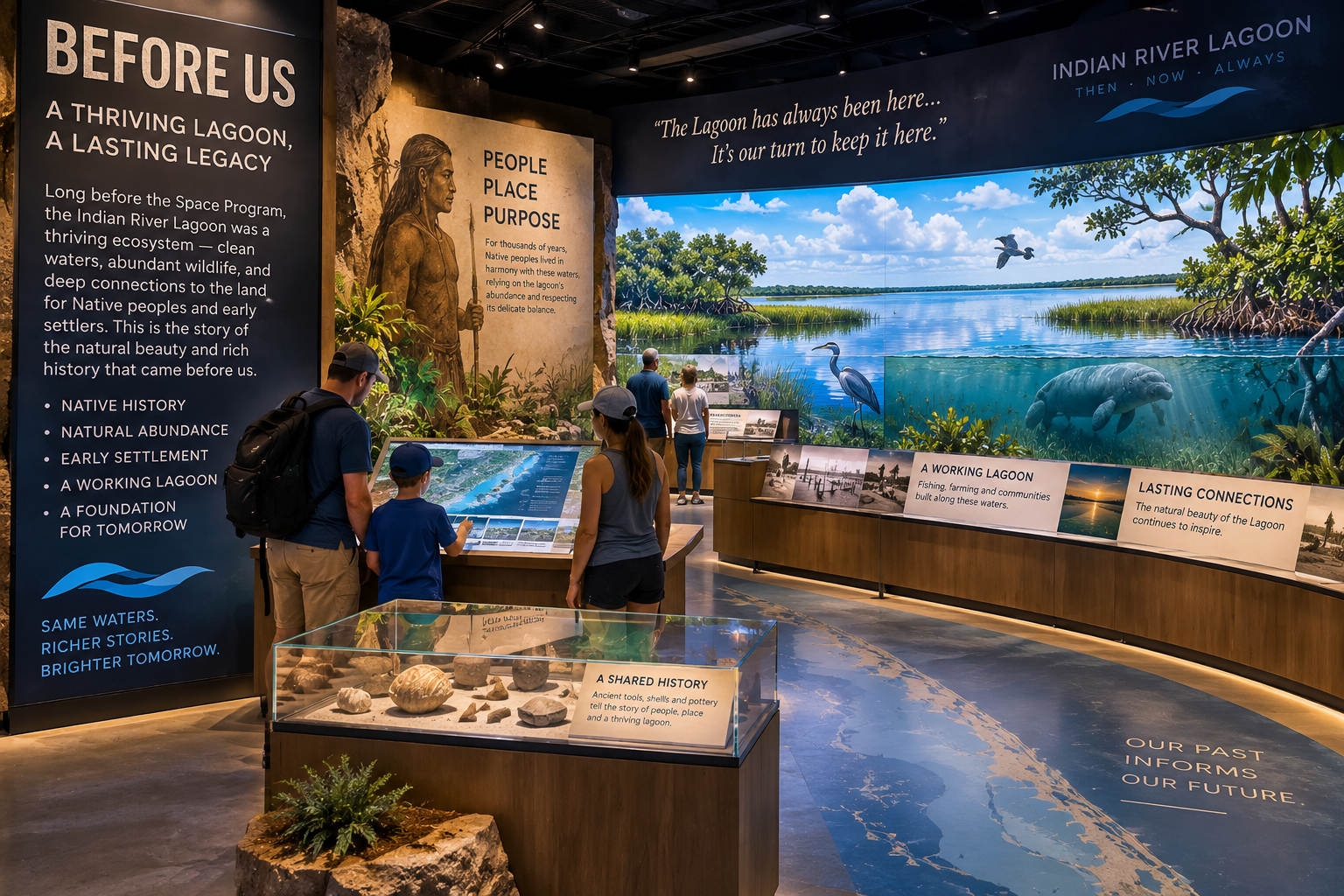
The Lagoon and the Land Before Modern Development.
Explore the natural lagoon, natural Florida landscape, Indigenous history, earliest human relationships with the lagoon, early communities, fishing and maritime life.
Indigenous history must be responsibly researched and should eventually involve appropriate historical and Indigenous expertise rather than making unsupported claims.
The Families, Workers and Communities That Shaped Brevard.
Explore families, communities, fishing families, agriculture, citrus, local towns, community leaders, workers, businesses, industries, tourism and people whose lives helped shape Brevard. Present growth honestly without creating a simplistic good-versus-bad narrative.
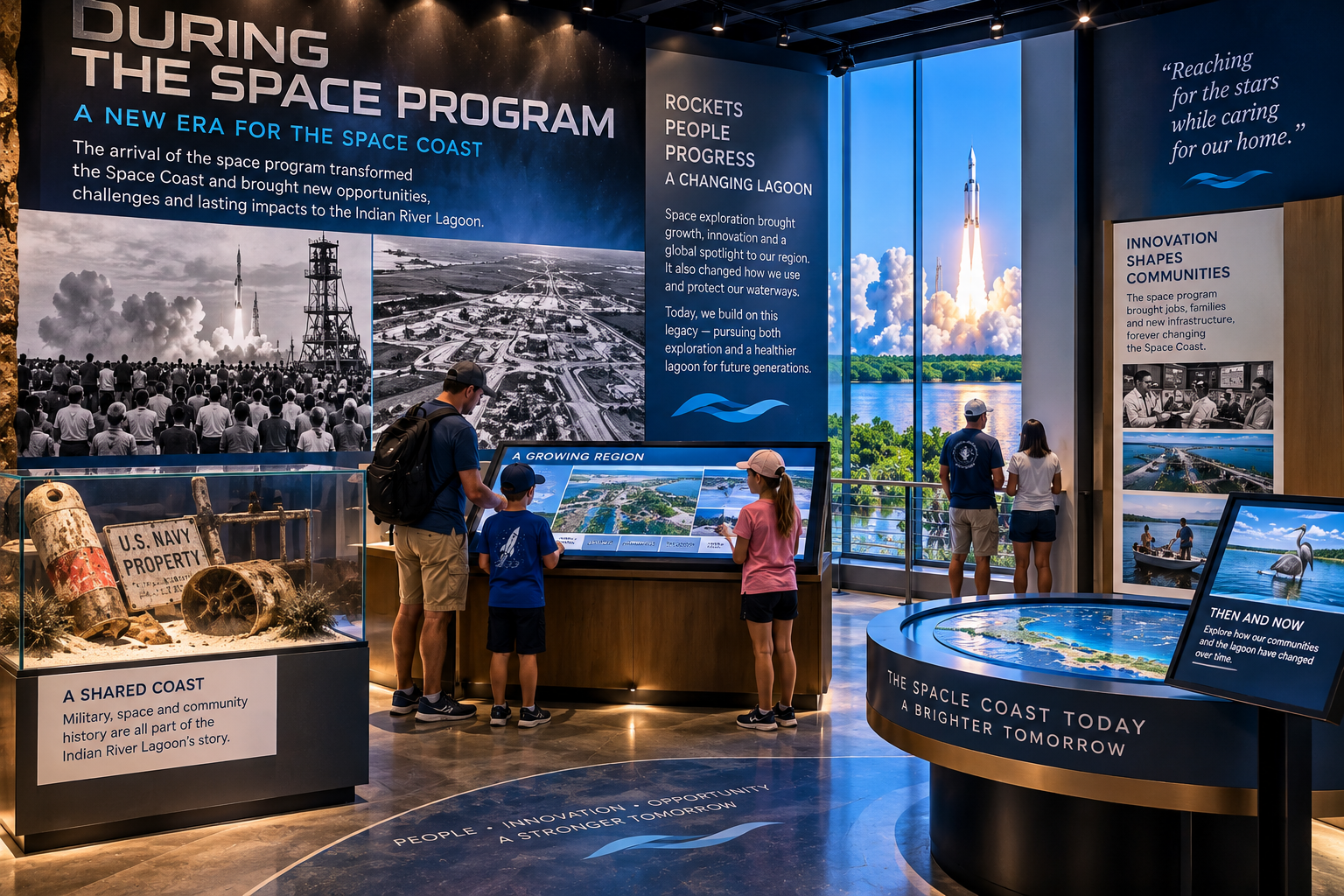
Space Coast Stories
A reviewed collection of photographs, oral histories, memories and historical materials contributed by residents and organizations. All submitted material would require appropriate review before public display. This is not an uncontrolled public publishing system and the archive does not currently exist.
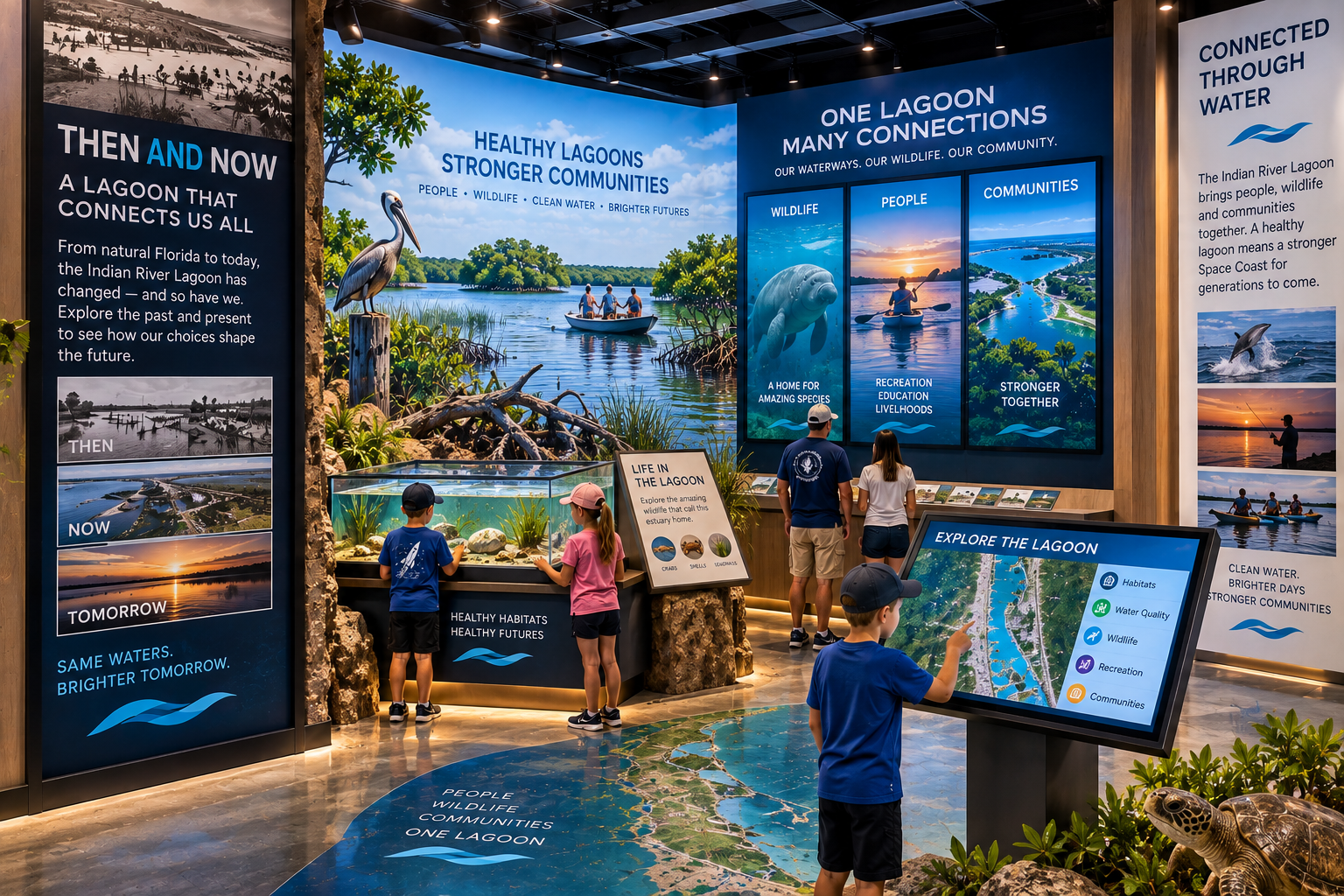
A Major Interactive Experience About Human Modifications to the Lagoon.
Explore canals, locks, dredging, causeways, mosquito-control impoundments, shoreline changes, development, altered water movement and other engineered changes. Use Haulover Canal as an important case study.
Organize case studies around: Why was it built? What benefit did it provide? What did it change? What unintended effects occurred? What did we learn? How can better science inform future decisions?
The Regional Story of a Major Port and Its Coastal Environment.
Tell the regional story of commercial fishing, working waterfront, cargo, maritime commerce, aerospace connections, cruise industry, tourism, recreation, regional growth and the relationship between a major port and the coastal environment.
This is not advertising for Port Canaveral and does not imply Port Canaveral sponsorship or endorsement.
PORT CANAVERAL THROUGH TIME
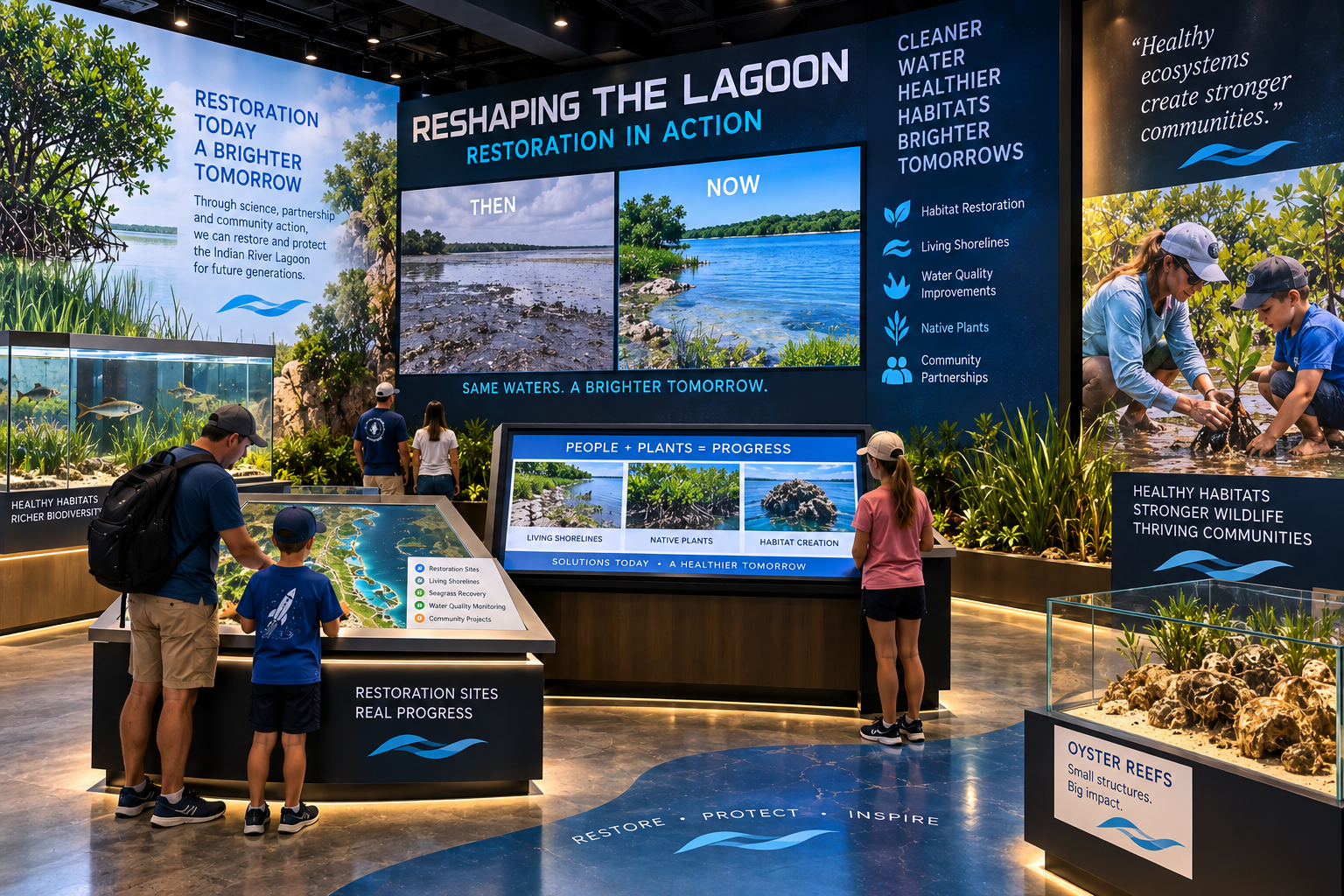
Why the Lagoon Attracts Anglers, Shrimpers, Boaters and Families.
Include recreational fishing and explain the ecology behind important local fisheries. Select a species and explore: Where does it live? What does it eat? What habitat does it need? How does water quality affect it? Why do people come here to catch it?
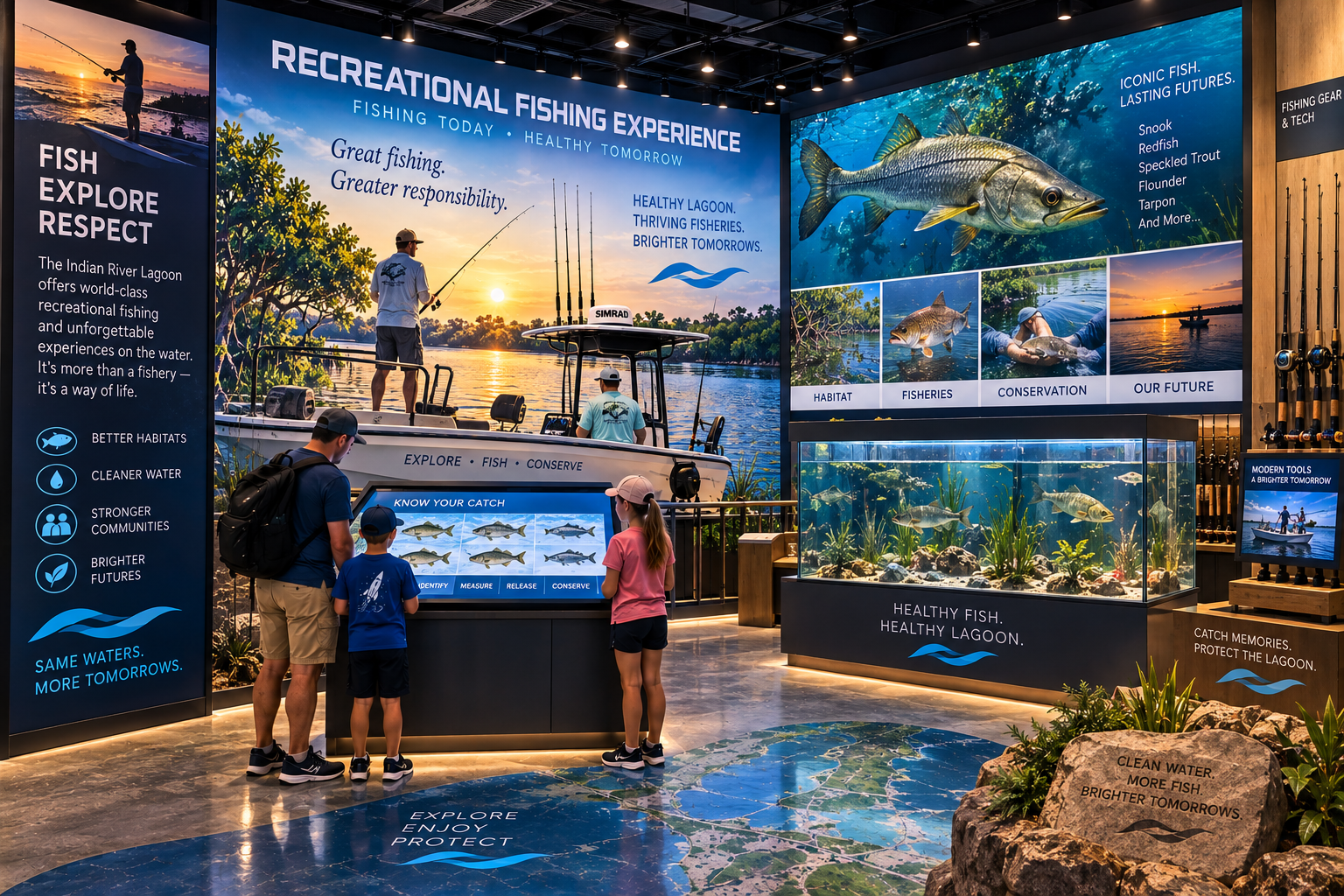
A Memorable Interactive Question About Shrimp Ecology.
Explain shrimp ecology, life cycle, movement and the environmental conditions associated with local recreational shrimping. Consider a simulated digital dip-net or cast-net educational experience.
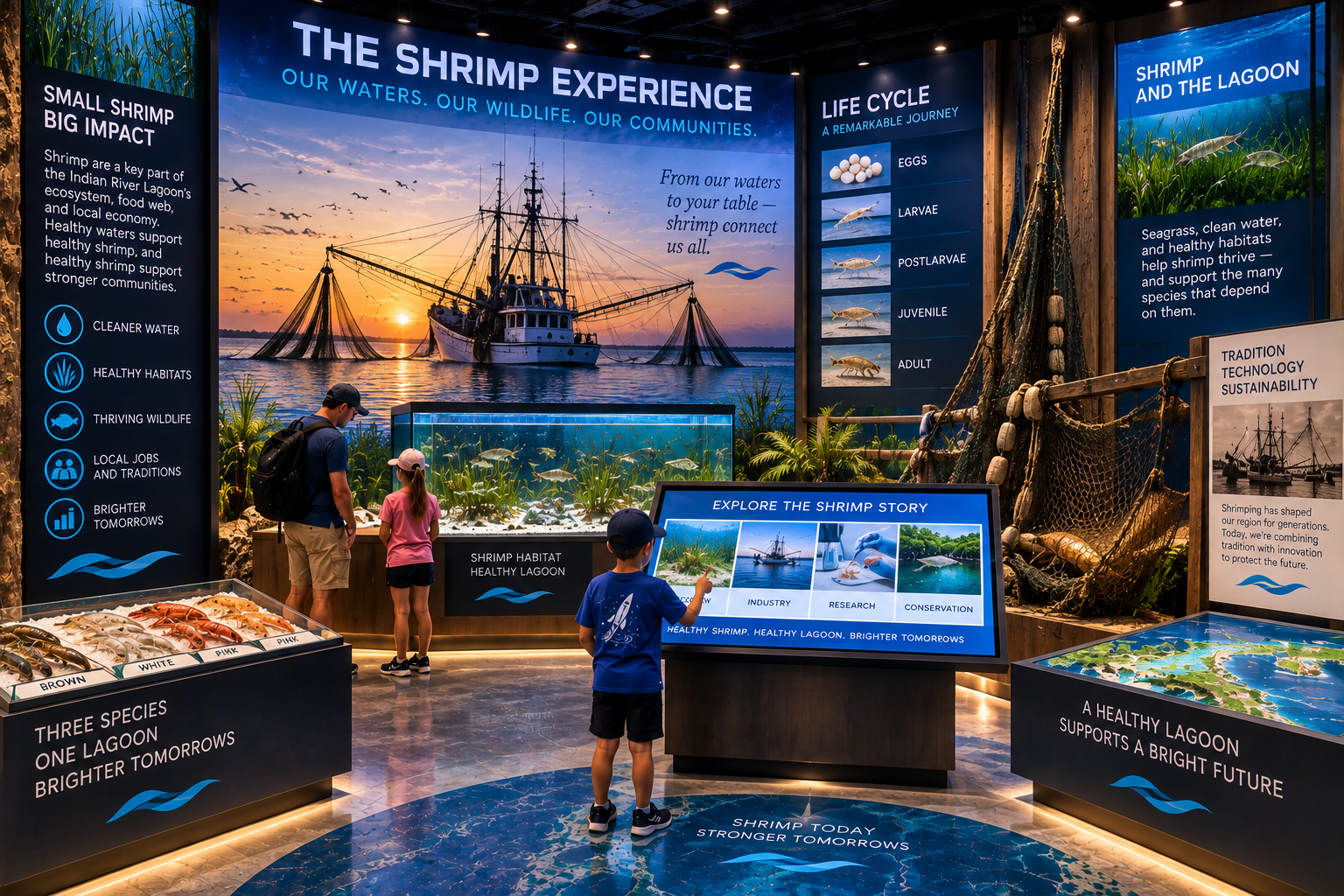
Healthy Water. Healthy Habitat. Healthy Fisheries. Food on Our Table.
Connect commercial fishing, recreational fishing, shrimp, blue crab, stone crab, oysters, clams, shellfish, working waterfronts, local food, healthy habitats and healthy fisheries.
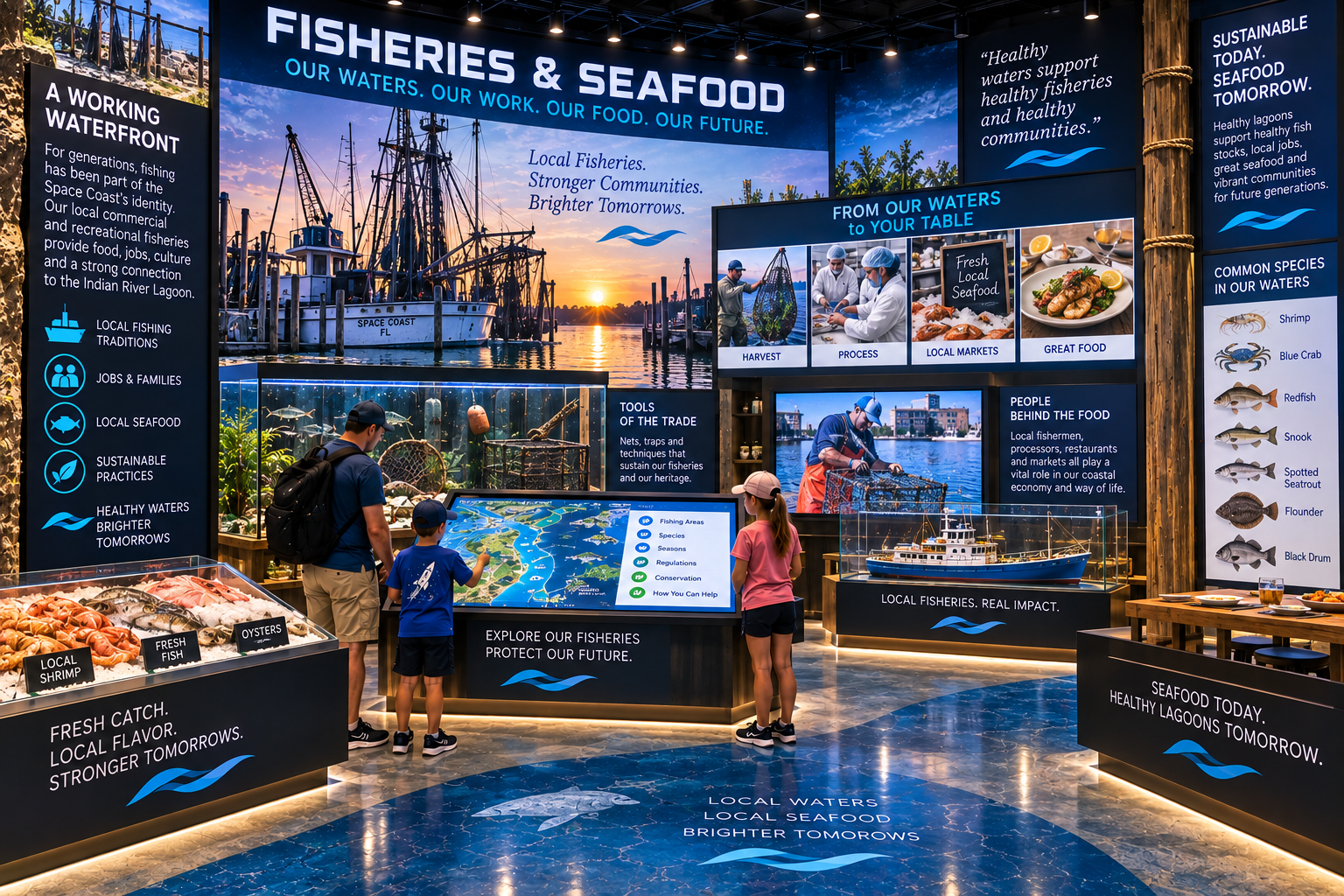
Commercial and Recreational Crabbing on the Lagoon.
Include both commercial and recreational crabbing. Explain blue crab, stone crab, commercial crabbers, recreational crabbing, how traps work, why traps are used, the importance of fisheries to local culture and economy, and how lagoon health affects fisheries. Use verified and current official data for changing numbers rather than hard-coding unsupported statistics.
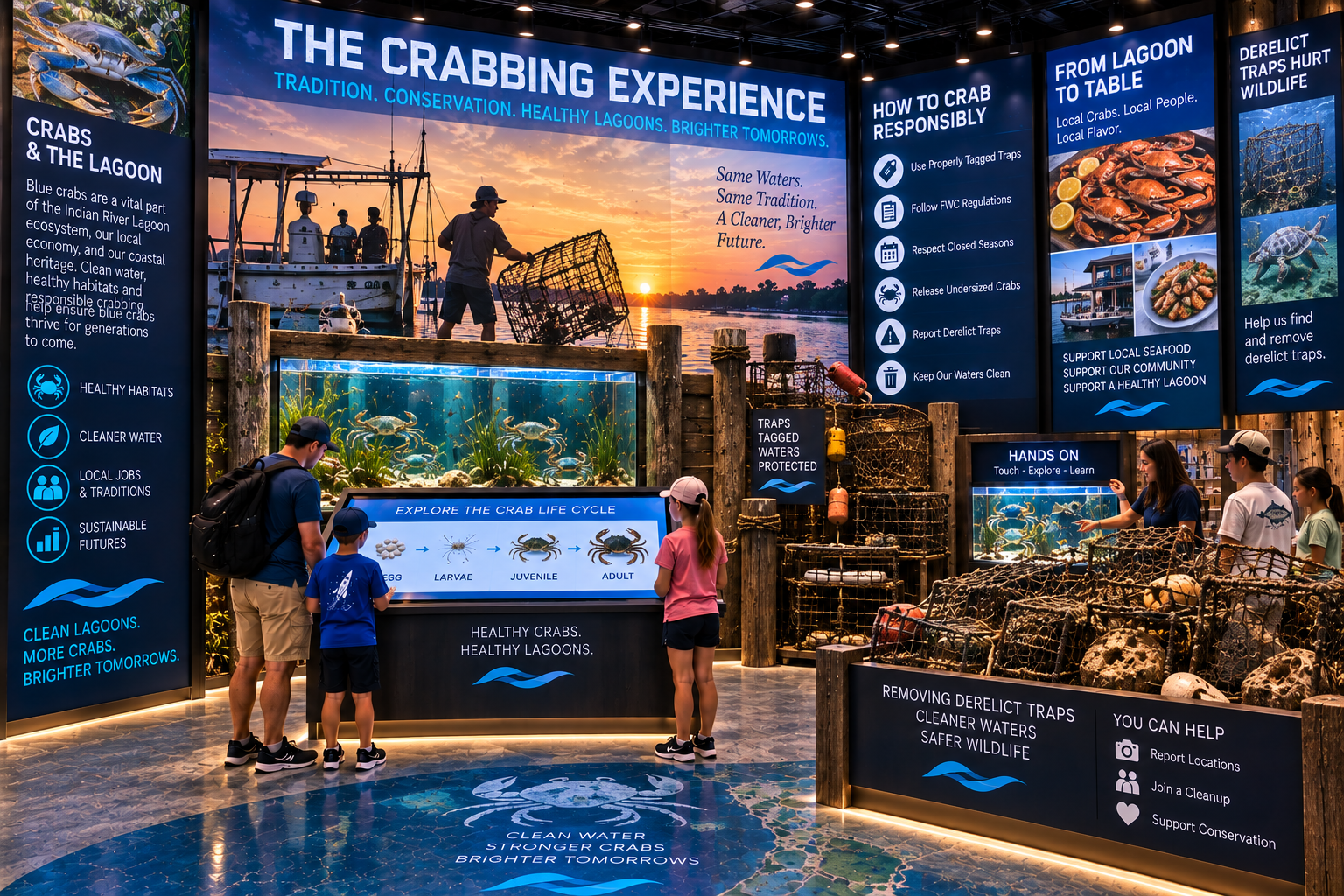
When a Working Trap Becomes a Ghost Trap.
Show the progression: Working trap → lost or displaced gear → derelict gear → potential continued capture, habitat or navigation impact → authorized recovery.
Make clear that crabbers are not being portrayed as the problem. Teach boaters to recognize trap floats and lines, avoid running over them when safely possible, never assume a trap is abandoned, never remove or disturb traps without proper authority, and use appropriate reporting processes.
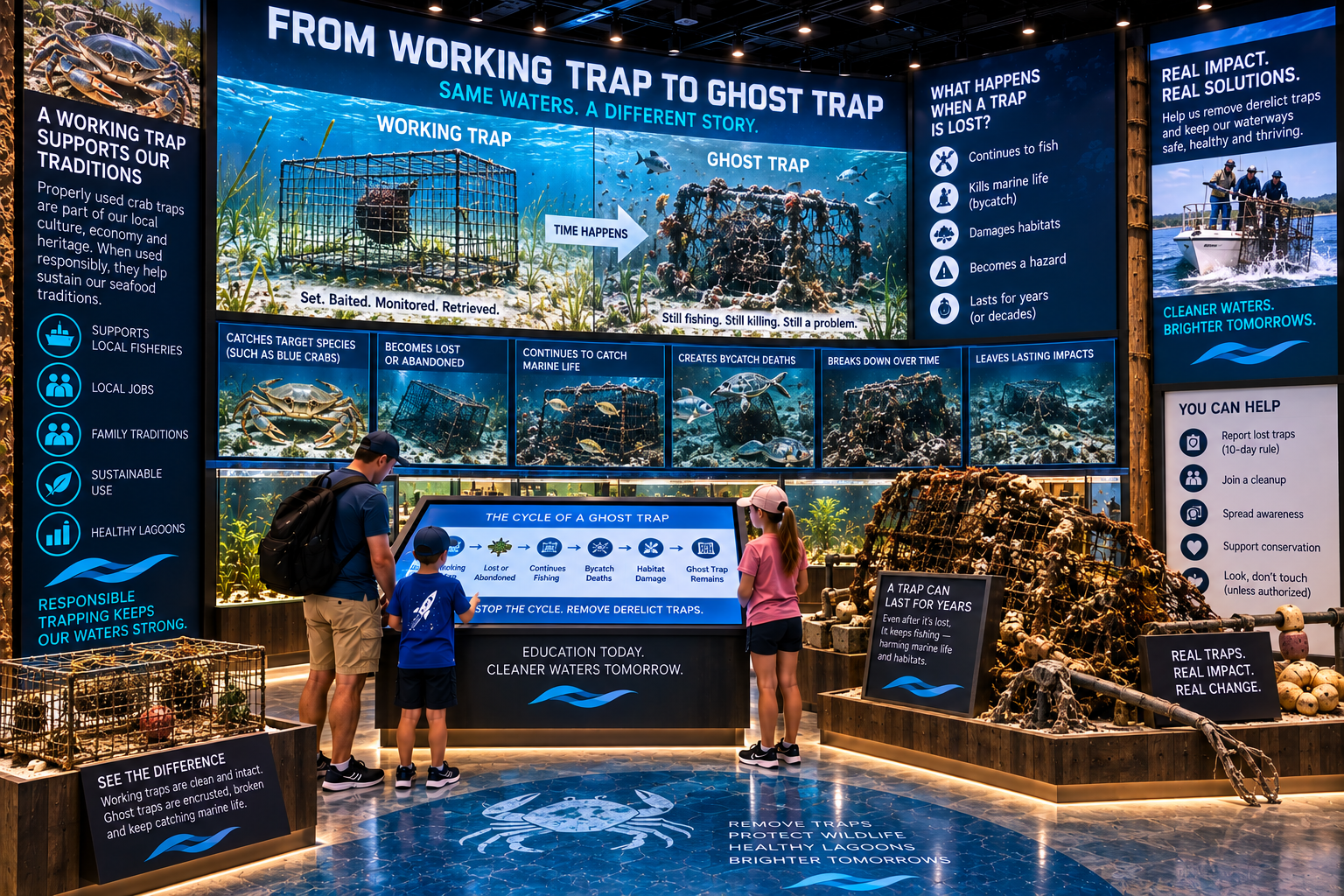
Choose Your Educational Depth.
Use the existing SCWS educational ecosystem to introduce fish, birds, mammals, reptiles, plants, mangroves, seagrass, wetlands, oysters, clams, habitats, invasive species, water quality and ecological relationships. Allow visitors to choose educational depth and connect deeper exploration to Percy's Conservation Academy and the Center's educational system.
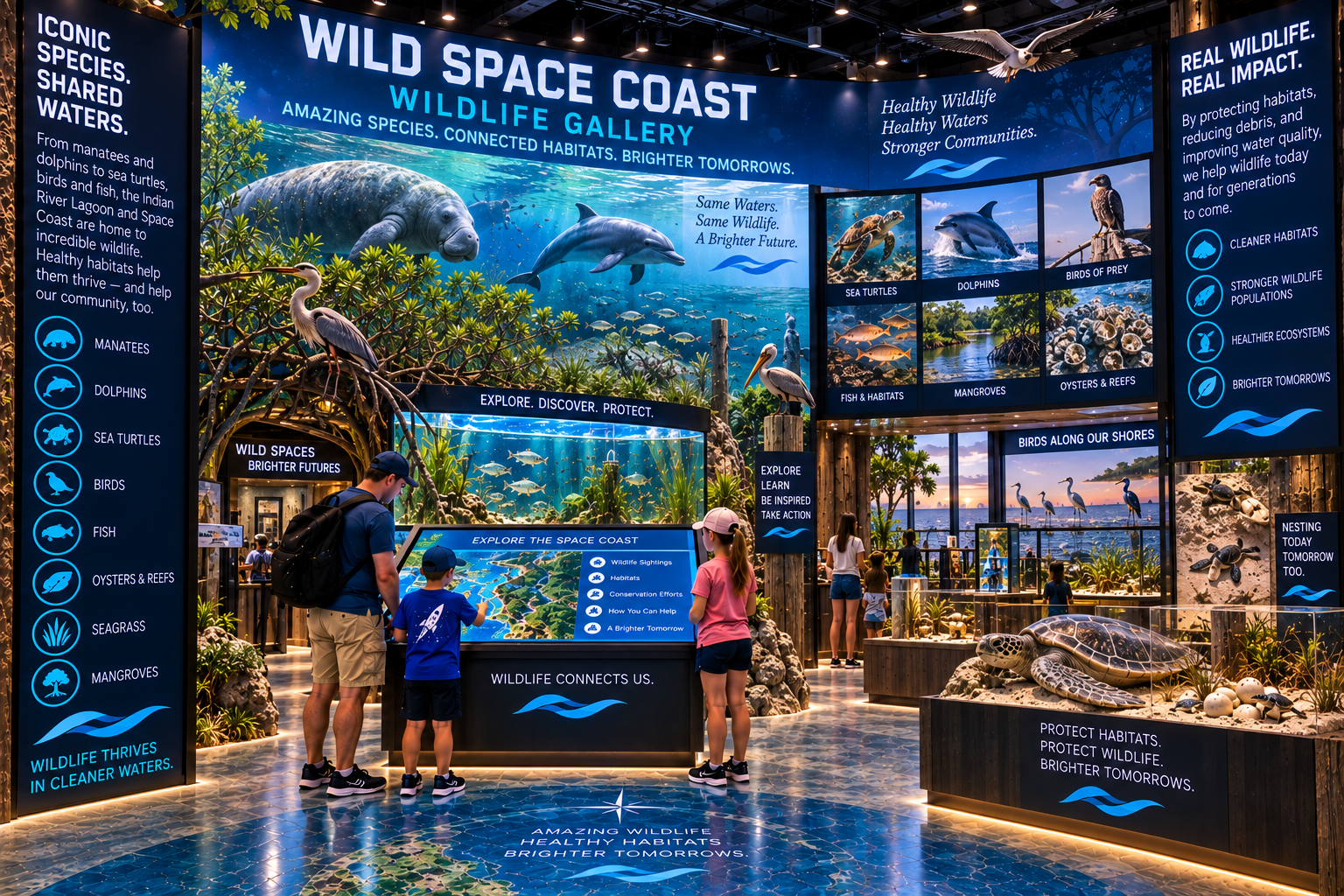
WHO ARE YOU?
WHAT DO YOU WANT TO EXPLORE?
The physical exhibit provides concise interactive learning and directs interested visitors toward deeper digital learning through Percy's Conservation Academy and other Center educational resources. Designed for children AND adults.
Bringing People, Growth, Waterways, Wildlife and Change Together.
The final portion of the gallery brings together people, growth, waterways, wildlife, industry, fisheries, environmental change and conservation — then directs visitors toward Currents Through Time and the Living Lagoon Monitor where environmental change can be explored through data and evidence.
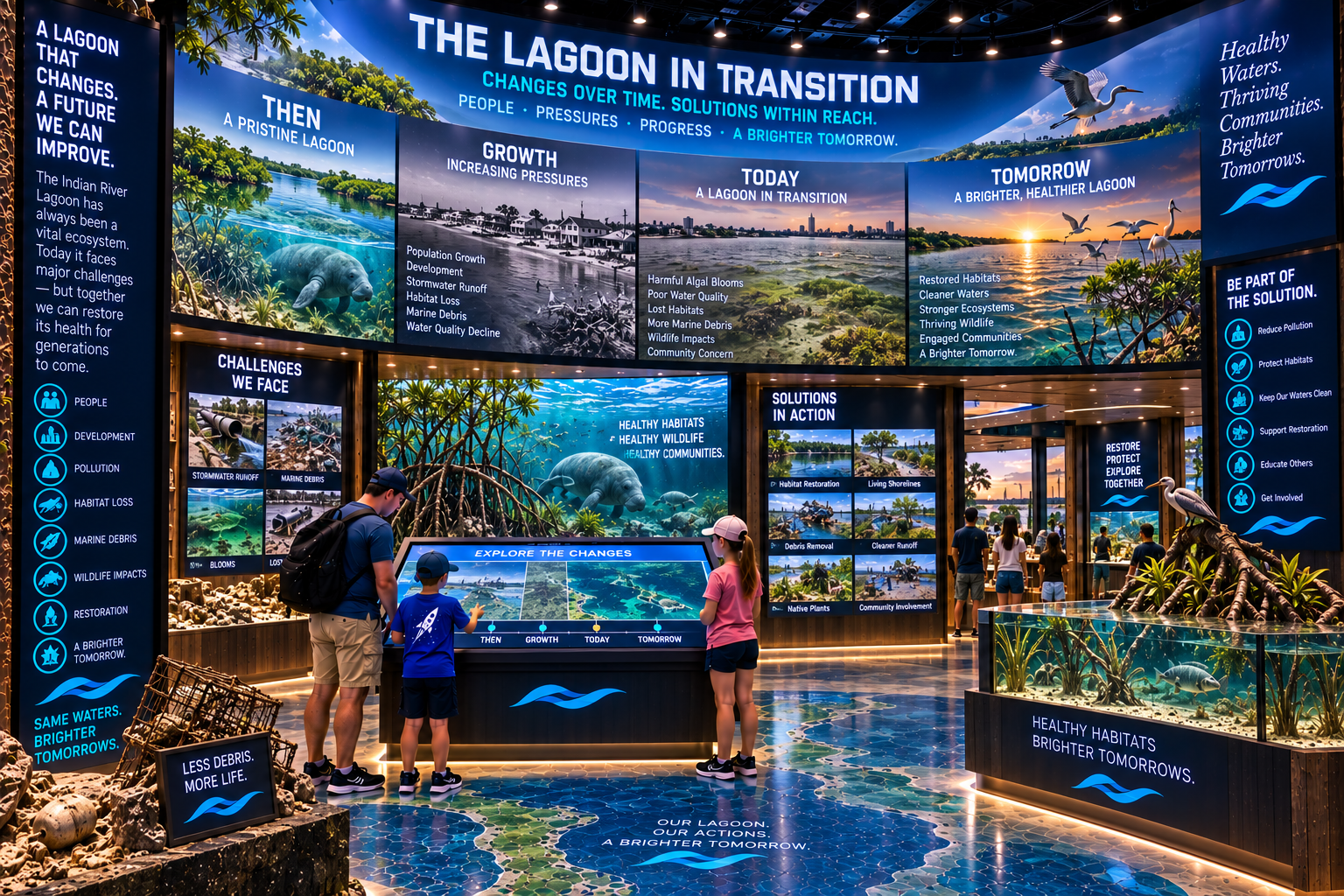
Ten Story Zones. One Interconnected Region.
Our Space Coast complements but does not duplicate the Space Coast Through Time Tower. The Tower primarily tells the vertical Space Coast and aerospace story. Our Space Coast tells the deeper story of people, communities, wildlife and cultural relationships with the water.
Before Us
Natural lagoon, natural Florida landscape, Indigenous history, earliest human relationships with the lagoon, early communities, fishing and maritime life.
People Who Built the Space Coast
Families, communities, fishing families, agriculture, citrus, local towns, community leaders, workers, businesses, industries, tourism and people whose lives helped shape Brevard. Includes a potential future Space Coast Stories community-history feature.
Reshaping the Lagoon
A major interactive experience about human modifications to the lagoon — canals, locks, dredging, causeways, mosquito-control impoundments, shoreline changes and altered water movement. Haulover Canal case study.
Port Canaveral: Gateway to the World
Commercial fishing, working waterfront, cargo, maritime commerce, aerospace connections, cruise industry, tourism, recreation and the relationship between a major port and the coastal environment.
Why We Come to the Water
The cultural and ecological story of why the Indian River Lagoon attracts anglers, shrimpers, boaters and families — including recreational fishing and the ecology behind important local fisheries.
Why Do the Shrimp Run?
Shrimp ecology, life cycle, movement, environmental conditions and local recreational shrimping culture — including a potential simulated digital dip-net experience.
From the Lagoon to Our Table
Commercial fishing, recreational fishing, shrimp, blue crab, stone crab, oysters, clams, shellfish, working waterfronts, local food and healthy habitats.
Crabbing & Working Waterfronts
Commercial and recreational crabbing, blue crab, stone crab, traps, working crabbers and the connection between fisheries and Lagoon health. Includes derelict-trap education.
Wild Space Coast
Fish, birds, mammals, reptiles, plants, mangroves, seagrass, wetlands, oysters, clams, habitats, invasive species, water quality and ecological relationships. Interactive learning for all ages.
A Lagoon in Transition
The final portion of the gallery brings together people, growth, waterways, wildlife, industry, fisheries, environmental change and conservation — then directs visitors toward Currents Through Time and the Living Lagoon Monitor.
Space Coast Through Time — Observation & Launch Tower
The Space Coast Through Time Observation & Launch Tower is envisioned as a six-story, climate-controlled visitor attraction combining Space Coast history, Indian River Lagoon history, conservation, aerospace, STEM, future technology, panoramic lagoon views and rocket-launch viewing.
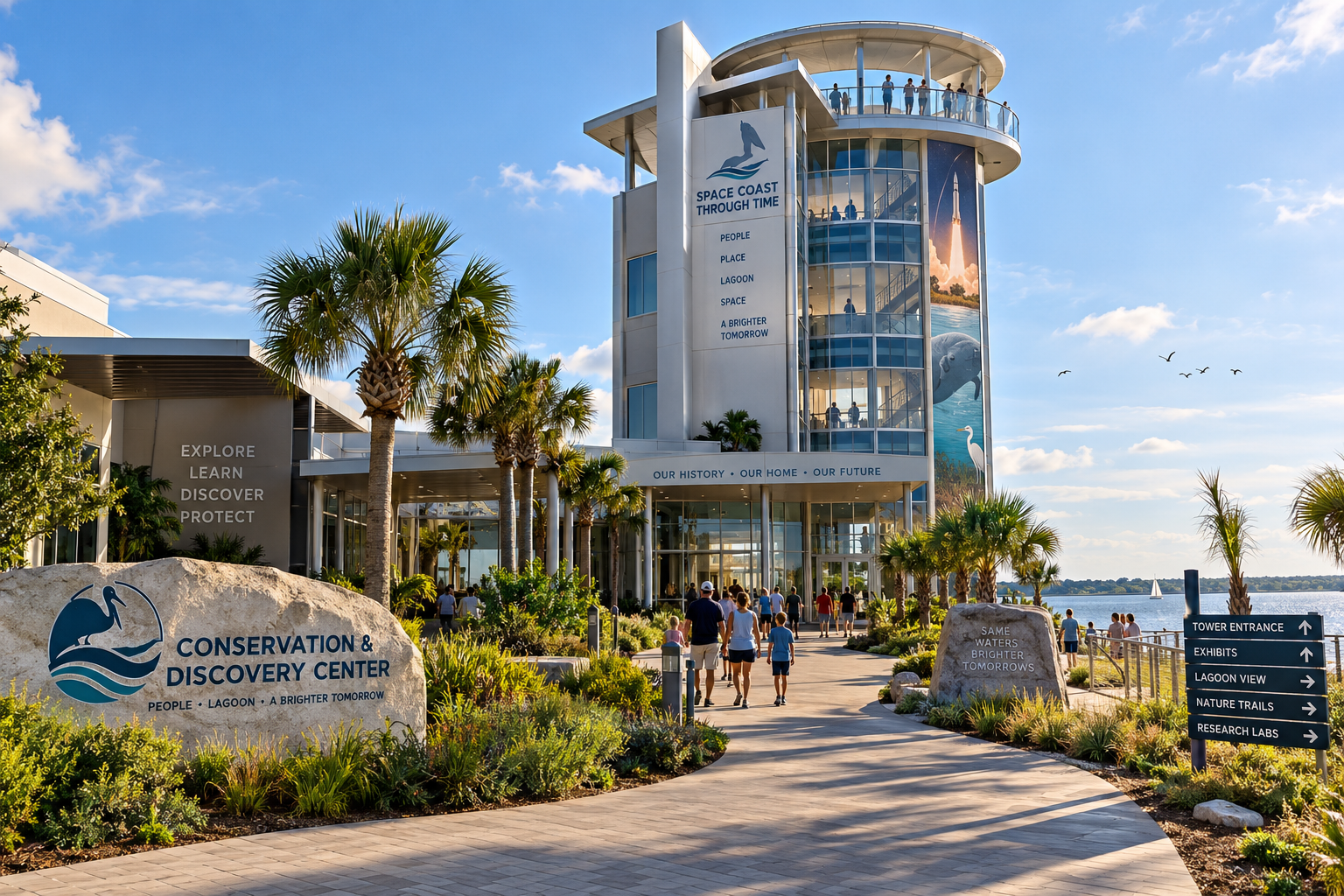
A Vertical Journey Through Time.
Each enclosed tower level is designed around a central elevator and stair building core with walk-around visitor circulation, floor-to-ceiling lagoon-facing glass and large adaptable digital exhibit walls. Levels 1–5 use adaptable digital exhibit infrastructure rather than relying heavily on permanent printed museum walls.
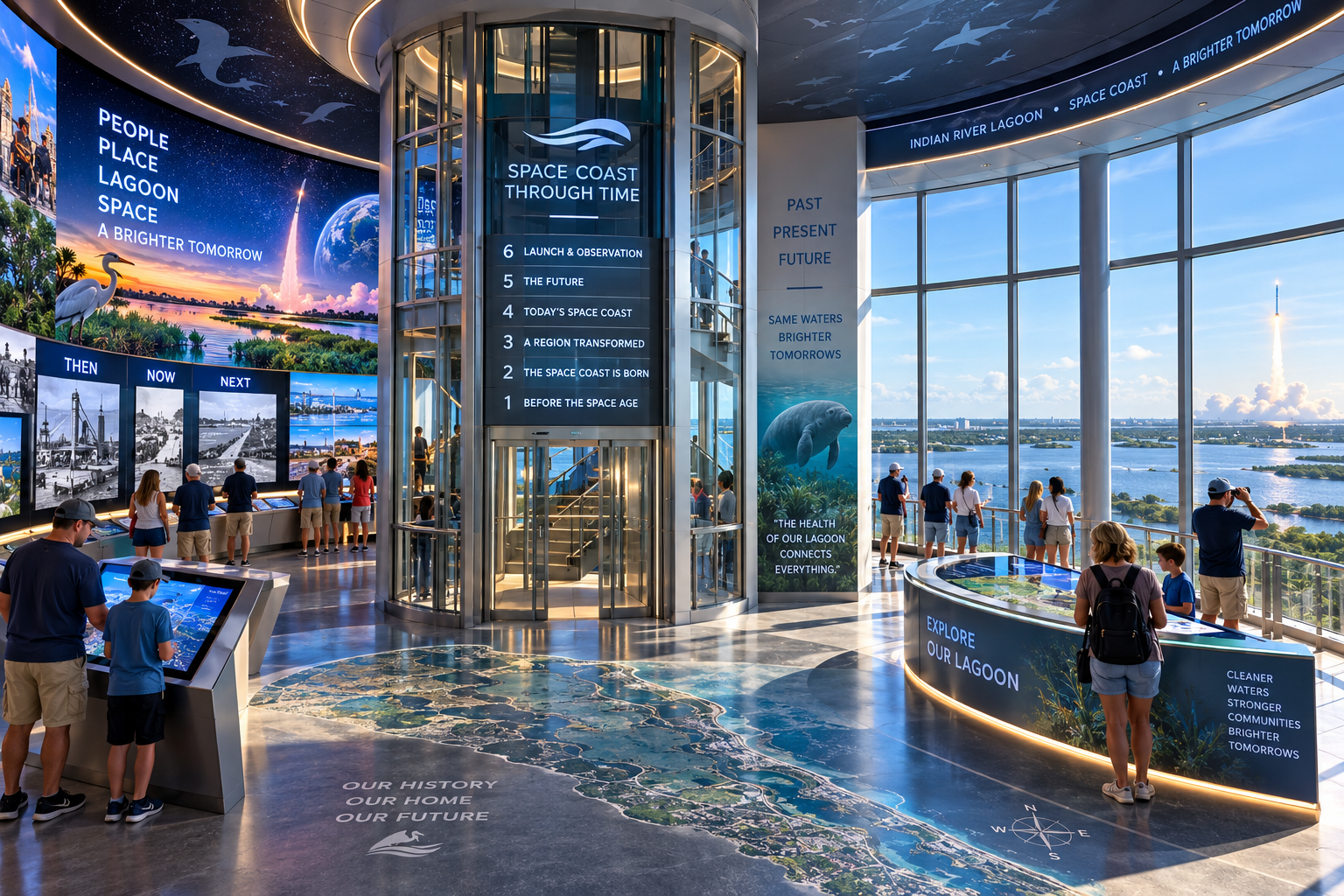
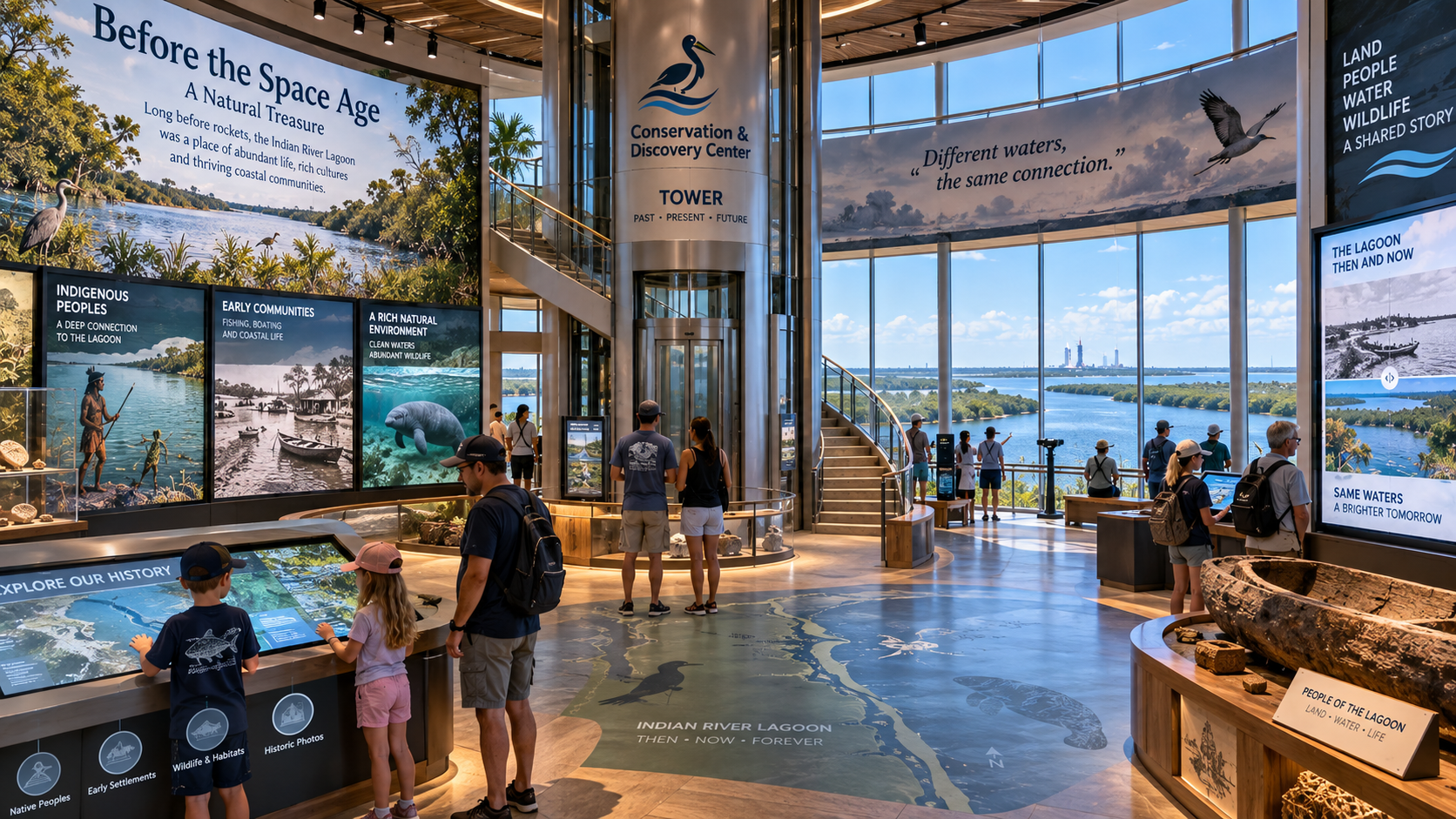
Introduce the Region Before the Modern Space Coast.
Topics may include the Indian River Lagoon, natural Florida, Indigenous history, early communities, fishing and maritime life, wildlife and the original coastal environment.
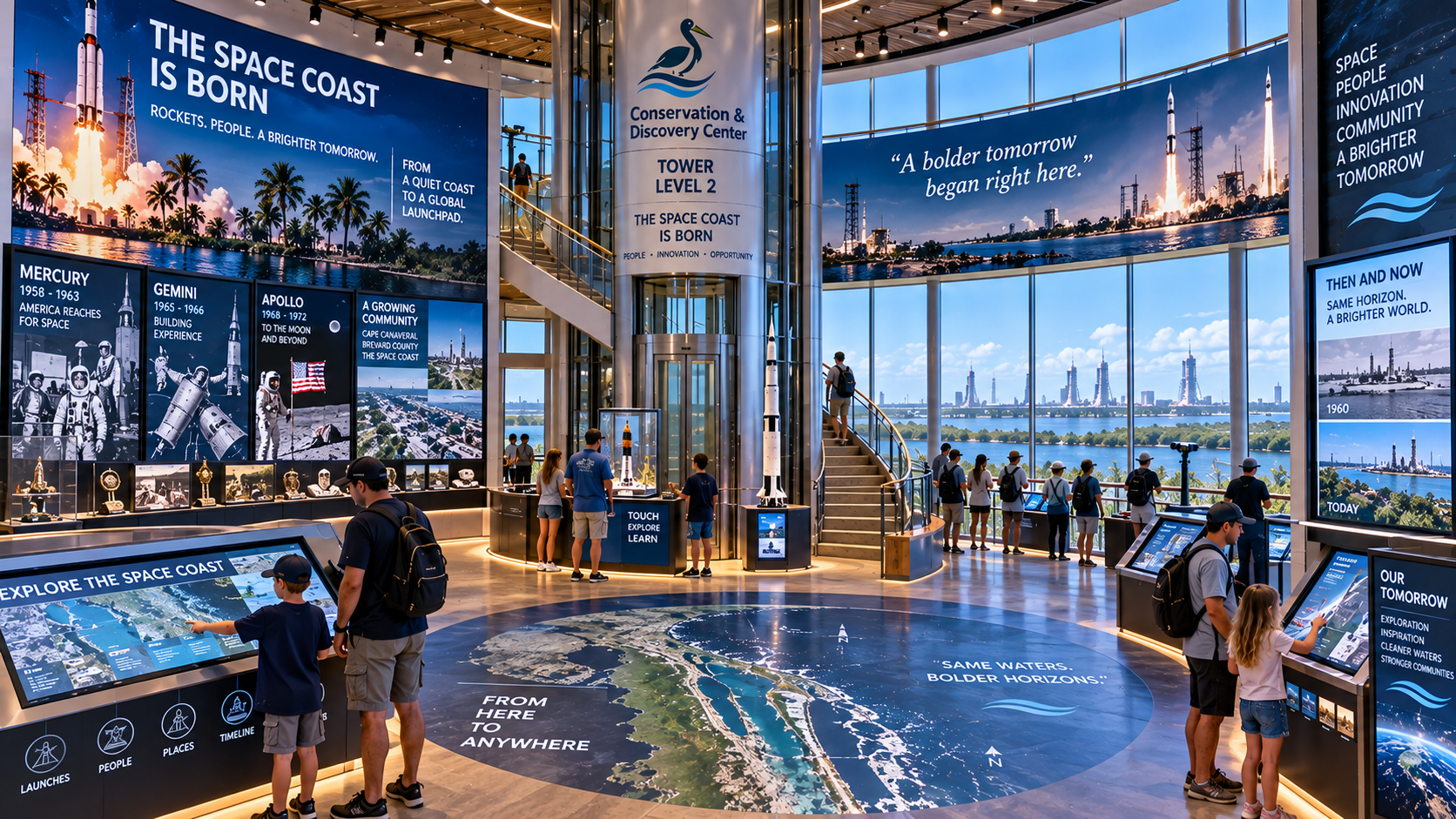
Cape Canaveral, Mercury, Gemini, Apollo and the Birth of the Space Coast.
Cover Cape Canaveral, Mercury, Gemini, Apollo, the early space program, the growth of Brevard County and the transformation into the Space Coast. Connect aerospace development with changes occurring in the surrounding communities and lagoon.
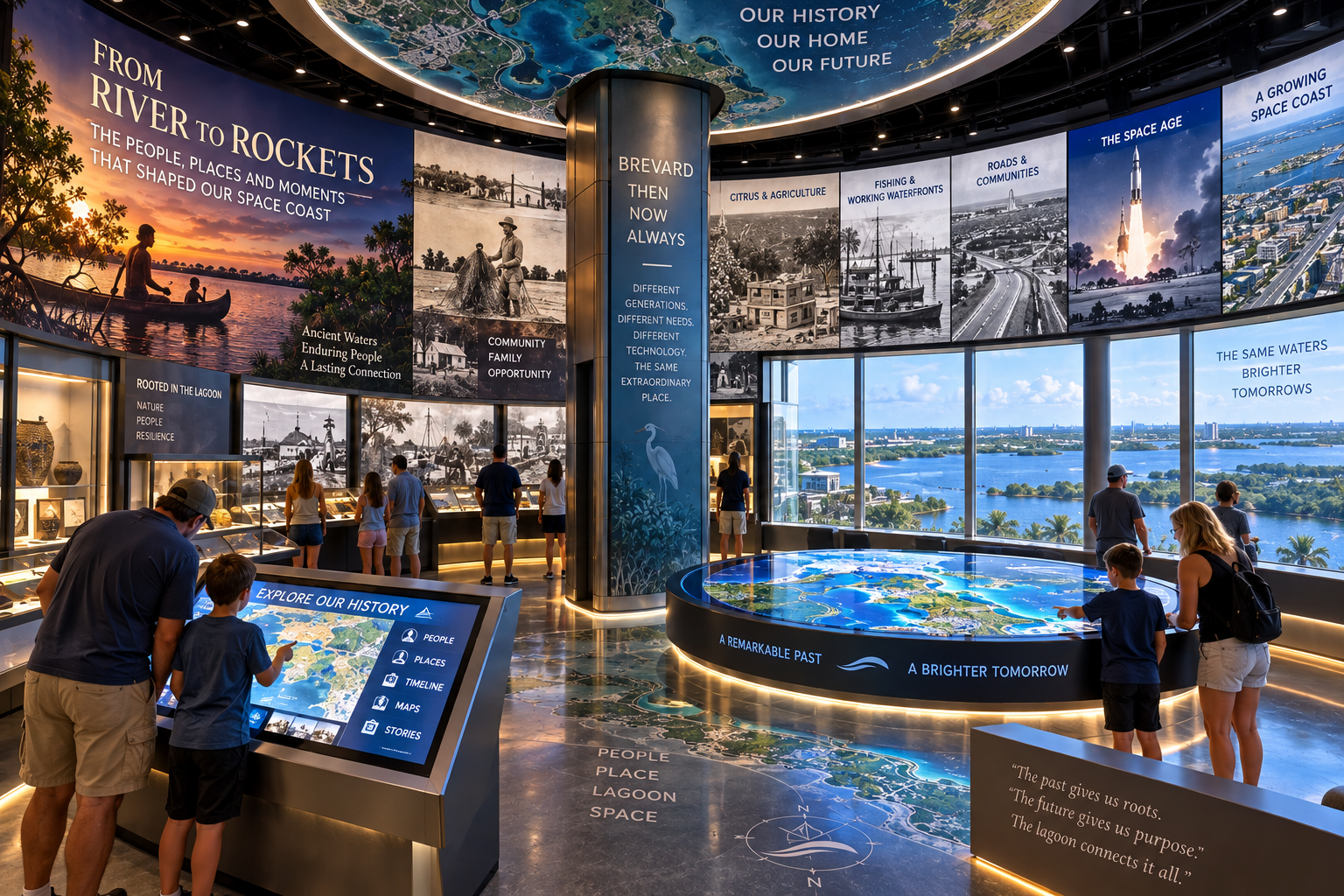
The Shuttle Era, Aerospace Expansion and a Changing Region.
Cover the Shuttle era, aerospace expansion, population growth, roads, housing, industry, regional development and environmental changes occurring during the same period.
Communities make decisions based upon the needs, technologies and knowledge available at the time, and environmental understanding evolves.
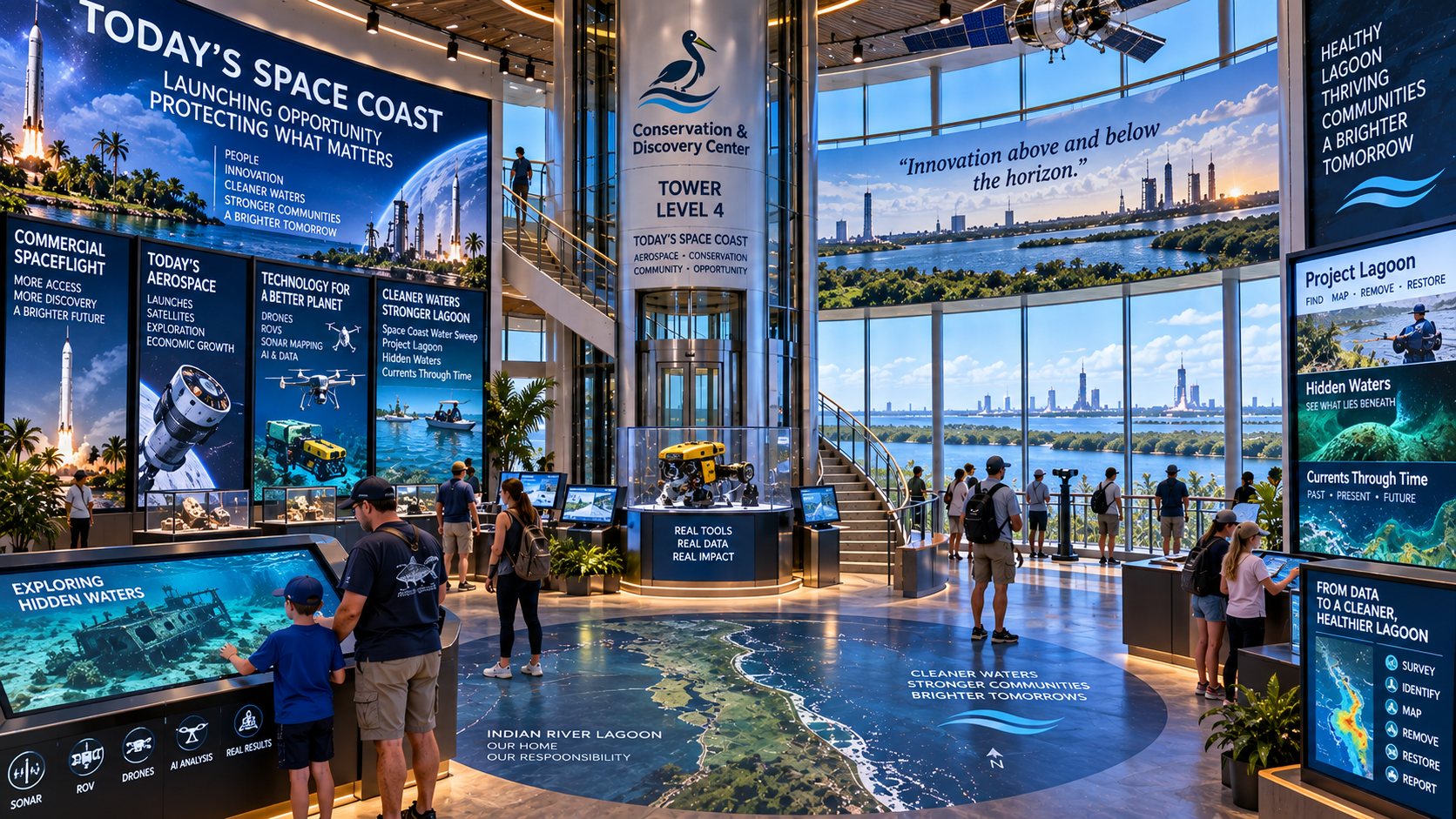
Aerospace Innovation and Environmental Stewardship Can Coexist.
Cover commercial spaceflight, current aerospace activity, modern conservation, Space Coast Water Sweep, Project Lagoon, Hidden Waters, Currents Through Time, drones, ROVs, sonar, environmental monitoring and restoration technology.
What Kind of Space Coast Do We Want to Leave for the Next Generation?
Explore reusable launch systems, lunar exploration, Mars, advanced aerospace, robotics, AI, drones, environmental technology, STEM careers, conservation science and future generations of the Space Coast.
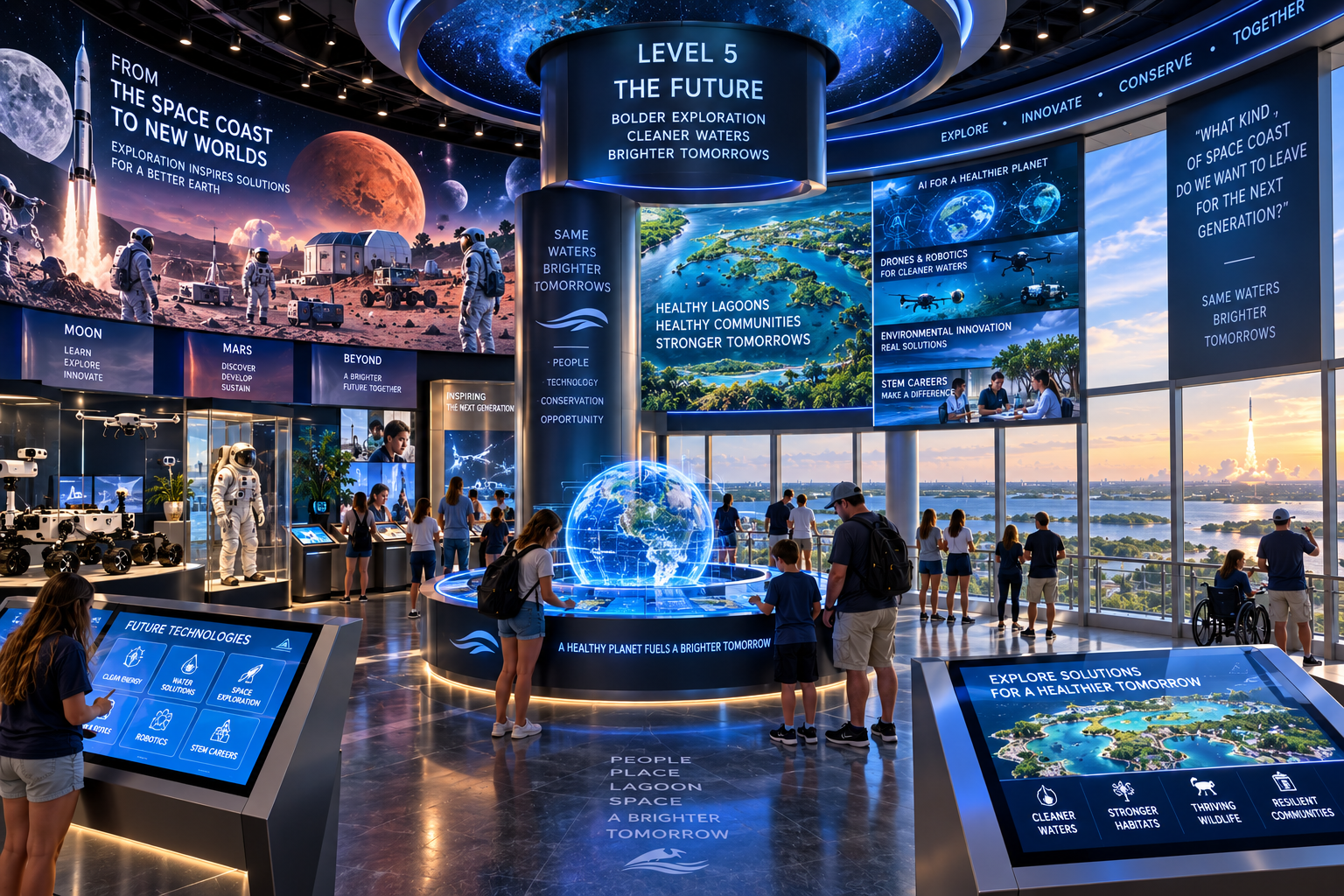
The Culmination of the Journey From Past to Present to Future.
A primarily panoramic observation and event destination. Potential uses include rocket launch viewing, launch parties, educational launch events, aerospace events, conservation events, sponsor events, donor events, community gatherings and appropriate private/corporate events.
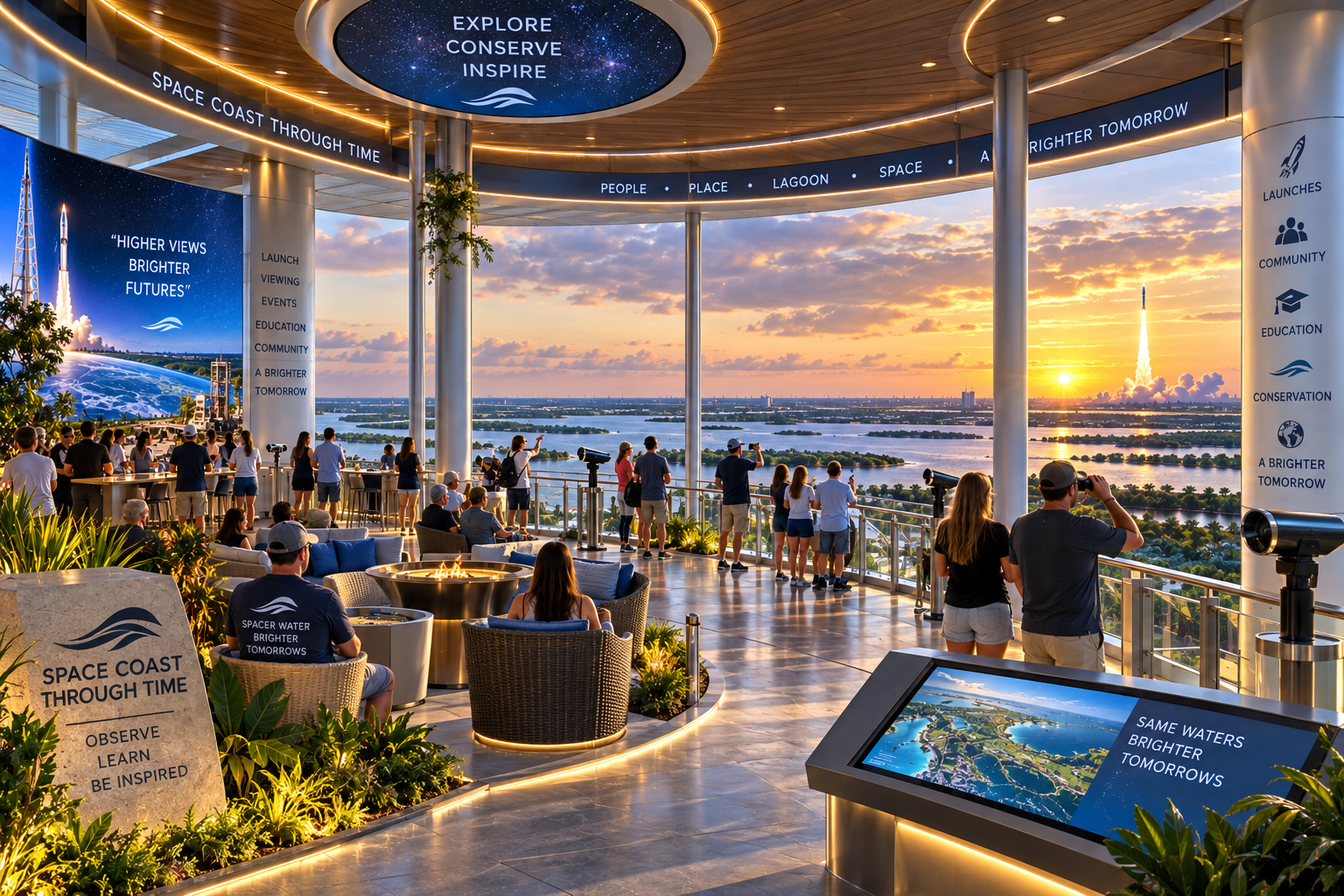
One Tower. Many Modes.
Levels 1–5 use adaptable digital exhibit infrastructure rather than relying heavily on permanent printed museum walls. This allows the tower to shift between conceptual modes.
NORMAL MODE
Historical experience assigned to each level.
LAUNCH MODE
Mission information, countdown, cameras, weather, trajectory and educational launch information.
SCHOOL / STEM MODE
Age-appropriate educational content.
CONSERVATION MODE
Project Lagoon, Currents Through Time, ROV, sonar, drone, restoration and environmental information.
PARTNER / EVENT MODE
Approved event-specific information without permanently branding the tower to any organization.
The Center and tower remain sponsor-neutral.
When a Launch Lights Up the Sky, the Whole Tower Comes Alive.
During a launch event, the tower's digital infrastructure can synchronize to show mission information, countdown, cameras, weather, trajectory and educational launch information across every level.
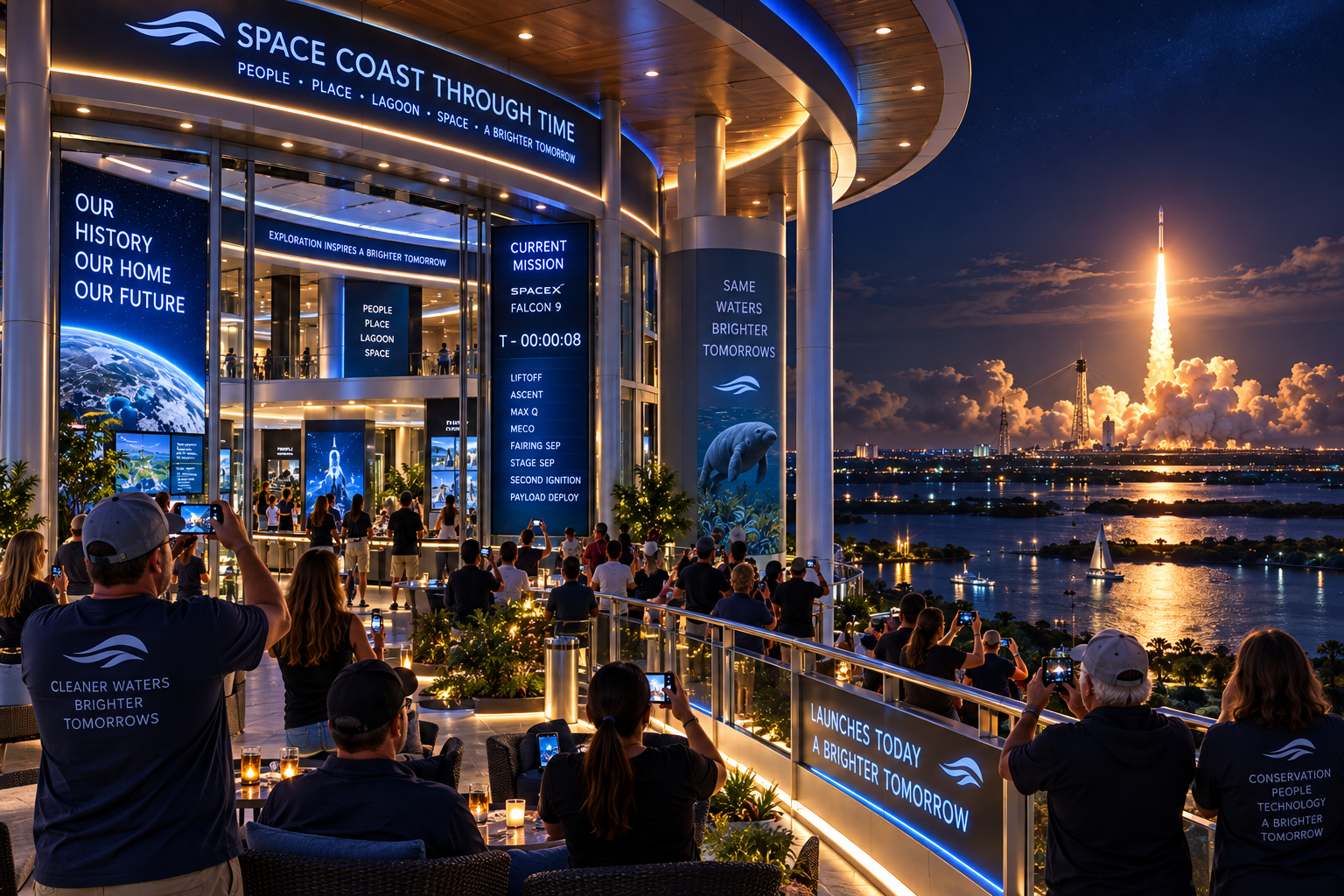
CONCEPTUAL PLANNING
The six-story Space Coast Through Time Observation & Launch Tower is a master-plan conceptual vision. Final tower design is subject to property selection, zoning, height restrictions, FAA/airport considerations, engineering, accessibility, fire/life-safety requirements and permitting. The conceptual six-story vision is not reduced merely because final site analysis has not occurred.
Science Begins in the Lagoon
From field observations to research questions. The Research Laboratory. Environmental analysis. Experimental water treatment research.
Don't Just Study the Problem.
Build a Better Solution.
The Conservation & Discovery Center is envisioned as a place where field observations from the Indian River Lagoon can connect directly with research, engineering, environmental data, prototype development and real-world testing.
A problem discovered by Project Lagoon could become a research question, a new design, a prototype, a field test — and eventually a conservation solution capable of being used far beyond one location.
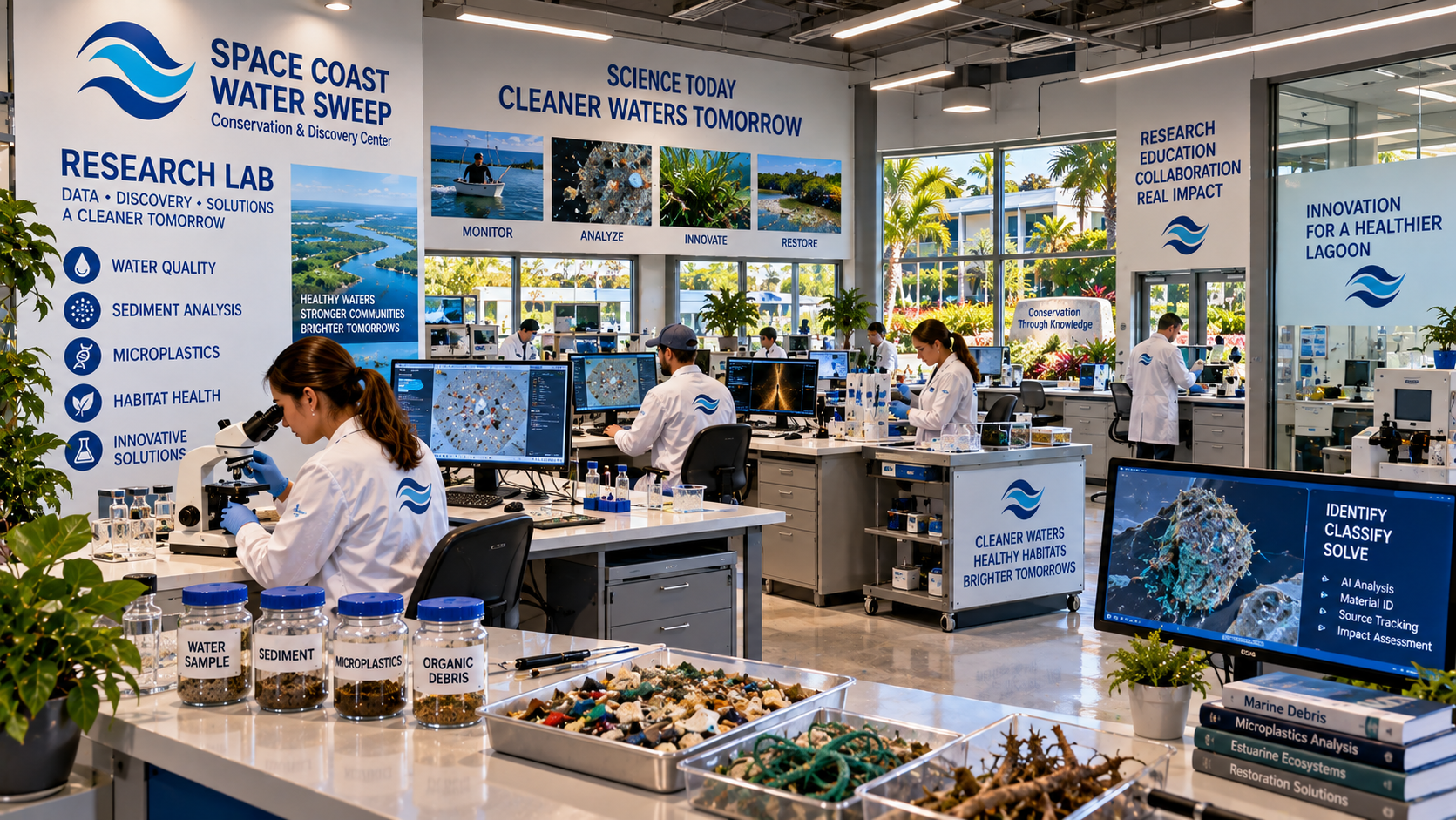
The Best Research Questions May Start Out on the Water.
Science and innovation begin with actual environmental observations. Not every observation automatically becomes a research project — but real-world experience can surface questions worth investigating.
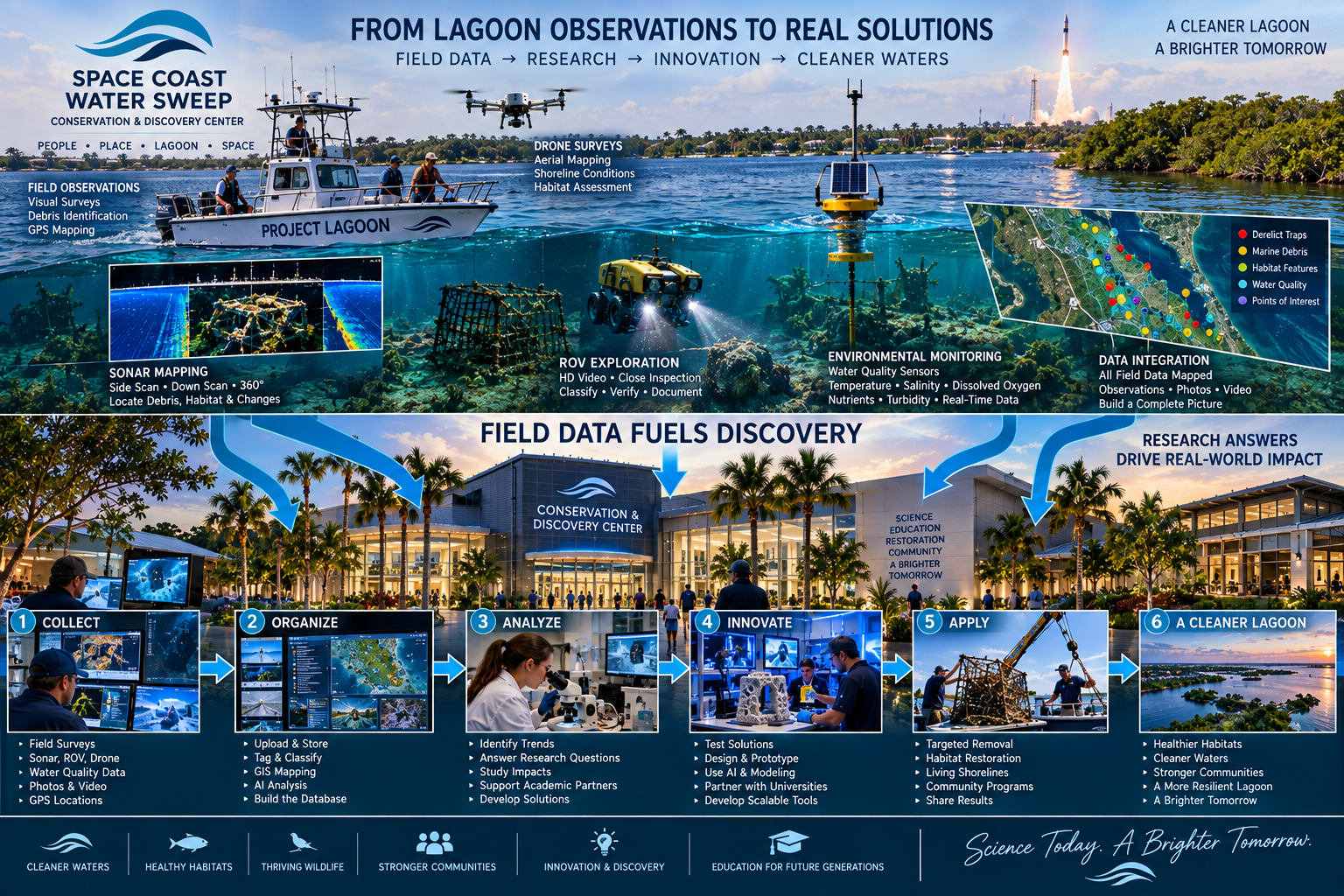
Understand the Environment Before Trying to Change It.
The proposed environmental Research Laboratory may support appropriate analysis of water, sediment, soil, sand, environmental materials, debris-related materials, potential leachate, microplastics, material composition and selected field samples. Future specialized equipment may include technologies such as XRF or other appropriate analytical systems, subject to final research scope, staffing, safety requirements and funding.
The proposed laboratory is not an accredited regulatory testing laboratory. It does not currently perform certified compliance testing. Specific analytical capabilities are not promised until equipment, methods and staffing are established.
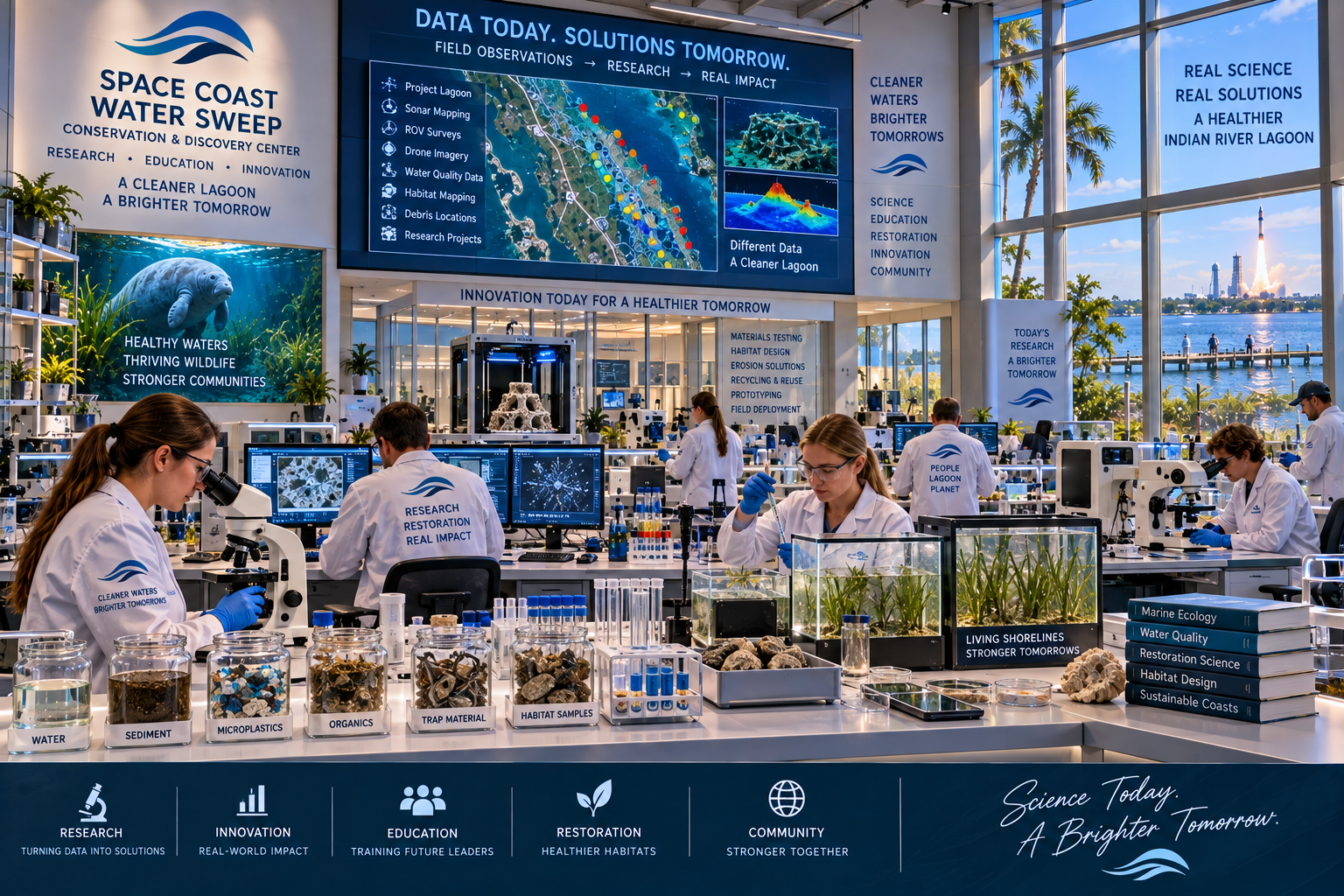
A Real-World Place Where New Water-Quality Solutions Can Be Developed, Tested and Demonstrated.
The Lagoon Water Treatment & Environmental Engineering Testbed is envisioned as a real-world environmental engineering research site where technologies that could improve estuarine water quality can be developed, tested, measured and demonstrated.
The Center is not claiming that one filtration system will clean the Indian River Lagoon. The Center is creating a place where new methods of improving lagoon water quality can be developed, tested, measured, demonstrated and — when successful — scaled into real-world solutions.
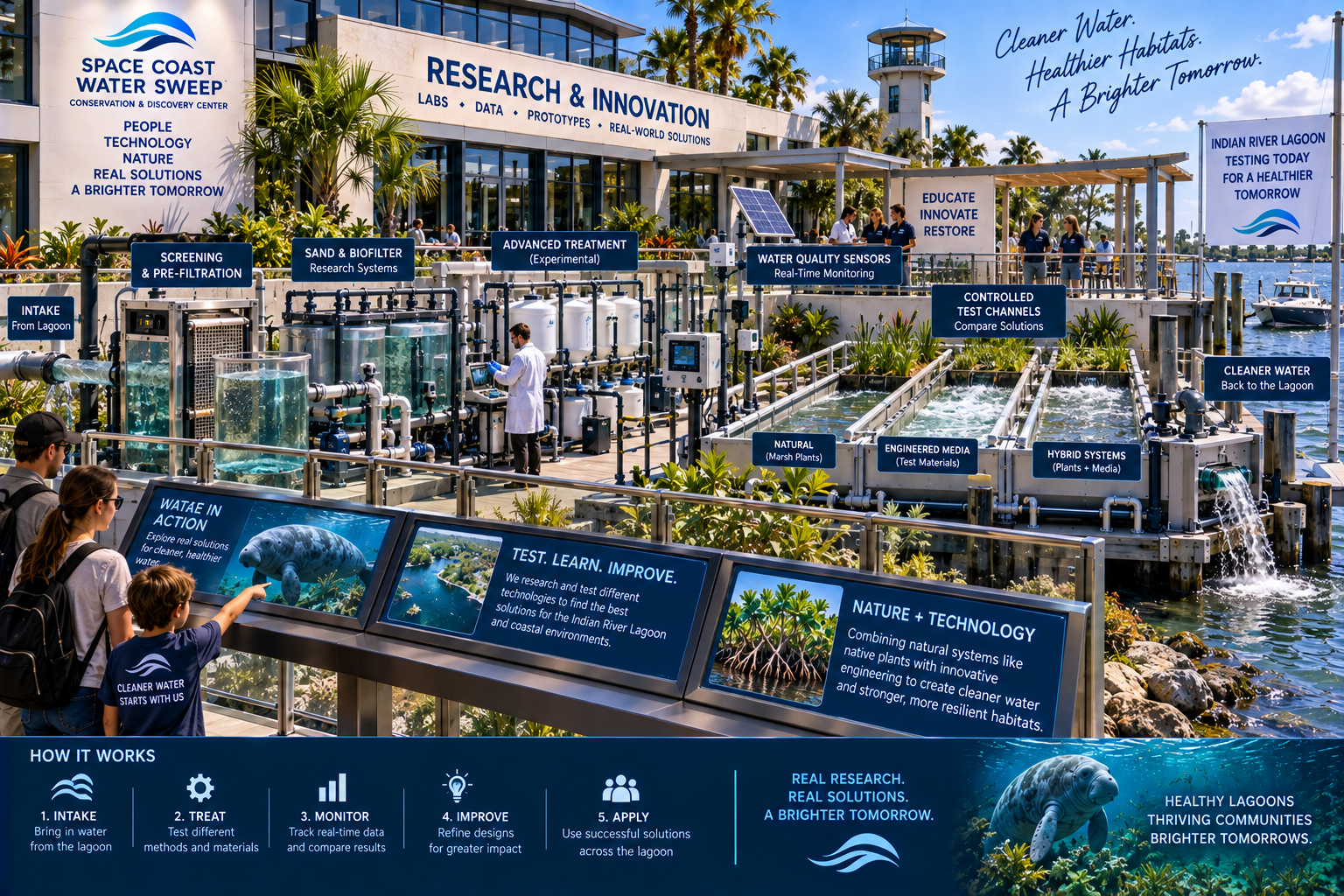
See Incoming Water. See Treated Water. See the Difference.
Connect the system to the Research Lab and AI/Data Hub. Where practical, allow visitors to see portions of the system and compare incoming water versus treated water through live digital exhibits.
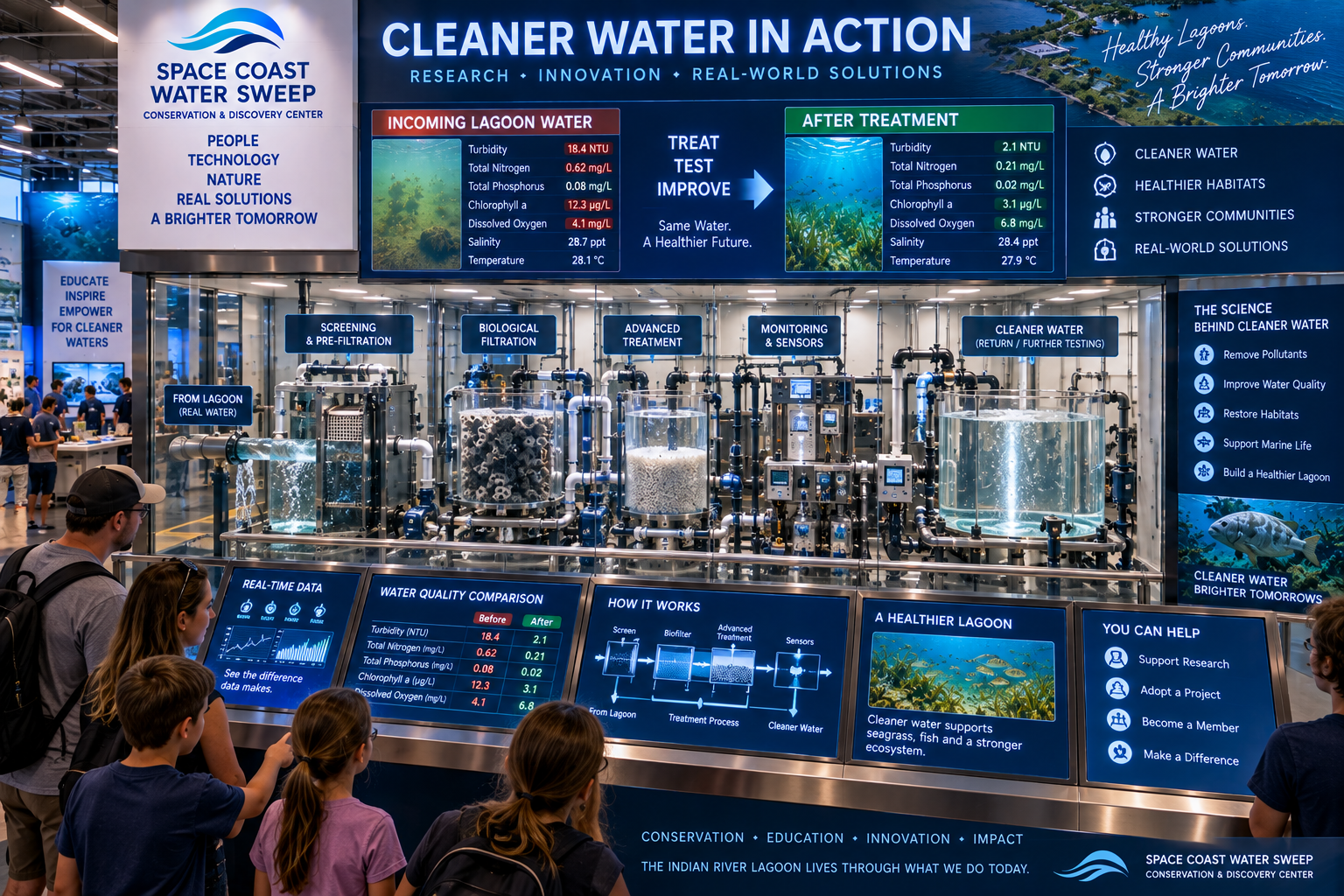
Three Categories of Research.
Organize research around three connected intervention zones: preventing and treating impacts before water enters the lagoon, controlled treatment and research within lagoon conditions, and post-treatment return, reuse and monitoring.
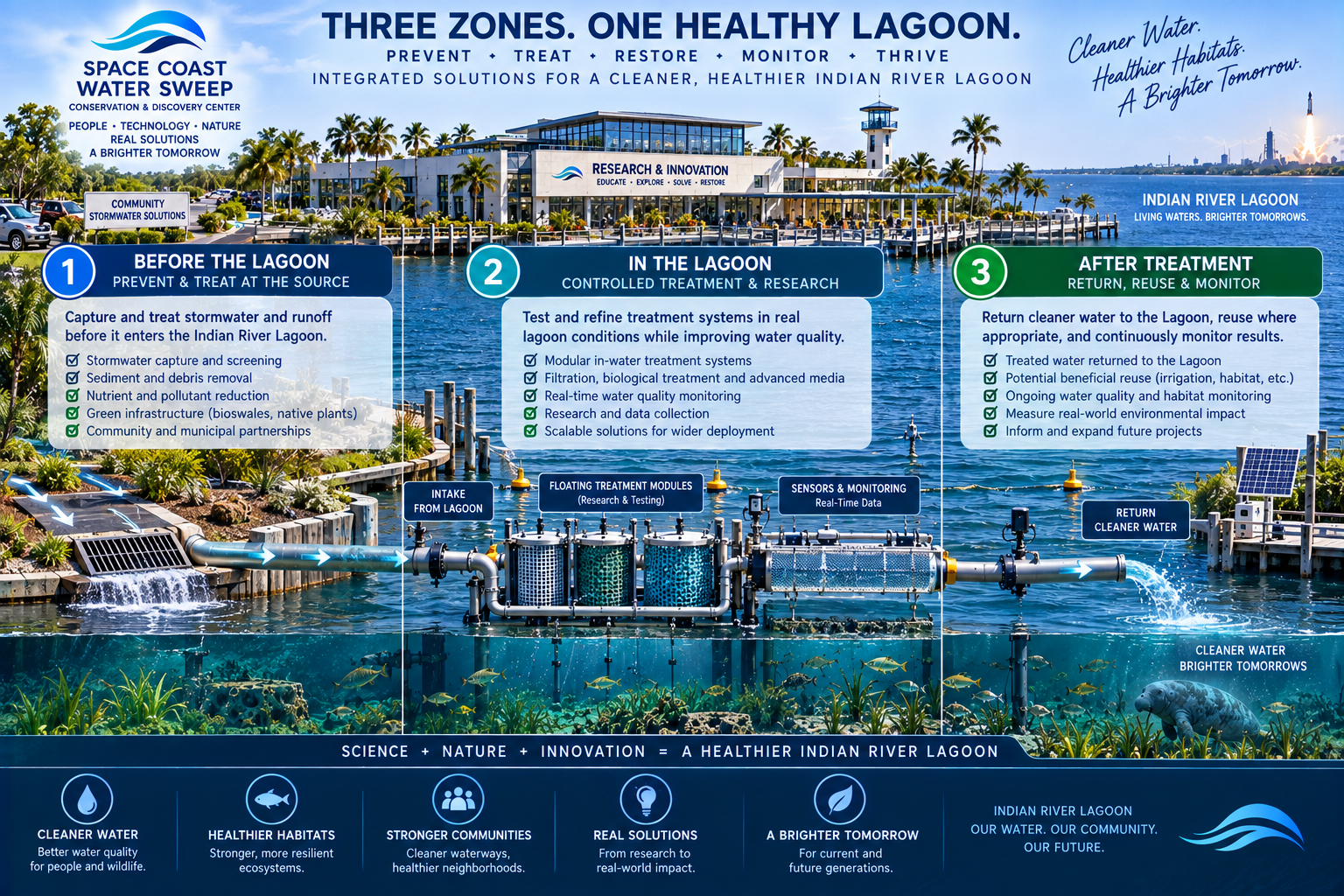
Potential Research Areas
The testbed is modular rather than permanently tied to one treatment method.
Can Freshwater Discharges Be Managed to Reduce Ecological Impacts?
Include research into large freshwater inputs entering the Indian River Lagoon. The Center does not claim that adding salt is the solution.
The research question: Can freshwater discharges be captured, reused, treated, stored, gradually released, blended, conditioned or otherwise managed to reduce ecological impacts associated with rapid salinity changes?
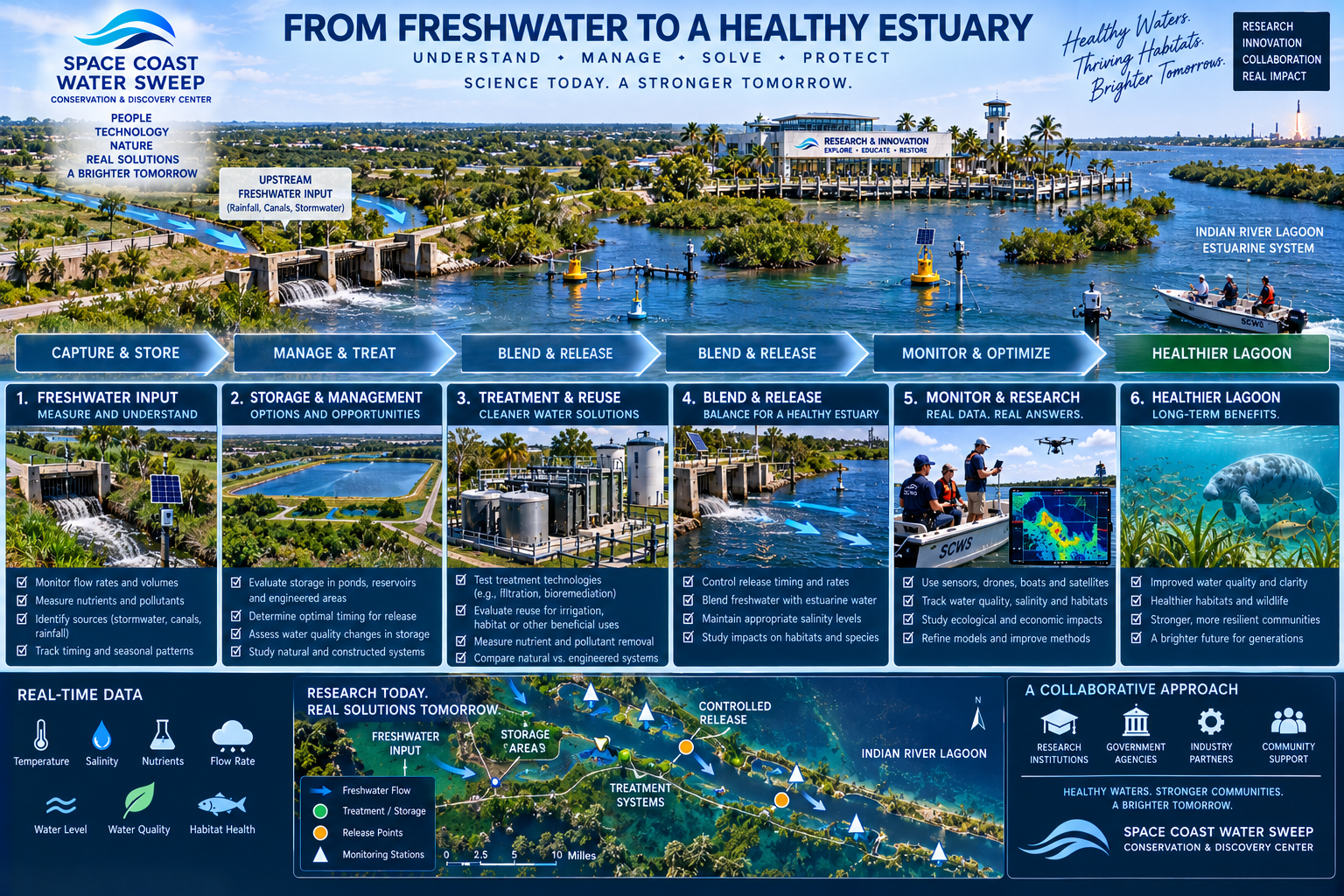
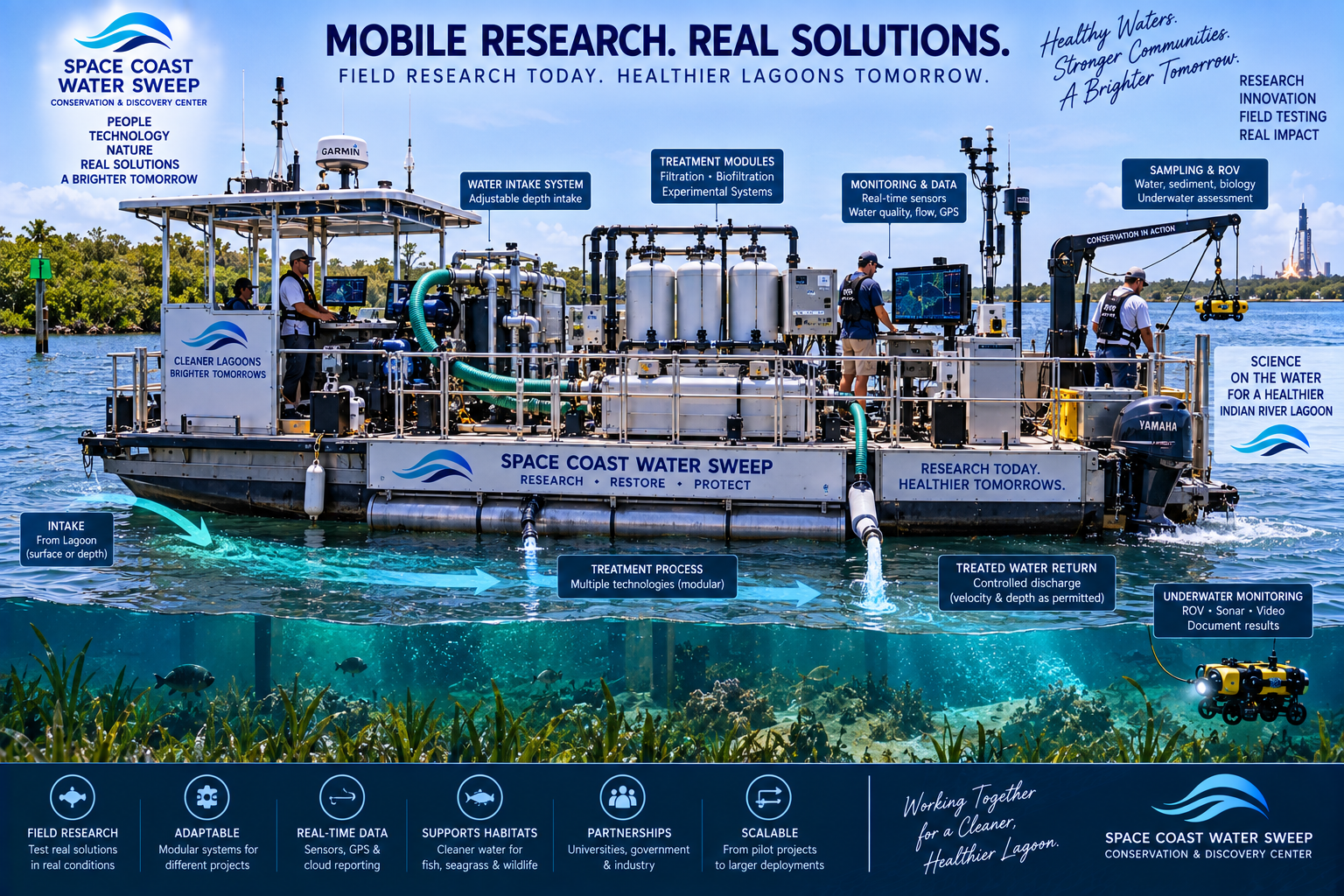
A Future Mobile Platform Could Take Treatment Research Into the Field.
A future mobile research concept could potentially use a dedicated vessel, pontoon, barge, trailer-based system or modular equipment. Permanent or temporary piping, remote treatment locations, larger pumping systems or distributed treatment infrastructure are described only as future possibilities requiring demonstrated benefit and appropriate authorization.
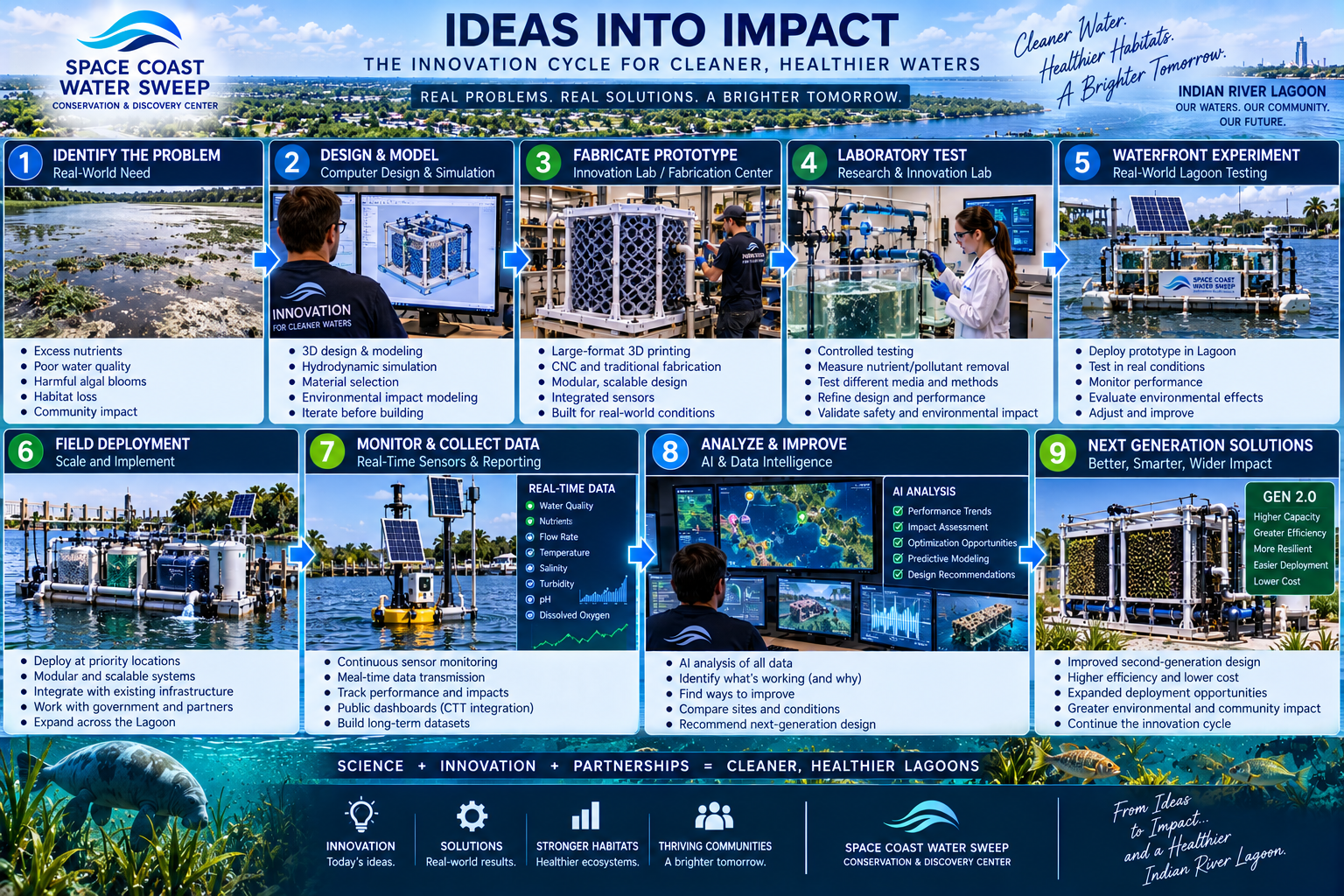
The Complete Development Cycle.
Connect this program directly to the Conservation Fabrication & Innovation Center. Show the complete development cycle from identifying a problem through scaling a successful solution.
THE CENTER IS NOT CLAIMING THAT ONE FILTRATION SYSTEM WILL CLEAN THE INDIAN RIVER LAGOON.
Where practical, visitors should be able to see real lagoon water entering an experimental system and view appropriate portions of treatment and measurement.
Students and researchers could investigate treatment effectiveness, energy requirements, operating cost, environmental effects and scalability.
PARTNER CAPABILITY
Concepts shown here may represent technologies or restoration methods developed, owned or implemented by partner organizations or other specialists. The Center is envisioned as a resource for collaboration, research, testing, monitoring, prototyping, education and field support — not as a replacement for existing organizations, businesses or proprietary technologies.
A Lagoon That Remembers
Currents Through Time. The Living Lagoon Monitor. Environmental memory that grows over time rather than losing knowledge.
To Understand the Lagoon Today, Sometimes You Have to Look Back.
Currents Through Time is envisioned as an environmental intelligence platform helping people explore evidence and change across the Indian River Lagoon. Project Lagoon and future Center research may eventually contribute appropriate information into this broader environmental intelligence ecosystem.
Not all Project Lagoon data is already integrated into CTT. Environmental datasets should not be overstated.
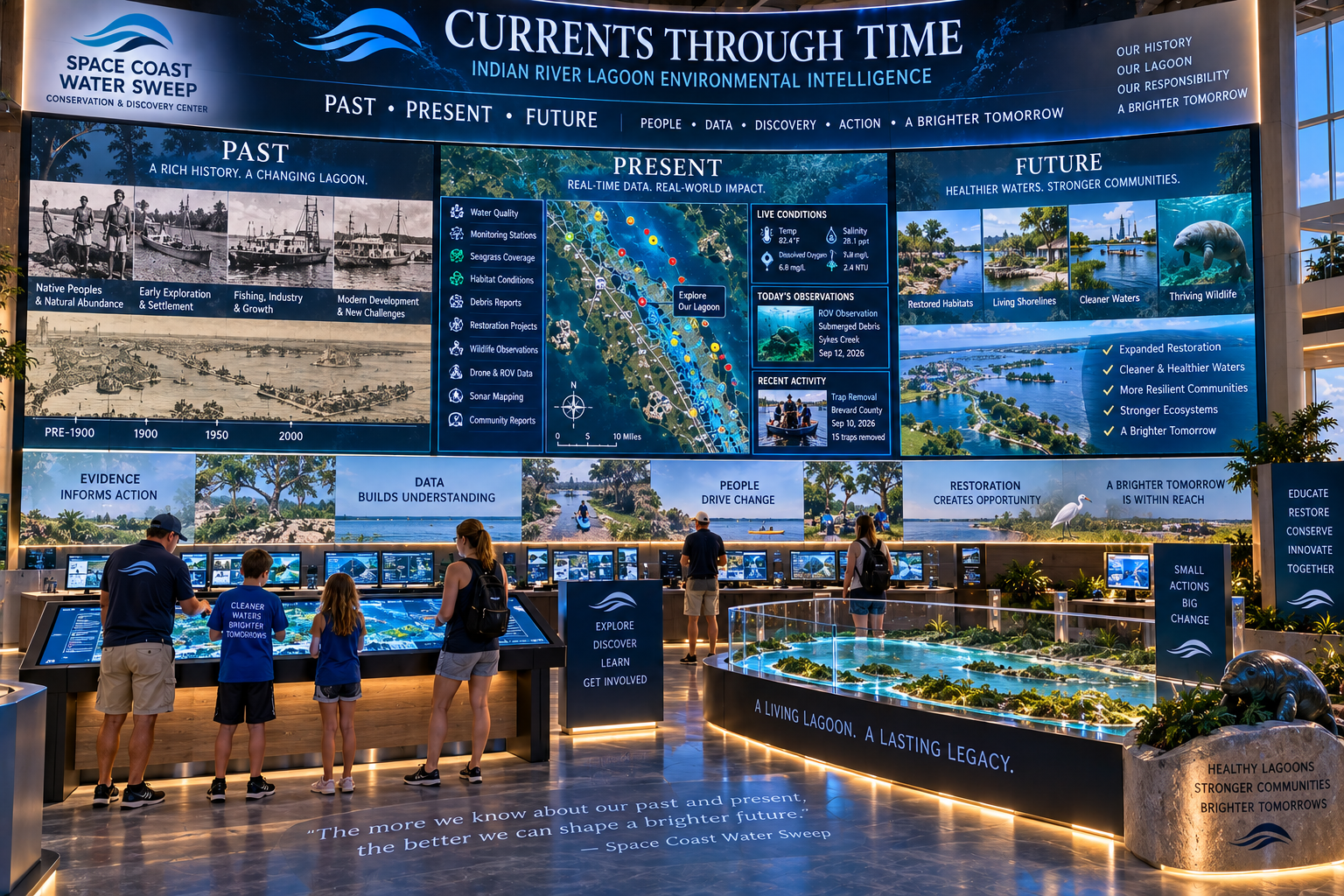
A Century of Lagoon History, Current Conditions and Incoming Data — Visible at a Glance.
Currents Through Time is the environmental intelligence and data platform. The Living Lagoon Monitor is the physical and digital visitor experience powered by that intelligence.
Unlike a traditional museum display, the Living Lagoon Monitor would continue changing as new environmental information enters Currents Through Time. Visitors could literally watch the lagoon's environmental record grow over time.
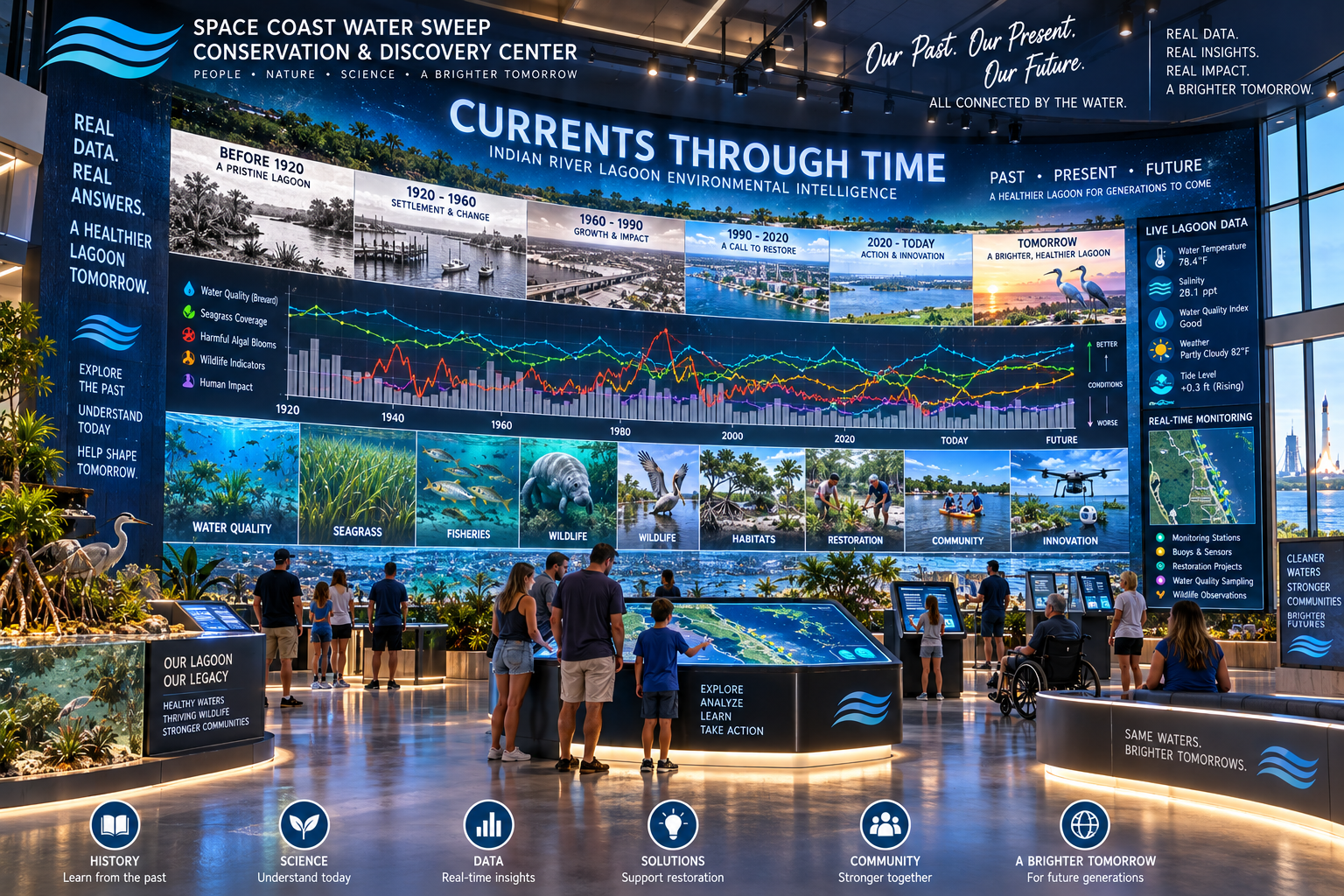
Three Layers of the Living Lagoon Monitor
The experience is designed around three interconnected layers.
THE WALL — UNDERSTAND THE LAGOON IN SECONDS
A massive digital environmental timeline showing historical conditions, major environmental events, trends, restoration activity, current conditions and incoming information.
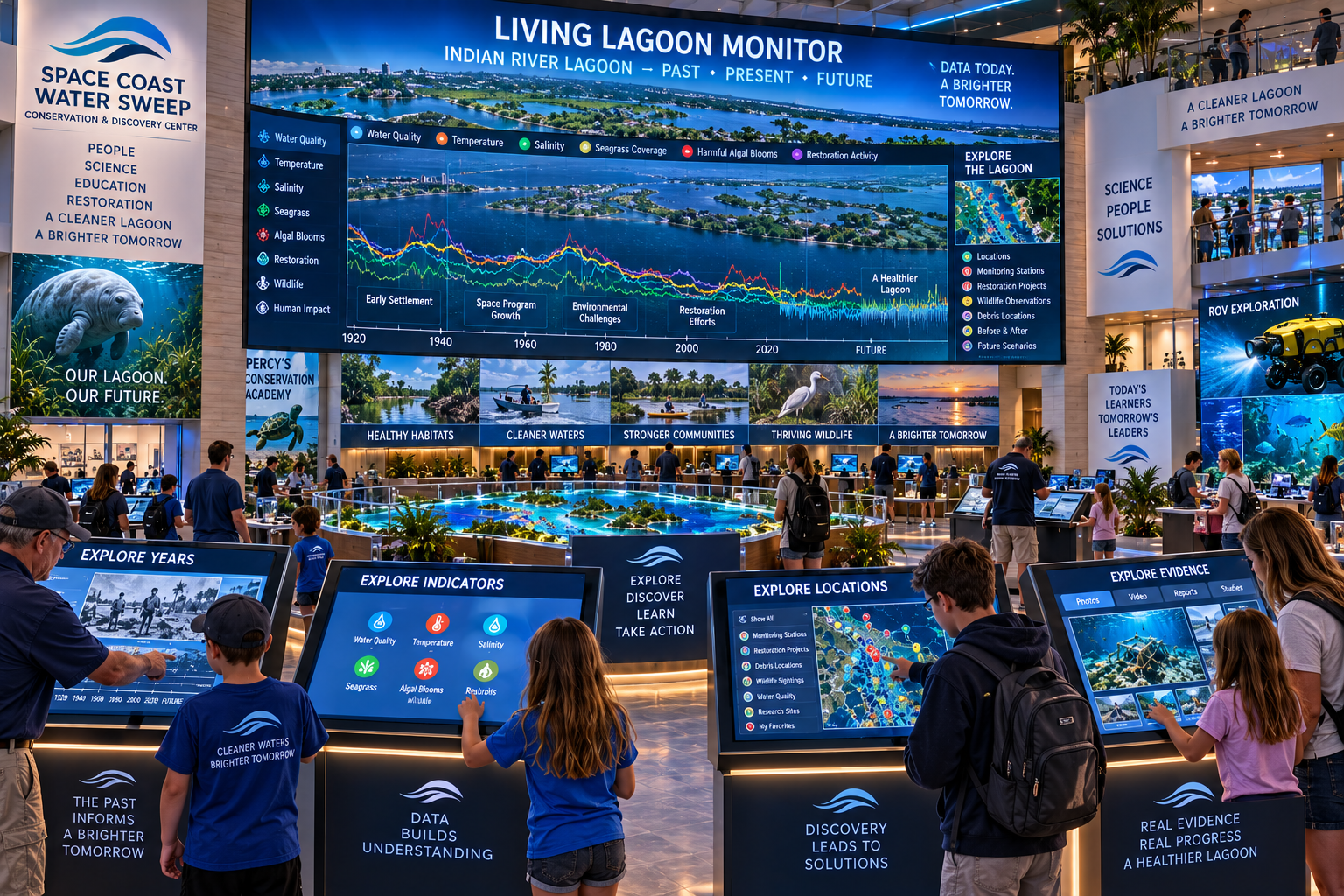
THE EXPLORER — SHOW ME WHY
Interactive displays allowing visitors, students and researchers to explore years, locations, indicators, events, evidence, datasets and environmental changes.
THE LIVE FEED — THE STORY IS STILL BEING WRITTEN
Show new validated observations, monitoring information, Project Lagoon records, research information and other appropriate environmental records becoming part of the growing knowledge base.
Show Me Why.
Students, families and researchers can use adjacent interactive touchscreen stations to explore years, environmental indicators, locations, events and supporting evidence while the large Living Lagoon Monitor remains visible nearby.
The Story Is Still Being Written.
New validated observations, monitoring information, Project Lagoon records, research information and other appropriate environmental records become part of the growing knowledge base — visible to visitors in real time.
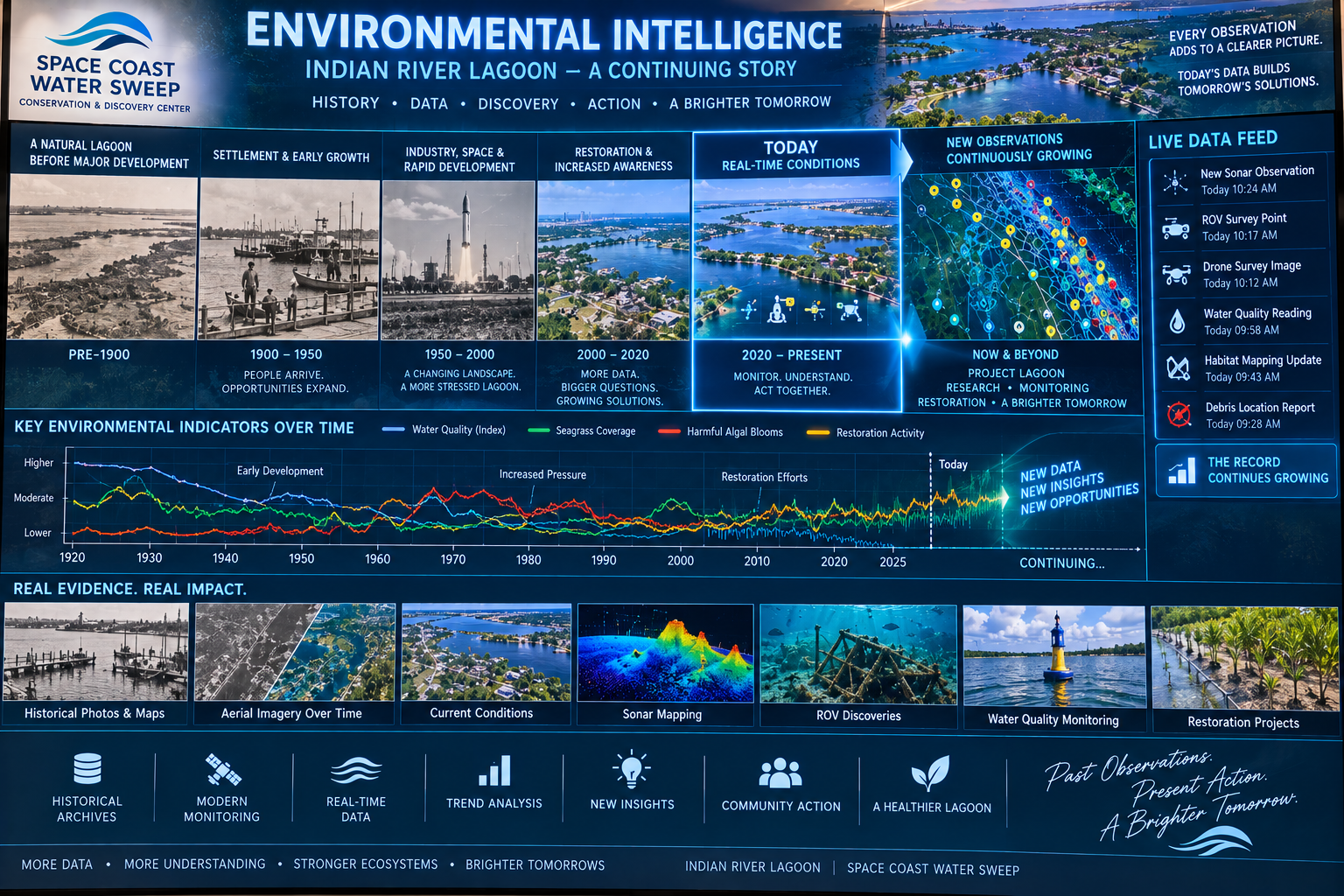
Unlike a traditional museum display, the Living Lagoon Monitor continues changing as new environmental information enters Currents Through Time. Visitors could literally watch the lagoon's environmental record grow over time.
What Was There. When. What Did We Do. What Changed. What Happened Later.
The long-term idea is to build an environmental memory that grows over time rather than losing knowledge every time a project, employee, student or research effort ends. Every appropriate survey, experiment, restoration effort and year can add to the Center's environmental memory.
AI & Environmental Intelligence
Center AI. Environmental intelligence. Data ingestion, analysis and pattern recognition. Public AI demonstrations. Secure computing infrastructure.
The Lagoon Doesn't Produce One Kind of Data.
Environmental understanding may require bringing together many different information sources. The proposed AI/Data Hub can help organize and connect information — organizing observations, comparing datasets, identifying patterns, assisting image/object review, identifying potential hotspots, creating maps, supporting field assignments, generating reports, preserving research provenance and supporting long-term analysis.
AI supports people. AI does not make final scientific, regulatory or recovery decisions autonomously.
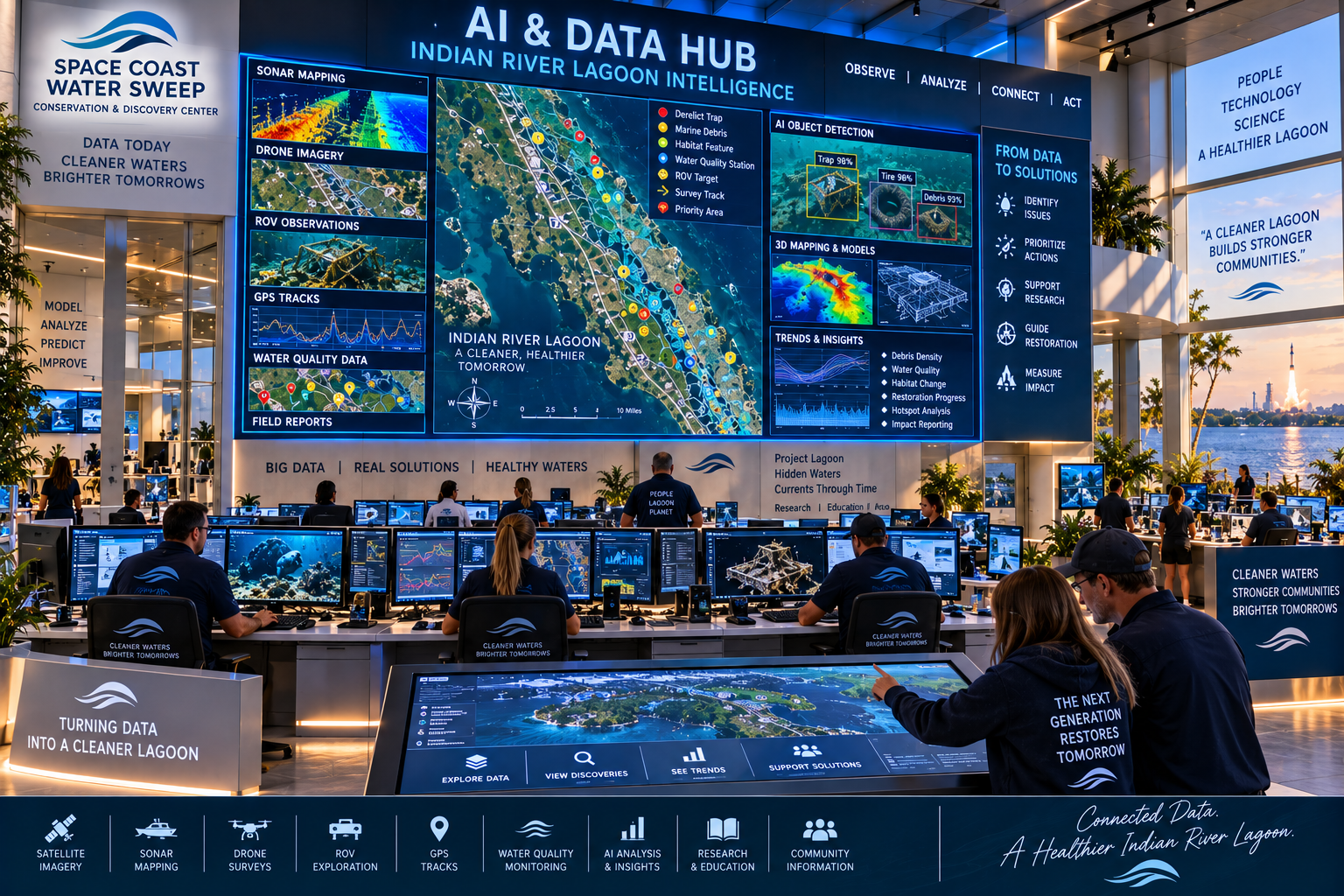
What AI Can Do — and What It Cannot
ORGANIZE
Ingest and connect information from many sources.
IDENTIFY
Assist with image review, object detection and pattern recognition.
MAP
Generate maps, hotspots and spatial analysis.
REPORT
Support field assignments, reports and long-term analysis.
PRESERVE
Maintain research provenance and institutional knowledge.
ASSIST
Help people — not replace scientific or regulatory judgment.
DATA GOVERNANCE
PUBLIC / EDUCATIONAL
Data shown to visitors and students through public displays and demonstrations.
INTERNAL
Operational and research data used by Center staff, researchers and partners.
RESTRICTED
Sensitive data protected for security, privacy or operational reasons.
AI ASSISTS. PEOPLE VERIFY.
THE AI TECHNOLOGY CAN CHANGE. THE CENTER'S MEMORY REMAINS.
The Physical Systems Behind the Intelligence
The Center's AI and environmental intelligence capabilities require physical computing infrastructure — servers, storage, networking and compute resources. This infrastructure is envisioned as a secured, environmentally controlled facility on the operations side of campus, not a public exhibit.
SERVERS / STORAGE / COMPUTE
Physical computing hardware for data processing, storage and analysis.
ENVIRONMENTAL CONTROLS
Climate control, cooling and humidity management for computing equipment.
RESILIENT POWER
Backup power and surge protection to preserve data and operations.
CYBERSECURITY
Network security, access controls and data protection measures.
CONTROLLED ACCESS
Physical access limited to authorized personnel on the secured operations side.
LONG-TERM DATA STORAGE
Environmental memory requires durable, organized long-term data preservation.
Sensitive system architecture, security configurations and operational details are not publicly disclosed. The public experiences AI through controlled demonstrations and displays — not through access to underlying infrastructure.
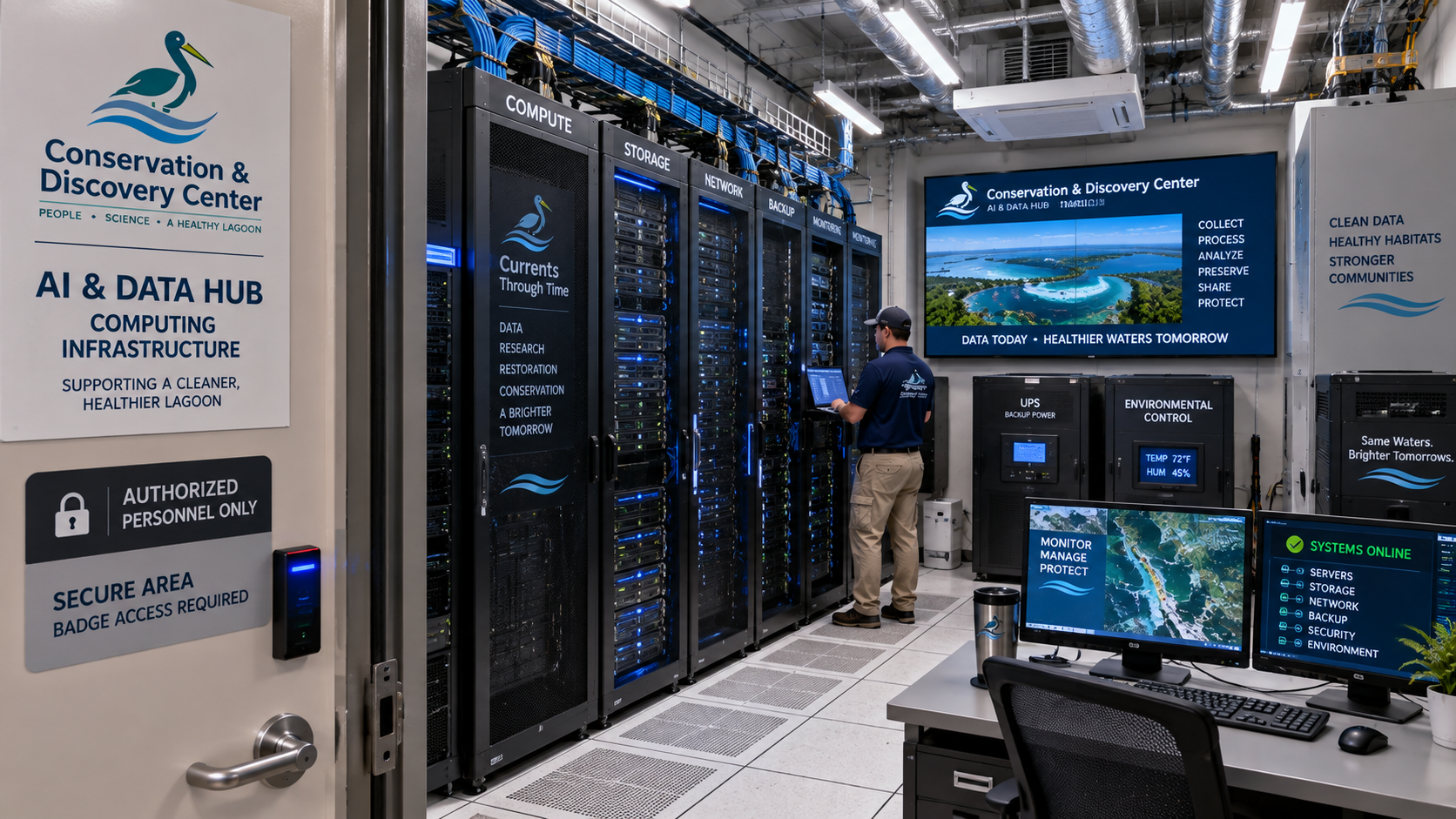
PUBLIC AI DEMONSTRATIONS
Visitors and students may be able to see how environmental data becomes information and how AI can assist conservation through controlled public displays and demonstrations. Human review, validation, provenance and appropriate scientific and agency procedures remain important throughout.
From Problem to Solution
The Conservation Fabrication & Innovation Center. Design, prototype, fabricate, test, deploy, monitor and improve. Failure is data.
Turn a Research Question Into Something You Can Test.
The proposed Innovation Lab is where ideas can move from research into practical design. It connects the Research Laboratory and AI/Data Hub to the fabrication side of the campus.
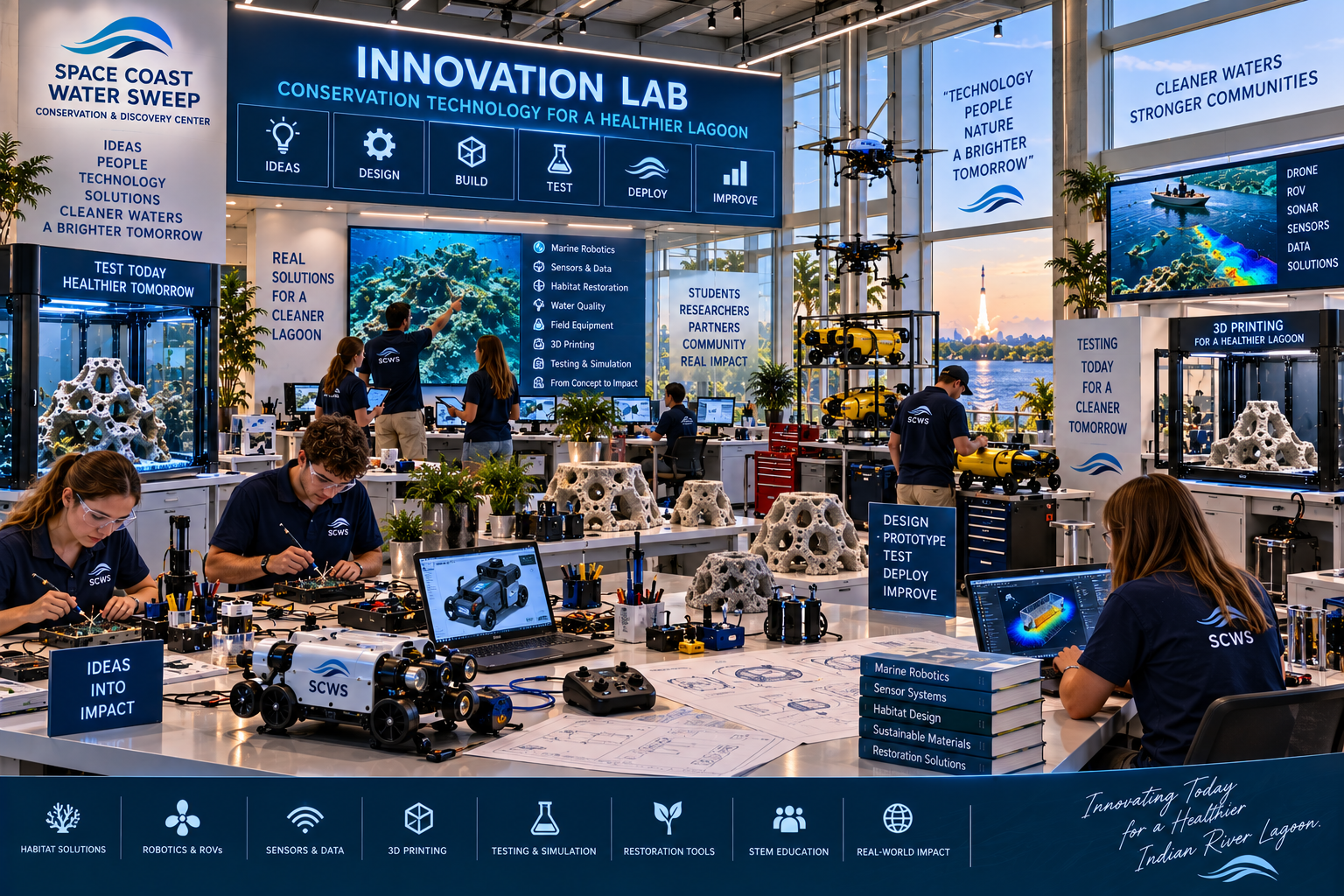
Sometimes the Next Conservation Tool Doesn't Exist Yet.
The Conservation Fabrication & Innovation Center is a major component of the long-term campus vision — a high-bay fabrication and prototype-development environment where approved conservation concepts can become physical prototypes.
Not all equipment has already been selected or purchased.
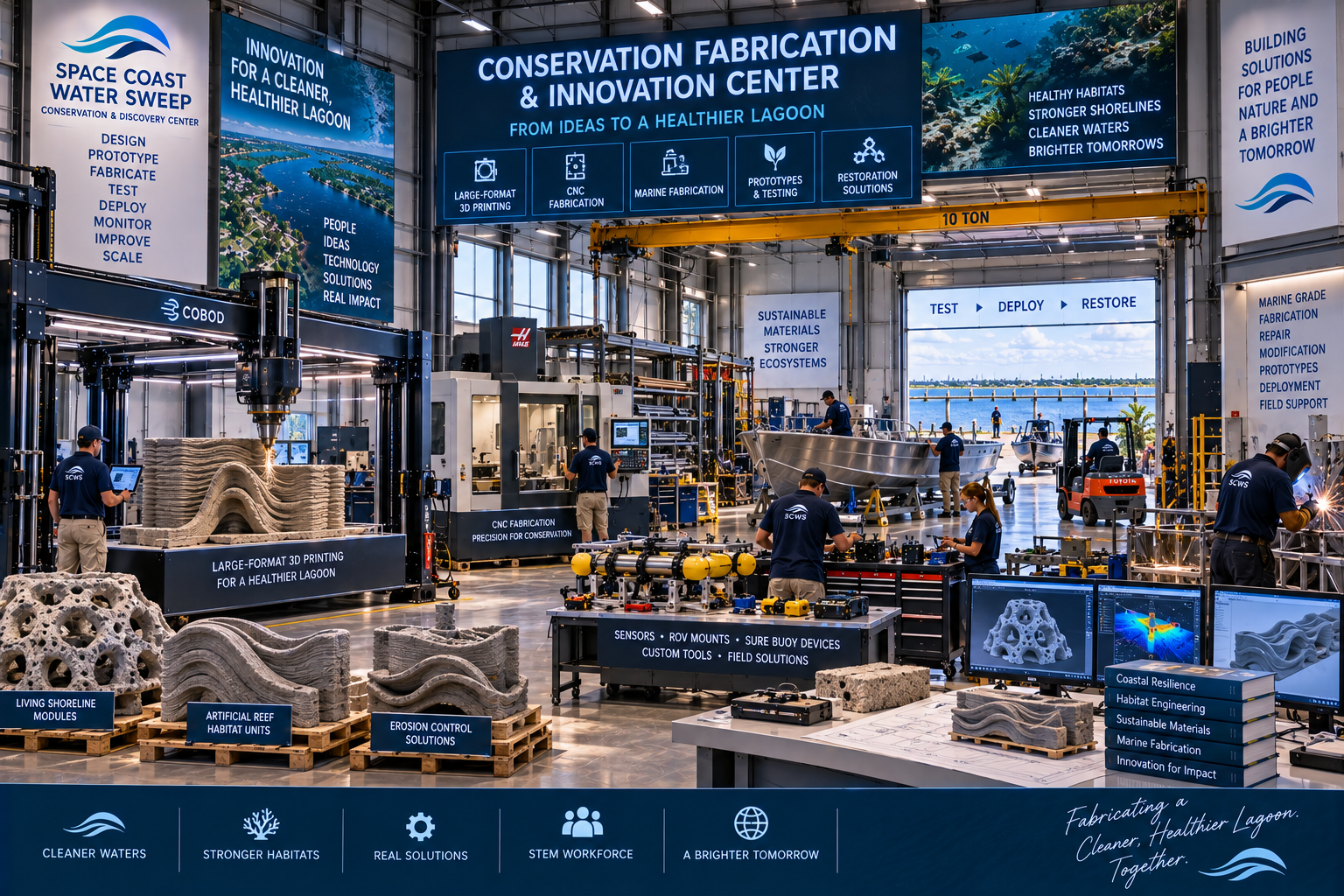
Build for the Problem — Not Just for the Shelf.
These are categories of innovation, not claims of finished commercial products. Development may involve original design, university collaboration, licensed technology, corporate partnerships, existing technology adapted with permission, and freedom-to-operate/IP review where appropriate.
LIVING SHORELINE COMPONENTS
Habitat-supporting shoreline and erosion-control concepts.
HABITAT STRUCTURES
Oyster, fish and other appropriate habitat modules.
WAVE ATTENUATION
Concepts that may help reduce wave energy where environmentally and structurally appropriate.
SEAGRASS PROTECTION
Devices or systems intended to support protection or restoration efforts.
FLOATING MONITORING PLATFORMS
Platforms for sensors, environmental monitoring or research.
SENSOR HOUSINGS & MOUNTS
Field-ready components for environmental instruments.
ROV / DRONE COMPONENTS
Specialized field equipment and research accessories.
MARINE DEBRIS COLLECTION TOOLS
Devices designed around Project Lagoon field experience.
PROJECT LAGOON EQUIPMENT
Custom field tools, baskets, mounts, handling systems and survey equipment.
FUTURE SURE BUOY TECHNOLOGY
Potential future buoy or monitoring-device concepts.
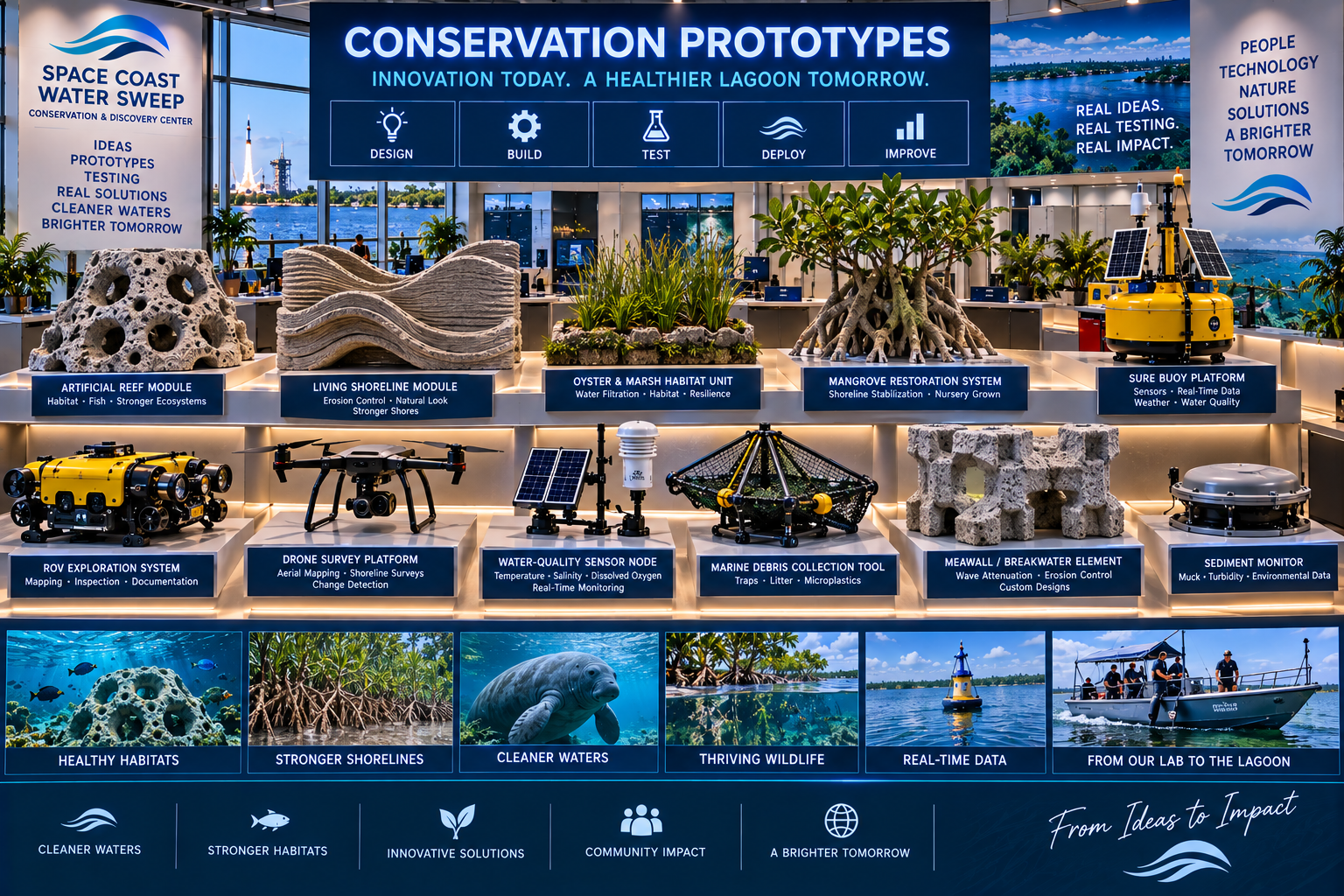
PARTNER CAPABILITY
Concepts shown here may represent technologies or restoration methods developed, owned or implemented by partner organizations or other specialists. The Center is envisioned as a resource for collaboration, research, testing, monitoring, prototyping, education and field support — not as a replacement for existing organizations, businesses or proprietary technologies.
A Conservation Solution Shouldn't Create a New Environmental Problem.
Materials used for restoration and marine applications must be evaluated carefully. Research and testing should determine suitability — a material is not 'eco-friendly' simply because it is recycled. 3D printing does not automatically make a material environmentally beneficial.
Evaluation may include environmental safety, structural performance, durability, marine exposure, leaching, ecological compatibility, manufacturing requirements, deployment method and end-of-life considerations.
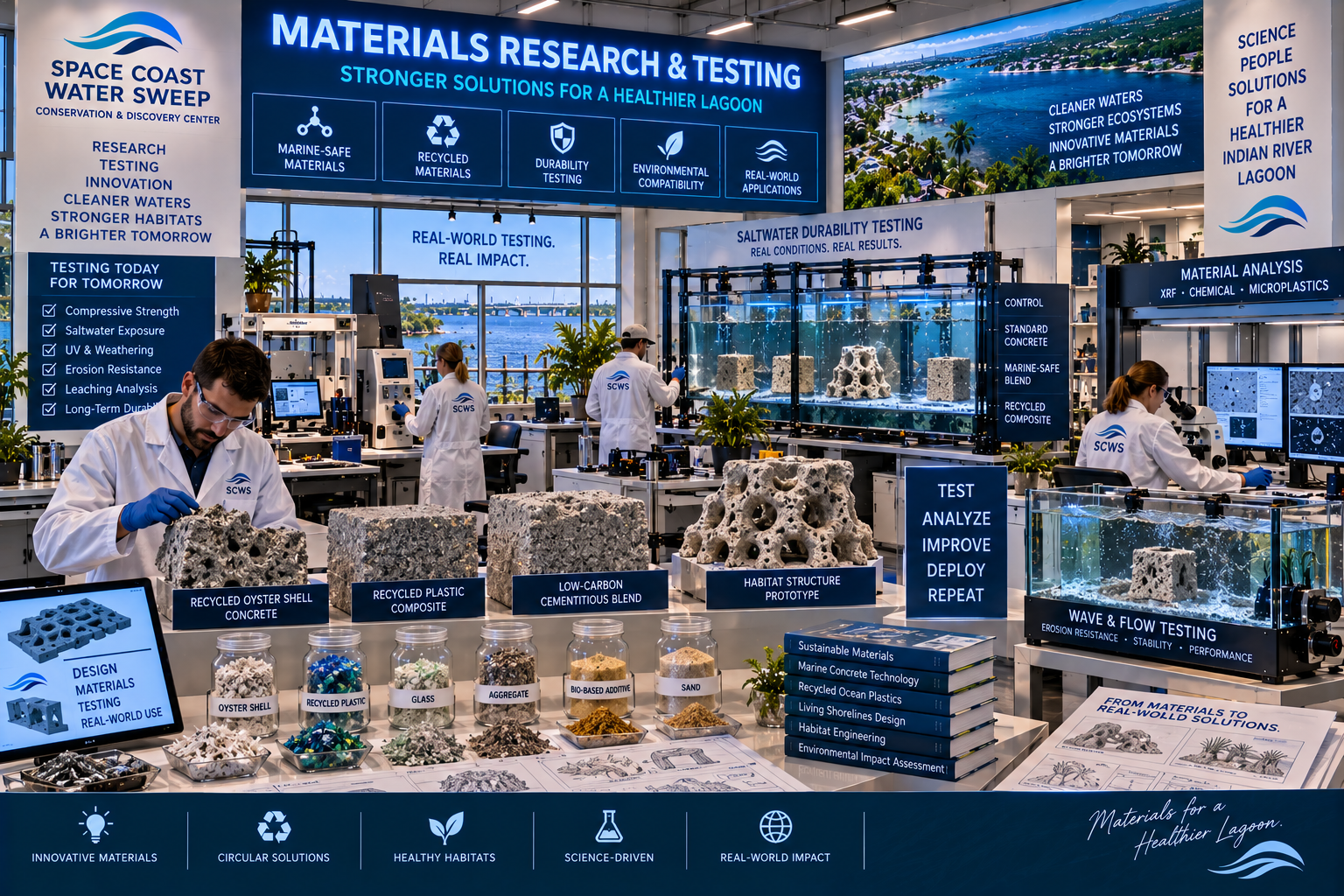
The Lagoon Becomes Part of the Testing Process.
Appropriate prototypes can move from controlled testing into carefully planned field pilots. All deployment remains subject to ownership/site permission, engineering, environmental review, permitting, navigation considerations, agency requirements, research protocols and monitoring requirements.
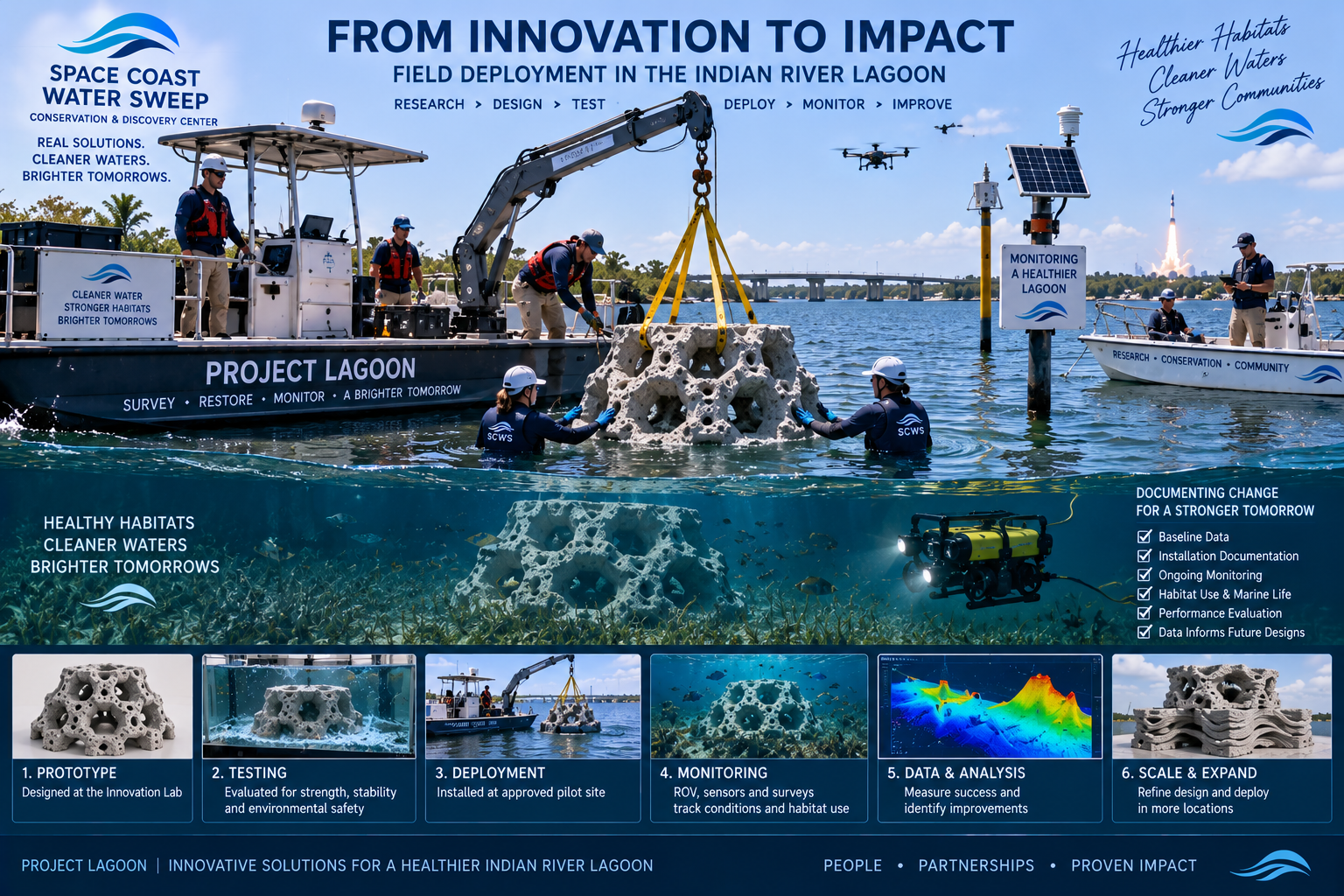
If We Don't Measure What Happens Next, We Haven't Finished the Experiment.
Deployment should be followed by monitoring. Possible measures depend on the project but could include physical durability, structural condition, habitat use, sediment response, shoreline response, water conditions, biological observations, maintenance requirements, sensor performance, failure modes, unintended impacts and comparison with baseline conditions.
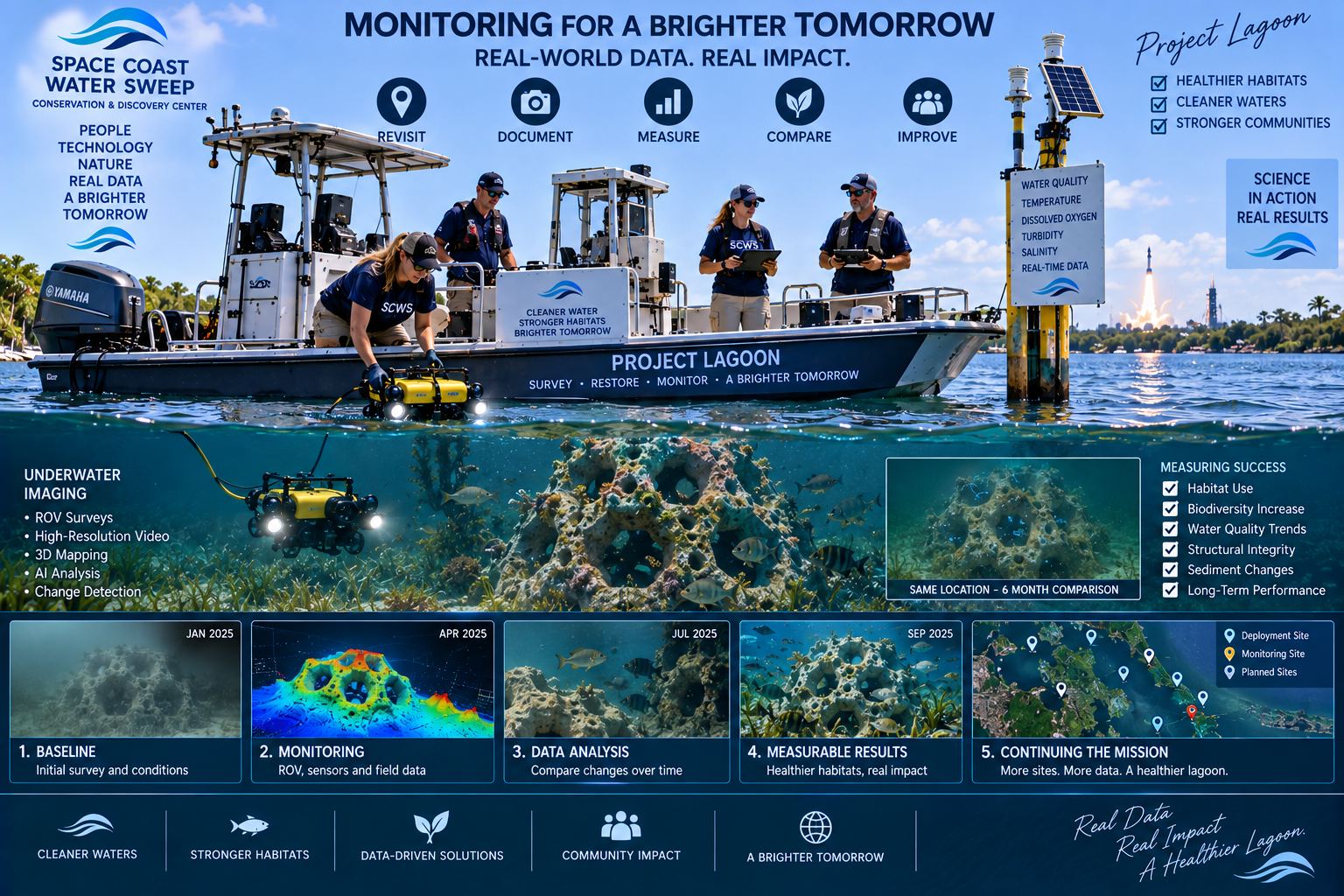
The First Version Doesn't Have to Be the Final Version.
Unsuccessful results can still provide valuable information. The Center should encourage evidence-based improvement rather than treating every prototype as a success.
A FAILED TEST CAN STILL BE A SUCCESSFUL EXPERIMENT IF WE LEARN FROM IT. FAILURE IS DATA.
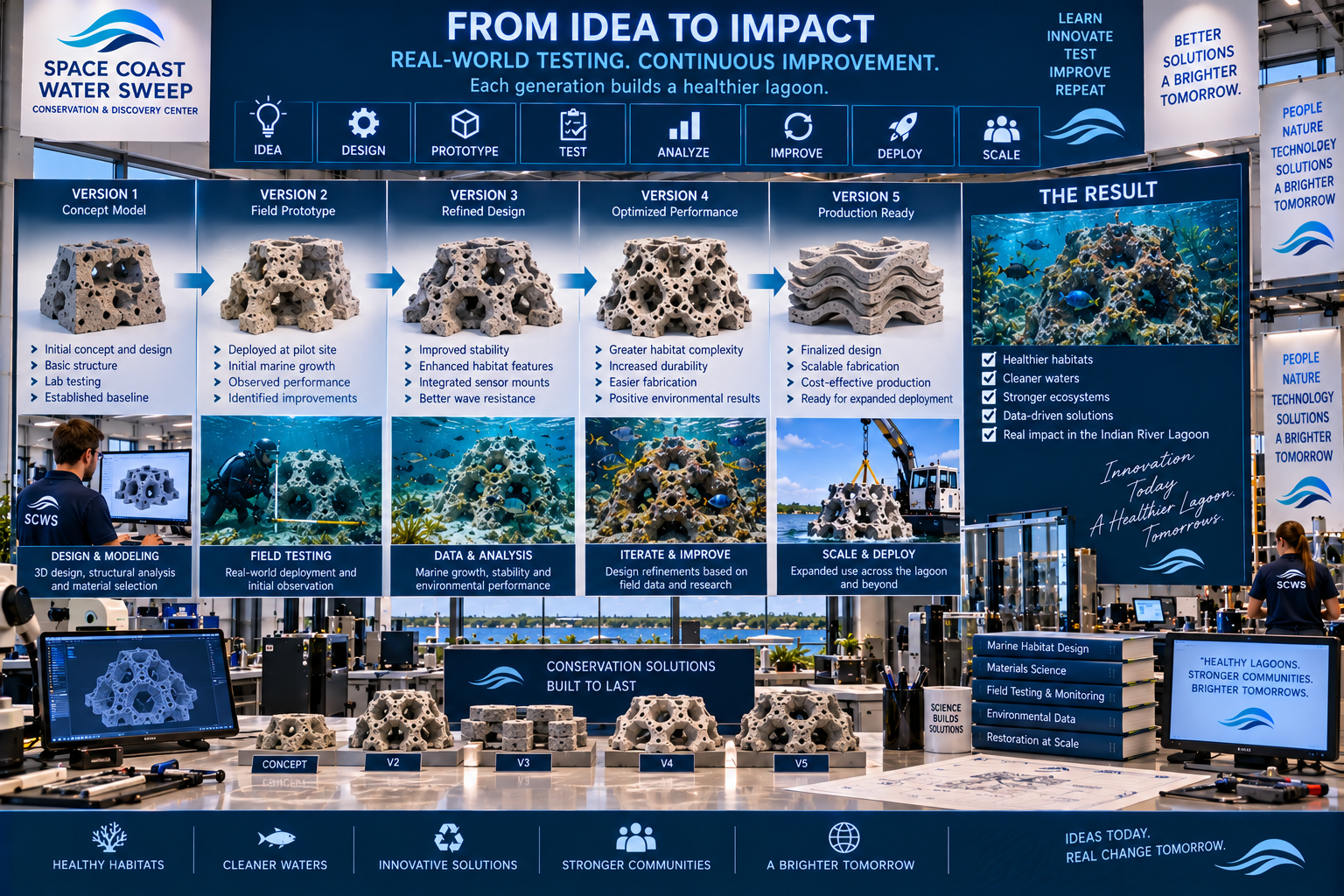
What If a Student Project Could End Up in the Lagoon?
The potential university and college collaboration model connects classroom learning to real-world conservation impact. Potential opportunities include capstone projects, senior design, undergraduate research, graduate research, internships, field research, prototype development, environmental monitoring and data analysis.
No university has formally partnered unless authorized.
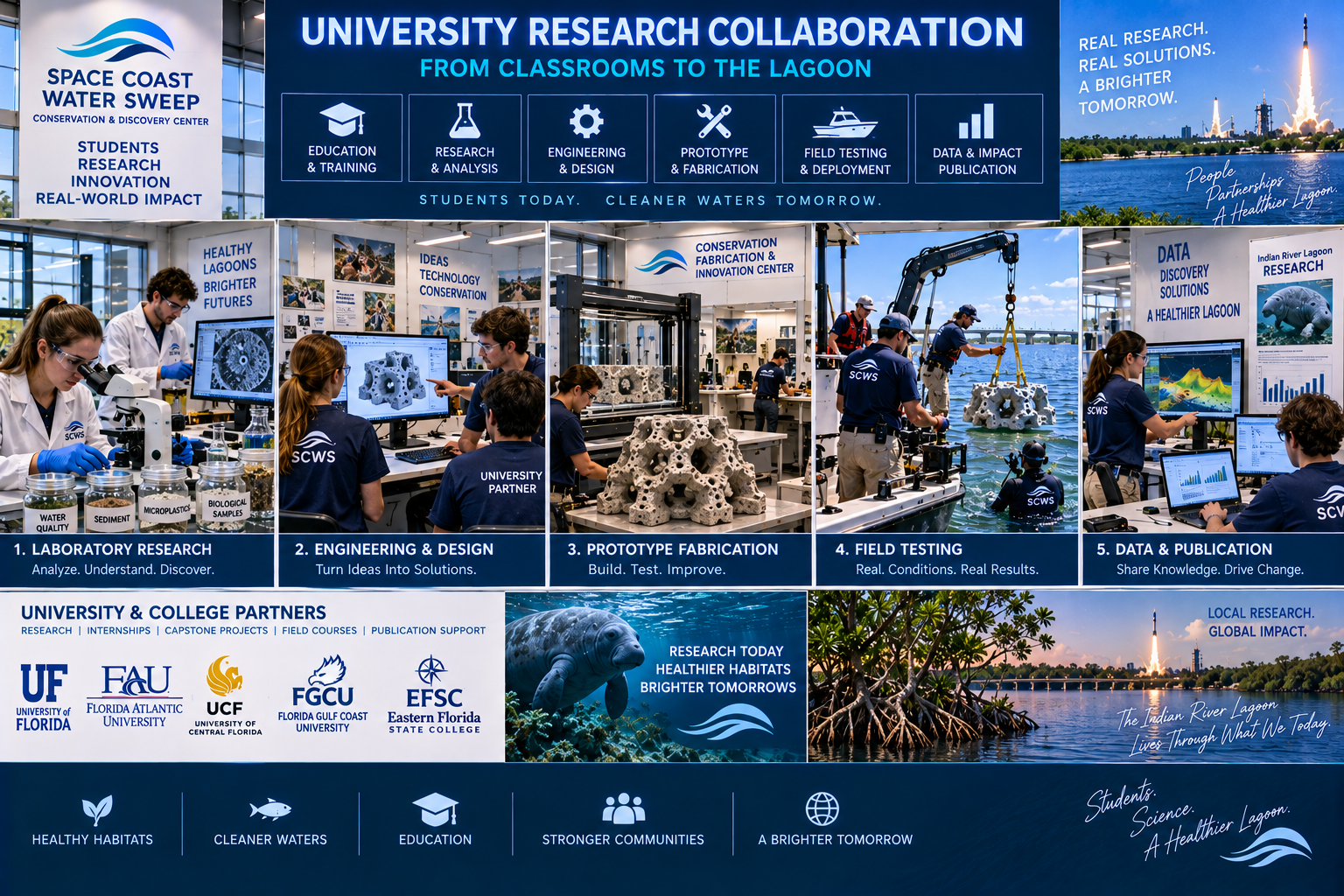
Don't Hide the Work Behind a Wall.
Appropriate portions of the Science & innovation campus can become part of the visitor experience. Visitors and school groups could safely observe real work without entering controlled laboratory or industrial areas. This connects to Percy's Conservation Academy and STEM education.
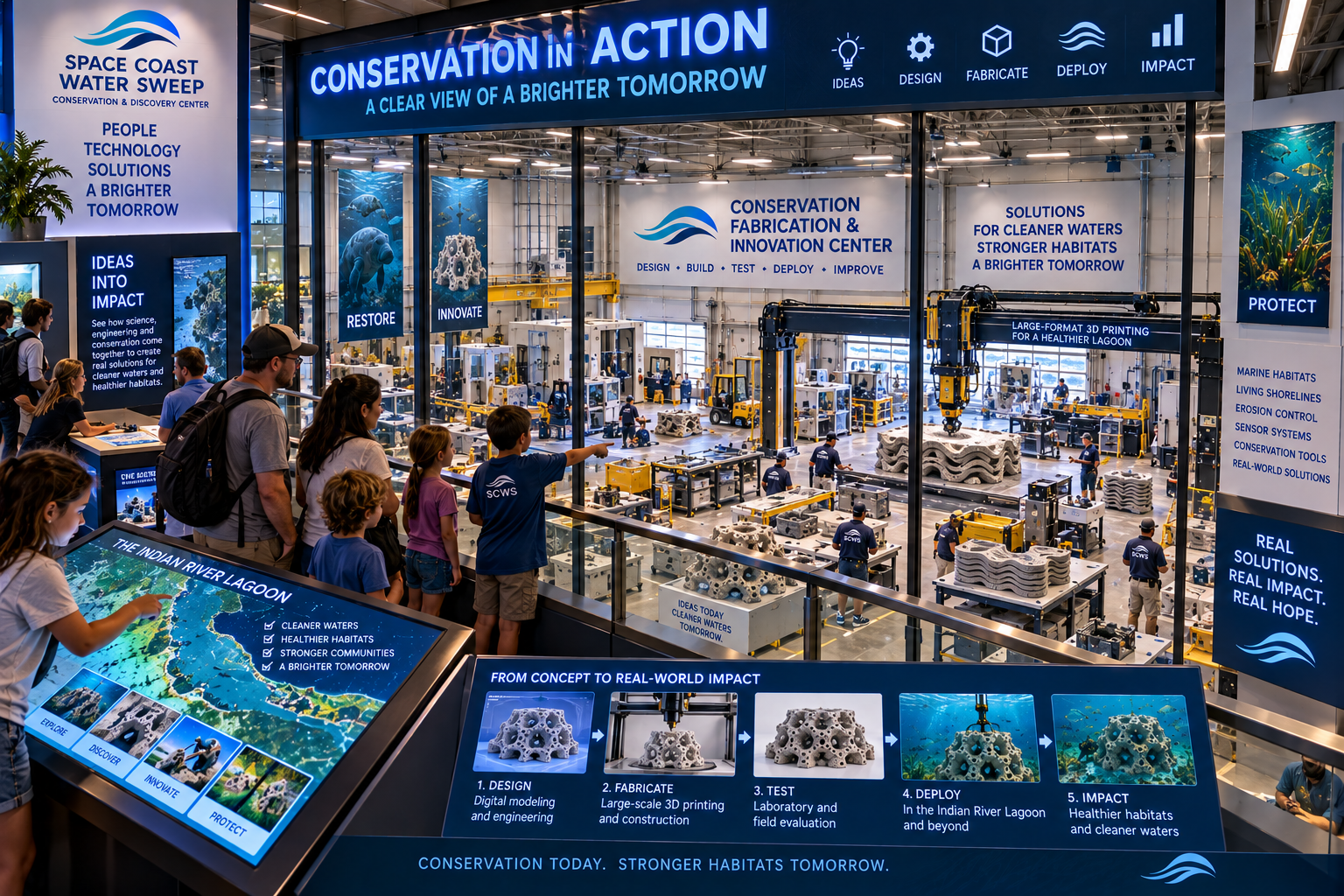
If Something Works, the Impact Shouldn't Have to Stop at One Test Site.
Successful, validated concepts may eventually have pathways to wider deployment. If SCWS develops original intellectual property, future licensing or mission-aligned manufacturing may be explored subject to nonprofit law, tax considerations, intellectual-property strategy, legal review, regulatory requirements, conflict-of-interest policies and board oversight.
Net resources generated through appropriate mission-aligned activity could support the nonprofit conservation mission. No revenue projections are made. Commercialization is not guaranteed.
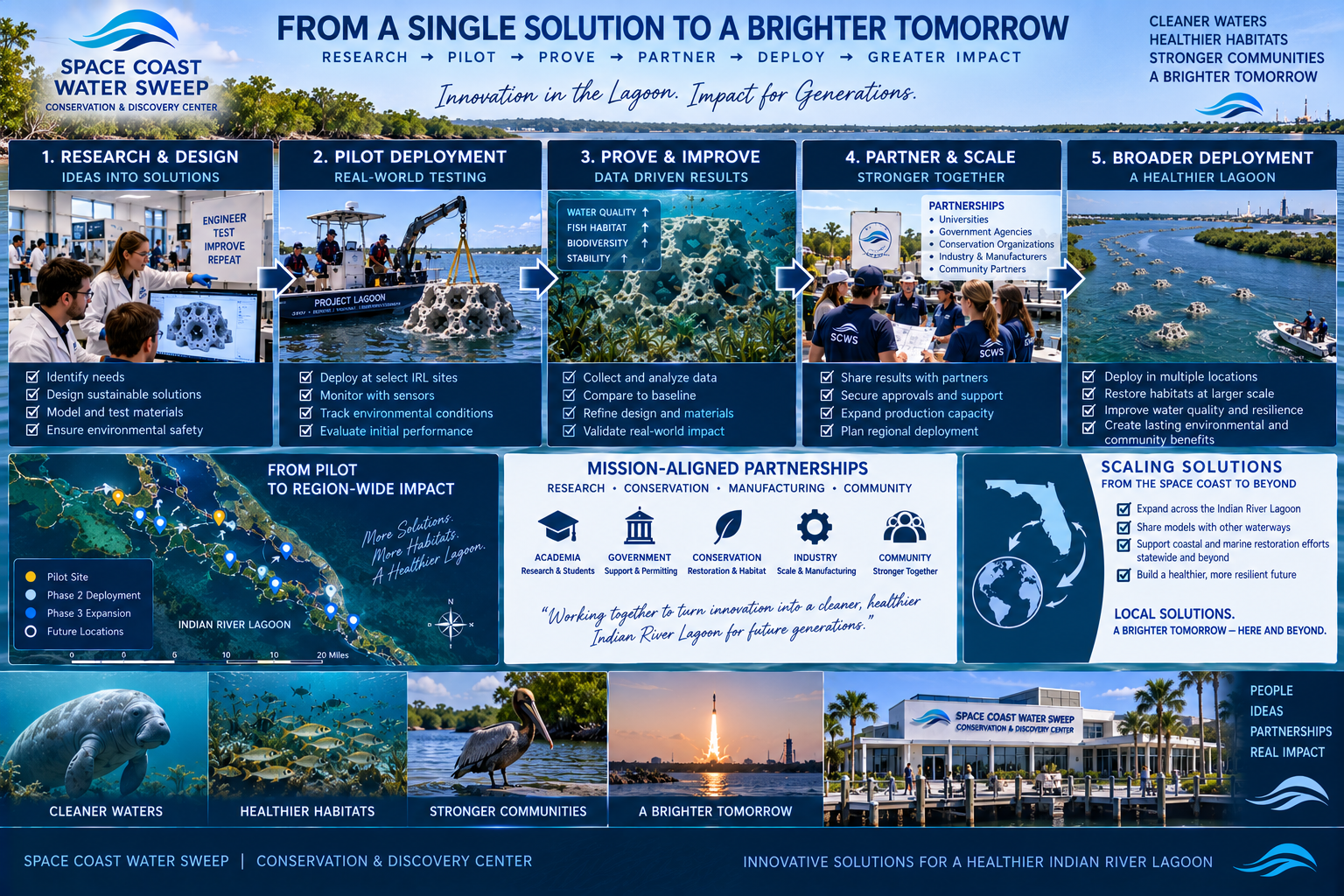
From a Problem in the Water to a Solution in the Water.
The real power of the Center is connecting capabilities that are often separated: field operations, science, data, engineering, fabrication, education and real-world testing.
THEN USE WHAT WE LEARN TO MAKE THE NEXT SOLUTION BETTER.
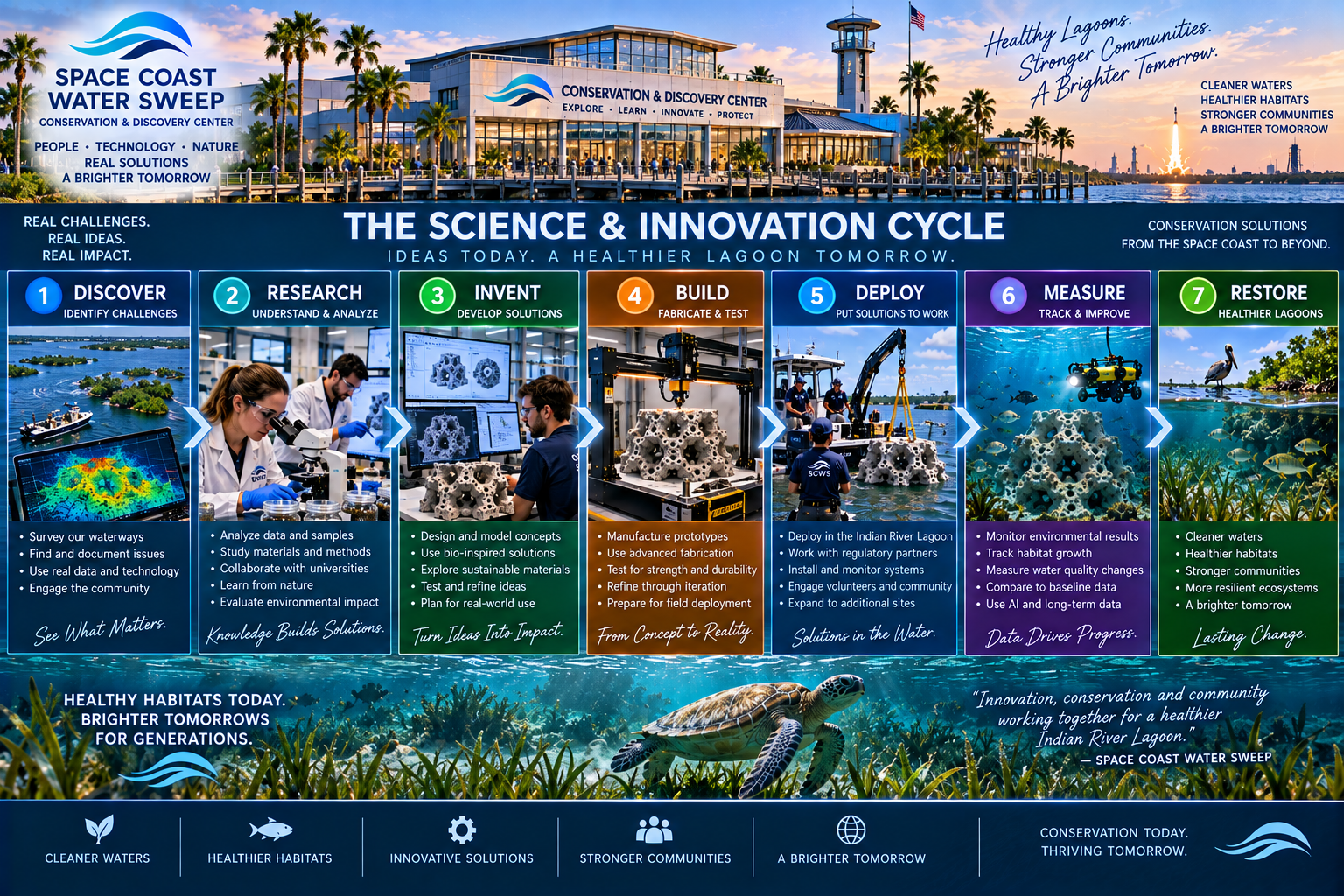
Learning Everywhere
Education is campus-wide. From early learning to career pathways. The entire campus is a classroom.
The Next Person Who Helps Save the Lagoon
May Walk Through These Doors as a Child.
The Conservation & Discovery Center is envisioned as a place where students, families, teachers, researchers and community members can move beyond reading about conservation and experience it firsthand.
A child may first meet Percy and discover how water reaches the Lagoon. Years later, that same student could return to use sonar, analyze environmental data, design a prototype, participate in university research or build a career protecting Florida's waterways.
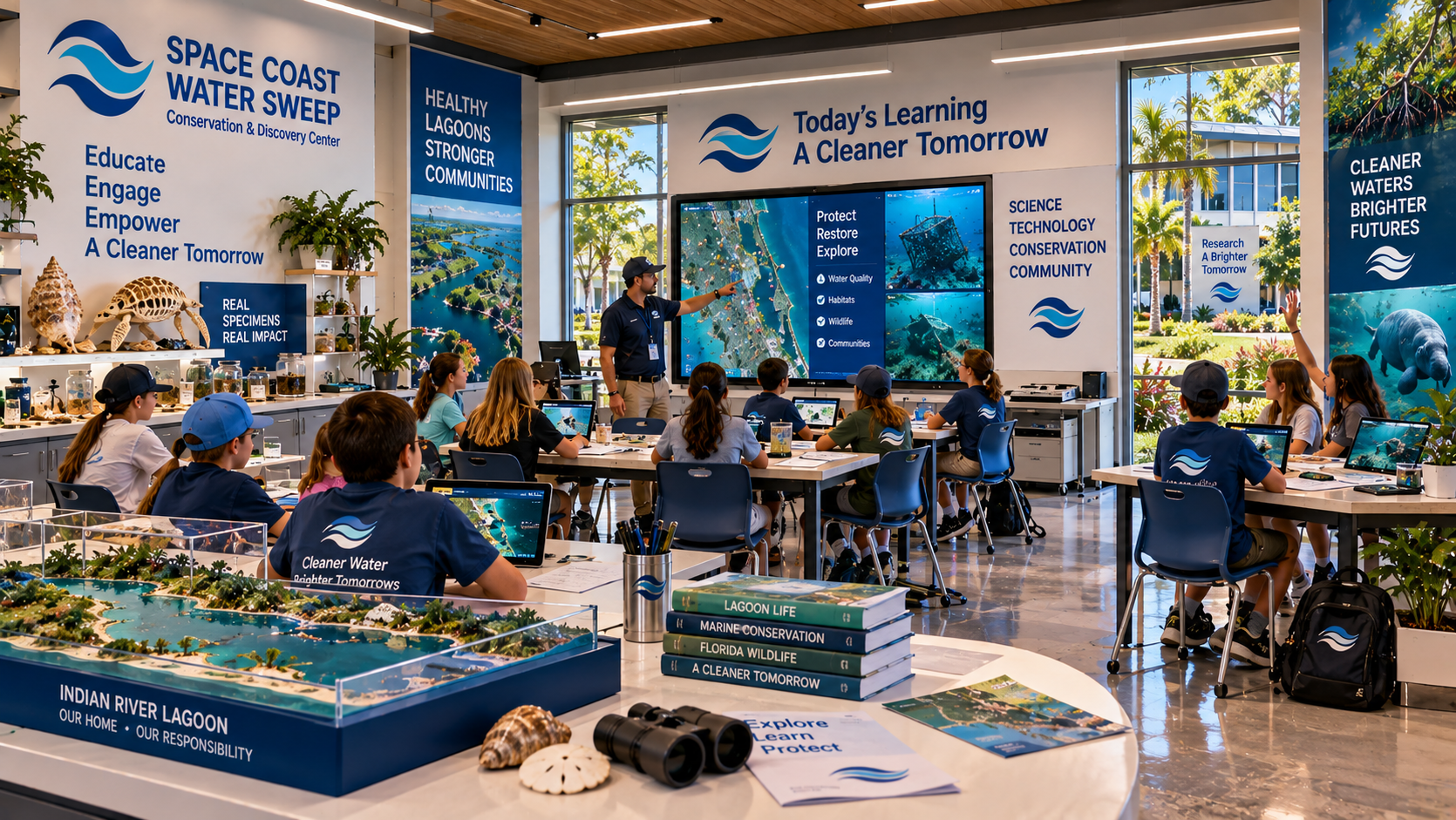
Before Someone Can Protect the Lagoon, They Have to Care About It.
Early education should begin with curiosity rather than technical terminology. Children can discover where water comes from, where stormwater goes, what lives in the Lagoon, why habitats matter, what pollution does, why marine debris matters, how people affect waterways and how conservation helps.
Learning should happen through stories, exploration, touch-friendly interactive exhibits where appropriate, outdoor experiences, observation, simple experiments, games, challenges and Percy.
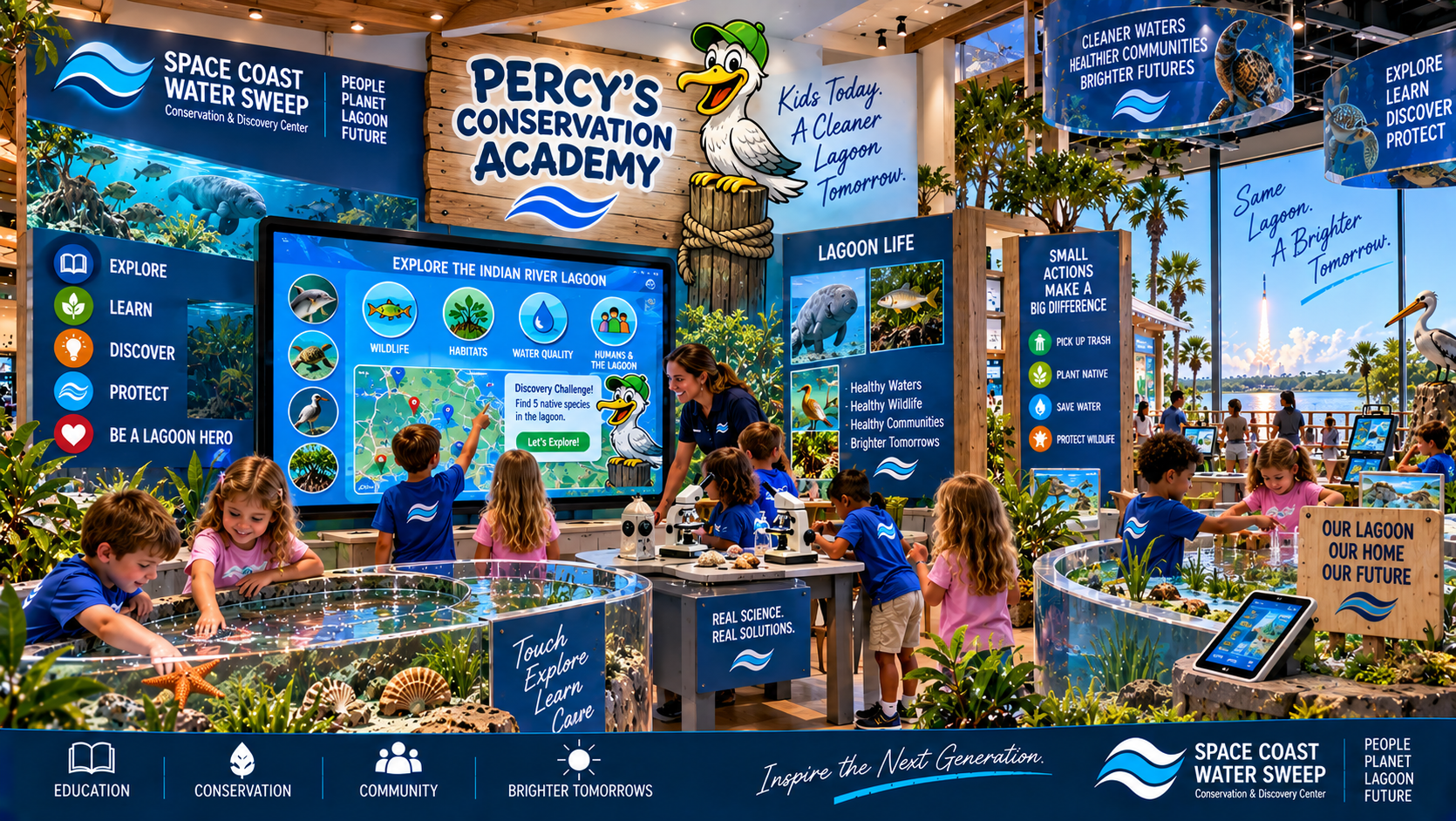
Conservation Needs a Guide Kids Want to Follow.
Percy's Conservation Academy should help make environmental science approachable without replacing teachers, scientists or real field expertise. Percy should connect digital learning to real experiences.
Percy is an educational guide, not an autonomous authority for scientific or safety decisions.
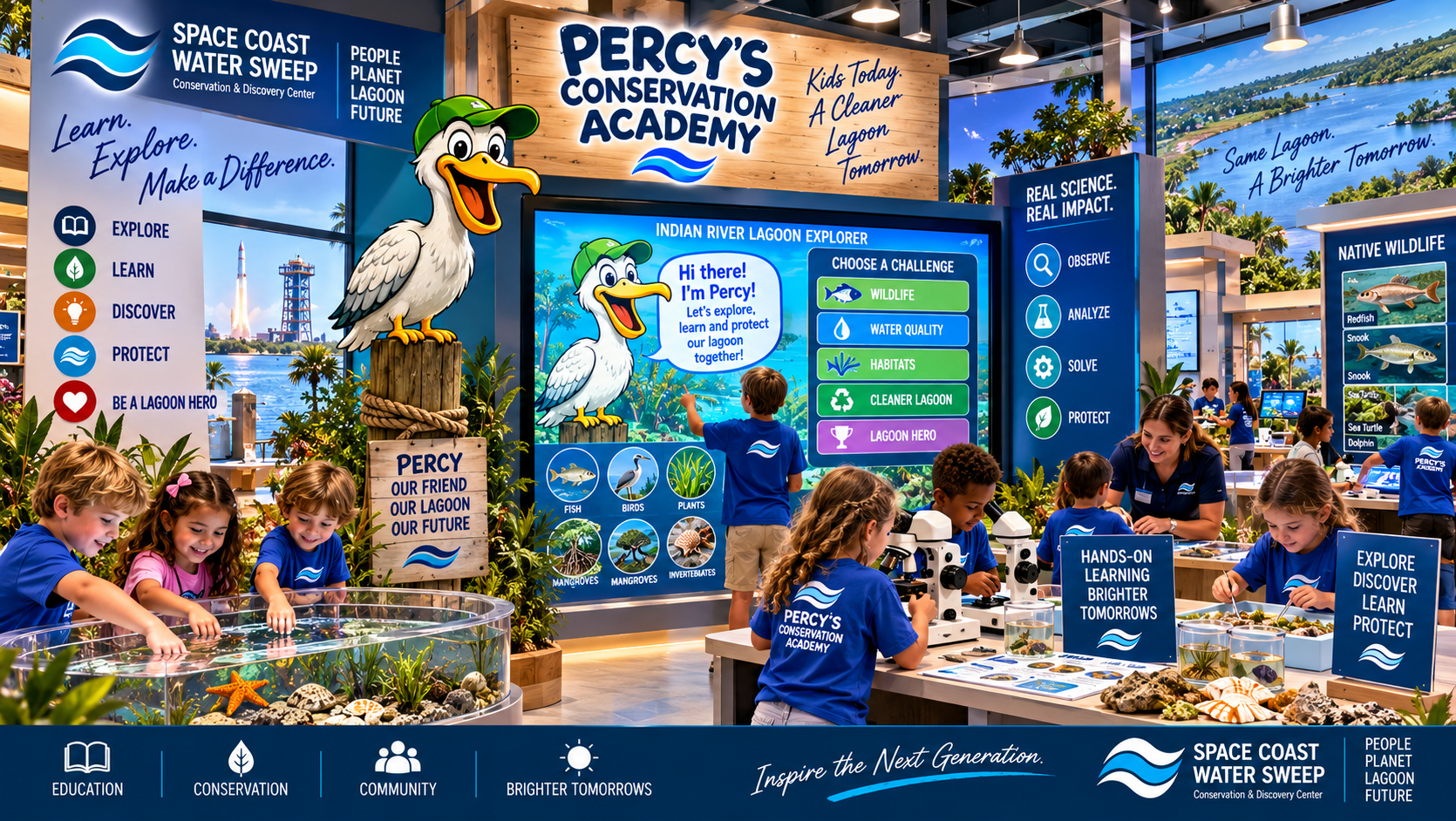
The Same Lagoon Can Teach Something Different at Every Age.
ELEMENTARY
MIDDLE SCHOOL
HIGH SCHOOL
COLLEGE / UNIVERSITY
COMMUNITY / LIFELONG LEARNING
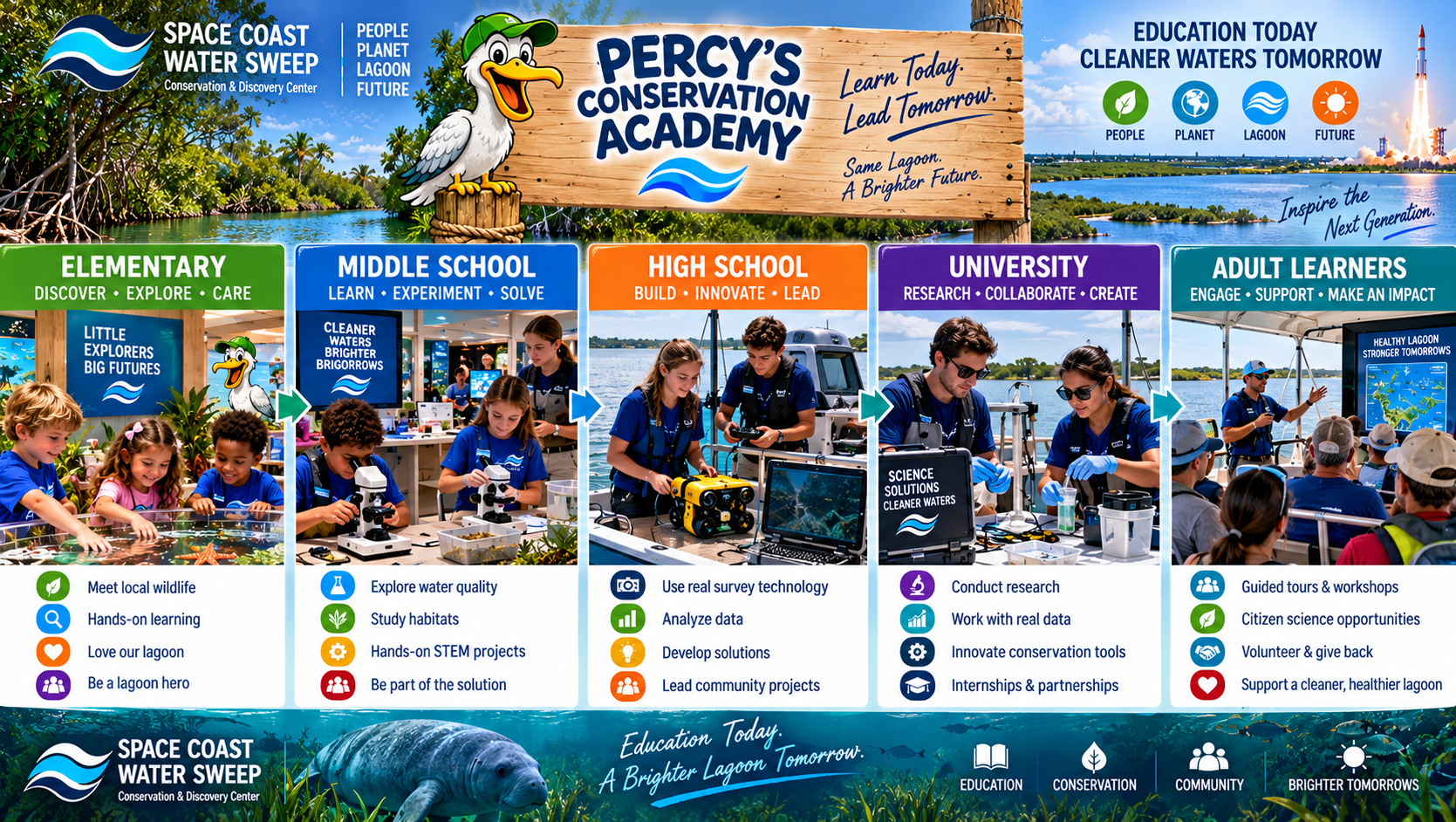
Water Is Life Supports Learning at Every Age.
The Water Is Life signature exhibit is not only a visitor experience — it is an educational platform. Age-layered interactions mean children can play while older students access deeper science, and adults can explore what's hidden in water regardless of their background. School groups, STEM programs and community visitors can all find their appropriate level of engagement.
Young Children
Interactive water play, making it rain, moving water, building a shoreline — sensory discovery that builds early curiosity about why water matters.
School Groups & STEM
Age-appropriate water chemistry, dissolved oxygen, salinity, turbidity, nutrients and microplastics — connecting water science to curriculum standards and STEM learning.
Adults & Community
Deeper water-quality science, environmental conditions, what's hidden in water and what conservation actions can help — accessible to any visitor regardless of background.
A scientific guardrail: Visually clear water does not automatically mean healthy or safe water. Water can look clean while containing things we cannot see. This exhibit teaches visitors of every age to look beyond what's visible — to water chemistry, dissolved oxygen, salinity, temperature, nutrients, turbidity, microorganisms, microplastics and more.
The Best Classroom May Be the Campus Itself.
The Center's existing experiences can become educational tools — each one connecting a different part of the Lagoon story to a different kind of learning.
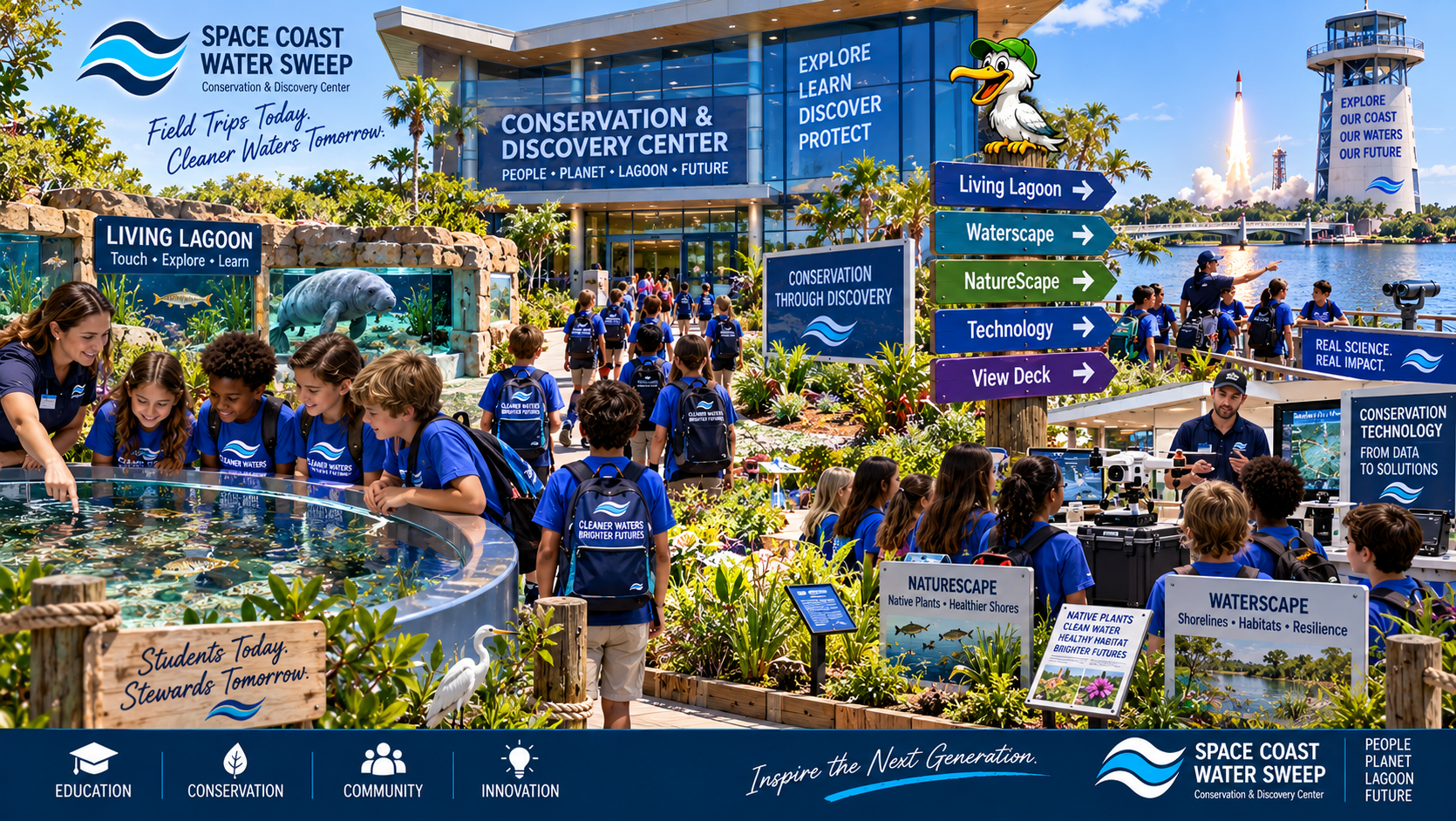
Don't Just Show Students a Picture of Sonar. Let Them Understand How It Works.
Appropriate hands-on exposure to technology helps students understand what a tool sees, what data it creates, how people interpret it and how it helps conservation. Experiences must be appropriate to age, safety, regulations and equipment availability.
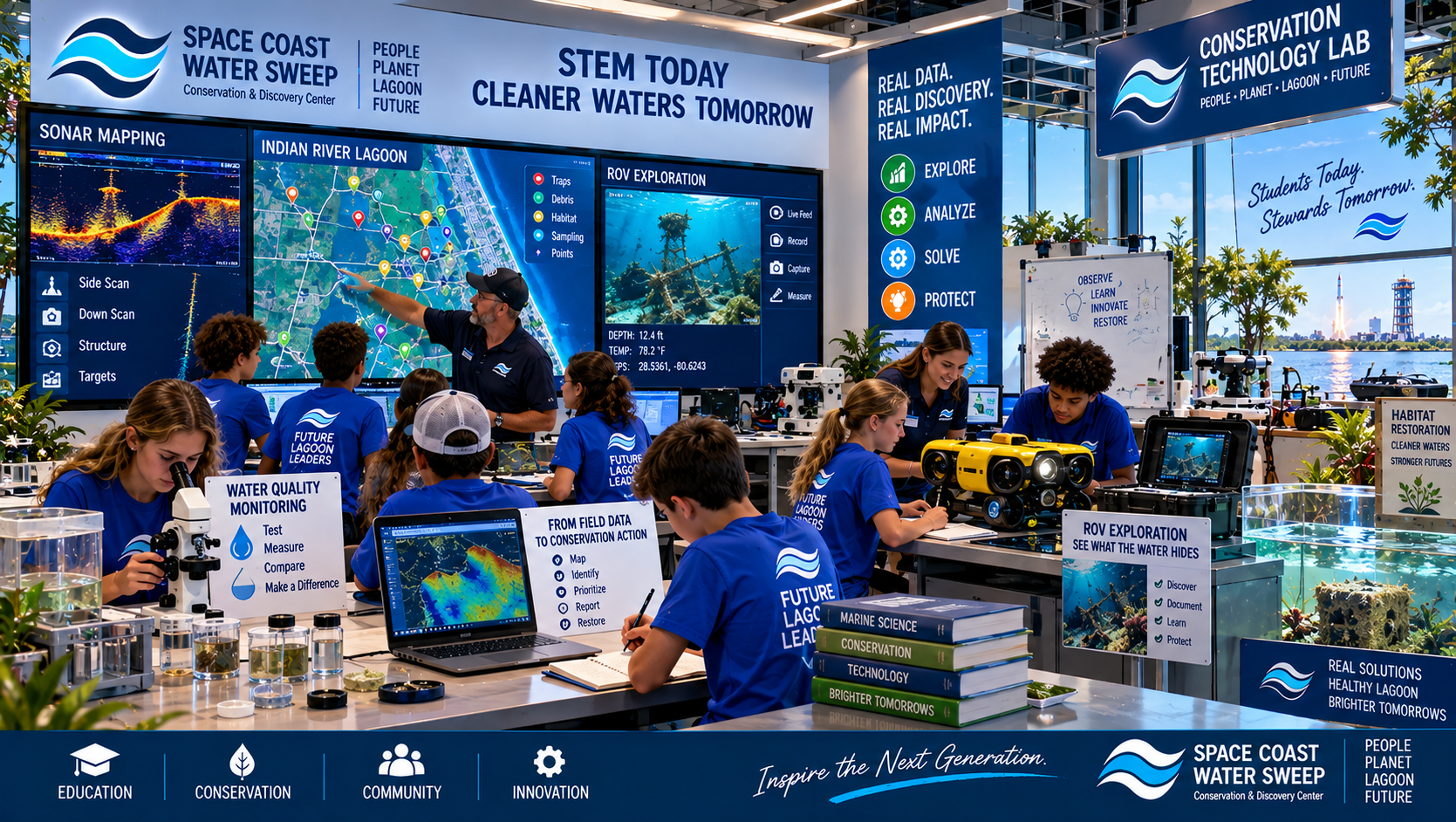
The Lesson Doesn't Have to End When Students Leave the Building.
Supervised field experiences can connect classroom learning to the real Lagoon. Students do not participate in hazardous debris recovery and do not perform regulated scientific work without appropriate supervision or protocols.
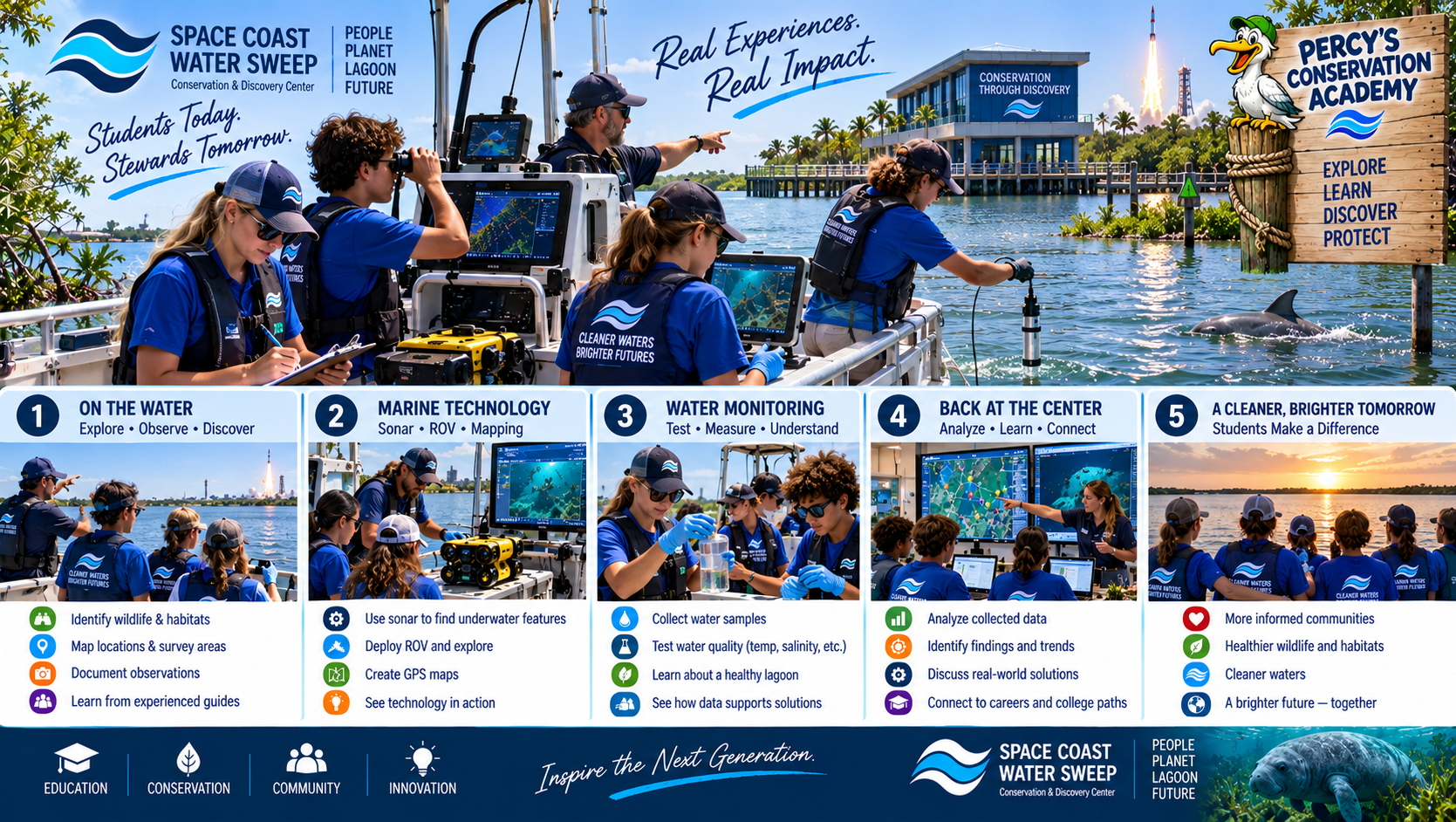
A Field Trip Can Become a Research Project.
Potential opportunities for colleges and universities span marine science, environmental science, biology, ecology, engineering, coastal engineering, materials science, robotics, computer science, AI/data science, GIS, environmental technology, communications and education. No formal university partnerships are claimed unless authorized.
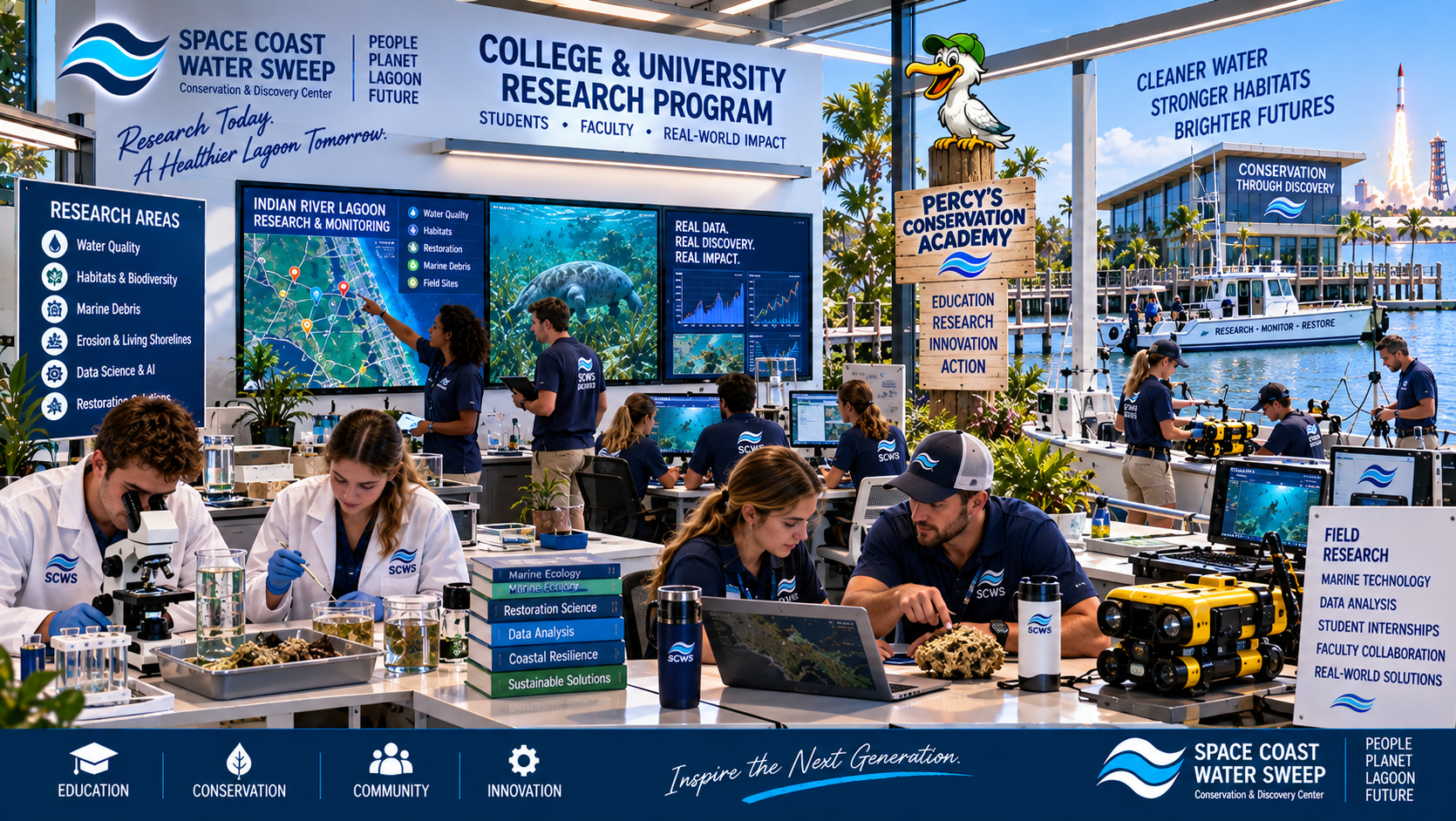
What If the Assignment Was to Solve a Real Problem?
Education can connect directly to the Innovation Lab and Conservation Fabrication & innovation Center. A Project Lagoon field observation could become a student challenge: study the problem, design a solution, build a prototype, test it, analyze results and improve it.
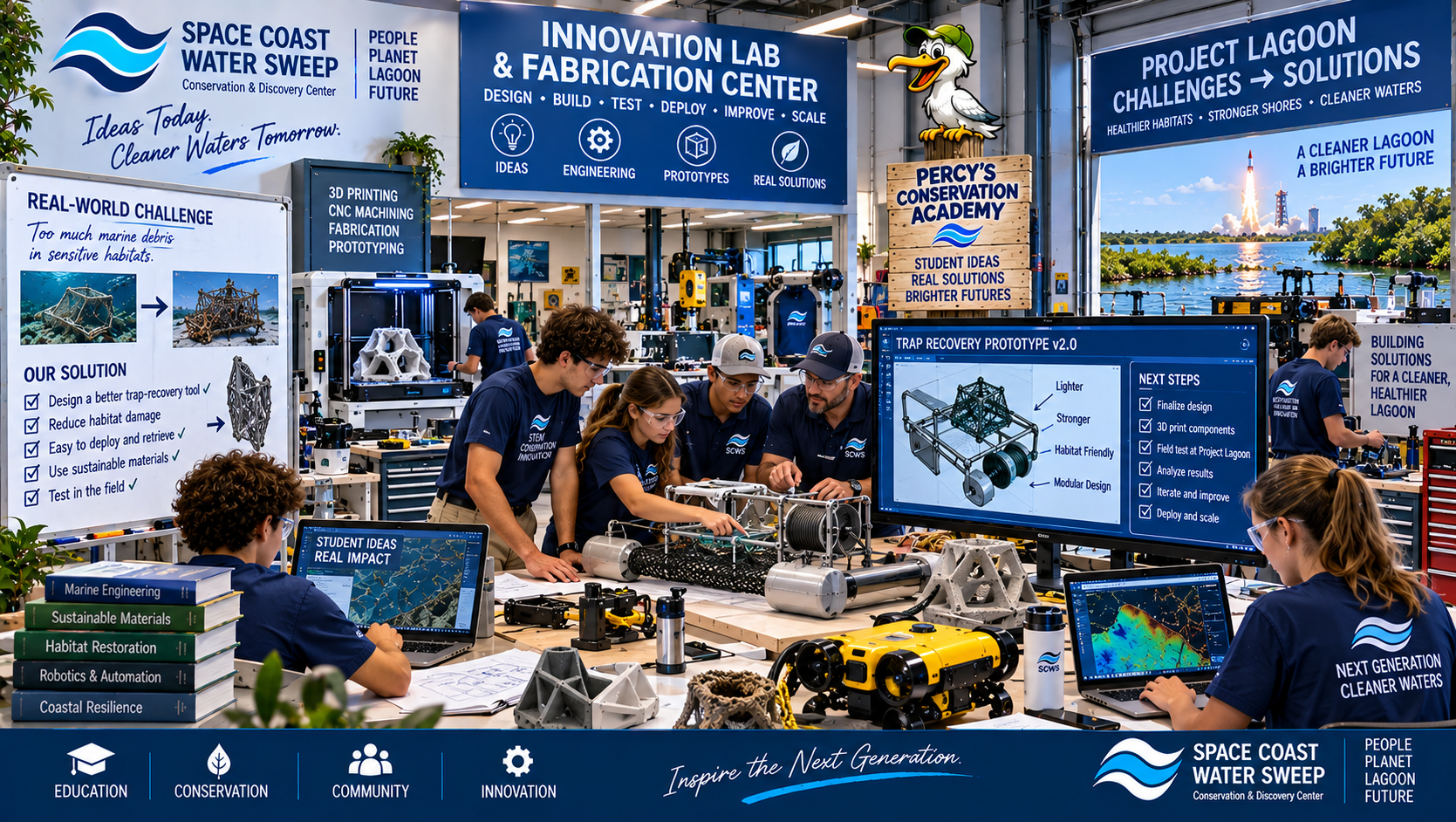
The Center Should Help Teachers Before, During and After the Field Trip.
Potential teacher resources are designed to support educators throughout the field-trip experience. Curriculum alignment and state approval are not claimed unless actually developed.
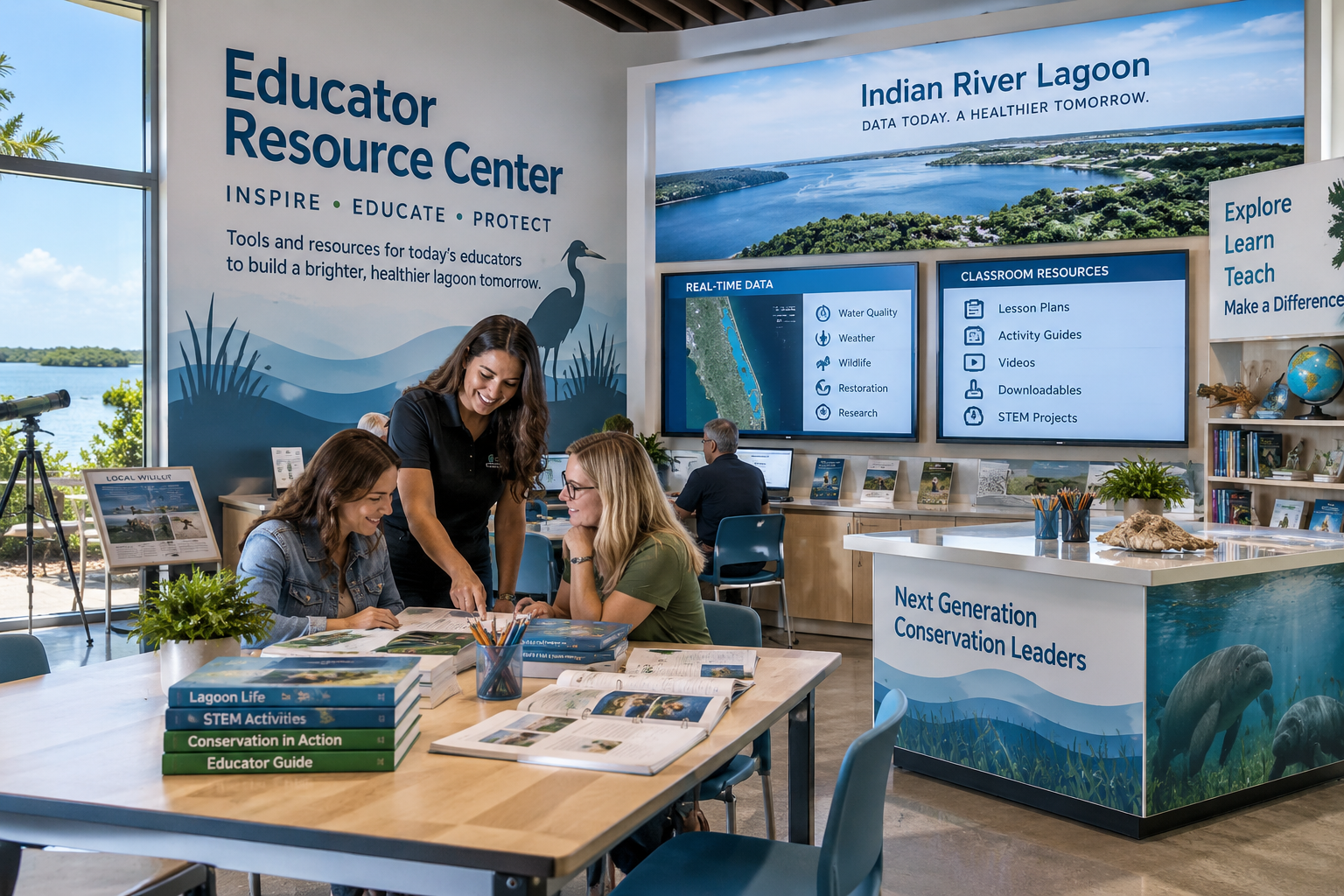
You Shouldn't Have to Be a Student to Keep Learning.
The Center should become a place where the Space Coast can gather around the Lagoon — with public lectures, scientist talks, conservation demonstrations, workshops, volunteer training, Lagoon history, technology demonstrations, restoration presentations, native landscaping education, community science where appropriate, family programs, evening programs and special events.
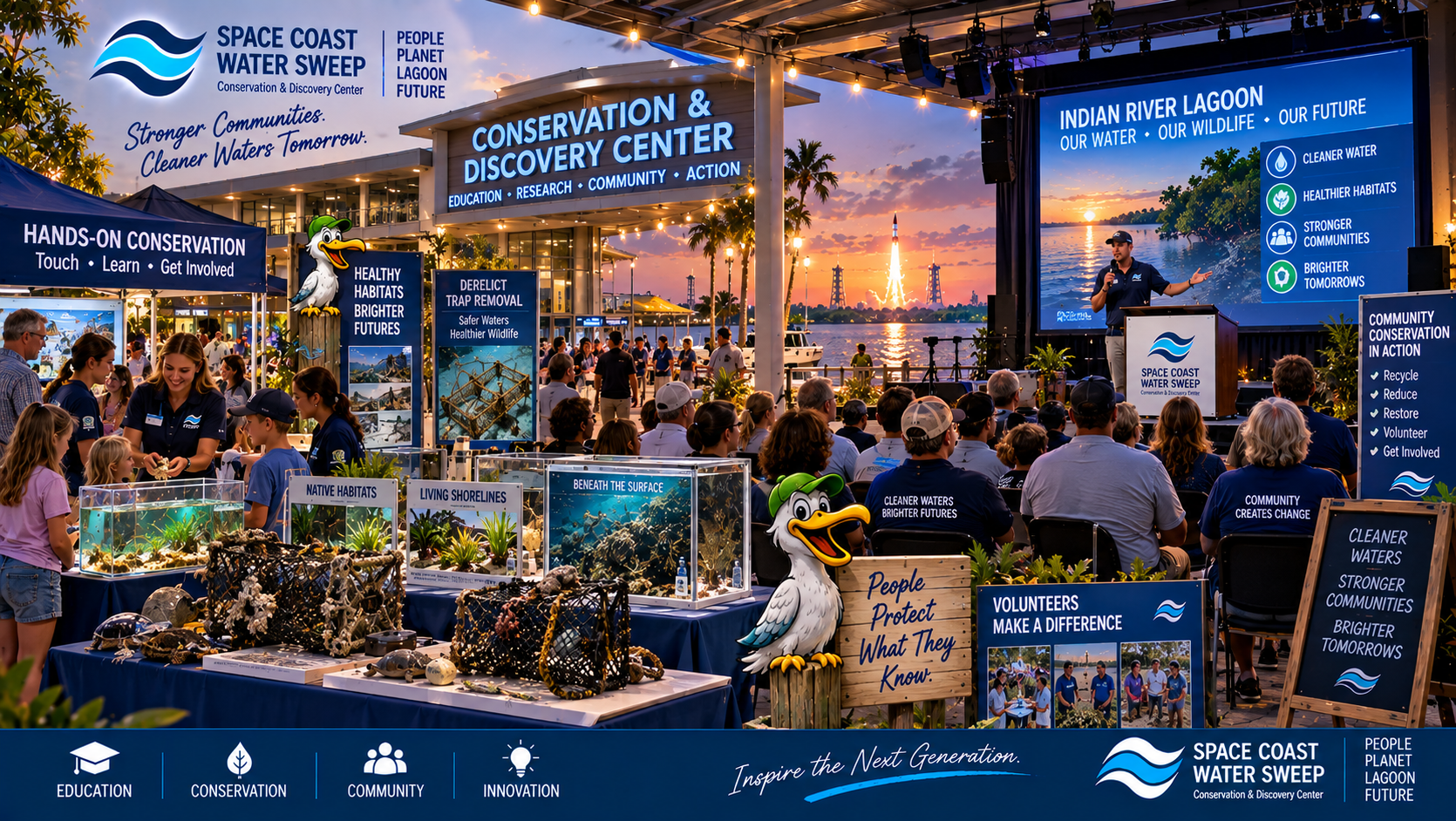
Learning Becomes More Powerful When People Can Do Something With It.
Appropriate education can lead to conservation action. All existing SCWS safety and authorization requirements are maintained. Not every visitor can independently remove marine debris or derelict fishing gear.
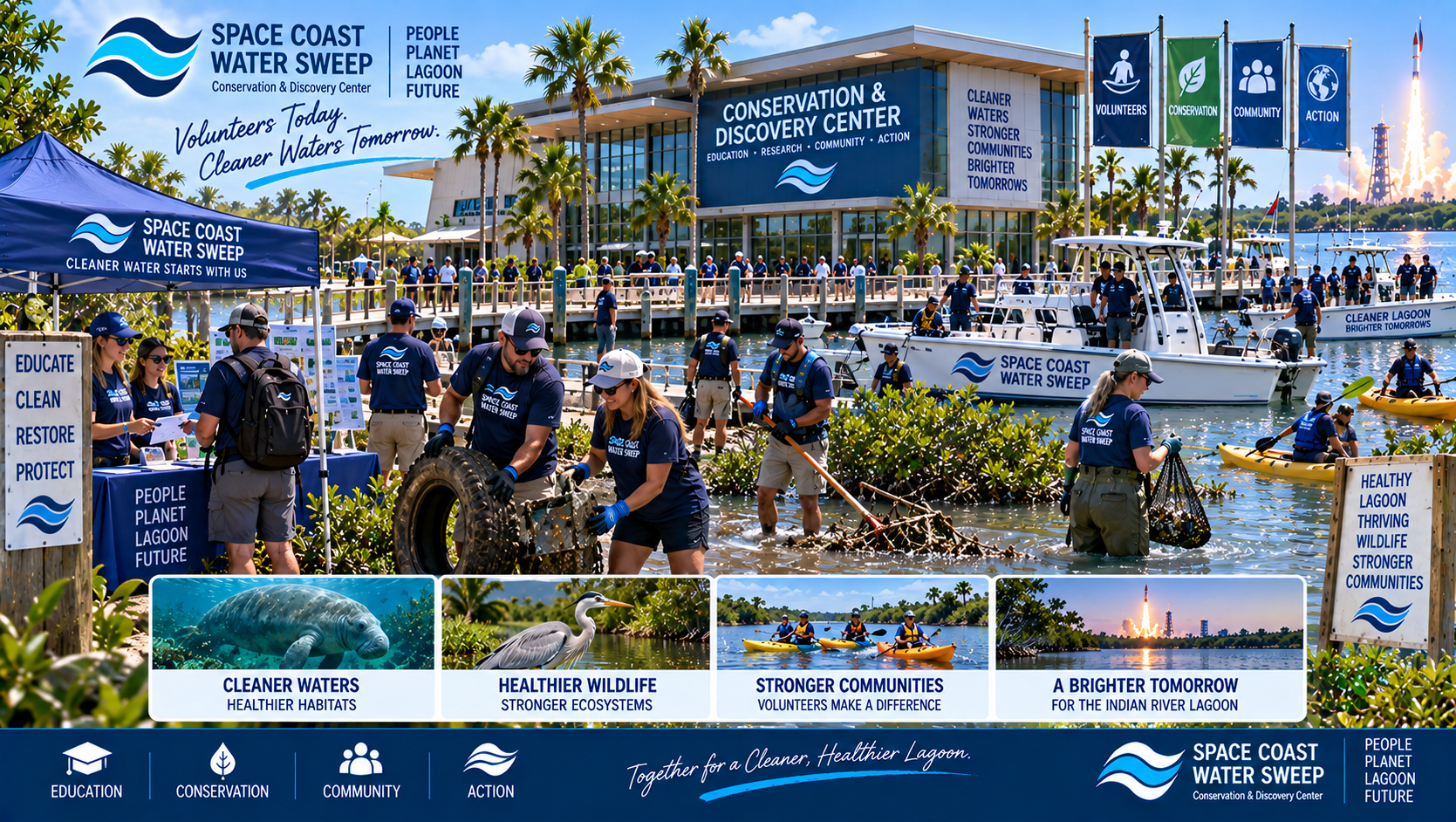
Learning Can Lead Directly to Participation.
Education is not separate from action. The Volunteer & Events Display connects what visitors learn to what they can do. A visitor who discovers why water matters in the Water Is Life exhibit can walk to the Volunteer & Events Display and find a cleanup, a kayak event or a conservation mission that fits their schedule — turning curiosity into commitment.
Arrive at the Center and explore the exhibits.
Discover why the Lagoon matters through Water Is Life, the Living Lagoon and the full educational experience.
See what SCWS volunteers do — land cleanups, water cleanups, kayak events, crab-trap removal and community conservation.
Find your next conservation mission through the Volunteer & Events Display and register for an event.
Come back for new programs, changing exhibits, seasonal experiences and deeper involvement over time.
All existing SCWS safety and authorization requirements are maintained. Not every visitor can independently remove marine debris or derelict fishing gear. Volunteer activities remain subject to training, authorization and appropriate supervision.
Someone Who Visits on a School Trip Could Come Back Years Later to Work Here.
The Center could expose students to career pathways they may not otherwise encounter — from marine science and engineering to field operations and nonprofit leadership. Employment is not promised.
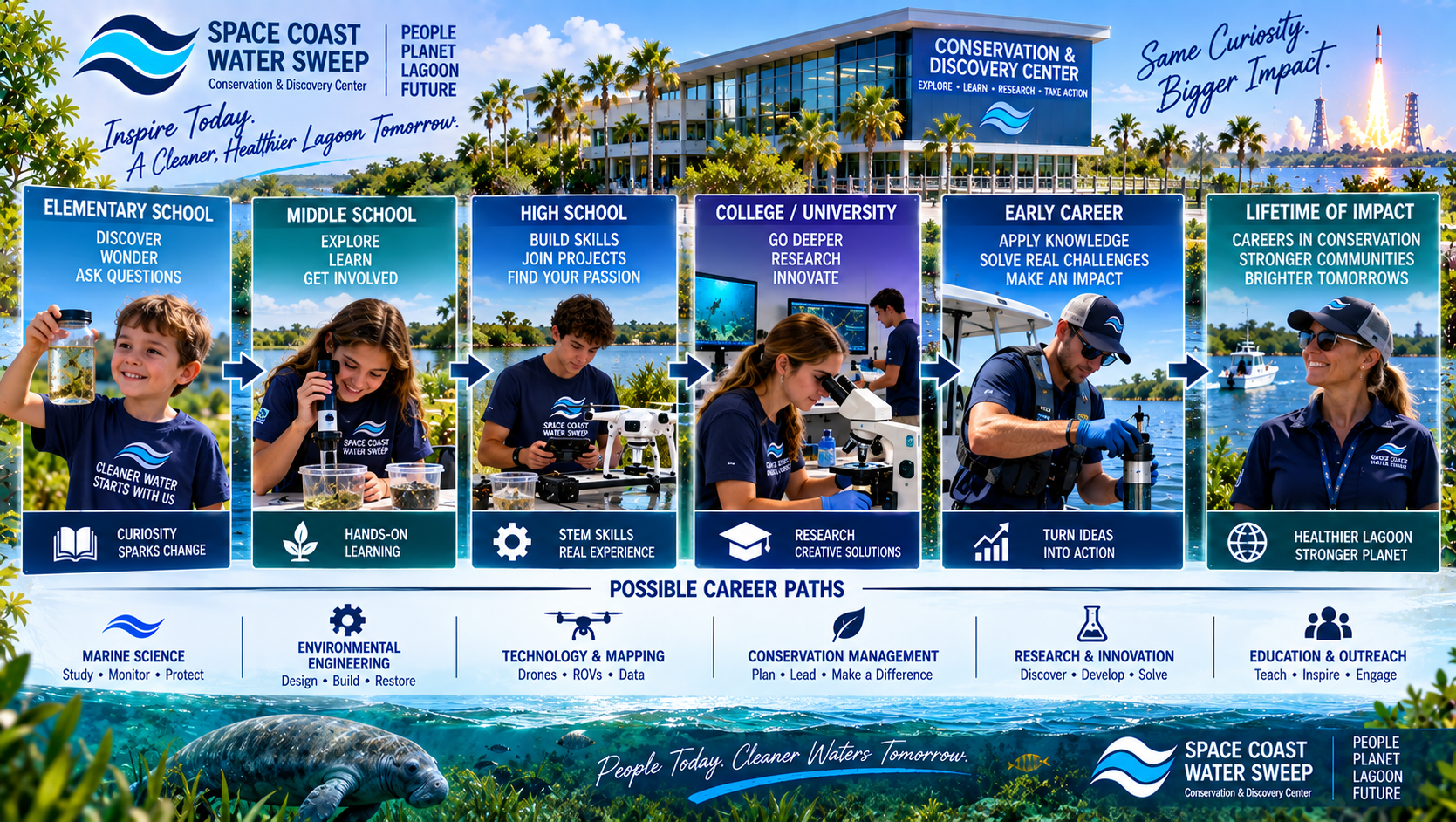
The Conservation Academy Doesn't Have to Stop at the Front Gate.
Future digital education can extend the mission beyond physical visitors — potentially allowing schools and families outside Brevard County to participate. National distribution or adoption is not claimed.
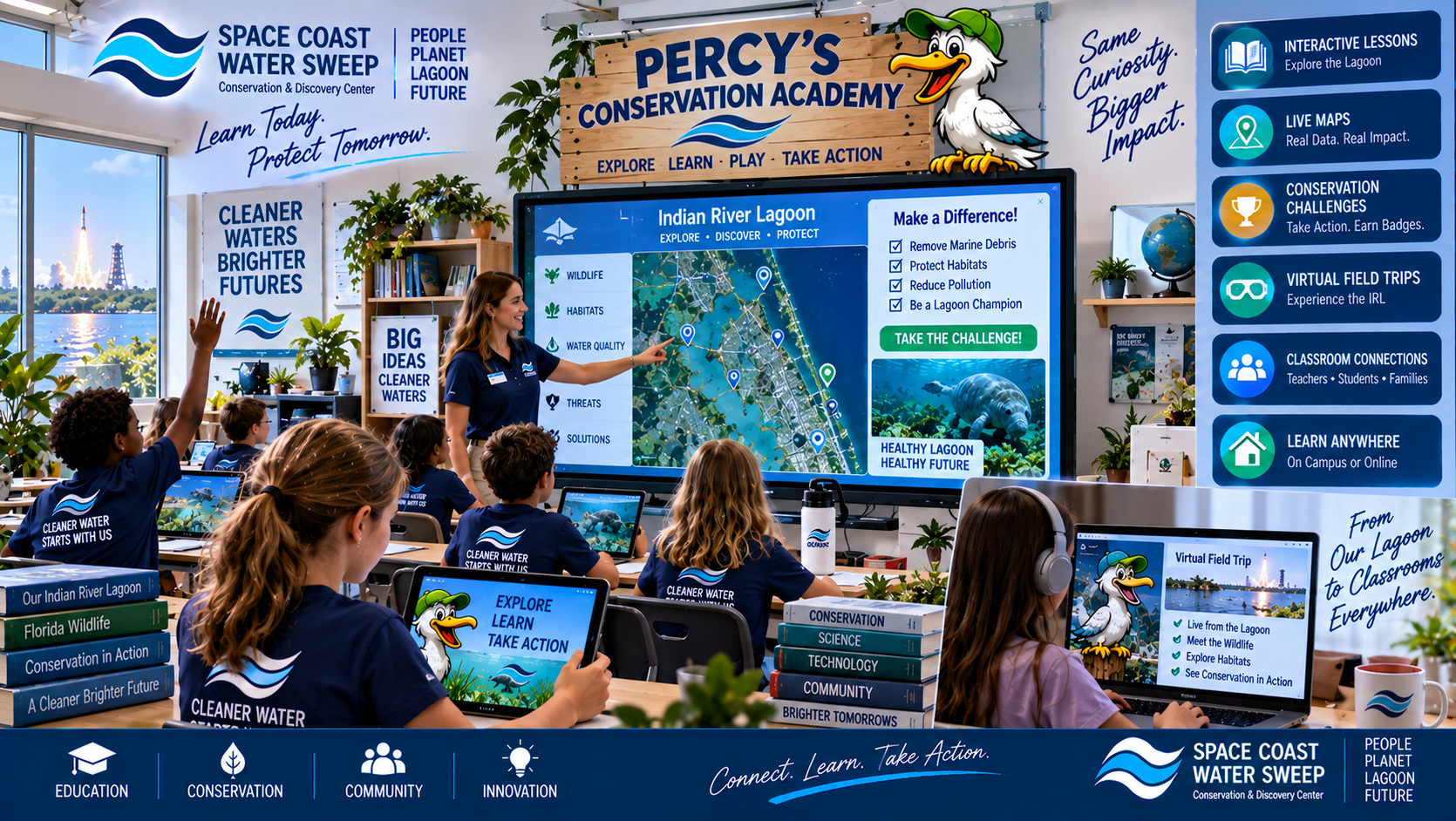
From Curiosity to Capability.
The long-term goal is not simply to teach someone one fact about the Indian River Lagoon. It is to create opportunities for people to deepen their relationship with conservation throughout their lives.
CHILD → STUDENT → RESEARCHER → VOLUNTEER → PROFESSIONAL → CONSERVATION LEADER
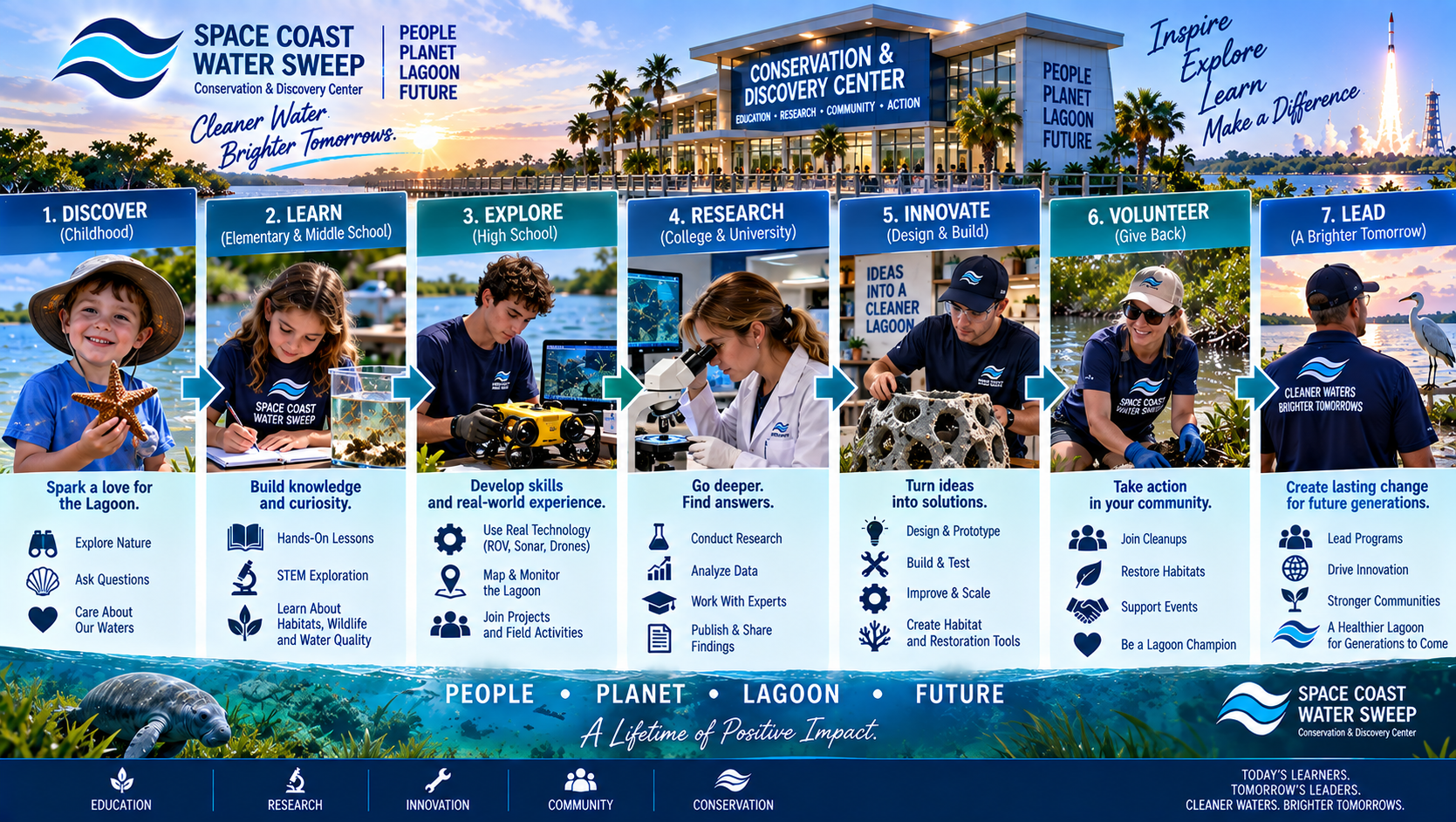
THE ENTIRE CAMPUS IS A CLASSROOM.
Explore the Waterfront & Outdoors
Public waterfront, boardwalks, trails, kayaks, eco-tour boat, research vessel, visitor day dock and outdoor learning.
The Best Way to Understand the Lagoon May Be to Get Out on It.
The proposed Kayak Adventure Center provides a dedicated launch separated from larger working vessel docks.
Bioluminescence is not guaranteed. Wildlife sightings cannot be promised.
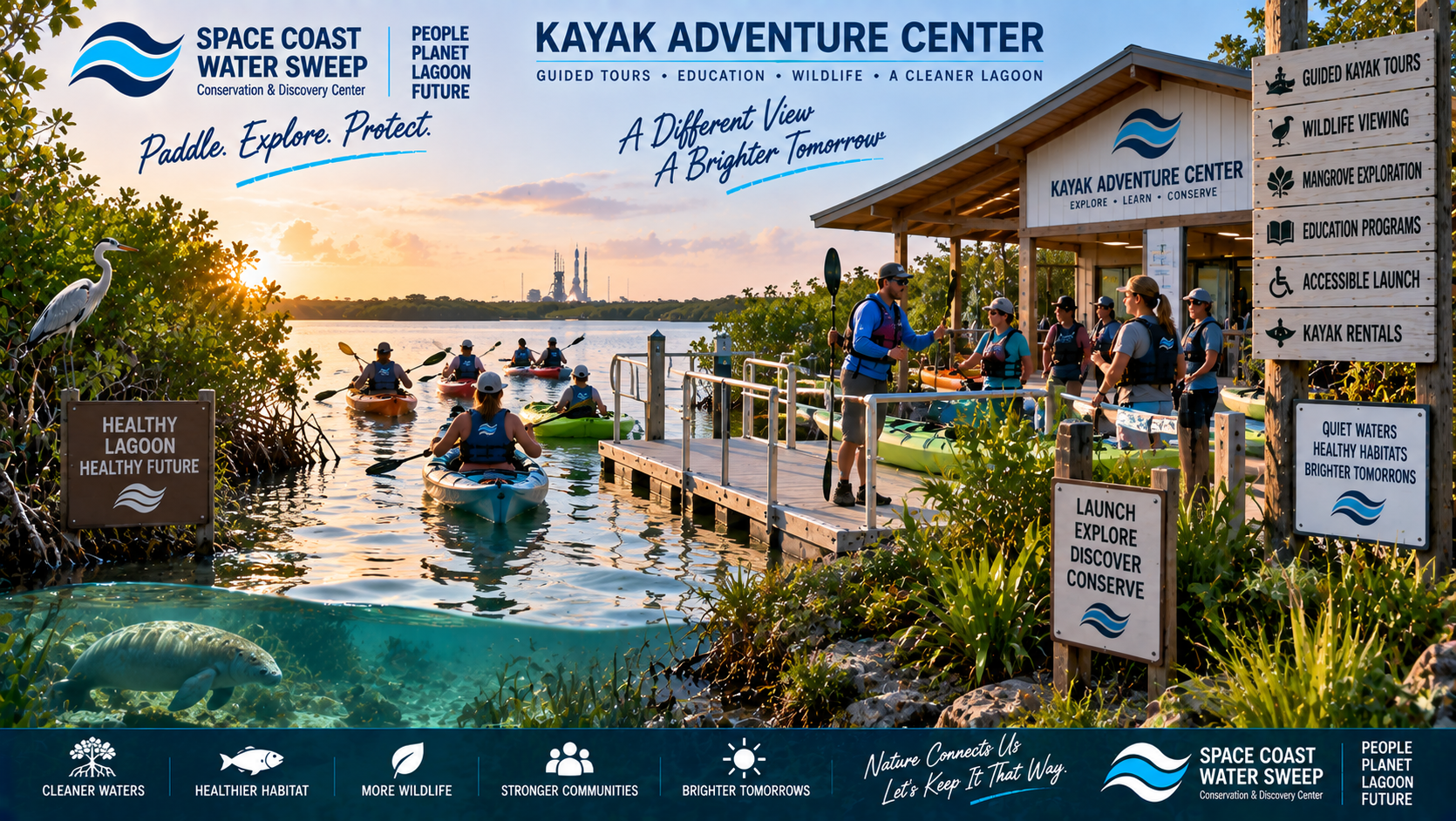
PUBLIC / FREE KAYAK LAUNCH
The Center concept may include a public kayak launch access area providing free kayak access to the water. Visitors would not need to purchase a guided kayak experience merely to launch. This remains a planning concept subject to final site design, property rights, permitting, operating rules, hours, safety requirements and available public access.
PAID GUIDED KAYAK EXPERIENCES
Guided kayak experiences may be offered as a separate visitor experience by a qualified outside operator. This paid program may include guides, equipment, scheduled experiences and other services. It does not eliminate or absorb the proposed public/free launch concept, and the public launch is not automatically part of the commercial guided-kayak concession.
The public/free kayak launch remains a planning concept and is not guaranteed until final site, property and permitting conditions are established.
DAY TOURS
Lagoon ecology, wildlife, mangroves, living shorelines, restoration, water quality, Project Lagoon interpretation, research-focused paddles.
EVENING / NIGHT TOURS
Sunset, nocturnal wildlife, astronomy / Space Coast interpretation where appropriate, seasonal bioluminescence when natural conditions support it.
See It Inside. Experience It Outside.
Inside, visitors can learn the science of bioluminescence in a controlled setting. Outside, when natural conditions support it, guided evening paddles may allow visitors to experience the real Lagoon after dark.
Natural bioluminescence is not promised.
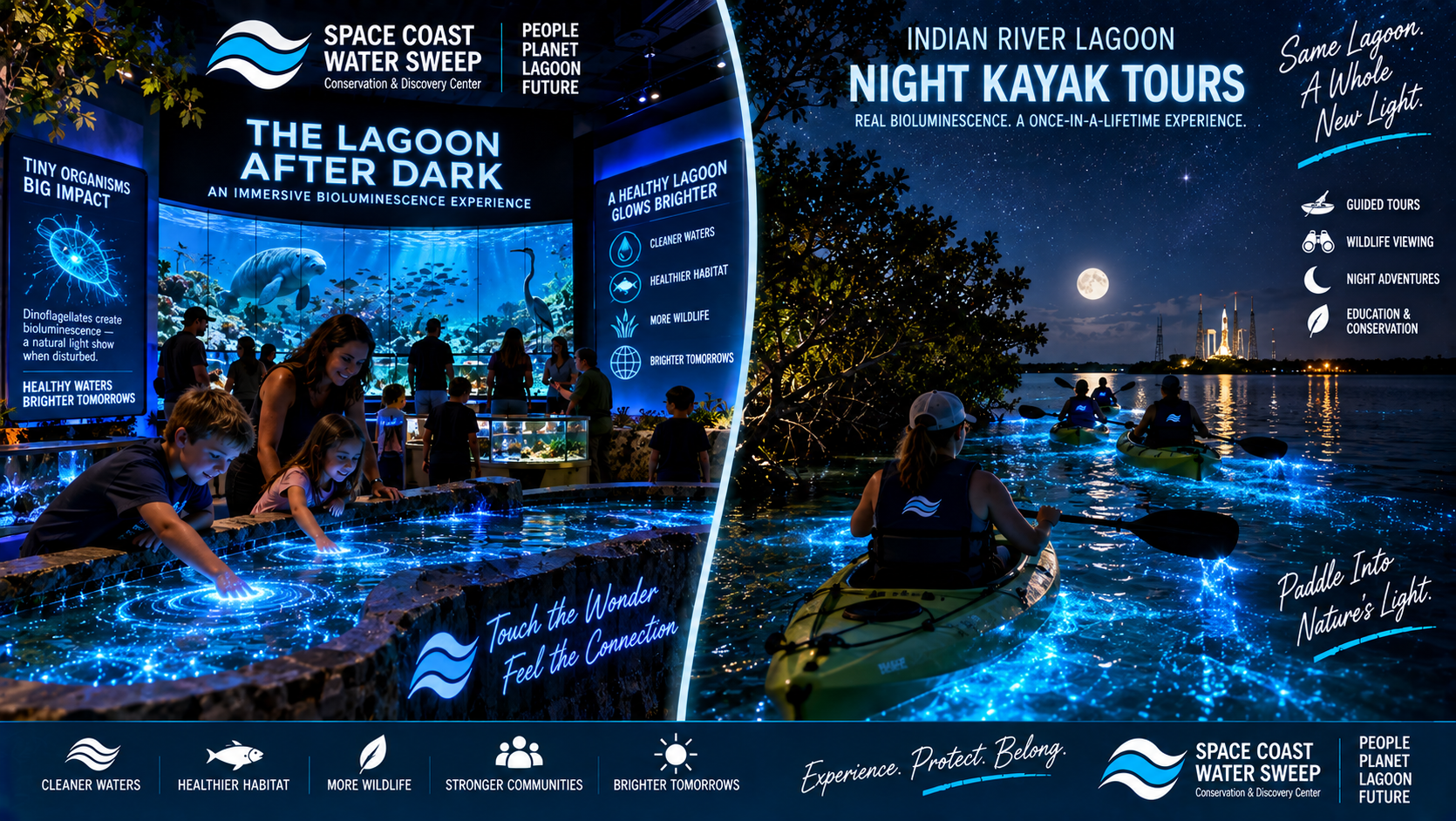
Some Stories Are Best Told From the Water.
The long-term vision may support a future larger eco-education / eco-tour vessel designed for approximately 40 passengers, subject to final design, USCG requirements and operating model.
Specific vessel size is not final. No vessel has been purchased.
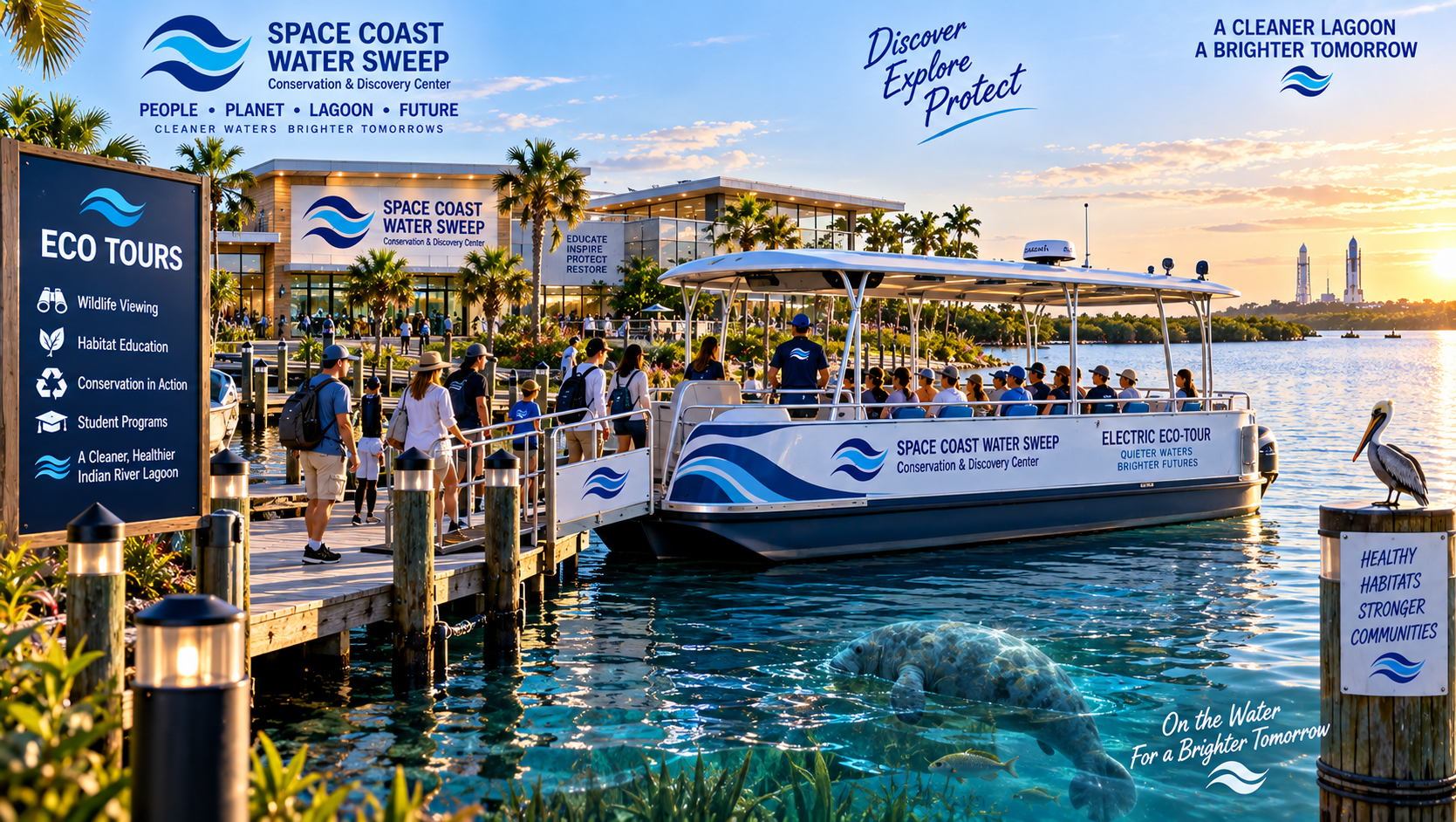
What If Your Tour Felt More Like Joining a Field Team?
The Lagoon Research & Discovery Vessel is a smaller dedicated vessel separate from the larger eco-tour boat — designed for up to six passengers plus appropriate crew, subject to vessel selection and applicable USCG requirements.
Passengers do not perform unsafe recovery operations.
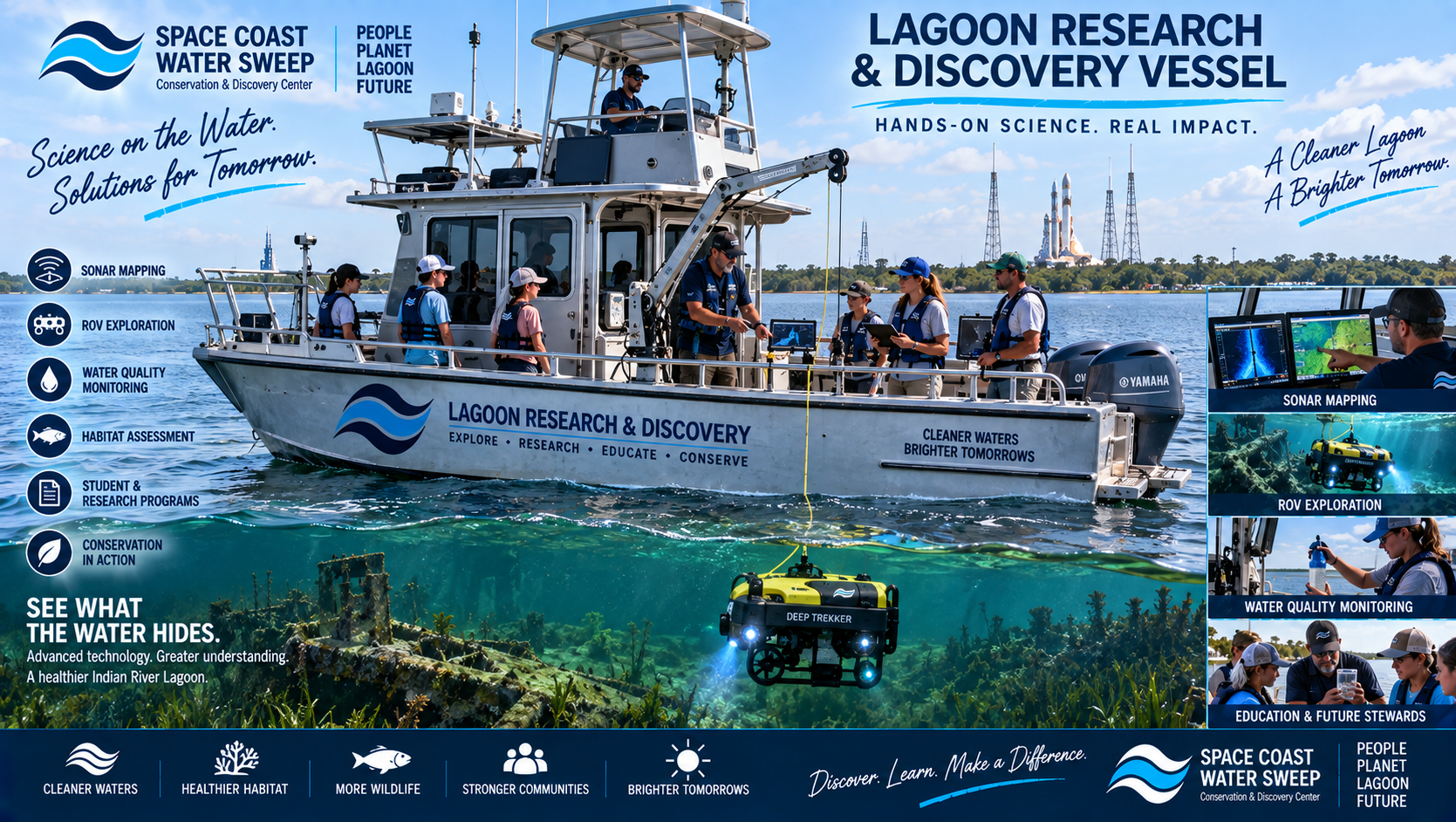
The Lagoon Is Part of a Much Bigger View.
The Center can celebrate its Space Coast setting without turning the project into a space attraction. Where location and sightlines permit, future opportunities may include launch viewing, waterfront observation, astronomy, evening programs and educational connections between Earth observation and conservation.
An observation point or tower may be possible if site planning, permitting and economics support it. Rocket visibility cannot be promised from an unknown future property.
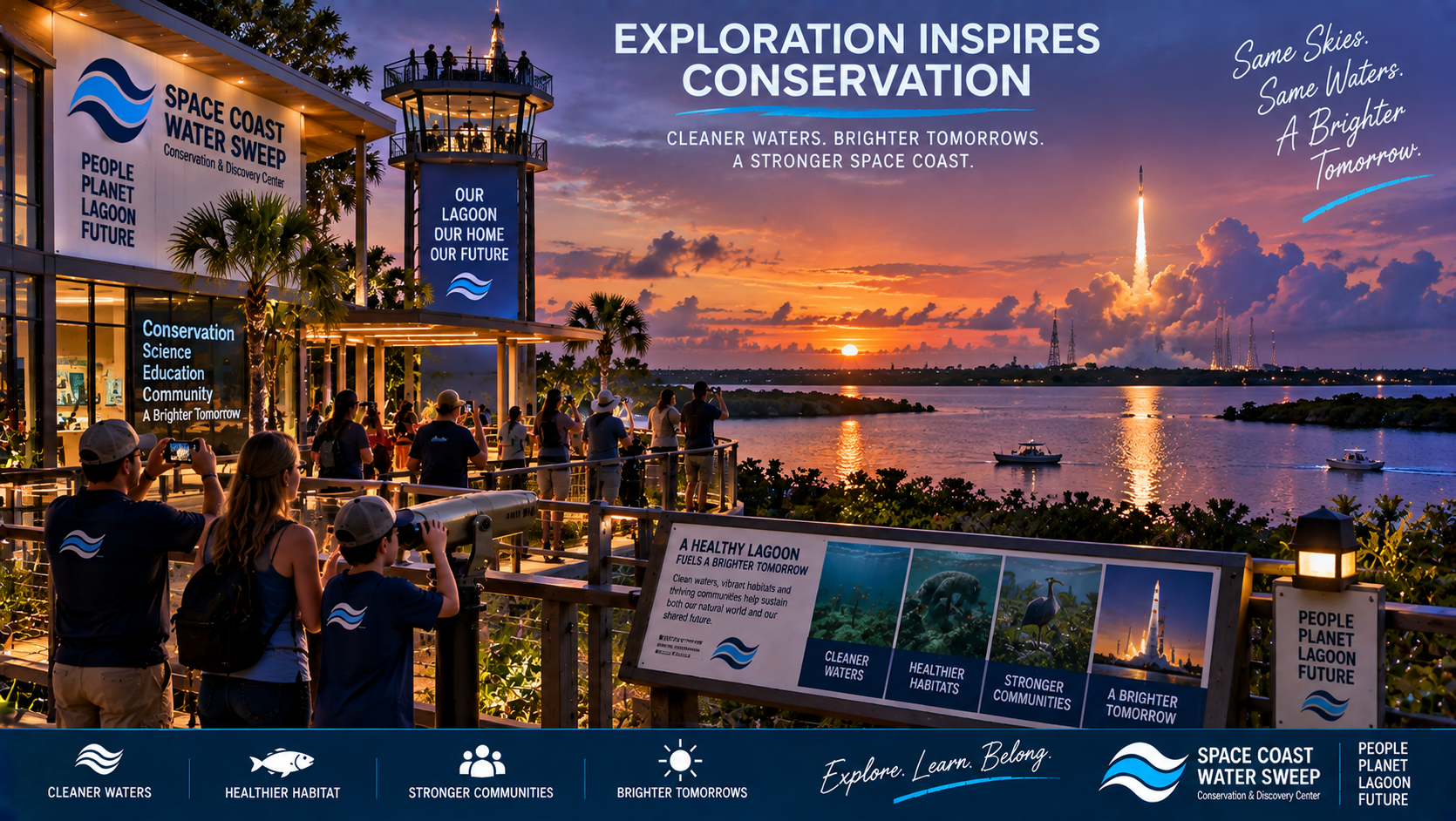
Arrive by Boat
A conceptual visitor day dock could allow private transient day-use boats visiting the Center to tie up for the day. This is NOT a full-service marina — it is a limited-capacity visitor day dock for boaters who want to experience the Center from the water.
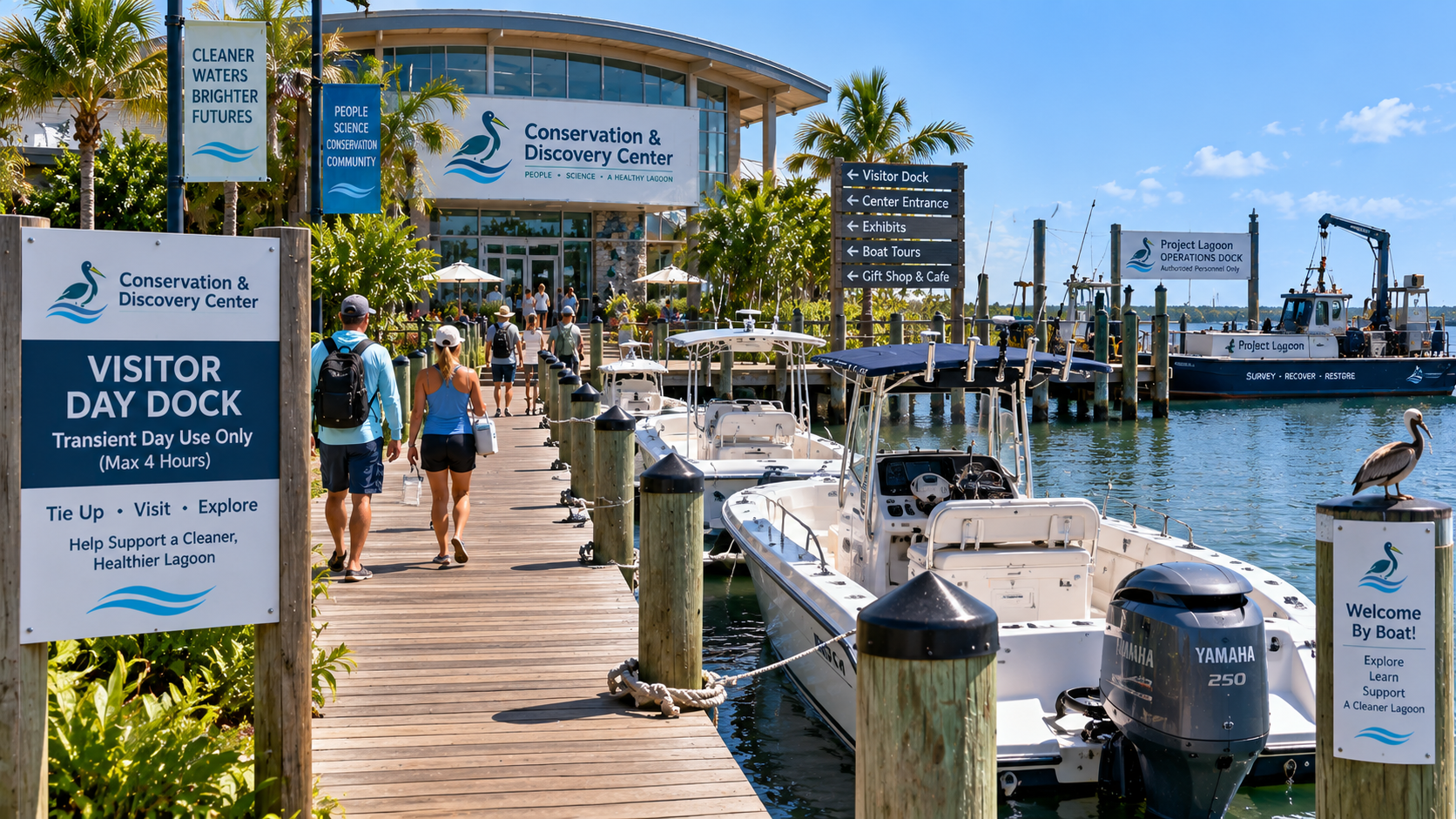
KEEP WATERFRONT FUNCTIONS DISTINCT
VISITOR DAY DOCK
ECO-TOUR / PUBLIC VESSEL
KAYAK
PROJECT LAGOON
RESEARCH
A Destination With Purpose
From arrival through repeat visitation. Free public gateway. Ticketed Center. Food, dining, store, membership and earned revenue supporting the mission.
You Shouldn't Need a Ticket to Get Started
The visitor experience begins with a FREE PUBLIC ARRIVAL ZONE before ticketed admission. Not everything requires a ticket — some food, restrooms, orientation and the Center Store should be accessible to all visitors.
The conceptual visitor flow moves from parking and arrival through a free public gateway, then through controlled admission and screening into the ticketed Center experience.
What the Free Public Area Could Include
These functions do not require ticketed admission:
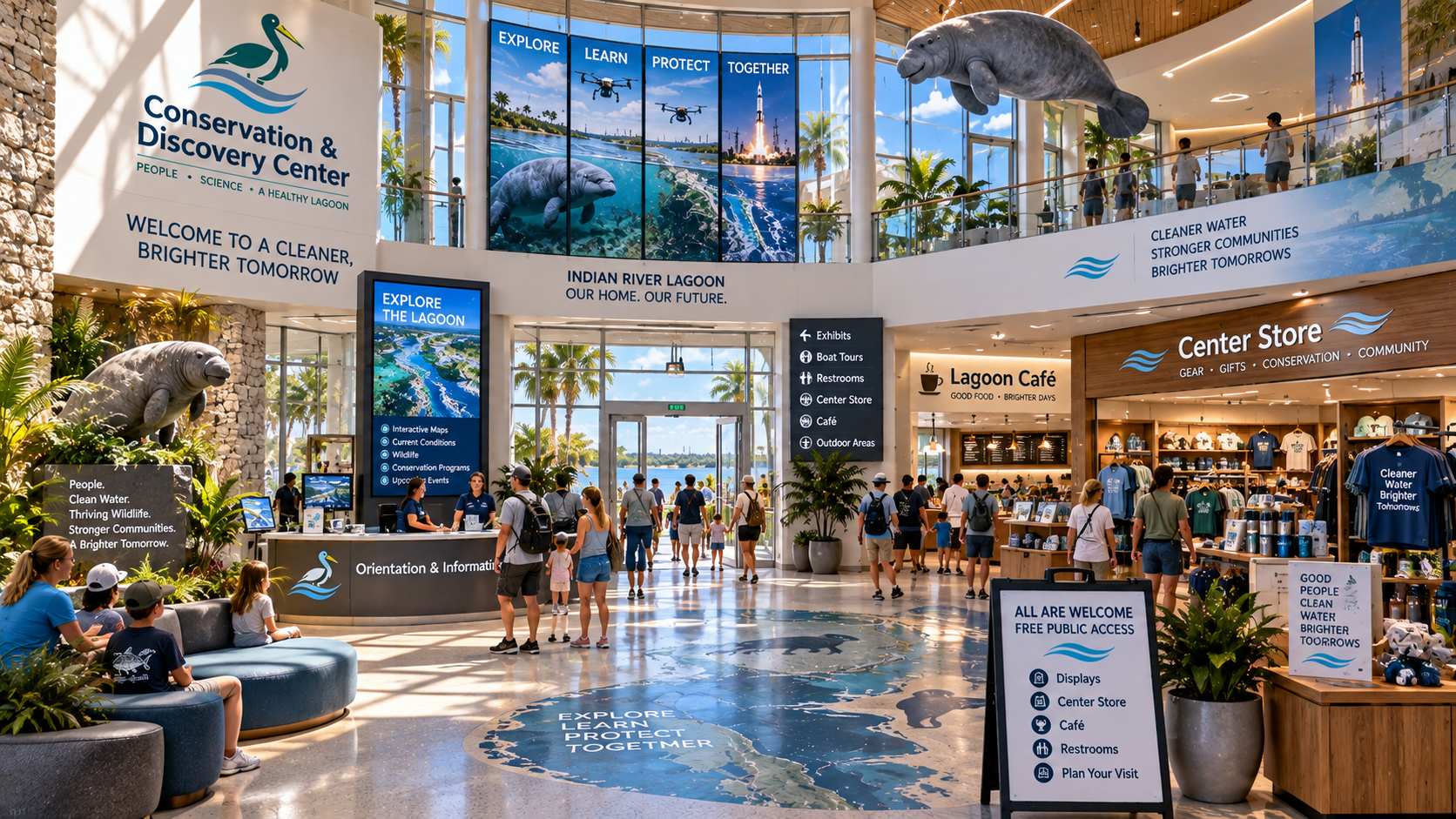
A Destination That Helps Power the Mission
The long-term vision includes mission-aligned earned-revenue opportunities such as visitor experiences, educational programs, guided experiences, memberships, events, merchandise and appropriate concessions/activities.
Earned revenue can complement donations, sponsorships, grants and partnerships and help expand conservation, research, education and restoration.
A Destination That Supports the Region
The Center is envisioned not only for local residents. It could become another reason for people to visit the Space Coast and spend additional time in the region — connecting conservation, education, Lagoon experiences, launch viewing, eco-tourism and community participation in one place.
All visitor audiences, partnerships and economic opportunities described below are conceptual and future-oriented. No specific organization has committed to any partnership unless explicitly confirmed.
LOCAL & REGIONAL VISITORS
Families, schools, residents, anglers, conservation groups and visitors already exploring Brevard and the Indian River Lagoon.
SPACE COAST DESTINATION VISITORS
Visitors traveling for launches, beaches, nature, Port Canaveral, Kennedy Space Center and other regional attractions who could add the Center to their trip.
CRUISE / PORT VISITORS
Future opportunity: appropriate partnerships could potentially create shore excursion, pre-cruise, post-cruise, conservation, eco-tour and Lagoon discovery experiences. No cruise line or port has committed.
FLORIDA VISITORS
Visitors from across Florida interested in conservation, nature, eco-tourism, environmental education and Space Coast experiences.
GROUP TOURS & SCHOOLS
Organized groups, school field trips, conservation groups, civic organizations and educational tours.
RESEARCHERS & STUDENTS
University partners, researchers, interns, STEM groups and conservation-focused academic visitors.
REASONS TO VISIT
THE REGIONAL OPPORTUNITY
A visitor who comes to the Center may also stay locally, eat locally, use local transportation, visit other attractions, participate in other nature experiences and spend additional time in the Space Coast region.
This creates potential opportunities for:
THE CONSERVATION FUNDING RELATIONSHIP
VISIT → EXPERIENCE → LEARN → PARTICIPATE → SUPPORT
SCWS EARNED REVENUE + AVAILABLE DONATIONS / SPONSORSHIPS / GRANTS + POTENTIAL PAYMENTS FROM INDEPENDENT OPERATORS UNDER FUTURE AGREEMENTS
= POTENTIAL RESOURCES SUPPORTING CENTER OPERATIONS AND SCWS MISSION
Independent operator customer revenue belongs to the operator — only an agreed payment from the operator to SCWS would become SCWS revenue. Restricted contributions remain subject to their restrictions. No financial outcome is guaranteed.
One Visit Shouldn't Be Enough.
The Center should be designed for repeat visitation. Someone may come for the Living Lagoon, for Lagoon After Dark, for a kayak tour, for an eco-tour, for a launch event, for a school program, for a new research demonstration, for a fabrication demonstration, for a temporary exhibit, for a community event, to bring visiting family, or simply to enjoy NatureScape and the waterfront. A future signature immersive adventure — Hidden Waters: The Expedition — could become a major family destination draw supporting repeat visitation, tourism and earned revenue.
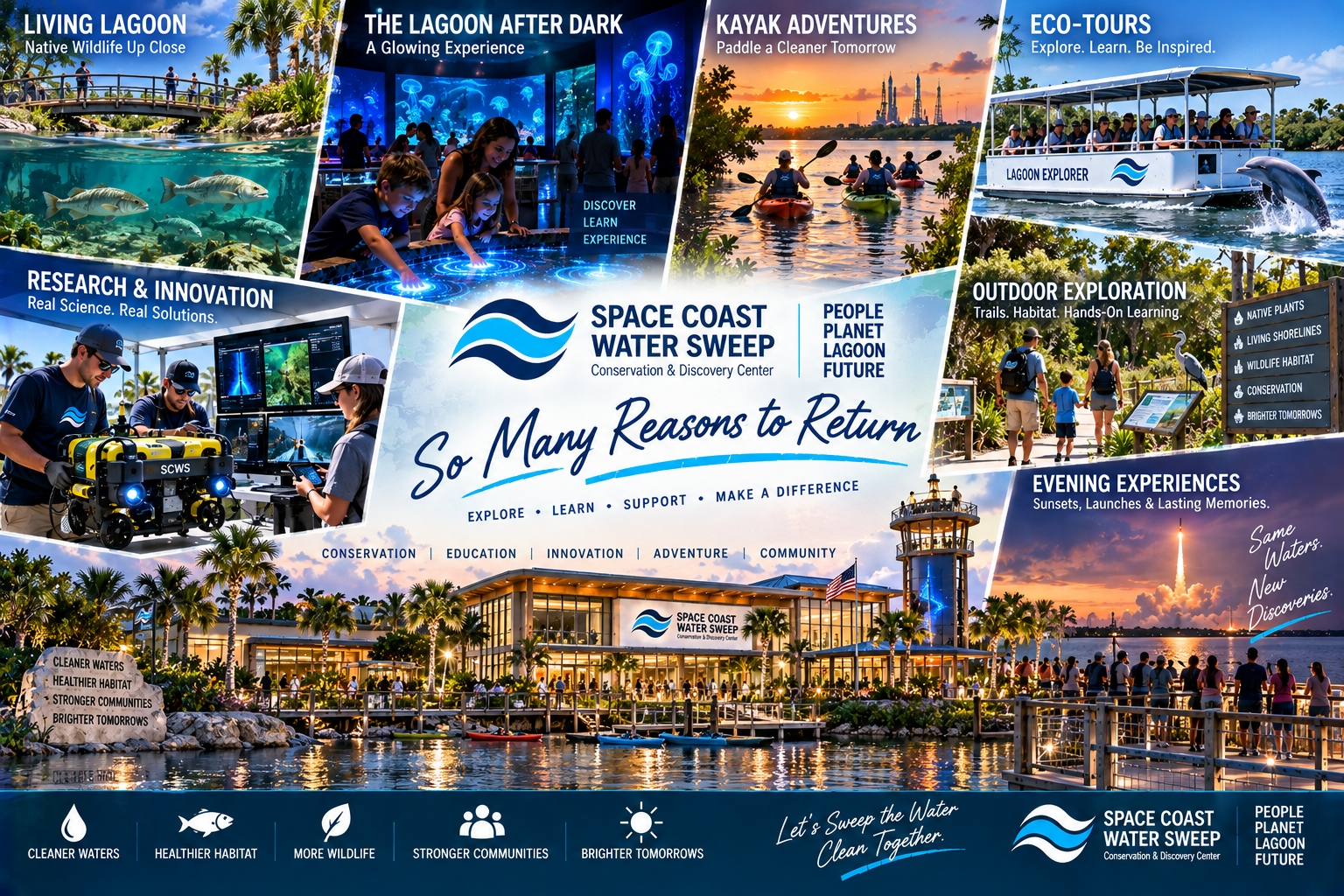
The Experience Can Help Power the Mission.
Earned revenue can complement donations, grants and sponsorships. Some activities would be operated by SCWS directly, while others may be provided by independent commercial operators under future agreements.
When an activity is provided by an independent operator, customer payments belong to that operator. SCWS would receive only whatever payment is established under the future agreement, if any. The final operating structure remains under development.
No prices are stated. No revenue projection is claimed. Commercial activity does not replace the nonprofit mission.
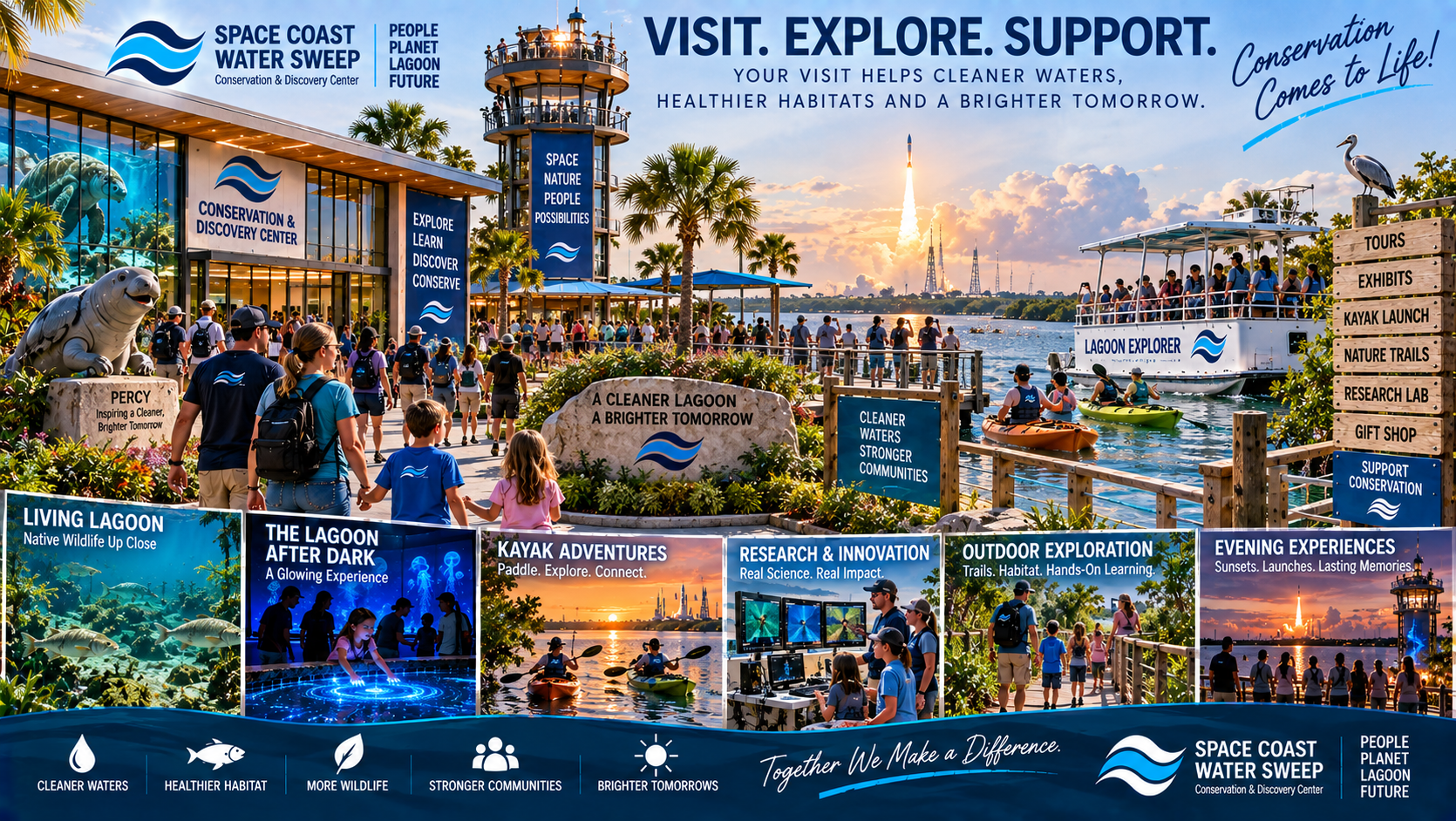
The Visitor Experience Doesn’t Stop at the Exhibits.
A working conservation campus should also be a welcoming place to spend time. The Center is being planned with mission-connected retail, distributed food and beverage, comfortable indoor and outdoor gathering spaces, and coffee — all designed to feel like part of the Conservation & Discovery Center experience rather than a generic shopping mall or food court.
These visitor services are also part of the long-term earned-revenue model that can help support the Center and its conservation mission.
A Mission-Connected Retail Experience Near the Main Entrance.
The primary Conservation & Discovery Center Store is envisioned near the main visitor entrance and exit — so visitors can discover something to take home as easily as they discovered the Lagoon.
The store should feel like an extension of the Center experience, not a generic gift shop. Merchandise can connect visitors to the conservation mission, the Space Coast, and what they learned during their visit.
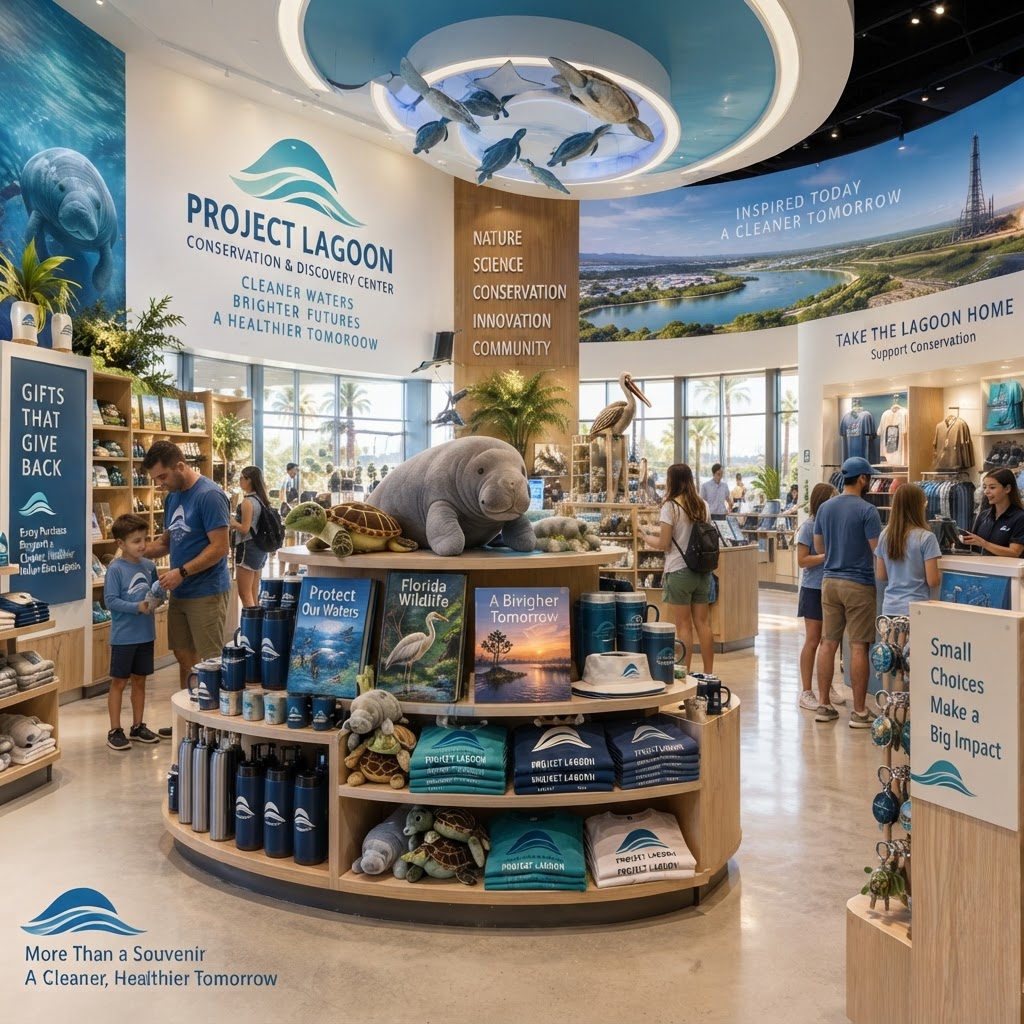
Not One Restaurant — Many Small Mission-Themed Locations.
The Center is not envisioned around a conventional full-service sit-down restaurant. Instead, smaller themed food and drink counters or kiosks may be located near major visitor experience areas throughout the campus.
The design and theme of each location can connect to the visitor experience around it — so food and beverage become part of the discovery rather than a separate stop.
POTENTIAL OFFERINGS:
- Grab-and-go meals
- Sandwiches / wraps
- Children's options
- Snacks
- Desserts / treats
- Bottled / canned beverages
- Fountain beverages where appropriate
- Specialty nonalcoholic cold drinks
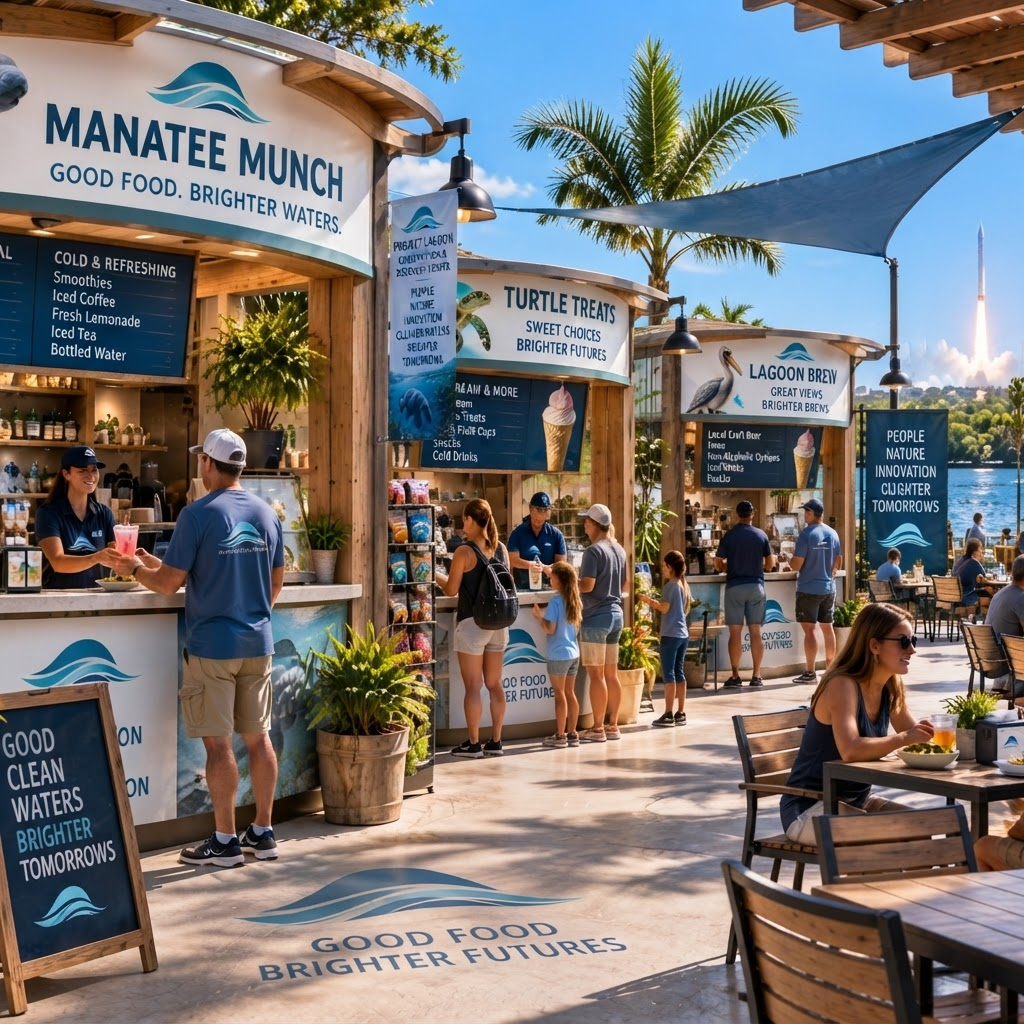
A Dedicated Indoor Coffee and Refreshment Location.
At least one dedicated indoor coffee and specialty beverage location is envisioned for the Center — a comfortable place to start a visit, take a break, or recharge between experiences.
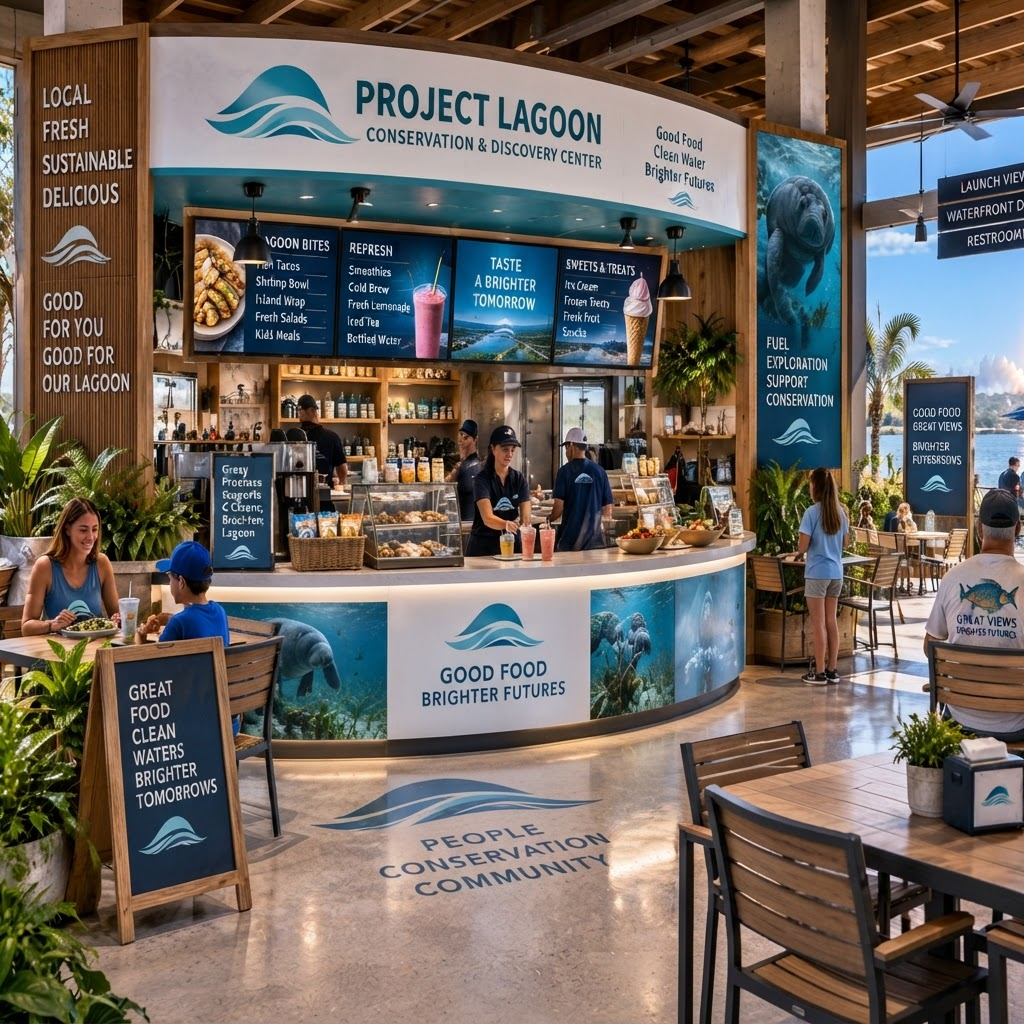
A Comfortable Air-Conditioned Place to Sit, Eat and Take a Break.
Because this is a Florida destination, the Center is envisioned with a substantial air-conditioned indoor dining commons where visitors can bring food purchased from Center food locations and sit together.
This is not a waiter-service restaurant. It is a flexible, comfortable visitor dining commons that also provides shelter from heat, rain and severe weather.
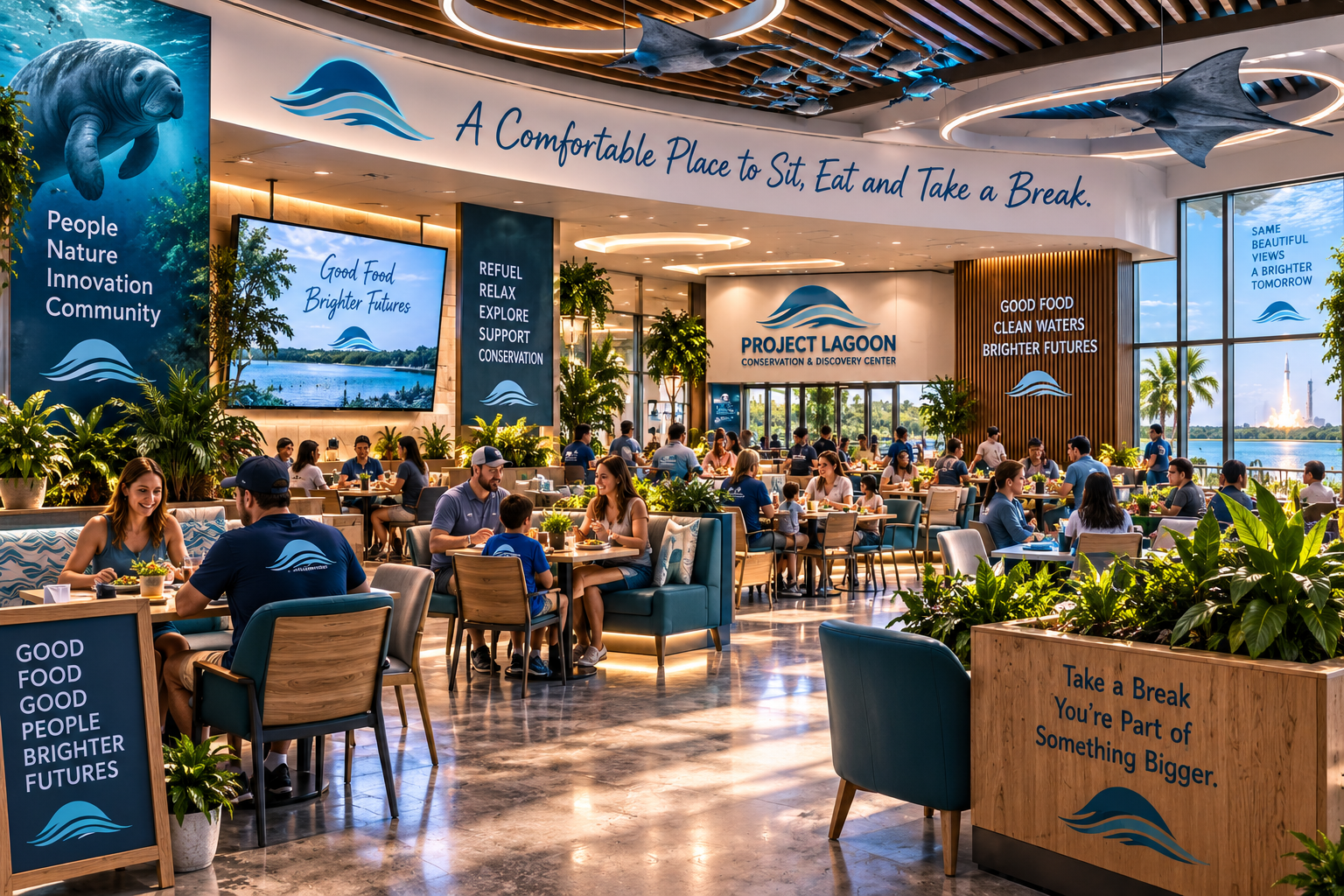
A Landscaped Outdoor Food and Gathering Area Connected to NatureScape.
A substantial themed outdoor dining and gathering area is envisioned as part of the campus — integrated with NatureScape and the outdoor conservation campus rather than placed as a generic food court.
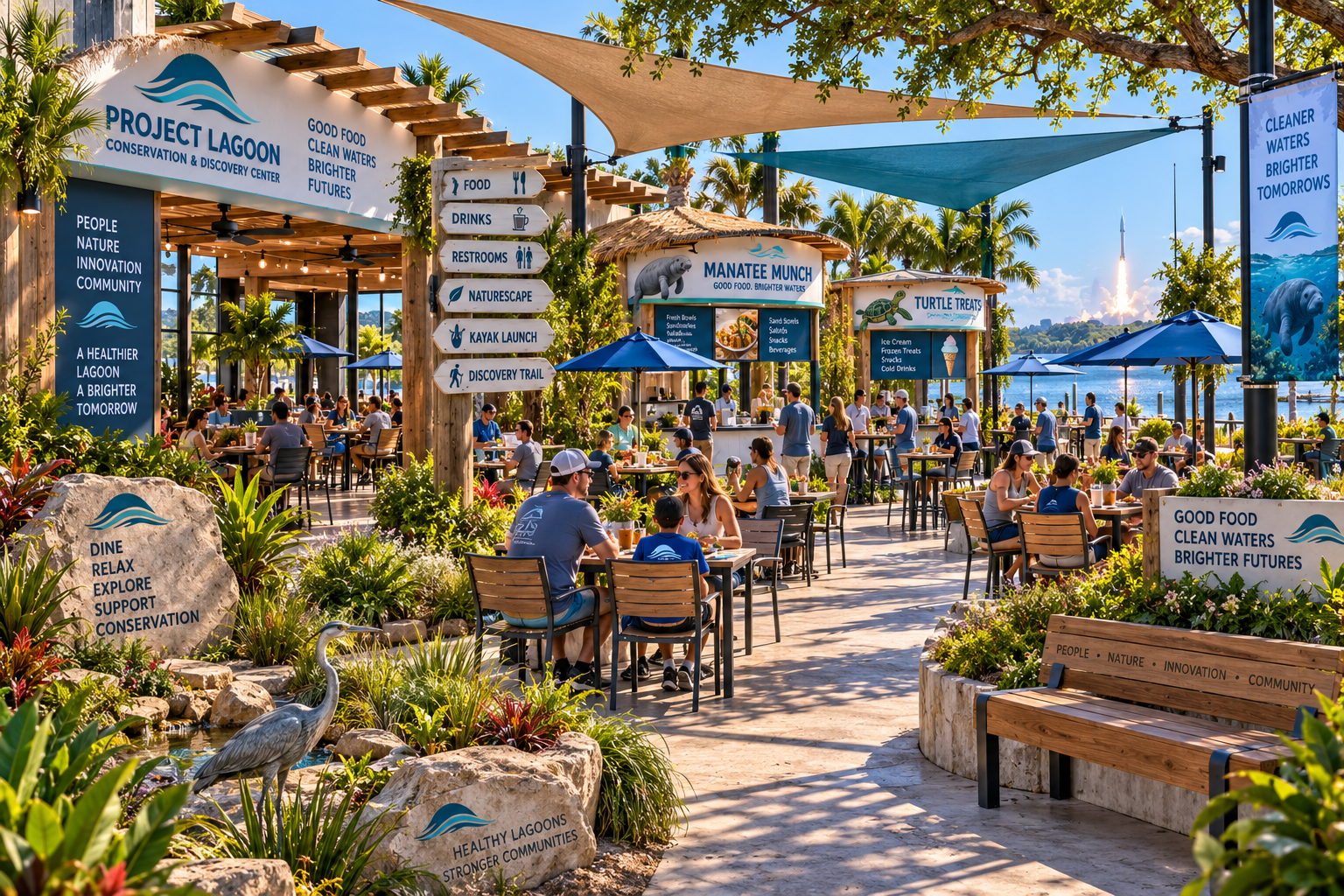
A Real Destination Needs Real Visitor Amenities.
A destination-scale campus serving families, school groups, seniors, people with disabilities and large visitor volumes requires well-distributed restroom and family-support facilities planned as part of the campus from the beginning — not added as an afterthought.
Final restroom count, locations and specifications have not been determined and remain subject to final campus design, applicable codes and accessibility requirements.
Retail and Dining Can Reflect the Conservation Mission.
Where feasible and appropriate, the visitor retail and food-and-beverage experience can incorporate conservation-minded practices that connect back to the mission — without making unsupported sustainability guarantees.
No zero-waste or other unsupported sustainability guarantees are made. Feasibility of all practices remains subject to operations, regulation, cost and final design.
No prices, attendance, revenue, margins, concession contracts or vendors are stated. Commercial activity does not replace the nonprofit mission — it can help support it.
More Than a Food Court
Inside the ticketed campus, broader distributed food and visitor services complement the free public area. These concepts are not yet finalized — no prices, program terms or vendor agreements are established.
FAMILY DINING COMMONS
Air-conditioned indoor dining for families and groups.
OUTDOOR DINING
Landscaped outdoor dining connected to NatureScape.
COFFEE
Dedicated coffee and specialty beverage location.
DISTRIBUTED FOOD KIOSKS
Themed food and beverage kiosks near major areas.
EVENING / DATE EXPERIENCES
Evening programming and dining for adult visitors.
SCHOOL / GROUP FOOD
Food service designed for school and group visits.
CONSERVATION CUP
Reusable cup program supporting refill and waste reduction.
CENTER MEAL CARD
Prepaid meal card concept for families and groups.
PERCY'S EXPLORER PAIL
Kid-friendly meal and activity concept.
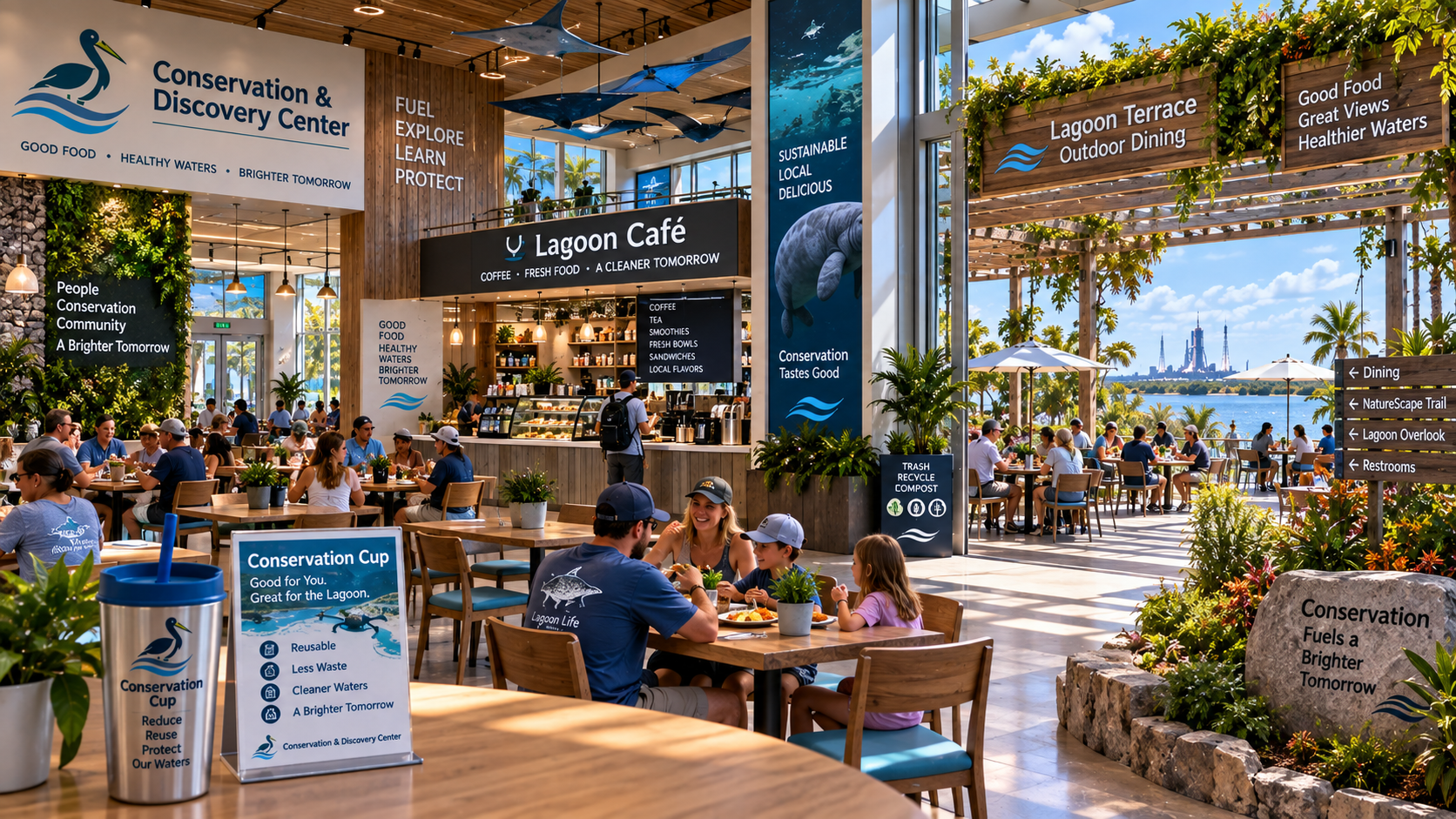
REFILL STATIONS • REUSABLE PROGRAMS • RESPONSIBLE PACKAGING
Water refill stations, reusable drinkware programs and responsible packaging choices help connect visitor dining to the conservation mission.
How the Center Could Help Support Its Mission
Visitors may support SCWS directly through Center activities while independent operators may earn their own customer revenue and potentially compensate SCWS under future agreements.
SCWS would use available unrestricted resources to operate the Center and advance its charitable mission.
Explore How the Center Supports Its MissionSafe, Welcoming & Ready
Security by design. First aid and guest care. Heat relief. Emergency readiness. Accessibility throughout the campus.
A Campus Designed to Stay Ready.
A working waterfront campus of this scope needs professional safety, communications and operational coordination infrastructure behind the scenes — helping the future Conservation & Discovery Center remain safe, coordinated, resilient and prepared.
A working waterfront campus may eventually include thousands of public visitors, school groups, public events, staff, researchers, laboratories, expensive technology, Project Lagoon operations, boats and docks, fabrication areas, outdoor attractions, parking and arrival areas, and restricted operational areas. A campus with that scope needs professional safety, communications and operational coordination infrastructure.
Primary Functions
Central campus security monitoring
Electronic access-control monitoring
Public entrance and parking monitoring
Waterfront and dock monitoring
Project Lagoon operations-area monitoring
Fleet and marine-operations awareness
Perimeter and gate monitoring
Alarm/status monitoring
Campus radio communications
Marine VHF communications where appropriate
Severe-weather and hurricane monitoring
Emergency and incident coordination
Backup communications
Critical-system UPS/emergency-power support
Incident documentation and coordination
Located on the Secured Operations Side of the Campus.
The Security & Operations Center is conceptually located on the secured staff/operations side of the campus, near the staff/operations entrance and positioned to support the broader campus.
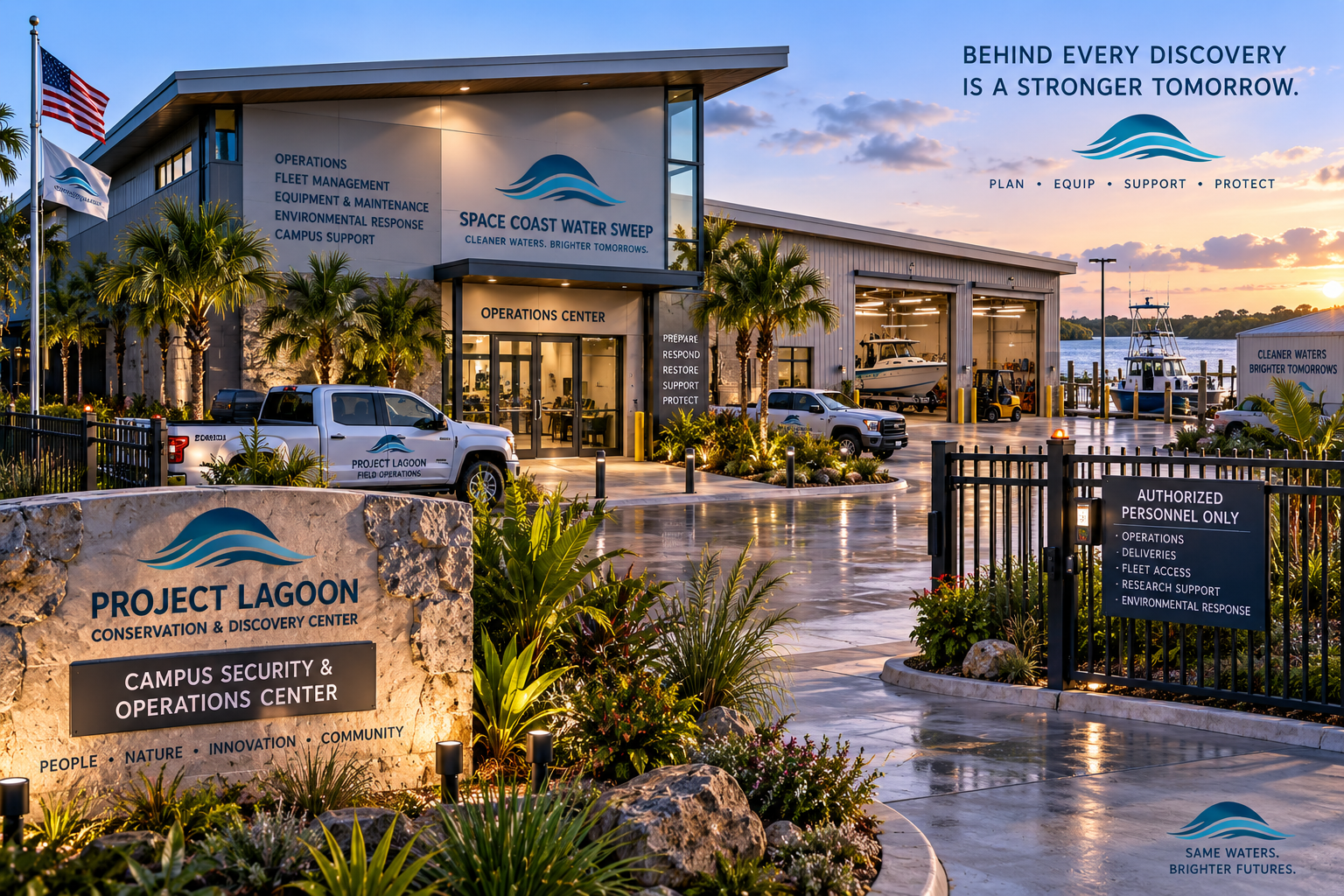
A Professional Operational Coordination Space.
The conceptual interior may include operator workstations, a large monitoring/data wall, a communications position and an incident-coordination workspace — supporting day-to-day awareness and coordinated response.
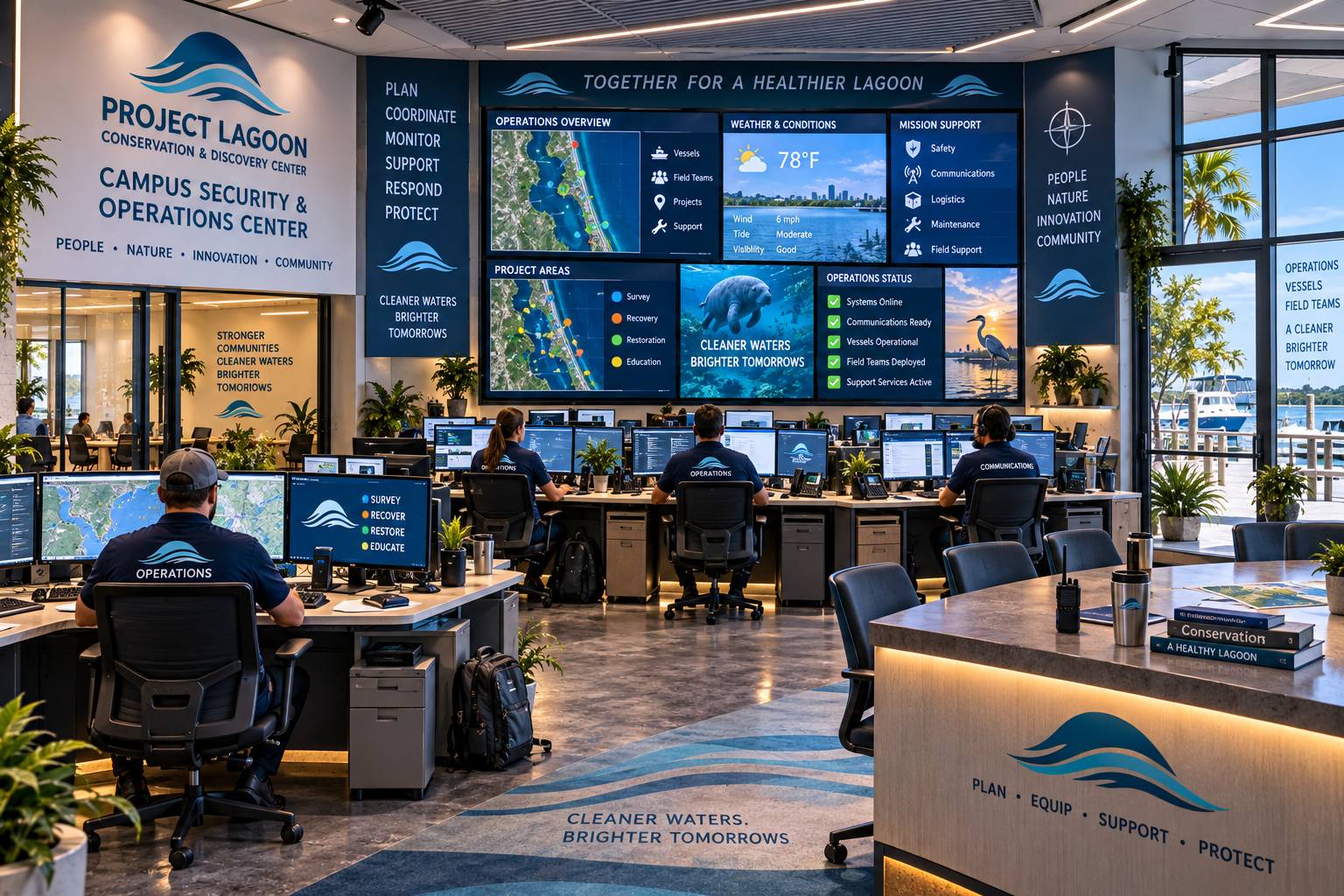
Physical Concept
As an early conceptual planning range, the facility is envisioned at approximately 800–1,500 square feet. Final size and configuration will depend on final campus design, staffing, technology, engineering and operational requirements.
Conceptual interior elements may include:
2–3 primary operator workstations
Large monitoring/video/data wall
Communications/radio position
Incident-management workspace
Secure equipment/network area
Controlled access
Possible supervisor/security office
Possible adjacent report/staff workspace
Final staffing levels have not been determined.
Emergency & Hurricane Role
During significant weather or campus incidents, the facility could also support incident coordination and continuity of campus operations. Potential functions may include:
Severe-weather monitoring
Hurricane preparation/coordination
Campus status monitoring
Communications coordination
Waterfront/fleet status awareness
Coordination of internal campus response
This facility is not a replacement for emergency management, law enforcement, fire/rescue, the Coast Guard, FWC, county or city agencies, or other responsible authorities. It coordinates the Center's own operations and works within appropriate emergency-management structures.
First Aid & Guest Care / Heat Relief / Cooling Room
Associated with the broader campus security and operations / guest-safety infrastructure — but not part of the secure monitoring and control room itself — the future campus should provide an appropriate location where visitors or staff experiencing minor injuries, illness, overheating or heat-related symptoms can receive initial assistance while appropriate medical or emergency services are contacted when necessary.
This is particularly important because the campus includes outdoor trails, waterfront areas, docks, kayak activities, outdoor dining, events, conservation operations and Florida heat. The purpose is first response, guest care, heat relief and emergency coordination.
FIRST AID & GUEST CARE AREA
- Basic first-aid supplies
- Seating and rest capability
- Communication capability
- Accessibility
- Space for staff assistance
- Appropriate access for emergency responders
HEAT RELIEF / COOLING ROOM
- Air-conditioned environment
- Seating / reclining capability where appropriate
- Drinking-water / hydration access
- Temporary seating and rest
- Guests feeling overheated
- Outdoor-event support
- Staff or volunteers working outdoors
- Florida summer conditions
The Center is not a medical clinic. Center personnel provide first response and guest care within their training and legal scope only. Serious medical emergencies remain the responsibility of appropriate EMS, fire-rescue and medical providers. Final first-aid staffing model and medical capabilities have not been determined.
Visitor-Support Infrastructure — Not a Hospital Emergency Room.
A welcoming, professional first-aid and heat-relief area associated with the campus security and operations infrastructure. It should look and feel like visitor-support infrastructure — comfortable, accessible and discreet — not a clinical emergency room.
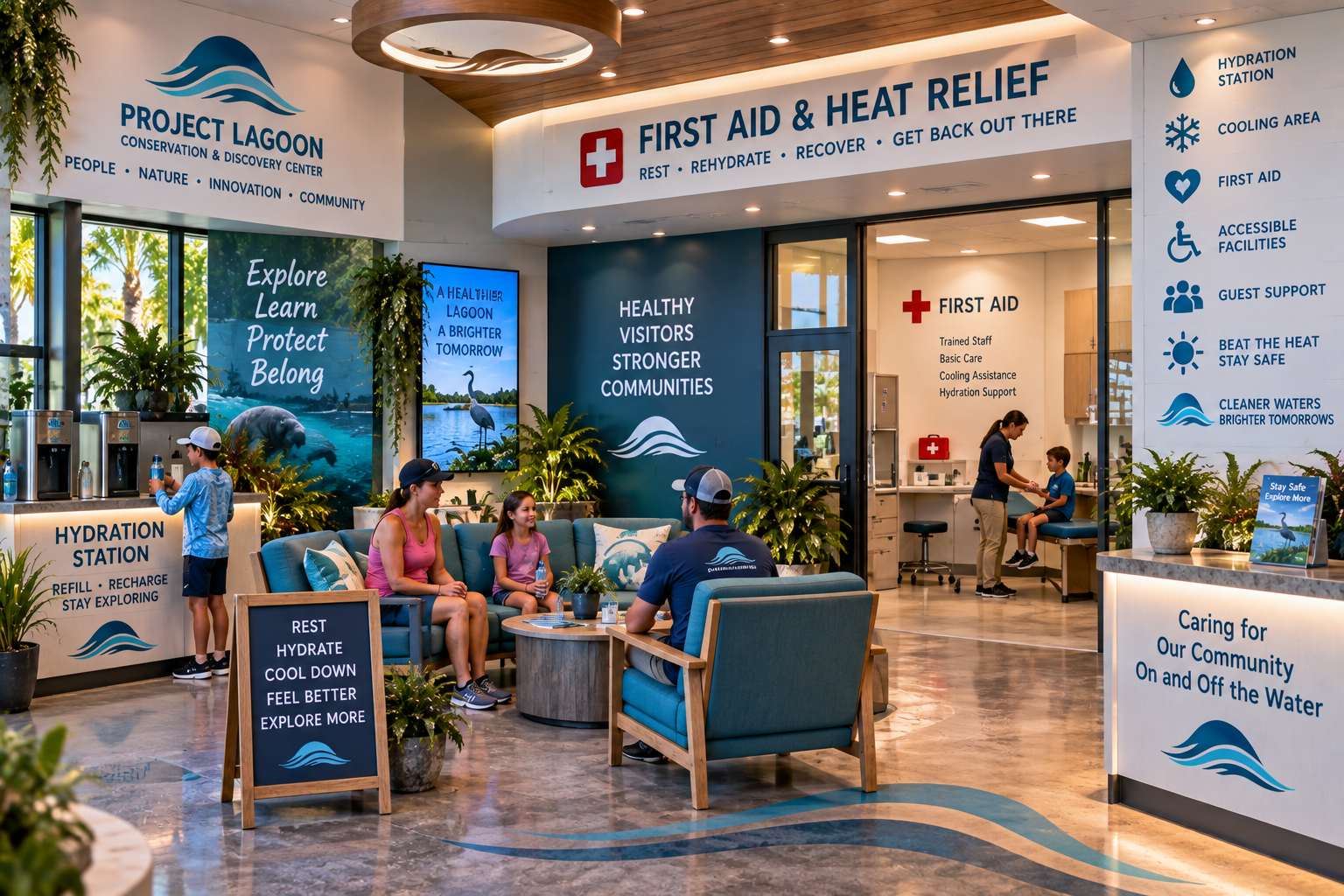
Campus Cleanliness & Custodial Staff
A destination built around environmental stewardship should demonstrate that stewardship in the way the campus itself is maintained. The future Center would require dedicated staff responsible for keeping the public campus clean, welcoming and well maintained.
Public-area cleanliness
Restroom servicing
Dining-area cleanliness
Litter collection
Waste-station servicing
Recycling collection
Spill response
Routine sanitation
Event cleanup
Outdoor-campus cleanliness
Visitor-area inspections
Coordination with maintenance/operations staff
Final staffing levels have not been determined.
The Security & Operations Center Is Not the AI & Environmental Intelligence Core.
AI & ENVIRONMENTAL INTELLIGENCE CORE
Supports environmental/scientific computing, environmental data ingestion, sonar/drone/ROV information, monitoring, research and long-term environmental intelligence.
CAMPUS SECURITY & OPERATIONS CENTER
Supports safety, security, access, communications, incident coordination and campus operations.
The two systems may exchange appropriate information where useful, but they remain distinct operational functions.
This Vision describes the purpose and capability of the future security system only. Detailed security configurations, camera locations, access-control architecture, communications architecture and emergency procedures would not be published publicly.
SECURITY BY DESIGN — NOT AN AFTERTHOUGHT
ZONE SEPARATION
Public, operational and secured areas are designed as distinct zones.
CONTROLLED ADMISSION
Professional pre-admission screening for ticketed Center entry.
ACCESSIBLE SCREENING
Adapted screening for wheelchairs, scooters, walkers, strollers and similar situations.
GUEST-SERVICE SECURITY
Security staff trained for guest service, not just enforcement.
Normal operations can use ICS-compatible organizational principles without pretending the campus is operating under formal ICS every day. During significant incidents, trained leadership can transition appropriately and integrate with responsible county/state/federal structures when requested. The Center does not claim authority over outside incidents.
For public safety, the Center does not publish detector settings, tactical screening procedures, security vulnerabilities, surveillance coverage details, radio frequencies, access-control secrets or other sensitive tactics.
A Campus That Practices What It Teaches
The Center itself becomes a living laboratory. Water, energy, waste, transportation, landscape, shorelines, buildings and data — all connected.
The Center Itself Becomes a Living Laboratory.
The campus should not simply teach other people how to protect water while becoming part of the problem itself. Every reasonable effort should be made to reduce the campus's own environmental impact, measure what works and use the property as a real-world learning environment.
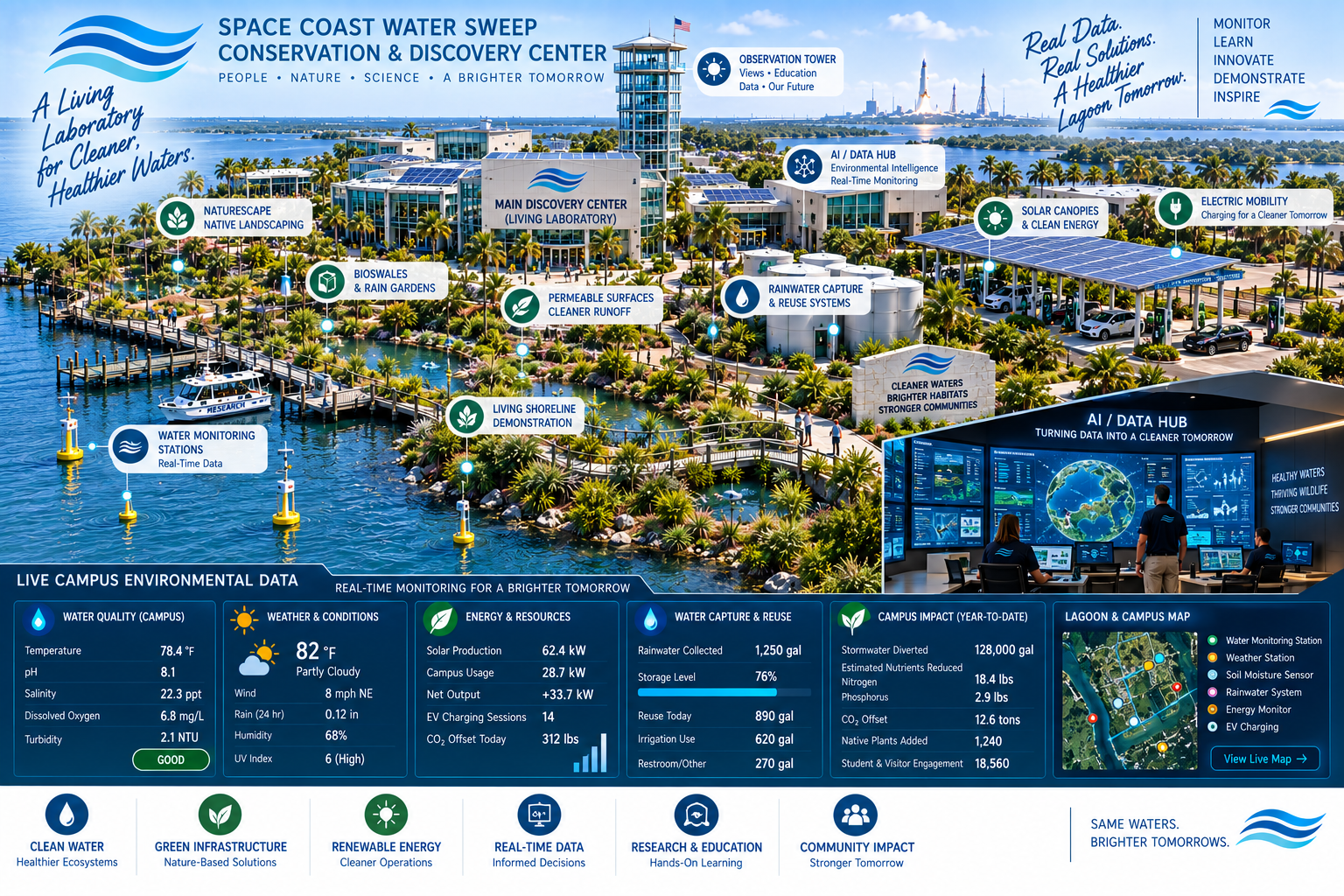
NatureScape
Florida-native landscaping and habitat-oriented landscaping throughout the grounds.
Living Shoreline Demonstrations
Real examples of appropriate living shoreline approaches, rain gardens, bioswales, shoreline buffers, erosion control and permeable surfaces.
Water & Runoff Management
Rainwater capture and reuse where feasible. Wash-down water management through engineered treatment and reuse systems. Freshwater management to minimize avoidable impacts to the Lagoon.
Energy
Solar field or solar canopies, efficient building systems, battery and storage possibilities, campus energy monitoring, electric vehicle charging, electric campus mobility and an electric eco-tour vessel.
Environmental Performance Monitoring
The Center's AI and data infrastructure may eventually help monitor campus energy generation, consumption, water use, captured and reused water, runoff systems, treatment systems and environmental performance.
Smart Waste & Recycling Infrastructure
Attractive enclosed smart solar waste and recycling stations throughout appropriate public areas — solar-powered where practical, with touchless or automatic openings, separate waste and recycling streams, fill-level monitoring where appropriate, and durable outdoor construction. Designed to become part of the visual identity of the campus.
Responsible Material Recovery
The Center would seek to recover and properly route recyclable and other recoverable materials wherever practical, including correcting visitor sorting mistakes when operationally feasible. Not all campus waste can be recycled; some materials may be contaminated, non-recyclable or require appropriate disposal.
Campus Cleanliness & Stewardship
Dedicated custodial staff and smart infrastructure keep the public campus clean, welcoming and well maintained — demonstrating environmental stewardship in the way the campus itself is maintained.
Responsible Food-Service & Refill/Reuse
Responsible food-service practices, refill and reuse systems, water refill stations and responsible packaging where feasible — connecting visitor dining and retail back to the conservation mission.
Smart Solar Waste & Recycling Stations
Rather than ordinary exposed commercial trash cans, the Center should explore attractive enclosed smart waste stations throughout appropriate public areas. The stations should become part of the visual identity of the campus — functional infrastructure that also contributes to the visitor experience.
Solar-powered operation where practical
Touchless or automatically opening lids where practical
Enclosed waste openings
Separate waste and recycling collection streams
Fill-level monitoring where appropriate
Efficient servicing
Durable outdoor construction
Odor and pest reduction
Clear visitor instructions
Accessible design
Locations near dining, attractions, trails and gathering areas
Locations along major pedestrian routes
DESIGN INSPIRATION
Designs could draw inspiration from Florida native plants, Indian River Lagoon wildlife, mangroves, seagrass and marine life — using sophisticated sculptural or architectural enclosures with shapes, textures, patterns, educational graphics or subtle wildlife and native-plant themes. They should still clearly function as waste and recycling stations and should not look like fake animals that could confuse visitors.
EDUCATIONAL CONNECTION
Even ordinary campus infrastructure can become part of the Center’s educational mission. A smart waste station could subtly show visitors what happens to their waste, what is recyclable, why contamination matters, how much material has potentially been diverted, why litter matters to waterways, and how responsible waste management protects the Lagoon.
No live diversion statistics are stated. If future digital displays or dashboards show statistics, they must use actual measured operational data.
RESPONSIBLE WASTE SORTING
Visitors should still be encouraged to place materials into the correct waste and recycling containers. However, visitors will sometimes use the wrong container. The future operations concept should therefore allow for appropriate downstream sorting and recovery of recyclable or otherwise recoverable materials where practical, helping reduce the amount of recoverable material lost because of incorrect visitor sorting.
The Center would seek to recover and properly route recyclable and other recoverable materials wherever practical, including correcting visitor sorting mistakes when operationally feasible.
The Center does not claim zero waste, 100% recycling, or exact diversion rates. Some materials may be contaminated, non-recyclable or otherwise require appropriate disposal. Final waste technology vendor and solar waste-station manufacturer have not been selected.
PROCESSING / RECOVERY BACK END
These public-facing smart stations are the collection front end. The future campus vision includes a behind-the-scenes Resource Recovery & Materials Management Center on the secured operations side — the processing and recovery back end that receives, sorts, recovers and responsibly routes appropriate campus materials and suitable smaller Project Lagoon recoveries.
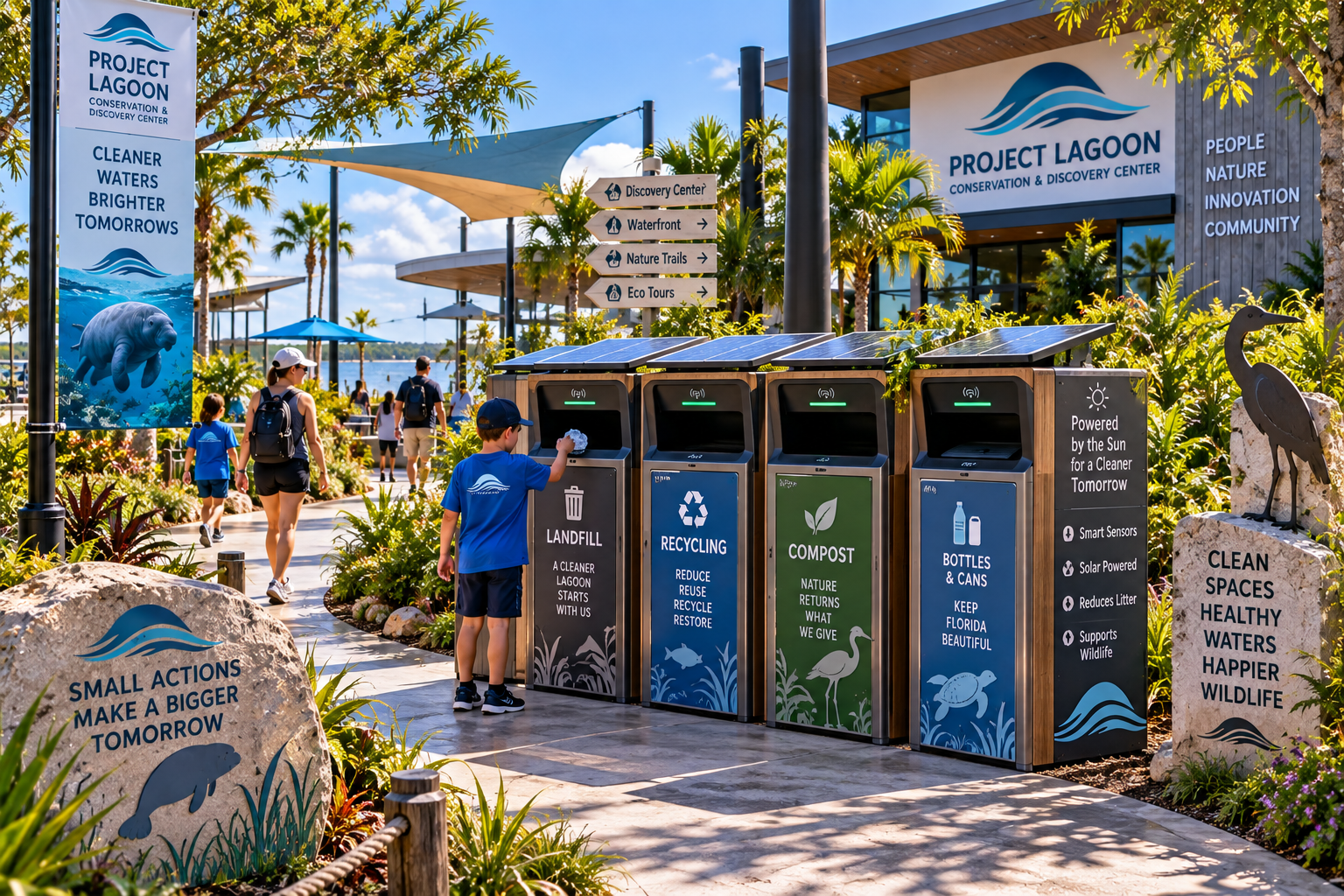
The campus is not claimed to be net-zero or fully solar powered unless future engineering demonstrates that. Campus runoff routing to another watershed requires future property-specific engineering, hydrology, drainage and regulatory review.
The Center Itself Becomes a Living Laboratory.
The campus should not simply teach other people how to protect water while becoming part of the problem itself. Every reasonable effort should be made to reduce the campus's own environmental impact, measure what works and use the property as a real-world learning environment — connecting grounds, infrastructure and operations to the research mission.
Campus Water Use & Rainfall
Campus water use, rainfall and runoff are measured and studied — not merely managed. Rain gardens, bioswales and permeable surfaces become real research sites.
Rainwater Capture & Treatment
Rainwater capture and reuse are explored where feasible. Treatment systems and wash-down water management provide real data on what works in a Florida coastal environment.
NatureScape & Living Shoreline Monitoring
NatureScape native landscaping and living shoreline demonstrations are monitored for habitat performance, runoff reduction and ecological response — connecting grounds management to conservation research.
Campus Energy Generation & Use
Solar field or solar canopies, efficient building systems, battery and storage possibilities and campus energy monitoring provide data on renewable energy performance in a coastal climate.
Electric Mobility & Charging
Electric campus mobility and charging infrastructure provide data on fleet energy use, operational patterns and the practical realities of electric transportation in a working conservation campus.
AI/Data Hub Environmental Monitoring
The Center's AI and data infrastructure may eventually help monitor campus energy generation, consumption, water use, captured and reused water, runoff systems, treatment systems and overall environmental performance — turning the campus itself into a research dataset.
The campus is not claimed to be net-zero or fully solar powered unless future engineering demonstrates that. No environmental performance results are claimed that do not yet exist. Campus runoff routing to another watershed requires future property-specific engineering, hydrology, drainage and regulatory review.
ONE CONNECTED LIVING LABORATORY
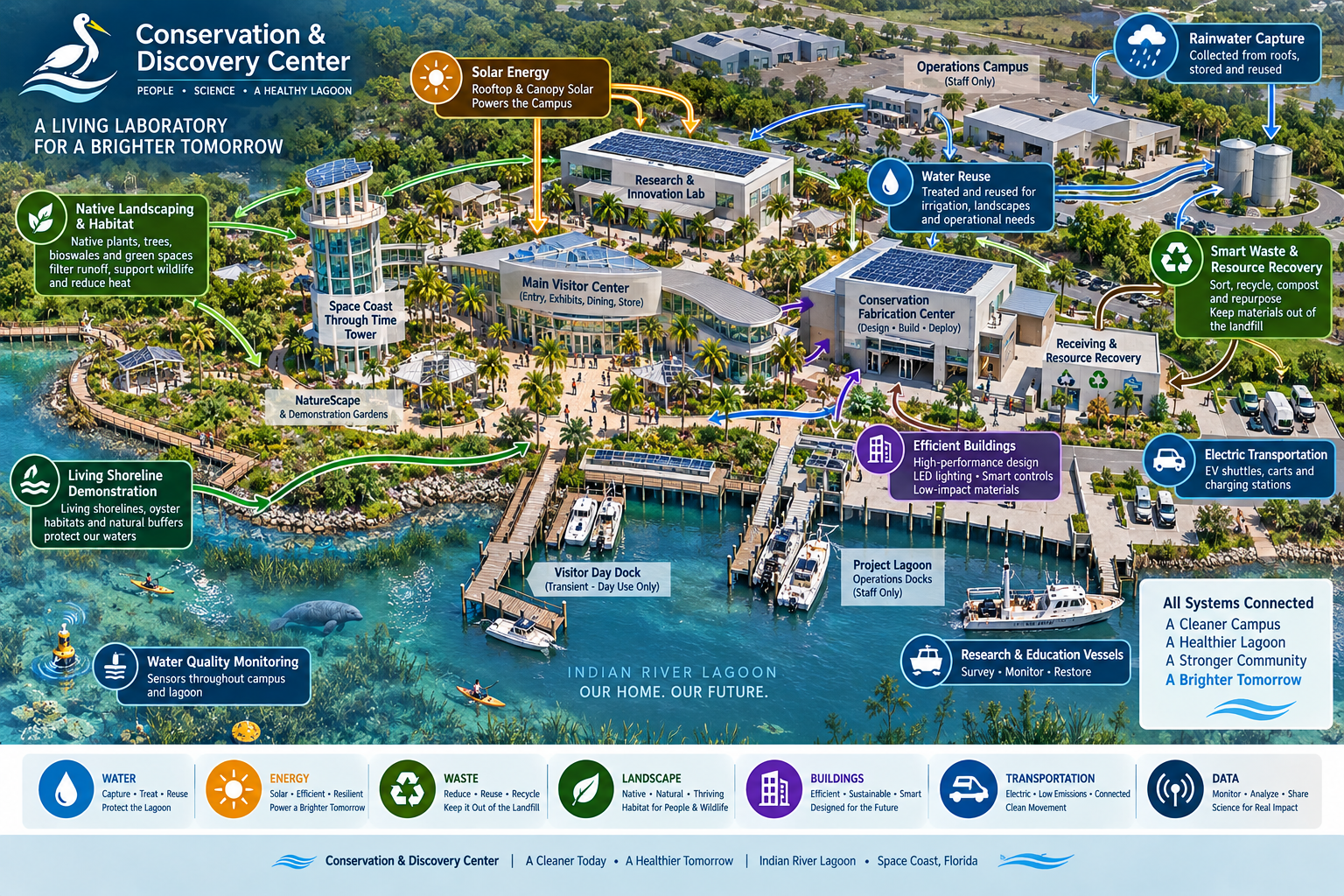
The Center is not claimed to be net-zero, 100% renewable, or off-grid. Solar is the primary current renewable-energy concept. Battery/storage, energy efficiency, smart energy management, electric campus transportation, waste reduction and Resource Recovery are all part of the vision — but specific performance claims require future engineering proof and commitment.
Built to Grow — Help Build the Vision
Plan the whole. Build in pieces. Development phasing, participation pathways, tourism, jobs and local economic activity.
A Vision This Big Will Never Be Built
by One Person or One Organization.
The Space Coast Water Sweep Conservation & Discovery Center is envisioned as a long-term, multi-phase conservation, science, education, technology and public-discovery campus for the Indian River Lagoon.
Making it real will require far more than one source of funding. It will require people who can fund, sponsor, build, design, research, engineer, donate, connect, advise, provide materials, provide technology, help identify property, open doors, make introductions and share the vision.
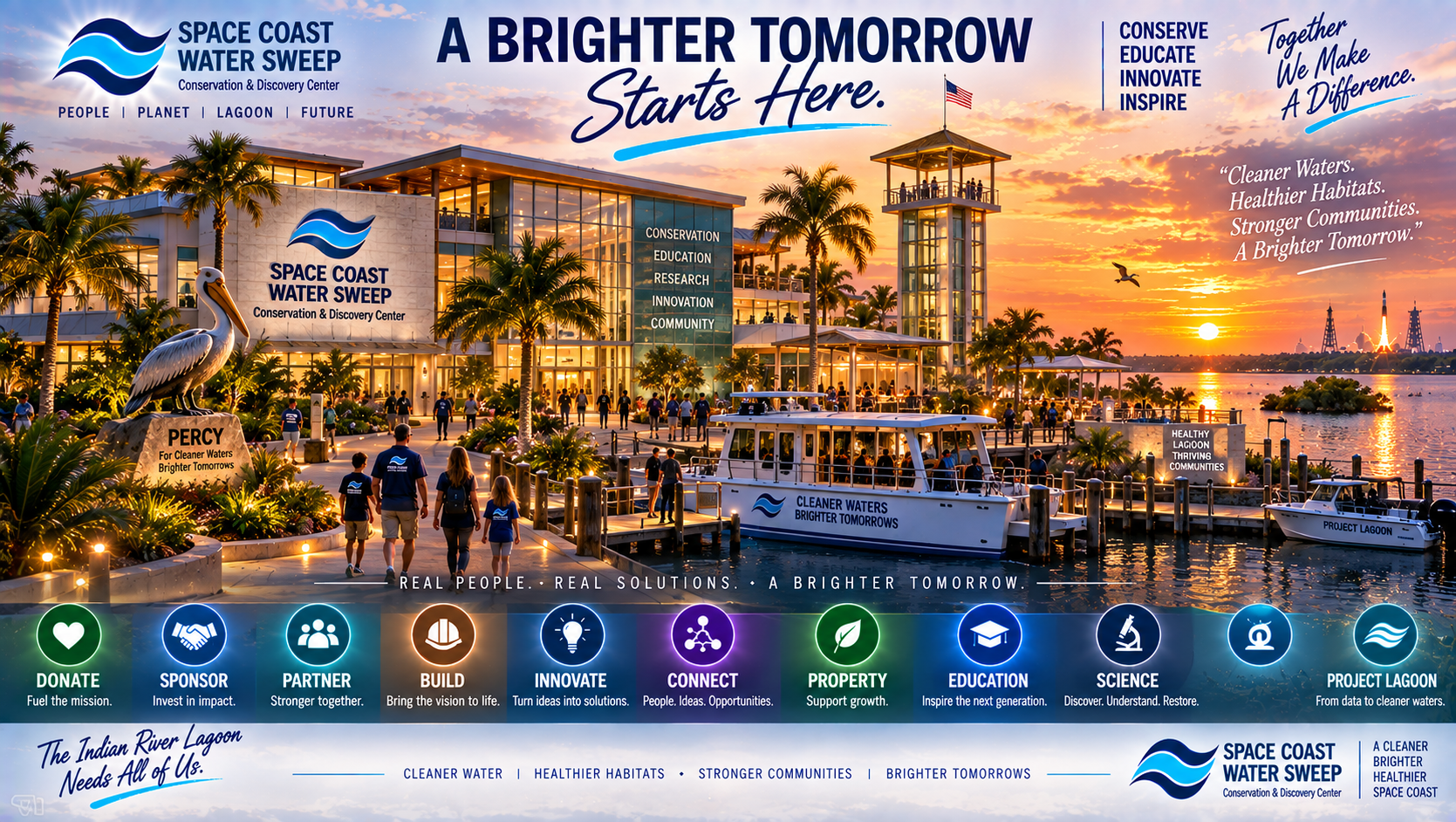
You Don't Have to Fund the Whole Vision to Help Move It Forward.
DONATE
Support the nonprofit conservation mission.
SPONSOR
Support a facility, program, vessel, technology, exhibit, research capability or visitor experience.
PARTNER
Bring institutional, technical, research, conservation or community capability.
HELP BUILD
Construction, engineering, architecture, marine infrastructure, fabrication or facility expertise.
BRING TECHNOLOGY
Marine electronics, AI, sensors, robotics, drones, ROVs, research equipment or other mission-supporting technology.
HELP FIND THE PLACE
Property, development, site-selection, land, waterfront or real-estate expertise.
CONNECT US
Introduce SCWS to people, organizations or institutions that can help.
BRING AN IDEA
A good solution may begin with someone asking, “Have you thought about…?”
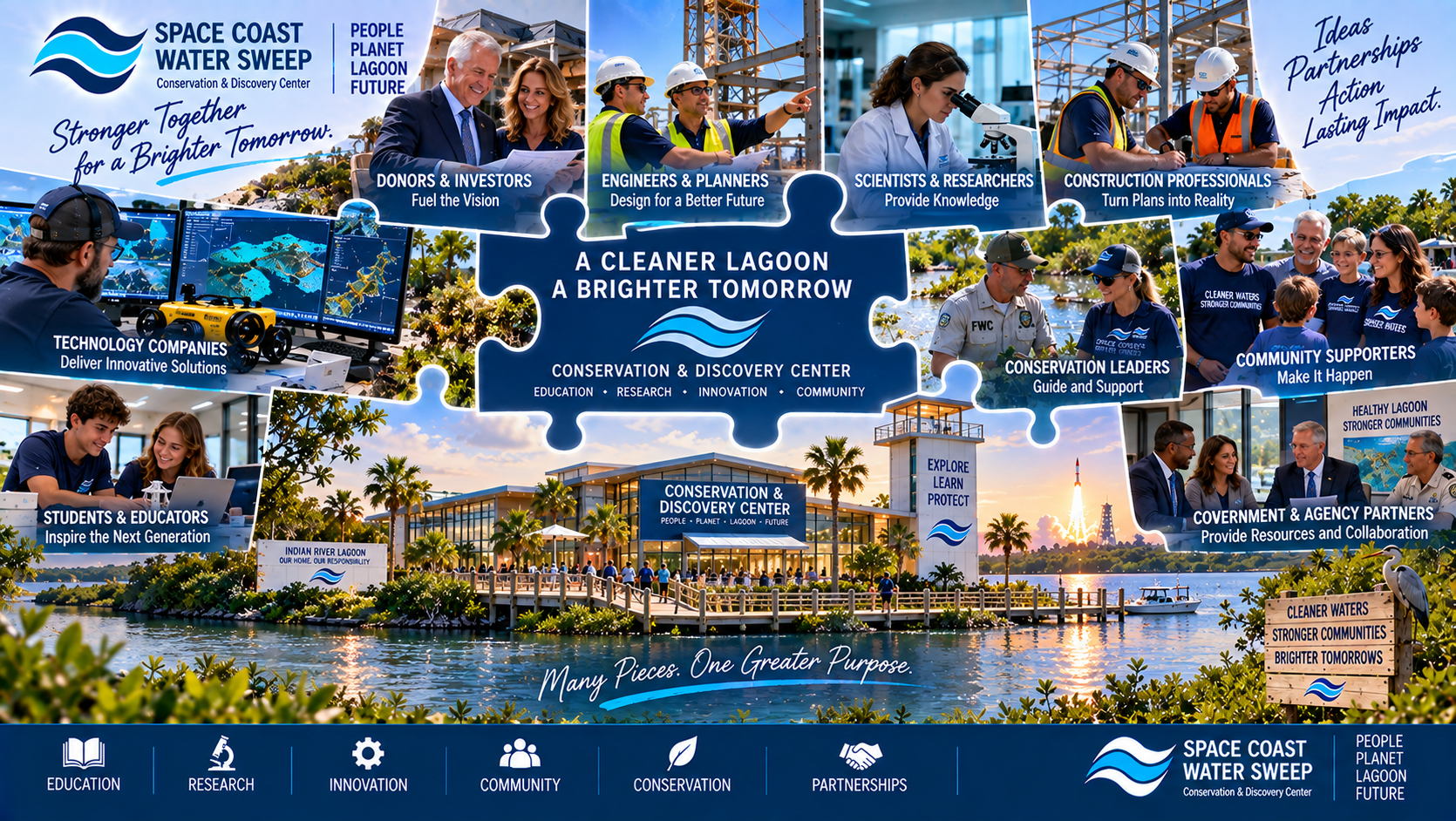
Plan the Whole. Build in Pieces.
The vision is comprehensive, but it does not have to appear all at once. Project Lagoon does not need to wait for the entire Visitor Center. Completed useful buildings and capabilities may activate in phases. There does not have to be one single grand opening — public milestones can occur over time.
Conceptual Progression
This is not a contracted construction schedule. It is a conceptual sequencing showing how the vision could grow over time.
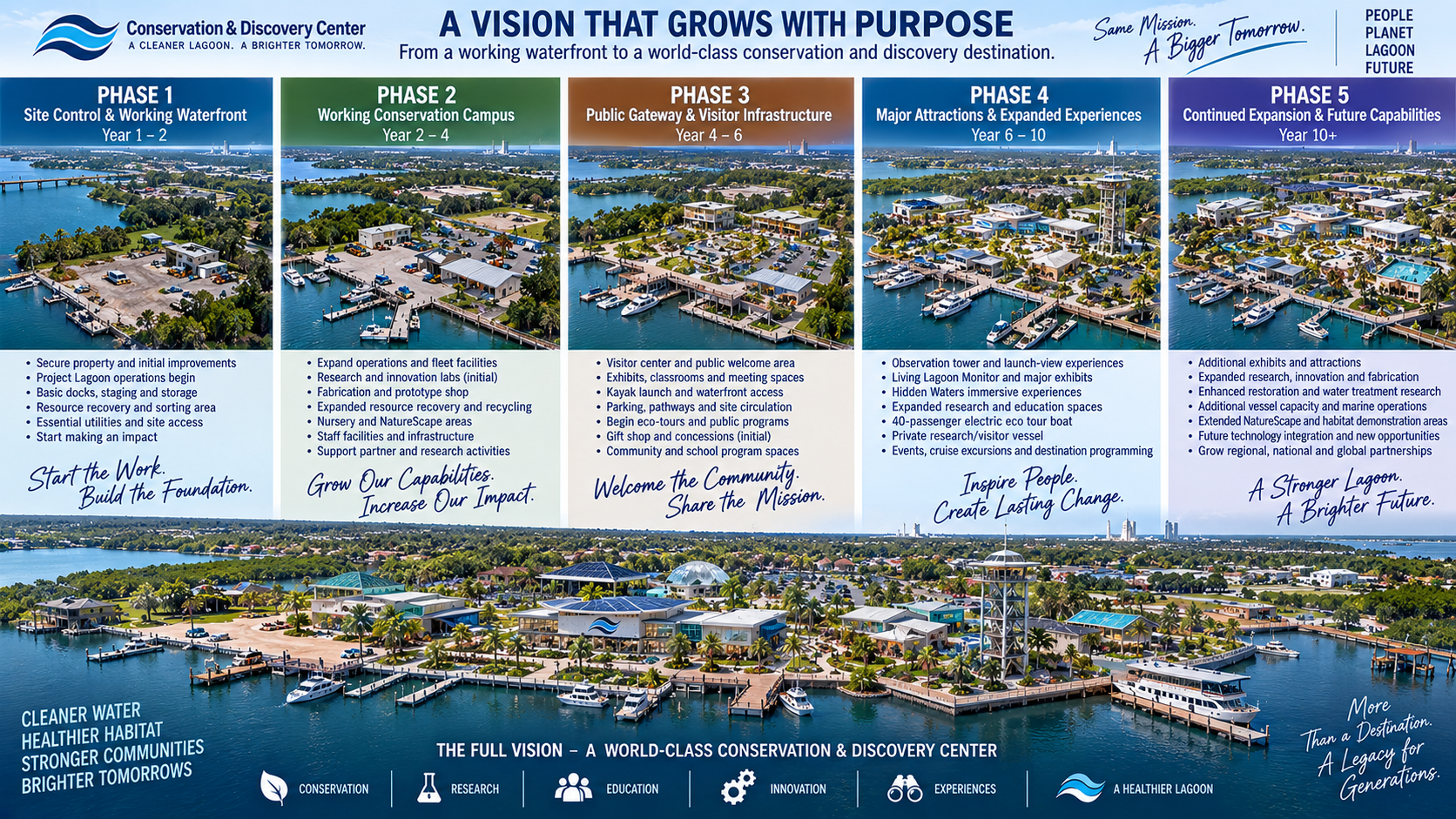
The Full Vision Doesn't Have to Appear All at Once.
These are conceptual sequencing examples, not committed construction phases. No dates or dollar amounts are attached. The final master plan has not been approved.
Strengthen Project Lagoon and existing conservation capability.
Secure or establish an appropriate long-term site.
Develop essential operations, research and education capacity.
Expand public discovery experiences.
Grow research, fabrication, university and visitor capability.
Continue mission-driven expansion as opportunities emerge.
BUILD WHAT WE CAN. PROVE IT WORKS. GROW FROM THERE.
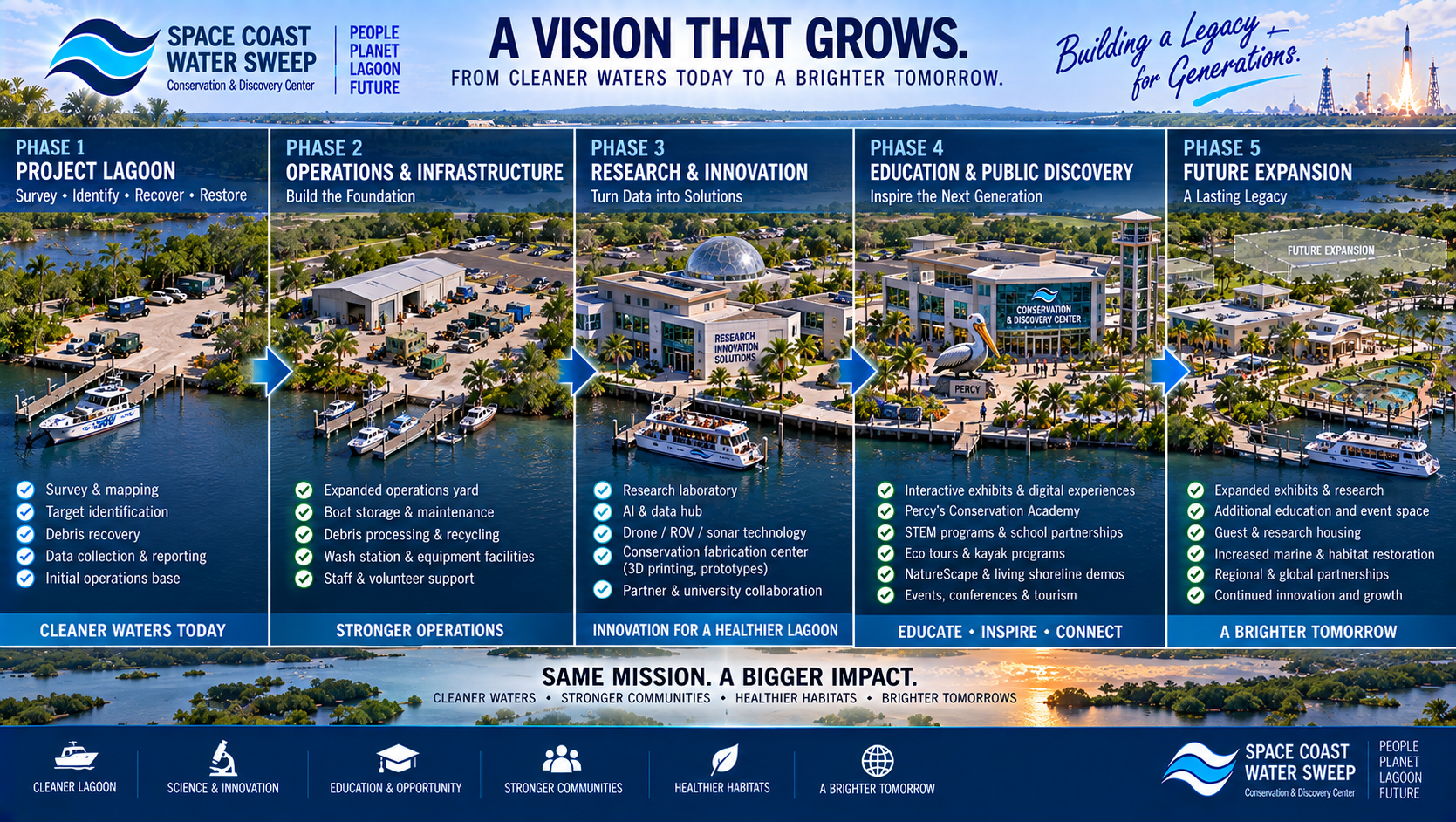
Help Build Capabilities That Don't Exist Yet.
These are examples of new capabilities envisioned for the campus — distinct from the existing sponsorship opportunities listed above. Future donors, sponsors, partners, foundations, technology organizations and major supporters may eventually help make some of these possible. No capability is permanently assigned to any specific supporter, and no existing sponsorship is implied.
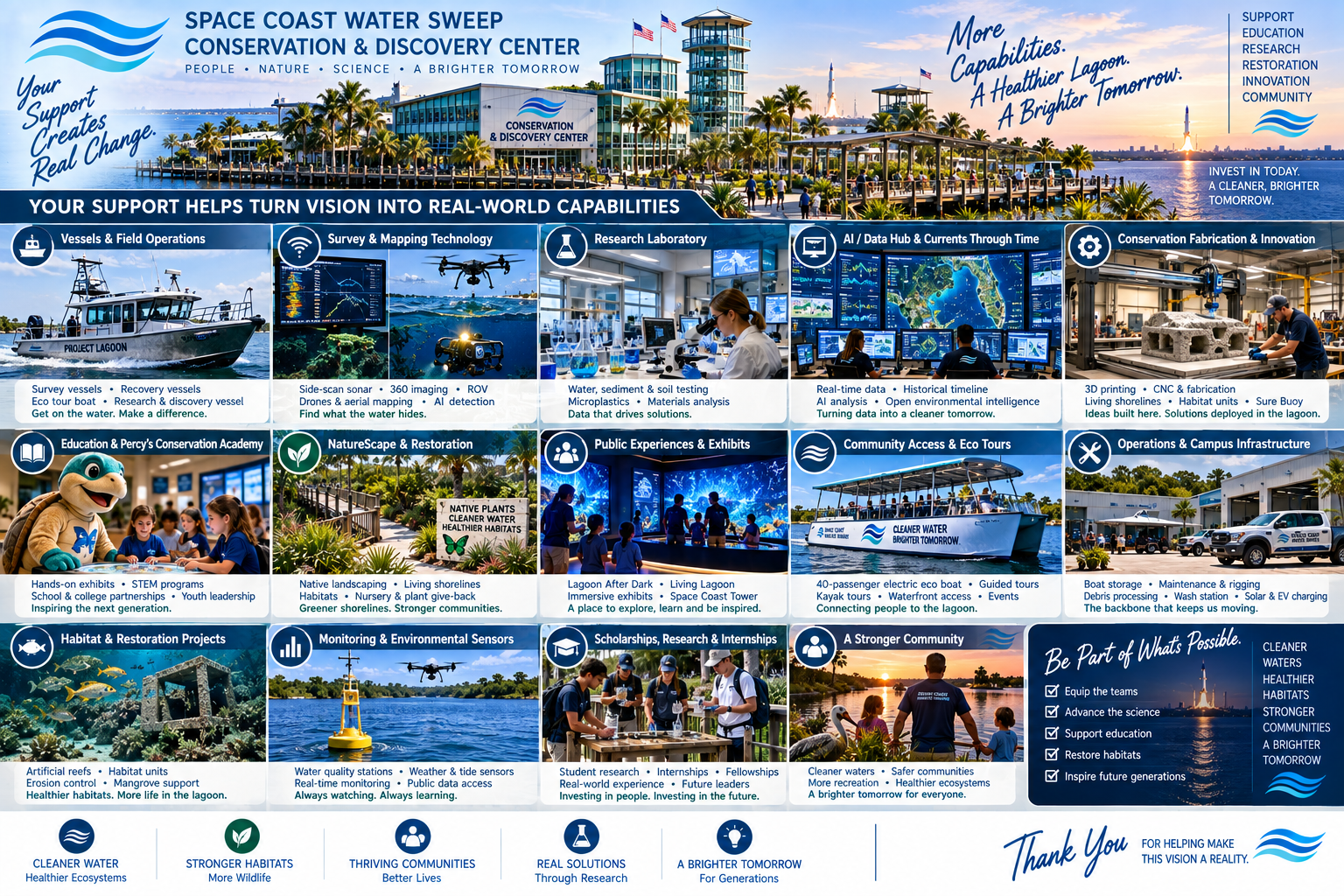
Water Is Life
The signature permanent exhibit — an immersive water installation with age-layered interactive learning.
Immersive Lagoon & Space Coast Theater
A purpose-built immersive theater with rotating programs that let visitors travel through the story.
Accessible Campus Mobility
Electric parking shuttles, on-demand discovery vehicles and guest assistance vehicles designed for accessibility from the start.
Electric Transportation
Electric campus fleet, charging infrastructure and an electric eco-tour vessel.
Renewable-Energy Infrastructure
Solar field or solar canopies, battery and storage possibilities and campus energy monitoring.
Living-Campus Infrastructure
NatureScape, living shoreline demonstrations, rain gardens, bioswales and rainwater capture systems.
NatureScape / Living Shoreline Demonstrations
Real examples of Florida-native landscaping and living shoreline approaches that visitors can see and learn from.
Research / Testbed Infrastructure
The Lagoon Water Treatment & Environmental Engineering Testbed, the Research Laboratory and the Innovation Lab.
Volunteer Technology / Event Display
The Volunteer & Events Display and the digital infrastructure that connects visitors to conservation missions.
Education Programming
Percy's Conservation Academy, school field trips, STEM programming, teacher resources and university collaboration.
No prices are assigned. No fixed sponsorship packages are created. No naming rights are promised. No company logos are implied. These examples simply demonstrate the variety of ways someone may eventually help build the vision. All participation remains subject to project development, nonprofit governance, legal review, sponsorship policies, funding priorities, property selection, permitting and final agreements.
There Is More Than One Way to Help Build This.
The right next step depends on who you are, what you know, what you can contribute and what part of the vision connects with you.
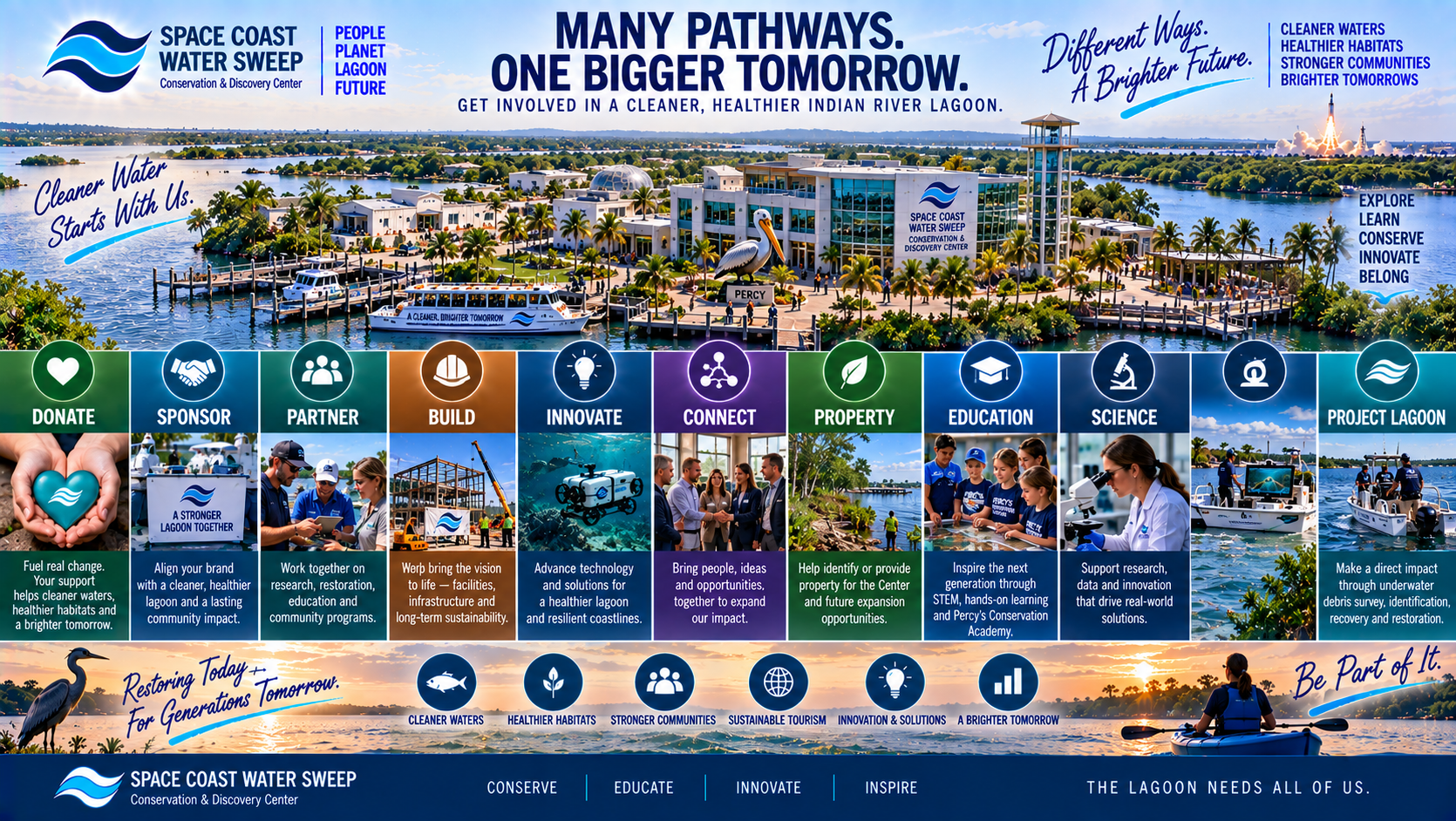
Sponsor Something People Can See Working.
Corporate and philanthropic sponsorship can be tied to real mission capability — from vessels and technology to exhibits and education programs. No prices are assigned, sponsorship availability is not final, no exclusivity is implied, and no company is named as an existing sponsor unless authorized.
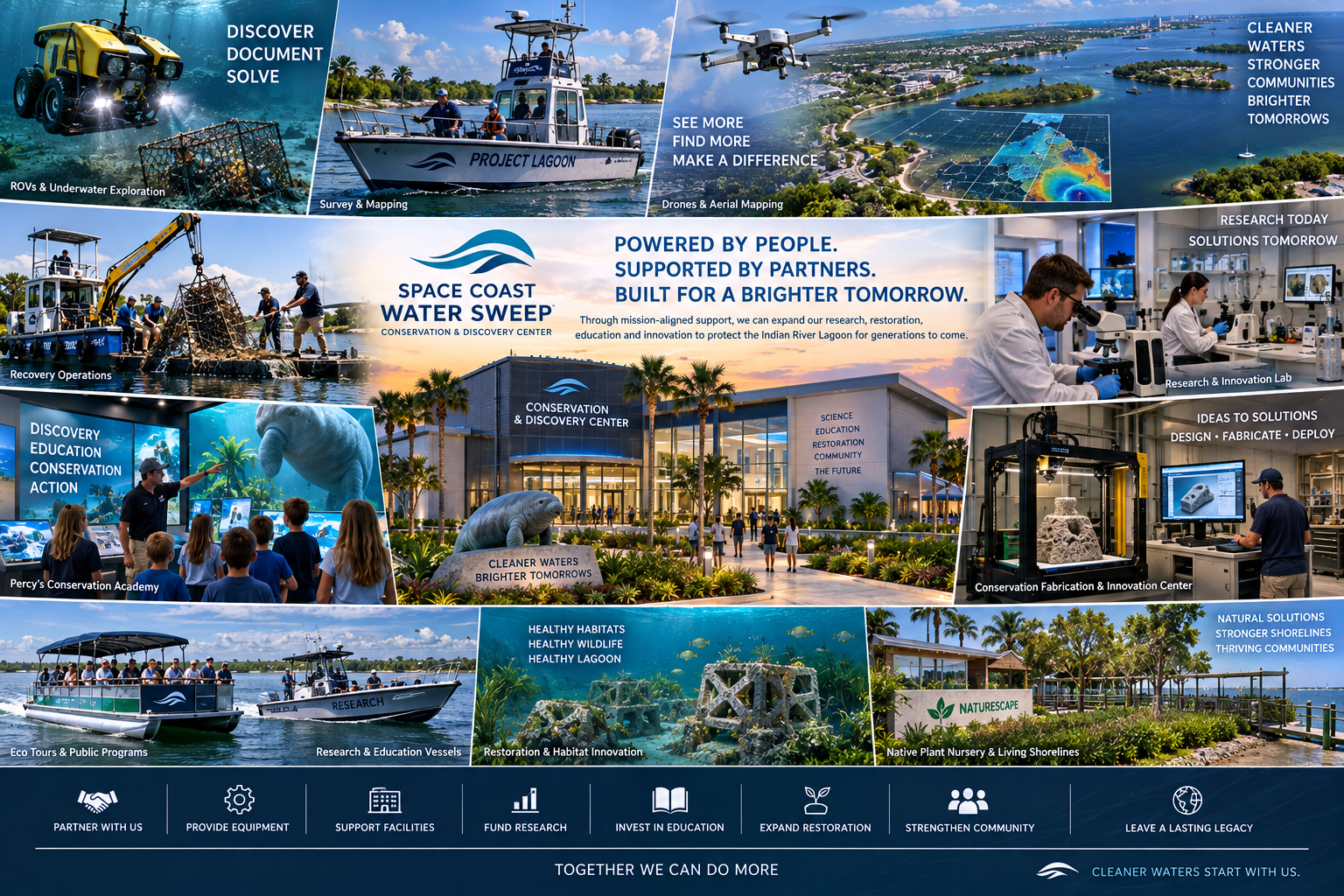
You Don't Need to Build a Building to Help Protect the Lagoon.
Direct donations remain an important pathway. Donations may support SCWS mission needs according to organizational priorities, including conservation field work, Project Lagoon, equipment, education, technology, research, outreach, volunteer support, organizational capacity and future vision development.
General Donations remain unrestricted charitable support for SCWS's overall mission unless explicitly designated otherwise. Major or restricted support should be subject to written gift terms and appropriate legal/accounting review.
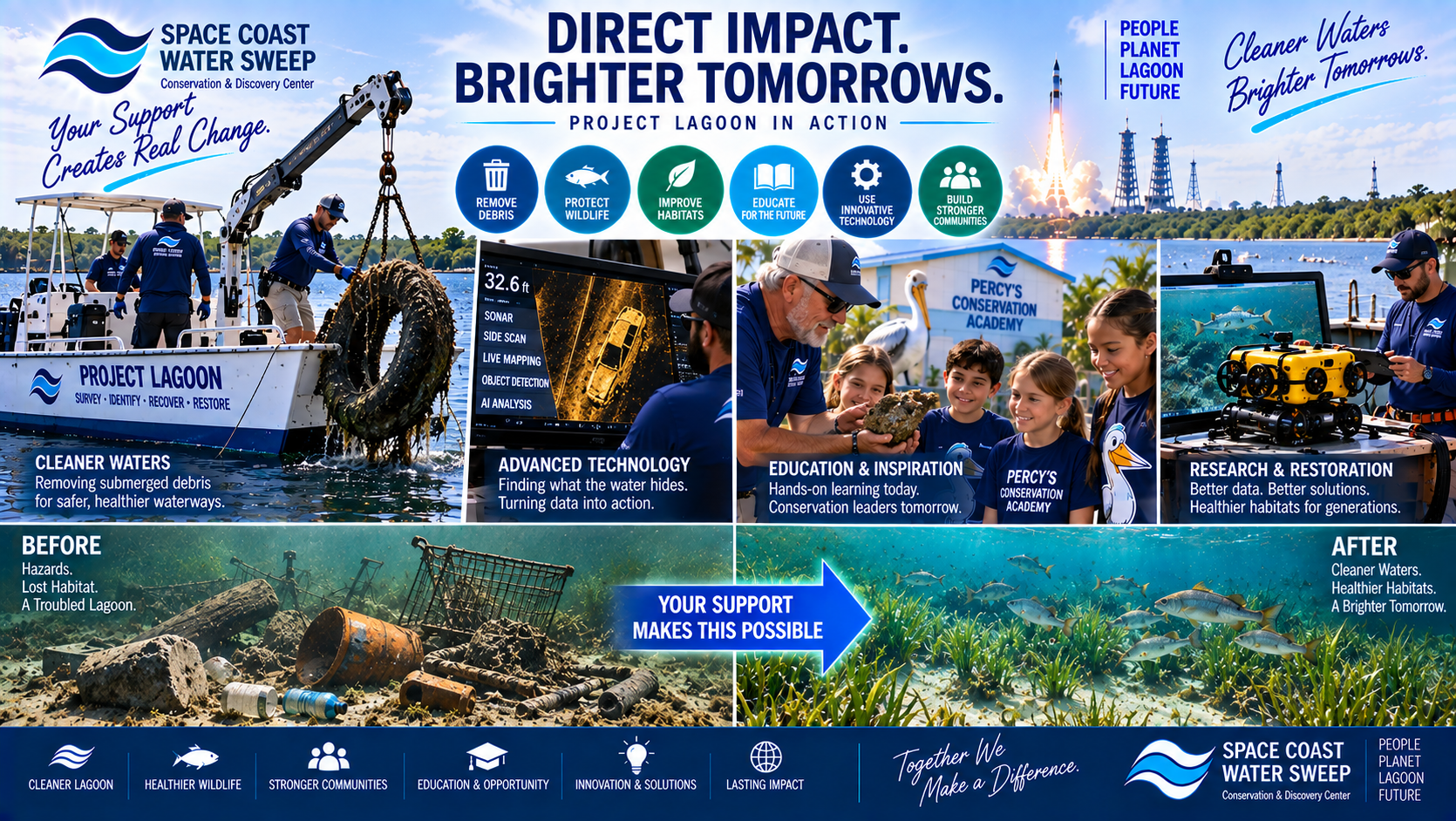
The Center Should Help Grow the Local Economy
THE CENTER SHOULD HELP GROW THE LOCAL ECONOMY, NOT TRY TO BECOME THE ENTIRE LOCAL ECONOMY.
The Center is envisioned as a Space Coast destination serving local residents, regional visitors, Florida visitors, national and international visitors, school groups, tour groups, eco-tourism visitors, cruise travelers and aerospace/launch visitors.
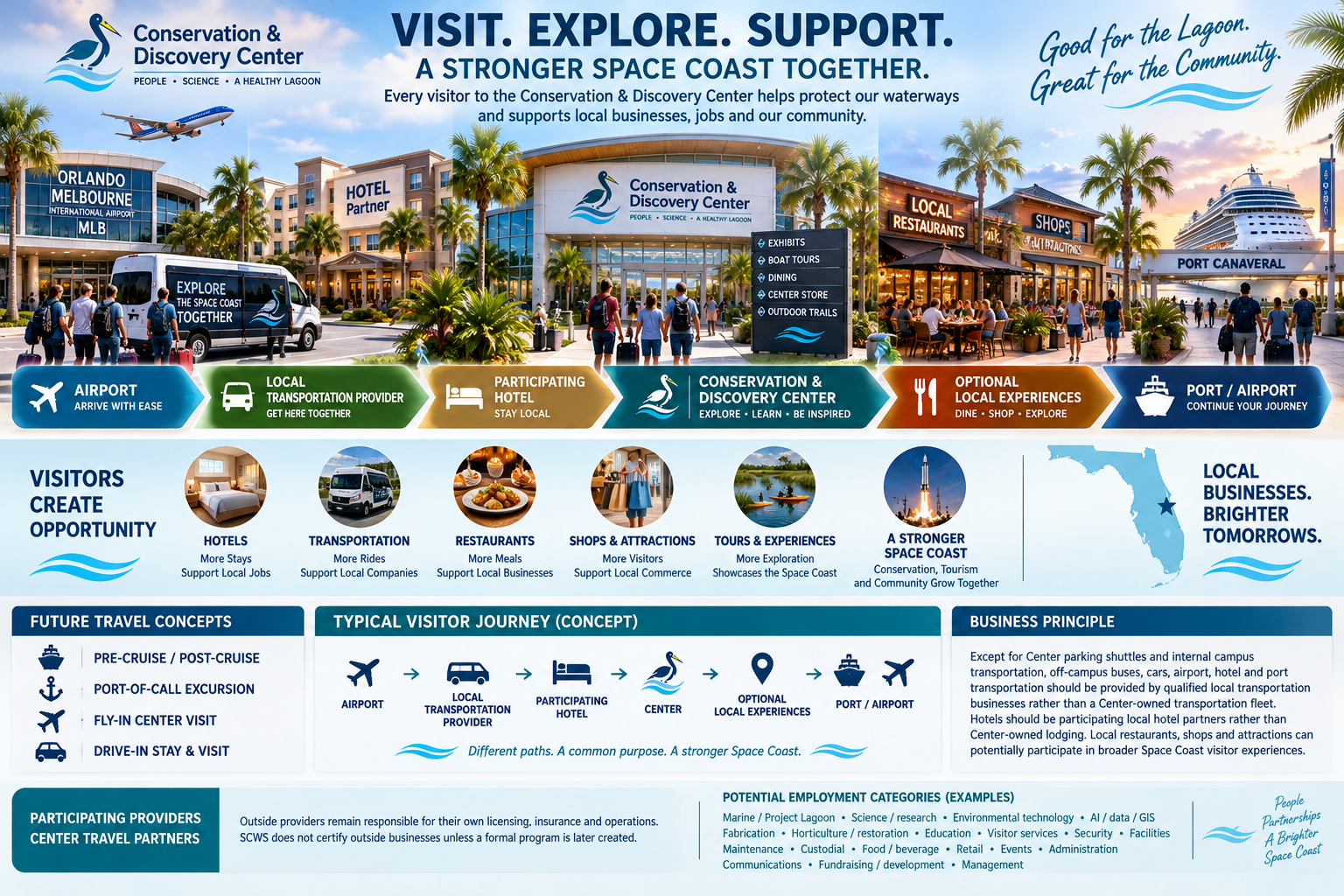
FUTURE TRAVEL CONCEPTS
BUSINESS PRINCIPLE
Except for Center parking shuttles and internal campus transportation, off-campus buses, cars, airport, hotel and port transportation should conceptually be provided by qualified local transportation businesses rather than a Center-owned transportation fleet. Hotels should be participating local hotel partners rather than Center-owned lodging. Local restaurants, shops and attractions can potentially participate in broader Space Coast visitor experiences.
Outside providers remain responsible for their own licensing, insurance and operations. SCWS does not certify outside businesses unless a formal program is later created.
POTENTIAL EMPLOYMENT CATEGORIES
No invented job counts, payroll totals, hotel-night totals, visitor-spending totals or economic-impact numbers are published. Those require a future professional staffing/business/economic-impact analysis.
If Something in This Vision Made You Think,
"I Know How I Could Help,"
We Want to Hear from You.
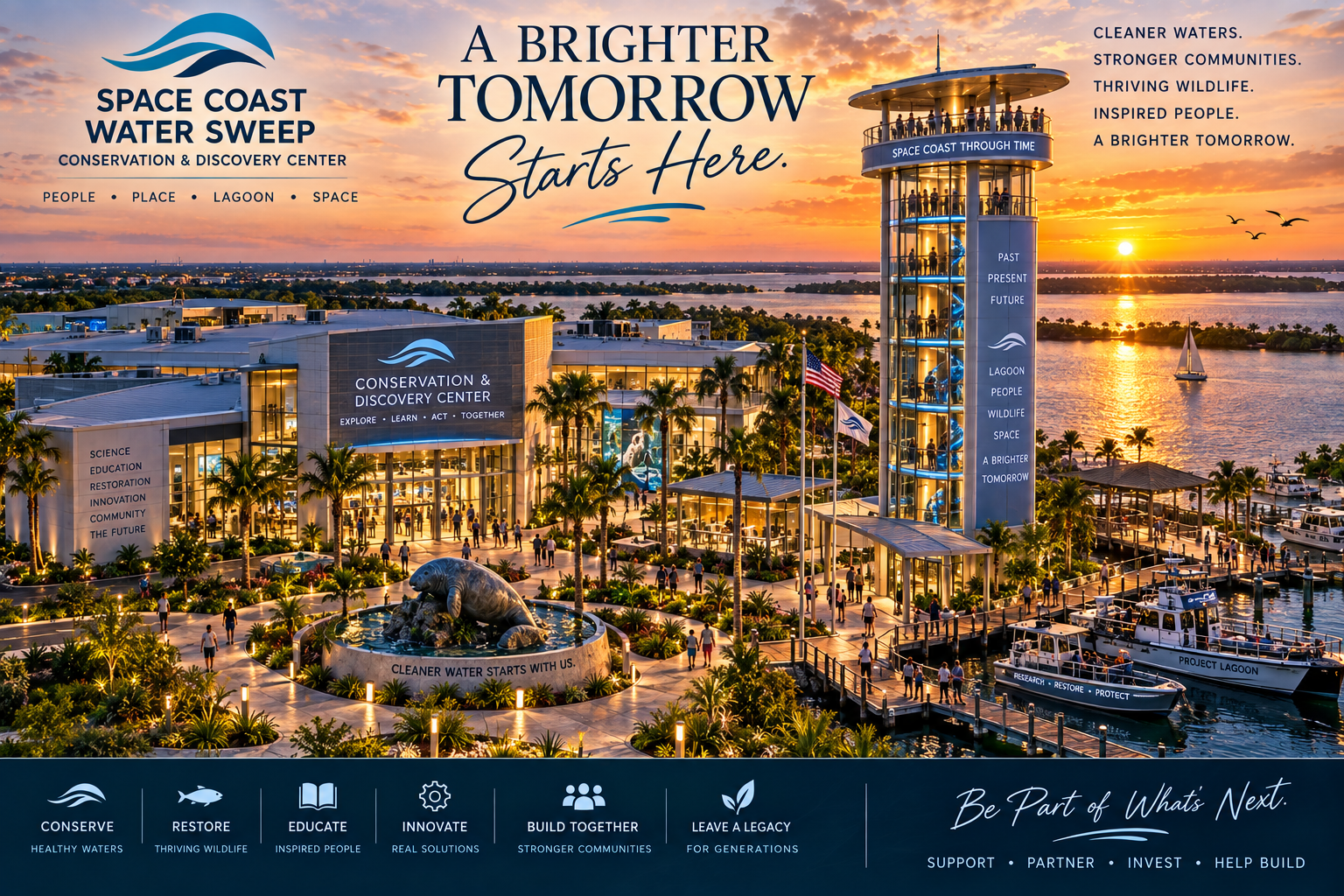
Someone Has to Imagine What Comes Next.
Space Coast Water Sweep started with people willing to get on the water and do the work.
The Conservation & Discovery Center vision asks a bigger question: What could happen if conservation, science, technology, education, community and the power of the Space Coast were brought together for the Indian River Lagoon?
We're beginning to imagine the answer.